
A Small Mark With a Vast Meaning
In Hindu Dharma, some practices look simple from the outside but carry a deep universe of meaning inside them. Applying tilak, tika, bindi, chandan, kumkum, vibhuti, or tripundra on the forehead is one such practice.
To many people, it may look like a religious mark. Some see it as a symbol of tradition. Some wear it during puja, festivals, temple visits, weddings, or daily worship. But in Sanatan Dharma, tilak is not just decoration. It is a spiritual reminder, an identity marker, a symbol of surrender, a sign of discipline, and a subtle practice connected with consciousness.
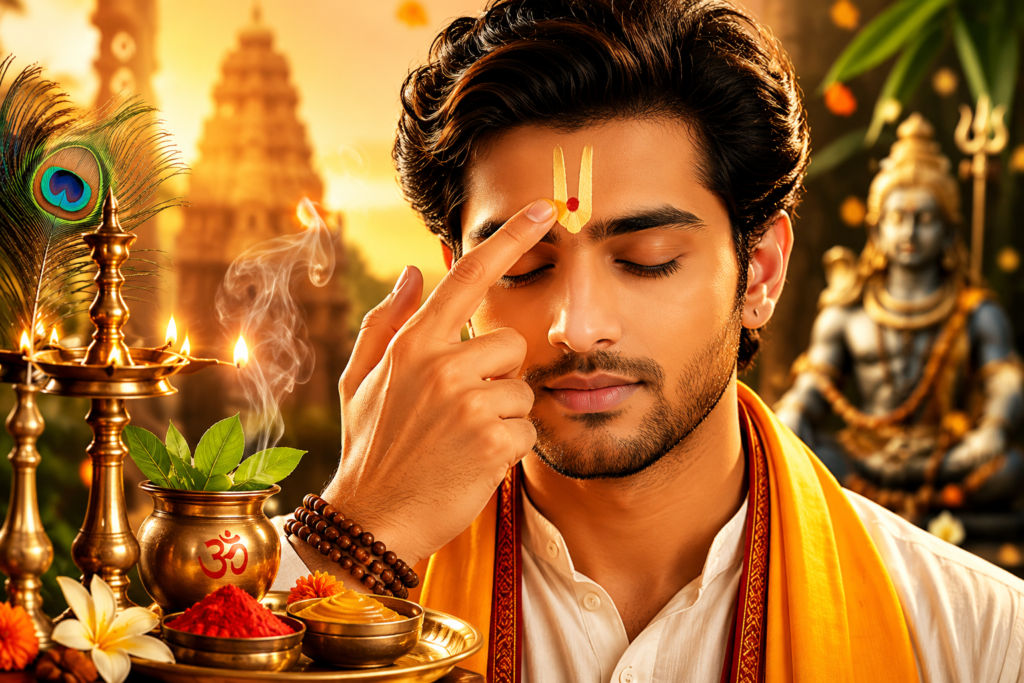
The forehead is not randomly chosen. The place between the eyebrows is traditionally associated with the Ajna Chakra, often called the “third eye” or the inner command center. In yogic understanding, this is the point of clarity, awareness, inner vision, and spiritual direction. When a person applies tilak there, the act becomes more than ritual. It becomes a daily reminder: “May my thoughts become pure, may my actions become dharmic, and may my ego bow before the Divine.”
This is why tilak has survived for thousands of years. It is not just a mark on the skin. It is a mark of inner alignment.
What Does Tilak Mean?
The Sanskrit word “tilaka” generally means a mark, ornament, or auspicious sign. In Hindu practice, tilak is usually applied on the forehead, but in many traditions it is also applied on other parts of the body such as the chest, arms, neck, or stomach.
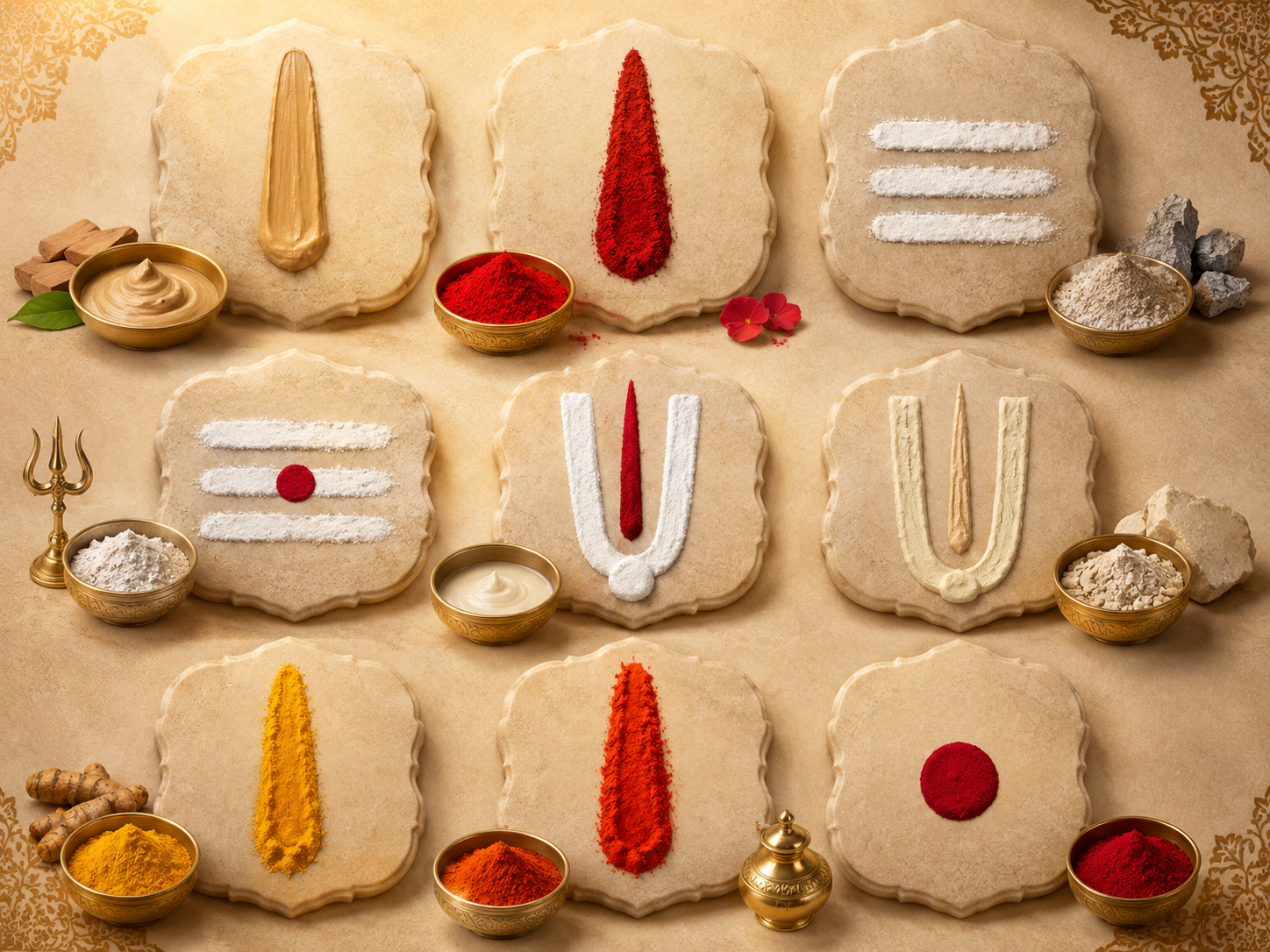
Different sampradayas use different forms of tilak. A Vaishnava may wear vertical U-shaped lines representing devotion to Lord Vishnu. A Shaiva may wear three horizontal lines of sacred ash representing Lord Shiva, renunciation, and the burning of ego. A Shakta devotee may wear red kumkum symbolizing energy, power, and the Divine Mother. A devotee of Lord Krishna may wear gopi chandan. Many households apply simple chandan or kumkum tika during daily puja.
This diversity is beautiful. It shows that Hindu Dharma does not force one uniform symbol on everyone. Instead, it allows different spiritual paths to express themselves through different marks.
Why Is Tilak Applied Between the Eyebrows?
The most common place for tilak is the space between the eyebrows. In yogic tradition, this point is linked with the Ajna Chakra. “Ajna” means command, perception, or inner direction. It is considered the center of focus, intuition, and higher awareness.
When we are confused, we often touch our forehead. When we concentrate deeply, the eyes naturally narrow and attention gathers between the brows. When a person meditates, the mind is often trained to become steady around this inner point. Hindu spiritual practice recognized this area not as an ordinary spot but as a symbolic gateway between the outer world and inner awareness.
Applying tilak here may serve three purposes:
First, it reminds the mind to stay centered.
Second, it marks the body as a temple of the Divine.
Third, it transforms an ordinary day into a sacred discipline.
That is why tilak is often applied after bathing, before worship, before leaving home for important work, before exams, before travel, before marriage rituals, and before spiritual ceremonies.
Does Tilak Activate the Pituitary Gland?
This is one of the most interesting questions. Many people say tilak activates the pituitary gland. To understand this correctly, we need to separate traditional belief from modern medical science.
In yogic and spiritual language, the point between the eyebrows is connected with Ajna Chakra, inner vision, intuition, and command over the senses. Some modern interpreters relate this area symbolically to the brain’s regulatory systems, including the hypothalamus, pituitary gland, pineal gland, and nervous system. The pituitary gland is often called the “master gland” because it releases hormones that influence growth, metabolism, reproduction, stress response, and several body functions.
When tilak is applied gently between the eyebrows, it creates touch stimulation on an area rich in sensory nerves. This gentle pressure may help bring attention to the forehead and create a calming, mindful effect. If sandalwood paste is used, its cooling sensation may produce a soothing feeling. If the practice is combined with prayer, mantra, slow breathing, and devotion, it can help reduce mental restlessness and prepare the mind for focus.
In this way, tilak may not “switch on” the pituitary like a button, but it can become part of a calming ritual that influences mental state, attention, and stress response. Since the body’s stress system is connected with the hypothalamic-pituitary-adrenal axis, a peaceful devotional routine can indirectly support emotional balance.
So the most accurate statement is this: tilak is traditionally believed to energize the Ajna Chakra, and scientifically it may support focus, mindfulness, cooling, and calmness when applied with devotion and awareness.
The Deeper Spiritual Meaning of Tilak
Tilak has many layers of meaning. It is not only about the material used or the shape drawn.
1. Tilak Means “I Belong to the Divine”
When a devotee applies tilak, they are saying: “My body, speech, thoughts, and actions should be connected to Dharma.” It is a visible reminder that life is not only about eating, earning, competing, and worrying. Life has a spiritual purpose.
2. Tilak Means “My Ego Must Bow”
The forehead is associated with identity and pride. Applying tilak there is symbolic. It says that the ego must be purified. The “I” must surrender to something higher.
3. Tilak Means “My Thoughts Should Become Pure”
Because tilak is placed near the seat of thought and attention, it becomes a reminder to keep the mind clean. It silently asks: Are my thoughts truthful? Are my intentions pure? Am I acting with Dharma?
4. Tilak Means “The Body Is a Temple”
In Hindu thought, the human body is not considered dirty or meaningless. It is a temple where the Divine presence can be realized. Just as a temple is decorated with sacred marks, flowers, lamps, and sandal paste, the body is also honored with tilak.
5. Tilak Means “Wake Up Your Inner Vision”
The third eye is not about physically seeing something with another eye. It means seeing beyond illusion, ego, anger, jealousy, and attachment. A person with inner vision can see truth more clearly.
This is why tilak is not superstition. It is symbolic psychology, devotional discipline, and spiritual philosophy combined.
To understand how Hindu knowledge is organized across Vedas, Upanishads, Puranas, and other sacred texts, readers can explore our detailed guide on the Sacred Scripture Tree of Sanatan Dharma.
For readers interested in how ancient Indian wisdom connects with modern life, our article on Ramayana and Mahabharata as history and evidence gives a deeper perspective.
Different Types of Tilak and Their Meanings
Hindu tradition has many types of tilak. Each one carries its own symbolism, deity connection, and purpose.
1. Chandan Tilak
Chandan tilak is made from sandalwood paste. It is usually light yellow, cream, or pale brown. It is widely used in temples, daily puja, meditation, and auspicious ceremonies.
Meaning
Chandan represents coolness, purity, peace, and sattva. It is associated with calmness of mind and devotion.
Spiritual Purpose
Chandan tilak is ideal for people who want mental peace, focus, humility, and devotional softness. It is often used during Vishnu, Krishna, Rama, and general household worship.
Who Should Apply It?
Students, meditators, spiritual seekers, people dealing with stress, and anyone who wants a calm and sattvic state can apply chandan tilak.
Best Time
Morning after bath, before puja, before study, before meditation, or before any important work.
2. Kumkum Tilak
Kumkum is usually red and is traditionally made using turmeric processed with alkaline substances. In modern times, one should be careful to use natural, skin-safe kumkum.
Meaning
Red represents Shakti, energy, auspiciousness, courage, and life-force. It is connected with Devi worship, marriage, prosperity, and sacred feminine power.
Spiritual Purpose
Kumkum tilak invokes energy, protection, auspiciousness, and confidence. It is often applied during Devi puja, festivals, weddings, and family rituals.
Who Should Apply It?
Women commonly apply kumkum as bindi or tika, especially in married life. Men and women both apply kumkum during puja and blessings. Devotees of Durga, Lakshmi, Kali, and other forms of Devi often use red tilak.
Best Time
During Devi worship, festivals, temple visits, weddings, griha pravesh, and important family rituals.
3. Vibhuti or Bhasma Tilak
Vibhuti or bhasma is sacred ash. Shaiva devotees commonly apply it as three horizontal lines on the forehead, called tripundra.
Meaning
Ash reminds us of the final truth of the body: everything material returns to dust. It represents detachment, purification, renunciation, and the burning of ego.
Spiritual Purpose
Vibhuti tilak reminds the devotee that pride, anger, greed, and attachment must be burnt in the fire of wisdom. It connects the wearer with Lord Shiva’s path of inner freedom.
Who Should Apply It?
Devotees of Lord Shiva, spiritual seekers practicing detachment, and people who want to remember the temporary nature of worldly life can apply vibhuti.
Best Time
During Shiva puja, after chanting Om Namah Shivaya, during Maha Shivaratri, before meditation, or after visiting a Shiva temple.
4. Tripundra Tilak
Tripundra is the famous Shaiva tilak made of three horizontal lines, usually with sacred ash. Sometimes a red dot is added in the center.
Meaning of Three Lines
The three lines can symbolize many things: the three gunas, the three states of consciousness, the three impurities, the three fires, or the three syllables of AUM. In Shaiva understanding, they also represent the burning of ignorance through Shiva’s wisdom.
Spiritual Purpose
Tripundra teaches: “Do not be trapped by ego, desire, and illusion. Remember Shiva, remember truth, remember the eternal Self.”
Who Should Apply It?
Shaiva devotees, seekers of vairagya, meditators, and those who follow Shiva-centered worship can wear tripundra.
5. Urdhva Pundra Tilak
Urdhva Pundra is the vertical Vaishnava tilak, often shaped like a U or two vertical lines, sometimes with a central line. It is worn by devotees of Vishnu, Krishna, Rama, Narayana, and related Vaishnava traditions.
Meaning
The upward lines represent the feet of Lord Vishnu or the path of spiritual upliftment. The center line may represent Lakshmi, devotion, or the Lord’s presence depending on the tradition.
Spiritual Purpose
It reminds the devotee to live in surrender, bhakti, humility, and service.
Who Should Apply It?
Vaishnava devotees, Krishna bhaktas, Rama bhaktas, and those who follow Vishnu-centered worship.
Best Time
Daily after bath, during temple worship, during Ekadashi, during Krishna Janmashtami, Rama Navami, Vishnu puja, and bhajan-kirtan.
6. Gopi Chandan Tilak
Gopi chandan is a sacred clay used especially in many Vaishnava traditions.
Meaning
It represents devotion, purity, surrender, and connection with Krishna bhakti.
Spiritual Purpose
It is believed to remind the devotee of Vrindavan, Krishna’s lotus feet, and the path of loving surrender.
Who Should Apply It?
Krishna devotees, Vaishnavas, bhakti practitioners, and those who chant names of Krishna or Vishnu.
7. Haldi Tilak
Haldi, or turmeric, is deeply connected with purity, health, fertility, and auspiciousness.
Meaning
Yellow represents positivity, prosperity, purity, and sacred energy.
Spiritual Purpose
Haldi tilak is often used in auspicious ceremonies, marriage rituals, and blessings. It symbolizes good fortune and protection.
Who Should Apply It?
Anyone during auspicious rituals. It is especially common in weddings, new beginnings, puja, and family ceremonies.
8. Sindoor or Vermilion Mark
Sindoor is traditionally applied by married Hindu women in the hair parting, but it may also appear as a forehead mark in some contexts.
Meaning
It represents marriage, commitment, auspiciousness, and the sacred bond between husband and wife.
Spiritual Purpose
It is connected with grihastha dharma, protection, and the dignity of married life.
Who Should Apply It?
Traditionally, married women apply sindoor according to family and regional customs.
9. Bindi
Bindi is often worn by women between the eyebrows. It may be religious, cultural, aesthetic, or symbolic depending on context.
Meaning
Bindi represents focus, beauty, feminine grace, inner awareness, and auspiciousness.
Spiritual Purpose
Traditionally, it marks the Ajna point and reminds the wearer of inner balance and sacred identity.
Who Should Apply It?
Women commonly wear bindi daily or during special occasions. Men may also apply tika at the same point during rituals.
Which Tilak Should You Apply and Why?
This depends on your purpose, tradition, and inner feeling.
If you want peace and focus, apply chandan tilak.
If you want devotion to Vishnu or Krishna, apply urdhva pundra or gopi chandan.
If you want detachment and Shiva consciousness, apply tripundra or vibhuti.
If you want Shakti, courage, and auspicious energy, apply kumkum.
If you want blessings for a new beginning, apply haldi-kumkum.
If you want a simple daily practice, apply a small chandan or kumkum tika between the eyebrows after bath and prayer.
The most important thing is not the outer mark alone. The real power of tilak comes when it is applied with bhava — sincere feeling.
A tilak without awareness becomes only a mark. A tilak with devotion becomes a doorway.
How to Apply Tilak Properly
First, wash your face and hands.
Sit calmly for a moment.
Take natural chandan, kumkum, vibhuti, or gopi chandan.
Apply it gently between the eyebrows or according to your tradition.
Do not apply it in a hurry like a cosmetic product. Apply it with a sankalpa.
You may silently say:
“May my thoughts be pure. May my speech be truthful. May my actions follow Dharma.”
Or:
“Om Namah Shivaya.”
Or:
“Om Namo Narayanaya.”
Or:
“Jai Shri Krishna.”
Or:
“Jai Mata Di.”
This turns the act into a living spiritual practice.
The Scientific Side: What Can Be Reasonably Understood?
From a modern perspective, tilak can be understood in a few practical ways.
1. Mindfulness Trigger
When a person applies tilak every morning with prayer, it creates a mental signal. The brain begins to associate that action with calmness, devotion, and discipline. This is similar to how daily rituals can shape mood and attention.
2. Sensory Stimulation
The forehead region has sensory nerves. Gentle touch or pressure between the eyebrows may help bring awareness to the present moment. This may support concentration during prayer or meditation.
3. Cooling Effect of Chandan
Sandalwood paste gives a cooling sensation. This can feel soothing, especially in hot climates or during stress. The cooling effect may support relaxation, though it should not be treated as a medical cure.
4. Emotional Regulation Through Ritual
Rituals reduce chaos in the mind. When someone begins the day with bath, prayer, tilak, and mantra, the mind receives structure. A structured mind is less easily disturbed.
5. Identity and Ethical Reminder
A visible tilak can remind a person to behave with dignity. If someone has applied a sacred mark, they may become more conscious of speech, anger, and actions. This is a powerful psychological function.
Is Tilak Mentioned in Vedas?
Direct references to the exact modern practice of tilak as worn today are more clearly found in later Hindu traditions, Upanishadic, Puranic, Agamic, Tantric, and sampradaya-based practices rather than as one uniform command in the four Vedas.
This is important to understand. Hindu Dharma developed through Shruti, Smriti, Purana, Itihasa, Agama, Tantra, and living guru-parampara. Many practices we follow today are not always present as one single Vedic instruction but are rooted in a long spiritual civilization.
For example, Shaiva traditions connect tripundra and sacred ash with texts such as Bhasmajabala Upanishad, Brihajjabala Upanishad, and Kalagni Rudra Upanishad. Vaishnava traditions developed urdhva pundra as a mark of devotion to Vishnu and Krishna. Shakta traditions use kumkum and red marks to invoke Devi’s power.
So the best way to say it is: tilak is not merely a social custom; it is a sacred practice developed through Hindu spiritual literature, temple traditions, and sampradaya wisdom.
Tilak and the Three Great Paths: Shiva, Vishnu, and Shakti
Tilak also tells a story of Hindu diversity.
A Shaiva tripundra says: burn the ego and remember Shiva.
A Vaishnava urdhva pundra says: surrender at the feet of Vishnu.
A Shakta kumkum says: awaken divine energy and honor the Mother.
A simple chandan tika says: keep the mind cool, pure, and devoted.
A bindi says: remember the inner eye of awareness.
Different marks, different paths, but one deeper aim: to make human life sacred.
This is the beauty of Sanatan Dharma. It does not ask everyone to walk in the same outer style. It invites everyone to rise inwardly.
Common Mistakes People Make With Tilak
Many people apply tilak only during festivals and forget its daily meaning. Some wear it for identity but not for inner transformation. Some use chemical products without checking whether they are safe for the skin. Some judge others based on the type of tilak they wear.
These mistakes reduce the beauty of the practice.
Tilak should not create pride. It should reduce pride.
Tilak should not create division. It should deepen devotion.
Tilak should not be used to show superiority. It should remind us of humility.
The real tilak is not only on the forehead. The real tilak is in conduct.
Can Anyone Apply Tilak?
Yes, anyone can respectfully apply tilak, especially during puja, temple visits, festivals, meditation, or spiritual practice. However, if a particular tilak belongs to a specific sampradaya, it is better to understand its meaning before wearing it casually.
For daily use, chandan, kumkum, haldi, or simple tika are widely accepted. If you follow Shiva, Vishnu, Krishna, Rama, or Devi worship, you can choose the tilak connected with your devotion.
The key is respect. Tilak is sacred, not fashion alone.
Final Thought: Tilak Is a Technology of Remembrance
The modern world is full of distractions. We wake up and immediately look at mobile phones. We rush into work, stress, comparison, desire, fear, and competition. In such a world, tilak is a tiny but powerful spiritual technology.
It reminds us:
You are not only a body.
You are not only a profession.
You are not only your worries.
You are a conscious being.
Your mind can be purified.
Your actions can become dharmic.
Your life can become sacred.
A small mark on the forehead can become a big mark on the soul if applied with understanding.
That is the true power of tilak.
It is not just ritual.
It is remembrance.
It is discipline.
It is identity.
It is surrender.
It is science of the mind, symbolism of the soul, and devotion of the heart — all in one sacred mark.
Medical reference for understanding the hypothalamic-pituitary-adrenal stress system.
Read More Interesting Content in My Blog Section.
FAQ:
1. Why do Hindus apply tilak on the forehead?
Hindus apply tilak on the forehead as a sacred sign of devotion, purity, spiritual identity, and inner awareness. The point between the eyebrows is traditionally connected with the Ajna Chakra, also known as the third eye point, which represents focus, intuition, and wisdom.
2. Is applying tilak only a religious ritual?
No. Tilak is not just a ritual. It has spiritual, cultural, symbolic, and psychological importance. It reminds a person to keep thoughts pure, stay connected with Dharma, and begin life’s actions with devotion and discipline.
3. Does tilak activate the pituitary gland?
Traditionally, tilak is believed to energize the Ajna Chakra, which is linked with clarity and inner awareness. Scientifically, there is no strong medical proof that tilak directly activates the pituitary gland. However, applying tilak gently between the eyebrows may support mindfulness, focus, calmness, and devotional awareness.
4. What is the scientific reason behind applying tilak?
From a modern perspective, tilak can act as a mindfulness trigger. The forehead area has sensory nerves, and gentle touch at this point may help bring attention inward. Materials like sandalwood also create a cooling sensation, which may help the mind feel calm during prayer or meditation.
5. What is the deeper spiritual meaning of tilak?
Spiritually, tilak represents surrender to the Divine. It reminds a person that the body is a temple, the mind should remain pure, and actions should follow Dharma. It is also a symbol of humility, devotion, and inner awakening.
6. What are the main types of tilak in Hinduism?
The main types include chandan tilak, kumkum tilak, vibhuti or bhasma tilak, tripundra, urdhva pundra, gopi chandan tilak, haldi tilak, sindoor mark, and bindi. Each has its own meaning and is connected with different traditions, deities, and purposes.
7. What is the meaning of chandan, kumkum, and vibhuti tilak?
Chandan tilak represents peace, purity, coolness, and sattva. Kumkum tilak symbolizes Shakti, energy, auspiciousness, and divine feminine power. Vibhuti or bhasma tilak represents detachment, purification, and the burning of ego, and is mainly associated with Lord Shiva.
8. What is the difference between tripundra and urdhva pundra tilak?
Tripundra is made of three horizontal lines, usually with sacred ash, and is associated with Lord Shiva. It represents renunciation, purity, and the destruction of ego. Urdhva pundra is a vertical Vaishnava tilak, often shaped like a U, and is associated with Lord Vishnu, Krishna, and Rama. It symbolizes surrender, devotion, and spiritual upliftment.
9. Who should apply which type of tilak?
A person seeking peace and focus may apply chandan tilak. Devotees of Shiva may apply vibhuti or tripundra. Devotees of Vishnu or Krishna may apply urdhva pundra or gopi chandan. For Shakti, auspiciousness, and Devi worship, kumkum is commonly used. For simple daily practice, chandan or kumkum tika is suitable.
10. Can tilak improve concentration and mental calmness?
Tilak may support concentration indirectly when applied with prayer, mantra, meditation, or mindful intention. The act of touching the forehead and focusing on the Ajna point can help the mind become calmer and more centered, especially when used as part of a daily spiritual routine.