
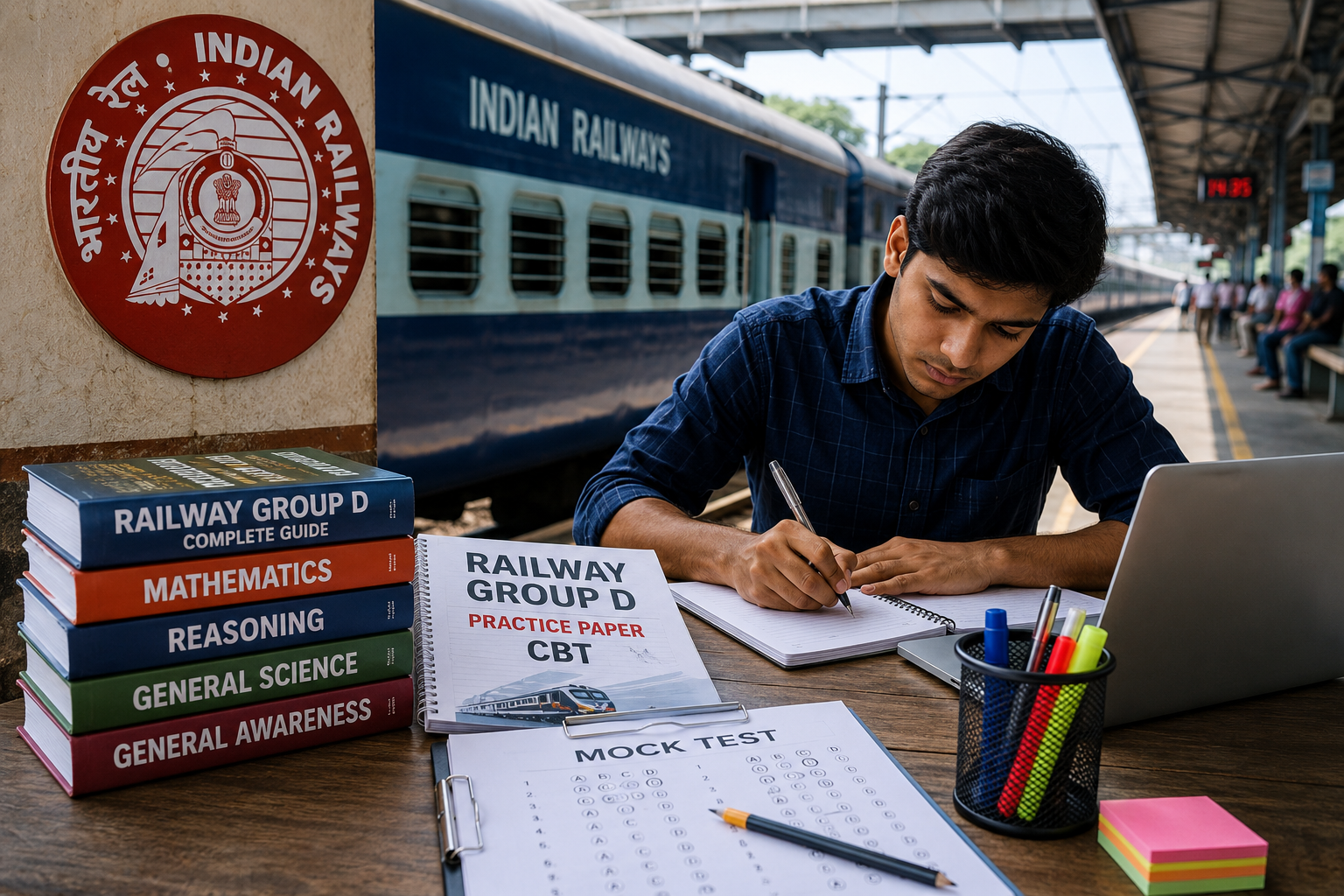

Railway Group D is one of the most popular government job exams in India for candidates who want to work in Indian Railways under Level 1 posts. Every year, lakhs of aspirants prepare for this exam because it offers a stable government job, decent salary, railway benefits and long-term career security.
If you are preparing for the Railway Group D Exam 2026, this complete guide will help you understand the exam pattern, syllabus, preparation strategy, previous year paper approach, CBT practice paper PDFs, mock test PDFs and important tips to improve your score.
In this post, students can download Railway Group D CBT Practice Papers and Mock Tests based on the actual exam pattern. The questions are prepared according to the official Railway Group D syllabus, covering Mathematics, General Intelligence and Reasoning, General Science, and General Awareness with Current Affairs.
What is Railway Group D Exam?
Railway Group D is conducted by Railway Recruitment Boards for various Level 1 posts in Indian Railways. These posts may include Track Maintainer, Assistant in different departments, Pointsman and other Level 1 roles depending on the official notification and vacancy details.
The selection process generally includes:
- Computer Based Test
- Physical Efficiency Test
- Document Verification
- Medical Examination
The CBT is the most important stage because final merit is mainly prepared on the basis of CBT performance, subject to qualifying the later stages. Candidates who clear the CBT are called for PET as per the required ratio and rules mentioned in the official notification.
Railway Group D is a great opportunity for students who have completed the required educational qualification and want a secure career in the railway sector. However, because competition is very high, simple preparation is not enough. Students need regular practice, time management, mock tests and a clear understanding of the syllabus.
Railway Group D Exam Pattern 2026
The Railway Group D CBT is a computer-based objective exam. The question paper usually contains 100 questions for 100 marks. The duration is 90 minutes for general candidates, while eligible PwBD candidates with a scribe may get 120 minutes as per rules.
Railway Group D CBT Exam Pattern
| Subject | Questions | Marks |
|---|---|---|
| General Science | 25 | 25 |
| Mathematics | 25 | 25 |
| General Intelligence and Reasoning | 30 | 30 |
| General Awareness and Current Affairs | 20 | 20 |
| Total | 100 | 100 |
There is negative marking in the CBT. For every wrong answer, one-third mark is deducted. This means candidates should avoid blind guessing and focus on accuracy along with speed.
The section-wise distribution may have small variation in the actual exam, so students should prepare all four subjects properly instead of depending only on one or two sections.
Railway Group D Selection Process
The Railway Group D selection process includes multiple stages. Students should not prepare only for the written exam and ignore the physical stage.
1. Computer-Based Test
The CBT is the first and most important stage. It includes questions from Mathematics, Reasoning, General Science, and General Awareness. Candidates must score above the required qualifying marks and cut-off to move to the next stage.
2. Physical Efficiency Test
Candidates shortlisted from CBT are called for PET. PET is qualifying in nature, but it is mandatory for eligible candidates. Male and female candidates have different physical standards.
For male candidates, the PET generally includes carrying 35 kg weight for 100 meters in 2 minutes in one chance without putting the weight down, and running 1000 meters within the specified time.
For female candidates, the PET generally includes carrying 20 kg weight for 100 meters in 2 minutes in one chance without putting the weight down, and running 1000 meters within the specified time.
Students must check the latest official notification for exact PET rules, exemptions and category-specific instructions.
3. Document Verification
Candidates who qualify CBT and PET are called for document verification. At this stage, candidates must produce original documents related to education, age proof, category certificate, photo identity, application details and other required certificates.
4. Medical Examination
The final stage is medical examination. Candidates must meet the medical standard required for the post. Medical fitness is very important because Railway jobs involve safety and operational responsibilities.
Railway Group D Syllabus 2026
The Railway Group D syllabus is not difficult, but it is broad. Students should prepare it in a systematic way.
Mathematics Syllabus
Mathematics questions are usually based on basic arithmetic and class 10 level concepts. Important topics include:
Number System, BODMAS, Decimals, Fractions, LCM, HCF, Ratio and Proportion, Percentage, Mensuration, Time and Work, Time and Distance, Simple Interest, Compound Interest, Profit and Loss, Algebra, Geometry, Trigonometry, Elementary Statistics, Square Root, Age Problems, Calendar, Clock, Pipes and Cisterns.
Best Strategy for Mathematics
Students should first learn formulas and basic concepts. After that, they should solve at least 25 to 30 questions daily. Focus more on percentage, ratio, profit and loss, time and work, time and distance, SI-CI and mensuration because these topics are regularly seen in railway exams.
General Intelligence and Reasoning Syllabus
Reasoning is one of the highest-scoring sections in Railway Group D. Important topics include:
Analogies, Alphabetical Series, Number Series, Coding-Decoding, Mathematical Operations, Relationships, Syllogism, Jumbling, Venn Diagram, Data Interpretation, Data Sufficiency, Conclusions, Decision Making, Similarities and Differences, Analytical Reasoning, Classification, Directions, Statement and Arguments, Statement and Assumptions.
Best Strategy for Reasoning
Reasoning improves with practice. Students should solve mixed reasoning sets every day. Start with easy topics like series, coding-decoding, directions and classification. Then move to syllogism, statement-based questions, data sufficiency and analytical reasoning.
General Science Syllabus
General Science questions are usually based on Physics, Chemistry and Life Science of class 10 level. Important areas include:
Physics: Motion, Force, Work, Energy, Sound, Light, Electricity, Magnetism, Heat and Measurement.
Chemistry: Matter, Atoms and Molecules, Acids, Bases, Salts, Metals, Non-metals, Chemical Reactions, Everyday Chemistry.
Biology: Cell, Human Body, Nutrition, Diseases, Plants, Animals, Environment, Reproduction and Life Processes.
Best Strategy for General Science
Students should revise NCERT class 9 and class 10 Science basics. Make short notes for formulas, definitions, diagrams and important facts. Do not study science like a board exam; study it from an MCQ point of view.
General Awareness and Current Affairs Syllabus
This section checks awareness of important events and basic general knowledge. Important topics include:
Science and Technology, Sports, Culture, Important Personalities, Economics, Politics, Indian Constitution, History, Geography, Environment, Railway-related updates and current affairs of national and international importance.
Best Strategy for Current Affairs
Students should read monthly current affairs and revise them weekly. Focus on awards, sports events, government schemes, important appointments, science missions, railway updates and national events. Last 6 to 8 months of current affairs should be revised before the exam.
Railway Group D Previous Year Question Paper
Previous year papers are very important because they help students understand the real difficulty level of the exam. They also show which topics are repeated and how questions are framed.
Students should use previous year papers for three purposes:
- To understand the exam pattern
- To identify repeated topics
- To improve time management
However, students should always depend on official Railway Recruitment Board websites for authentic exam notifications, answer keys, response sheets and official updates. Not every previous year paper PDF is permanently available on official websites, so candidates should be careful while downloading papers from random sources.
Official Source for Railway Group D Updates
Students should check the official Railway Recruitment Board websites for latest notifications, CBT updates, answer key notices, result updates and document verification information.
Official source: Railway Recruitment Board CEN 08/2024 notification
Download Railway Group D CBT Practice Paper PDF
Below are 10 Railway Group D CBT Practice Papers prepared according to the actual exam pattern. Each practice paper should include 100 questions from Mathematics, Reasoning, General Science and General Awareness.
| Practice Paper | Download |
| Railway Group D CBT Practice Paper 1 | PDF Link |
| Railway Group D CBT Practice Paper 2 | PDF Link |
| Railway Group D CBT Practice Paper 3 | PDF Link |
| Railway Group D CBT Practice Paper 4 | PDF Link |
| Railway Group D CBT Practice Paper 5 | PDF Link |
| Railway Group D CBT Practice Paper 6 | PDF Link |
| Railway Group D CBT Practice Paper 7 | PDF Link |
| Railway Group D CBT Practice Paper 8 | PDF Link |
| Railway Group D CBT Practice Paper 9 | PDF Link |
| Railway Group D CBT Practice Paper 10 | PDF Link |
These practice papers are useful for topic-wise revision and exam-level question practice. Students should solve at least one paper every two to three days in the beginning stage of preparation.
Students preparing for multiple government exams can also check our detailed SSC CGL guide here.
If you are also preparing for state-level government exams, you can read our BPSC practice paper guide here.
For more student-focused exam guides, visit our Students Zone.
Download Railway Group D CBT Mock Test PDF
Mock tests are different from practice papers. A practice paper helps you learn and revise, while a mock test should be attempted like the real exam with a timer.
| Mock Test | Download |
| Railway Group D CBT Mock Test 1 | PDF Link |
| Railway Group D CBT Mock Test 2 | PDF Link |
| Railway Group D CBT Mock Test 3 | PDF Link |
| Railway Group D CBT Mock Test 4 | PDF Link |
| Railway Group D CBT Mock Test 5 | PDF Link |
| Railway Group D CBT Mock Test 6 | PDF Link |
| Railway Group D CBT Mock Test 7 | PDF Link |
| Railway Group D CBT Mock Test 8 | PDF Link |
| Railway Group D CBT Mock Test 9 | PDF Link |
| Railway Group D CBT Mock Test 10 | PDF Link |
Students should attempt each mock test in 90 minutes. After completing the test, spend at least one hour analysing mistakes. The real improvement happens during analysis, not only during test attempt.
How to Prepare for Railway Group D Exam 2026
A good Railway Group D preparation plan should be simple, practical and consistent. Students do not need expensive resources if they follow the syllabus properly and practise every day.
Step 1: Understand the Syllabus
First, read the syllabus carefully. Divide it into four parts: Mathematics, Reasoning, General Science and General Awareness. Make a checklist of topics and mark your weak areas.
Step 2: Build Basic Concepts
Do not start with mock tests immediately. First build your basics. For Mathematics, learn formulas. For Reasoning, learn question types. For Science, revise class 9 and 10 concepts. For Current Affairs, start monthly revision.
Step 3: Follow a Daily Study Routine
A simple daily routine can be:
Mathematics: 1 hour
Reasoning: 1 hour
Science: 1 hour
Current Affairs: 30 minutes
Practice Questions: 1 hour
If you are a beginner, study 4 to 5 hours daily. If you are already prepared, focus more on mock tests and revision.
Step 4: Solve Previous Year Questions
Previous year questions help you understand what Railway actually asks. Do not just read questions. Solve them with a timer. Mark every wrong question and revise that topic again.
Step 5: Attempt Mock Tests
After completing 60 to 70 percent syllabus, start mock tests. In the final month, attempt at least 2 to 3 full-length mock tests every week.
Step 6: Prepare for PET
Many students focus only on CBT and ignore PET. This is a mistake. Start basic physical preparation early. Running, walking, stamina building and strength exercises should be included in your weekly routine.
60-Day Railway Group D Study Plan
Days 1 to 15
Focus on basic concepts. Cover arithmetic basics, reasoning basics, class 10 science and daily current affairs.
Days 16 to 30
Start topic-wise practice. Solve 50 to 80 questions daily. Revise formulas and short notes.
Days 31 to 45
Start full-length practice papers. Attempt at least 5 practice papers during this period. Analyse weak topics and revise them.
Days 46 to 60
Attempt mock tests under exam conditions. Revise current affairs, science facts, formulas and reasoning tricks. Avoid starting too many new topics in the last week.
Important Tips to Score Better in Railway Group D CBT
Accuracy is more important than blind speed because negative marking can reduce your score. Attempt easy questions first and avoid wasting too much time on one difficult question.
Reasoning and Mathematics can improve your score quickly if practised daily. General Science needs revision, while Current Affairs needs consistency.
Make a small notebook for formulas, science facts and current affairs. Revise this notebook every week. During the last 10 days, focus only on revision and mock test analysis.
Common Mistakes Students Should Avoid
Many students make the mistake of preparing only Mathematics and Reasoning while ignoring Science and Current Affairs. This can reduce the final score.
Another common mistake is solving mock tests without analysis. If you do not check your mistakes, your score may not improve.
Some students also ignore PET preparation. Since PET is mandatory for eligible candidates, physical preparation should start early.
Avoid depending on fake notifications, random social media updates or unofficial claims. Always check official RRB/RRC websites for authentic information.
Conclusion
Railway Group D Exam 2026 is a good opportunity for students who want a secure government job in Indian Railways. The exam is not impossible, but competition is very high. To succeed, students need a smart study plan, syllabus-based preparation, regular practice, previous year question analysis and full-length mock tests.
This post provides a complete Railway Group D preparation guide with exam pattern, syllabus, selection process, practice paper PDFs and mock test PDFs. Students should start with basics, practise daily, revise regularly and attempt mock tests seriously.
A disciplined student with clear concepts, good speed and strong revision can perform well in the Railway Group D CBT and move confidently toward the next stages of selection.
Read More Interesting Content in My Blog Section.
FAQ
1. Is Railway Group D exam difficult?
Railway Group D is not very difficult in terms of syllabus, but competition is high. A student with regular practice, good speed and proper revision can score well.
2. How many questions are asked in Railway Group D CBT?
The CBT generally contains 100 questions for 100 marks from General Science, Mathematics, General Intelligence and Reasoning, and General Awareness with Current Affairs.
3. Is there negative marking in Railway Group D?
Yes, there is negative marking. One-third mark is deducted for every wrong answer.
4. What is the best way to prepare for Railway Group D?
The best way is to complete the syllabus, solve previous year questions, practise topic-wise MCQs, attempt mock tests and revise current affairs regularly.
5. Is PET compulsory in Railway Group D?
PET is compulsory for eligible candidates shortlisted after CBT, except for categories specifically exempted as per official rules.