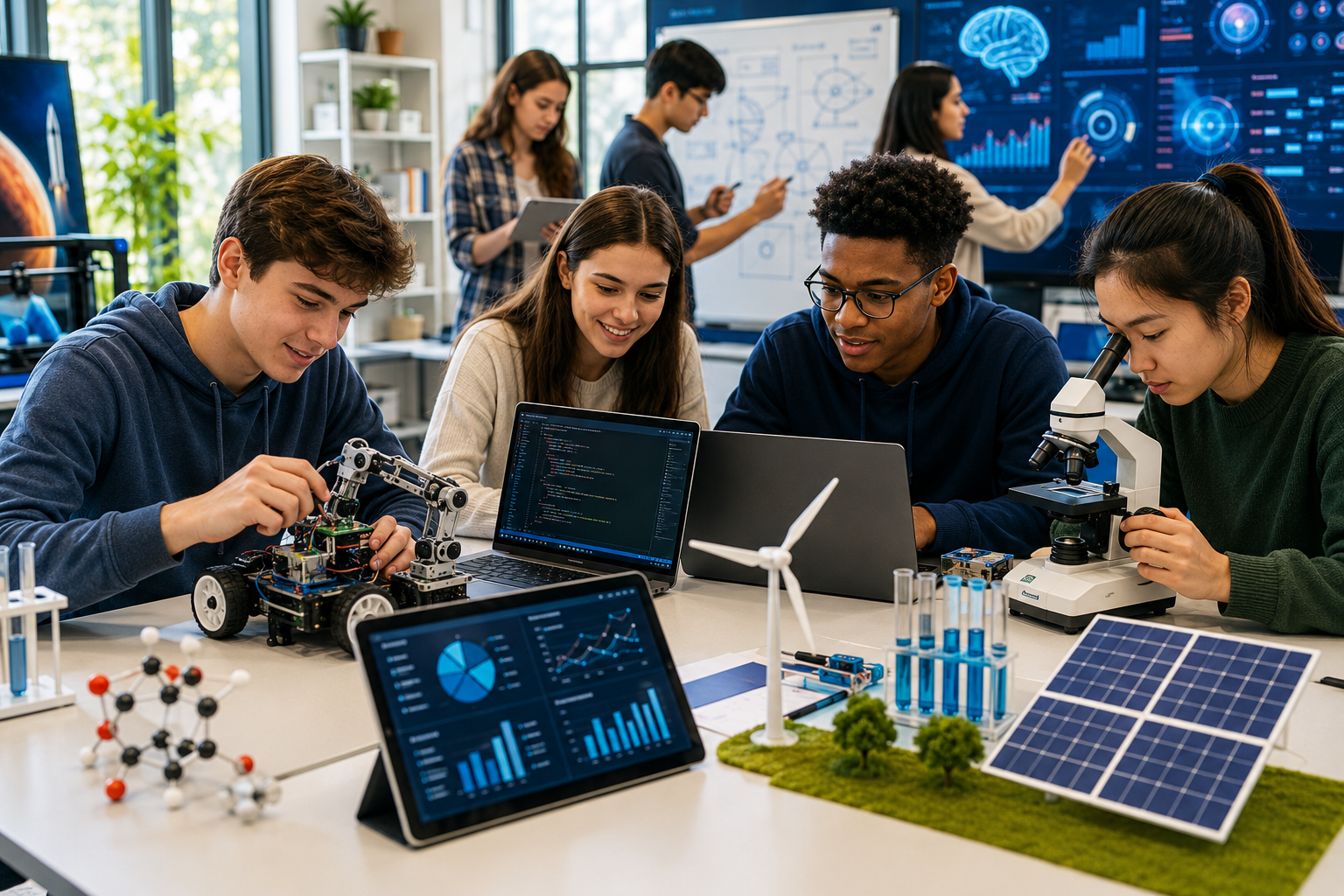

STEM careers are still among the strongest career choices for US students, but the AI era has changed the rules. It is no longer enough to simply choose computer science, engineering, or data science because they sound “safe.” Students now need to understand which STEM fields are growing, which skills are becoming valuable, and how to build a career path that combines technology, human thinking, and real-world problem-solving.
STEM Careers in 2026: How US Students Can Choose a Future-Proof Path in the AI Era
For many US students, STEM has always sounded like the safest career direction.
Parents say, “Choose science or technology.”
Teachers say, “STEM jobs pay well.”
Career guides say, “The future belongs to engineers, coders, scientists, and data experts.”
But in 2026, students are facing a new kind of confusion.
Artificial intelligence is changing how work happens. Coding tools can now write code. AI systems can analyze data. Automation is entering healthcare, finance, education, manufacturing, cybersecurity, and even creative industries. So a student may ask a very honest question:
“If AI can do so many technical tasks, which STEM career is actually safe for my future?”
That question is important. The future is not simply about choosing STEM. The future belongs to students who choose the right STEM direction and combine it with adaptability, AI literacy, communication, creativity, and practical problem-solving.
Why STEM Still Matters in 2026
STEM stands for Science, Technology, Engineering, and Mathematics. These fields are connected to many of the biggest changes happening in the world: artificial intelligence, cybersecurity, clean energy, robotics, medical technology, space research, climate science, biotechnology, data analytics, and advanced manufacturing.
According to the US Bureau of Labor Statistics, employment in computer and information technology occupations is projected to grow much faster than average from 2024 to 2034, with about 317,700 openings each year on average. This shows that technology careers are not disappearing, but they are changing rapidly.
At the same time, the World Economic Forum’s Future of Jobs Report 2025 highlights AI and big data, networks and cybersecurity, and technology literacy as some of the fastest-growing skill areas for the coming years.
This means students should not think, “AI will destroy every STEM job.” A better way to think is:
AI will reduce demand for routine skills, but increase demand for people who can use technology wisely to solve real problems.
The Hidden Problem: Students Are Choosing STEM Without Understanding the Market
Many students choose STEM because it sounds impressive. But they may not understand what daily work in that career actually looks like.
For example, a student may choose computer science because they like apps, but later discover they do not enjoy debugging, algorithms, or long hours of technical problem-solving. Another student may choose engineering because it sounds stable, but they may not know which engineering branch has stronger future demand. A student may choose biology because they like science, but may not understand the additional education needed for medical, biotech, or research careers.
This is the problem no one discusses enough: STEM is not one career path. It is a large world of very different paths.
A cybersecurity analyst, a robotics engineer, a data scientist, a nurse informatics specialist, a renewable energy engineer, and a statistician may all belong to the STEM world — but their skills, work environment, salary path, and future opportunities can be very different.
So before choosing a STEM career, students should ask:
What kind of problems do I enjoy solving?
Do I prefer computers, machines, people, health, nature, space, numbers, or design?
Do I enjoy coding, research, building, analyzing, protecting systems, or explaining ideas?
How much education will this career require?
Will this field still grow if AI becomes more powerful?
Can I combine this field with AI tools instead of competing against them?
These questions can save students from blindly choosing a career that looks good online but does not match their strengths.
Students who want more academic and career-focused guidance can explore our Students Zone, where we publish practical resources on study habits, future careers, exam preparation, and student success.
Choosing a future career can feel overwhelming, so students may also find our guide on Best Study Plan for Students useful for building better learning routines without burning out.
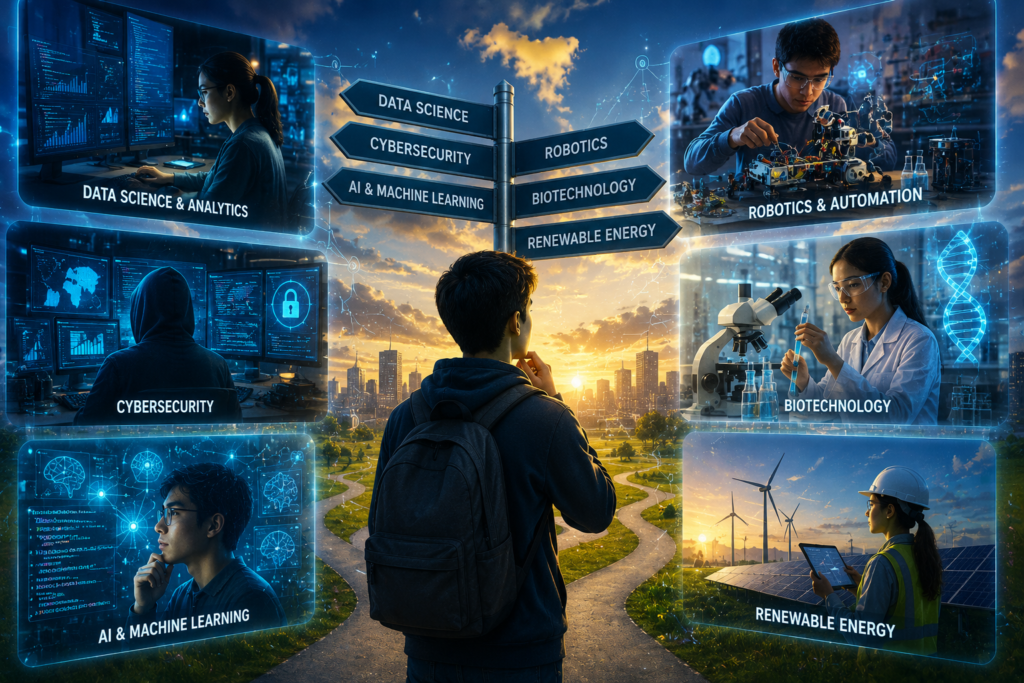
Best Future-Proof STEM Careers for US Students in 2026
1. Data Science and AI Analytics
Data science remains one of the strongest STEM paths because every major industry now depends on data. Businesses, hospitals, banks, schools, sports teams, government agencies, and technology companies all use data to make better decisions.
A data scientist does not simply “look at numbers.” They collect, clean, analyze, and explain data so that organizations can solve problems. In the AI era, this field becomes even more important because AI systems need good data, careful interpretation, and human judgment.
The US Bureau of Labor Statistics projects employment of data scientists to grow 34% from 2024 to 2034, which is much faster than the average for all occupations. BLS also reported a median annual wage of $112,590 for data scientists in May 2024.
This makes data science a strong option for students who enjoy math, patterns, technology, and problem-solving.
Useful skills include Python, statistics, data visualization, machine learning basics, SQL, Excel, communication, and ethical decision-making.
2. Cybersecurity
Cybersecurity is one of the most important STEM fields because almost everything is now digital. Banks, hospitals, schools, companies, government systems, and personal devices all need protection from cyberattacks.
As AI grows, cybersecurity becomes even more important. Attackers can use AI, but defenders can also use AI to detect threats faster. This creates demand for students who understand systems, networks, risk, privacy, and digital defense.
BLS reported that information security analysts had a median annual wage of $124,910 in May 2024, showing strong earning potential in this field.
Cybersecurity is a good fit for students who enjoy puzzles, investigation, ethical hacking, systems thinking, and protecting people from digital harm.
Useful skills include networking, Linux basics, cloud security, Python or scripting, risk analysis, incident response, and security certifications.
3. AI Engineering and Machine Learning
AI engineering is one of the most exciting STEM career paths, but students should understand it clearly. It is not only about using ChatGPT or AI apps. AI engineers design, train, test, and improve systems that can recognize patterns, make predictions, understand language, or automate tasks.
This field may require strong foundations in programming, mathematics, algorithms, data structures, machine learning, and software engineering.
Students interested in AI should not only learn tools. They should understand how AI works, where it fails, and how to use it responsibly.
A strong AI student in 2026 should learn:
Programming fundamentals
Data structures and algorithms
Machine learning basics
Statistics and probability
Ethics and bias in AI
Cloud computing
Real-world project building
AI will reward students who can go deeper than basic prompts.
4. Healthcare Technology and Biotechnology
Healthcare is becoming more technology-driven. Hospitals and medical companies now use data analytics, robotics, digital health tools, medical imaging, wearable devices, telemedicine, and AI-assisted diagnosis.
This creates a powerful opportunity for students who like both science and technology.
Healthcare technology careers may include biomedical engineering, health informatics, clinical data analytics, medical device development, genetic research, biotechnology, and digital health product design.
BLS has projected that healthcare and social assistance will be the fastest-growing industry sector from 2024 to 2034, driven largely by an aging population and chronic health conditions.
This is important because it shows that future STEM careers will not only be in software companies. Many of the strongest opportunities may appear at the intersection of healthcare and technology.
5. Robotics and Automation
Robotics is growing because companies want machines that can support manufacturing, logistics, healthcare, agriculture, defense, space research, and home assistance.
Robotics is a strong STEM path for students who enjoy building things, coding, electronics, mechanics, and real-world problem-solving.
A robotics career may combine mechanical engineering, electrical engineering, computer science, AI, sensors, control systems, and design thinking.
Students who are interested in robotics should not wait for college to begin. They can start with small projects, Arduino, Raspberry Pi, coding basics, school robotics clubs, 3D printing, or STEM competitions.
The best robotics students are usually not just good at theory. They build, test, fail, repair, and improve.
6. Renewable Energy and Climate Technology
Climate change, energy demand, and sustainability are creating new STEM opportunities. Students interested in engineering, physics, environmental science, chemistry, data science, and policy can explore careers in clean energy and climate technology.
Possible paths include solar energy engineering, battery technology, electric vehicles, environmental data analysis, carbon capture, smart grids, sustainable construction, and climate risk modeling.
This field is meaningful because it combines career growth with social impact. Students who want their work to matter beyond salary may find climate technology especially attractive.
Useful skills include environmental science, engineering basics, data analysis, energy systems, GIS tools, policy awareness, and project management.
Students who want to understand how artificial intelligence is already shaping daily life can also read our guide on How AI Is Used in Everyday Life, which explains real-world examples of AI in a simple and practical way.
What Skills Will Matter Most?
The biggest mistake students can make is thinking that one degree alone will protect their future.
In 2026, career safety comes from a skill combination.
Students should build a T-shaped skill set. That means they should go deep in one technical area, but also develop broad supporting skills.
For example:
A cybersecurity student should also understand communication and risk.
A data science student should also understand business problems.
An engineering student should also understand AI tools.
A biology student should also understand data analysis.
A computer science student should also understand ethics and product thinking.
The World Economic Forum says nearly 40% of skills required on the job are expected to change, and employers see skills gaps as a major barrier.
This means students should not think of education as something that ends after graduation. The future belongs to students who keep learning.
AI Will Not Replace Every STEM Student — But It Will Replace Passive Learning
This is the most important message for students.
AI may not replace every STEM career, but it can replace students who only memorize, copy, or follow instructions without understanding.
For example, AI can write simple code. But it cannot always understand a company’s full business problem, security risk, customer need, ethical concern, or long-term strategy. AI can generate an answer, but humans still need to ask the right question, verify the result, and apply judgment.
So the future STEM student must become more than a degree holder.
They must become:
A problem solver
A builder
A clear communicator
A responsible AI user
A lifelong learner
A person who can connect technology with human needs
This is why students should use AI as a learning assistant, not as a shortcut.
How High School Students Can Start Early
US high school students do not need to wait until college to explore STEM.
They can start with simple steps:
Take math and science seriously
Try beginner coding platforms
Join robotics or science clubs
Build small projects
Participate in STEM competitions
Take online courses
Explore internships or volunteering
Talk to professionals in different STEM fields
Read about real careers, not only degrees
Create a small portfolio of projects
A portfolio matters because it shows curiosity and initiative. A student who builds small projects often learns more deeply than a student who only reads about careers.
How College Students Can Choose Better
College students should not simply follow the most popular major. They should connect their major with a real career direction.
For example:
Computer science + cybersecurity
Biology + data analytics
Mechanical engineering + robotics
Environmental science + climate technology
Mathematics + AI modeling
Healthcare + informatics
Physics + aerospace or energy systems
This combination approach makes students more flexible.
Students should also use college years to build internships, projects, research experience, networking, and communication skills. Grades matter, but practical experience can make a big difference.
Final Thought
STEM careers in 2026 are full of opportunity, but students need a smarter approach.
The safest path is not simply “choose STEM.” The safest path is:
Choose a STEM field that matches your strengths.
Understand how AI is changing that field.
Build practical skills early.
Learn how to communicate and solve real problems.
Keep updating your skills as technology changes.
For US students, the AI era should not be seen only as a threat. It can also be a powerful opportunity.
The students who succeed will not be the ones who fear AI or blindly depend on it. They will be the ones who understand it, use it responsibly, and combine it with human intelligence.
That is the real future-proof STEM path.
Students can explore the official US Bureau of Labor Statistics STEM career outlook to understand which technology-related careers are projected to grow and what skills may matter most in the coming decade.
Read More Interesting Content in My Blog Section.
FAQ
1. What are STEM careers?
STEM careers are jobs related to Science, Technology, Engineering, and Mathematics. These include fields like data science, cybersecurity, robotics, AI, biotechnology, engineering, healthcare technology, and renewable energy.
2. Why are STEM careers important for US students in 2026?
STEM careers are important because technology, AI, healthcare, climate solutions, and automation are growing quickly. Students with strong STEM skills can find better opportunities in future-focused industries.
3. Which STEM careers are best for the future?
Some of the best future-focused STEM careers include data science, cybersecurity, AI engineering, robotics, biotechnology, healthcare technology, and renewable energy engineering.
4. Will AI replace STEM jobs?
AI may reduce some routine technical tasks, but it will also create demand for students who can use AI tools, solve real problems, think critically, and understand technology deeply.
5. Is computer science still a good career in 2026?
Yes, computer science is still a strong career path, but students should combine it with practical skills like AI, cybersecurity, cloud computing, data analysis, and real-world project experience.
6. What skills should students build for STEM careers?
Students should build skills in problem-solving, coding, data analysis, mathematics, communication, AI literacy, teamwork, and project-based learning.
7. Is cybersecurity a good STEM career?
Yes. Cybersecurity is one of the strongest STEM careers because businesses, schools, banks, hospitals, and governments need protection from digital threats.
8. Can students start preparing for STEM careers in high school?
Yes. High school students can start by learning coding basics, joining STEM clubs, building small projects, taking science and math seriously, and exploring competitions or internships.
9. Do students need to be excellent at math for all STEM careers?
Math is helpful in many STEM careers, but not every STEM path requires advanced math at the same level. Students should choose a field that matches their strengths and interests.
10. What is the best advice for students choosing a STEM career?
The best advice is to choose a STEM field that matches your interest, understand how AI is changing that field, build practical skills early, and keep learning as technology evolves.