
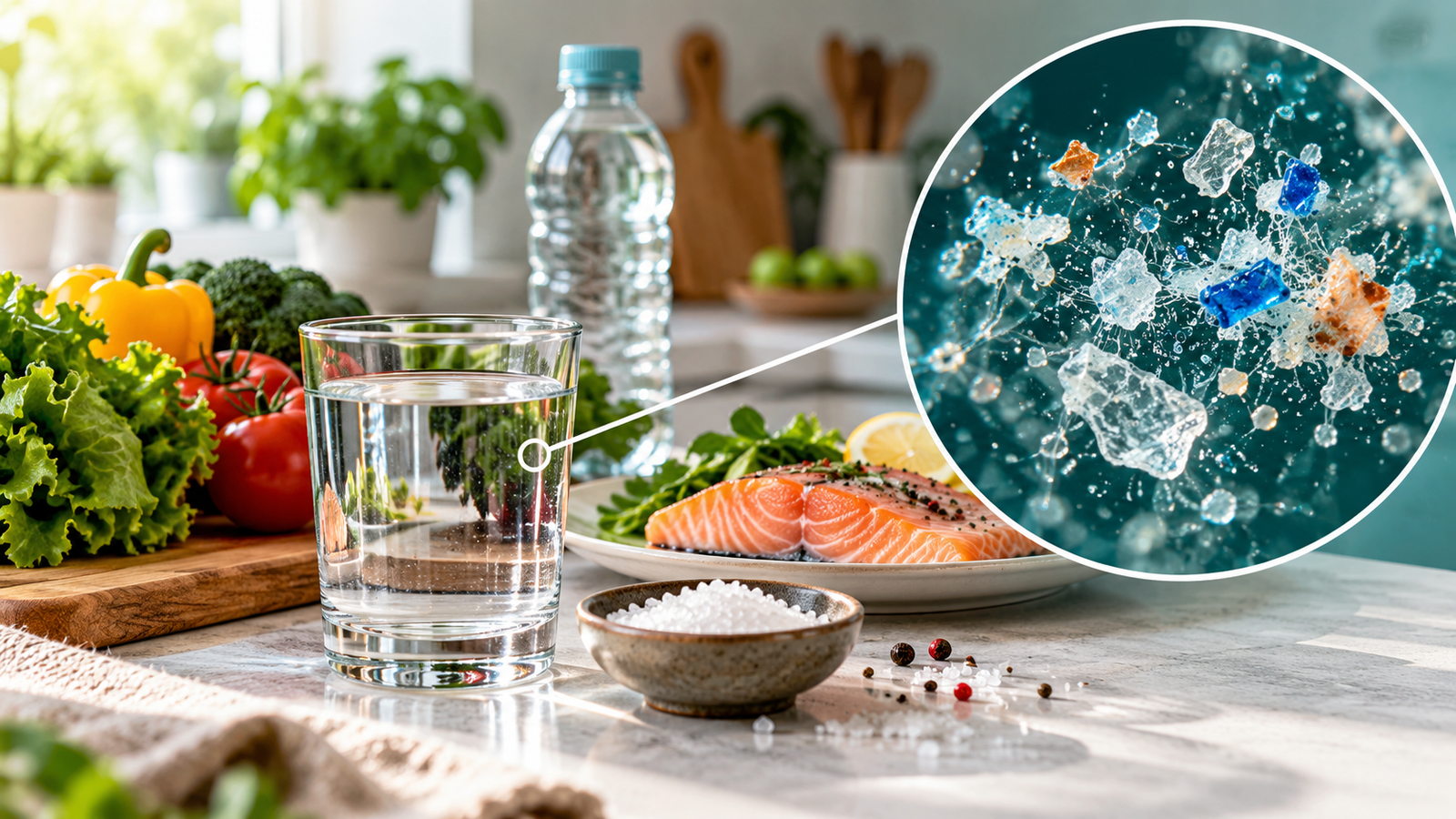

Microplastics are no longer just an ocean pollution problem. Researchers have detected microplastics in everyday food, tiny plastic particles in drinking water, seafood, salt, honey, and other foods. But how do these particles enter our meals, what does science actually know about their health effects, and how can we reduce unnecessary exposure? This detailed guide explores the evidence, the uncertainties, and practical steps for a healthier kitchen.
Imagine preparing a perfectly healthy meal. You wash your vegetables, choose fresh ingredients, avoid excessive oil, and drink a glass of water alongside your food.
Everything appears clean and nutritious.
But what if some of the food and water contain something you cannot see?
Not bacteria. Not preservatives. Not an artificial food colour.
Tiny pieces of plastic.
Known as microplastics, these particles have become an important subject of environmental and food-safety research. Scientists have found them in oceans, rivers, agricultural soil, drinking water, and several foods consumed around the world.
Even more intriguing is the discovery of nanoplastics, particles so small that researchers need specialised instruments to detect them.
The central question is no longer simply whether humans encounter microscopic plastic particles. It is how much exposure occurs, what happens to these particles inside the body, and whether everyday exposure causes meaningful health problems.
The answers are more complicated than many alarming social media headlines suggest.
Let’s explore what researchers have discovered, what remains uncertain, and how a few sensible changes in our daily routines may help reduce avoidable exposure.
1. What Are Microplastics, and How Do They Enter Our Everyday Food?
Understanding something too small to see
Microplastics are generally defined as plastic particles smaller than five millimetres. Some are visible as tiny fragments, while others are difficult to detect without specialised equipment.
Nanoplastics are even smaller, commonly described as plastic particles below one micrometre, although scientific size definitions are not fully standardised.
To understand the difference, consider three everyday objects:
A grain of rice is several millimetres long.
A human hair is approximately 70 micrometres in diameter.
A nanoplastic particle may measure less than one micrometre.
This means many plastic particles are far smaller than anything our eyes can distinguish.
Where do these particles come from?
Microplastics can originate from two broad sources.
Primary microplastics are manufactured as small particles for particular industrial or commercial purposes.
Secondary microplastics form when larger plastic objects gradually break down through sunlight, mechanical friction, temperature changes, and environmental weathering.
Common sources include discarded packaging, synthetic clothing fibres, vehicle tyres, plastic containers, industrial waste, and deteriorating plastic objects.
Over time, these particles can travel through air, waterways, and soil.
They may then enter agricultural and aquatic environments where food is produced.
How does plastic pollution reach our plates?
Consider a simple journey:
Plastic waste enters the environment.
Sunlight, friction, and weathering break larger items into smaller particles.
Some particles reach rivers, oceans, agricultural soil, or the atmosphere.
Food-producing organisms encounter these particles.
Some of the particles may enter foods eventually consumed by humans.
This process is not identical for every food.
Seafood may be exposed through aquatic environments, while crops may encounter particles through soil, irrigation, airborne deposition, or agricultural materials.
Food processing, handling, and packaging can introduce additional opportunities for contamination.
Importantly, the presence of plastic particles in an environment does not mean every particle reaches a person’s digestive system, and ingestion does not mean every particle stays inside the body.
Understanding these distinctions is essential for evaluating the real risks.
2. Which Everyday Foods and Drinks May Contain Microplastics?
Researchers have reported microplastics in a surprisingly wide range of foods.
However, detection levels can vary considerably between studies because researchers use different sampling procedures, analytical methods, particle-size thresholds, and contamination controls.
This means we should not treat every published particle count as a universal measurement.
Drinking water: one of the most closely studied sources
Plastic particles have been detected in both bottled and tap water.
A particularly notable study published in January 2024 examined three popular bottled-water brands using advanced laser-based imaging.
Researchers reported an average of approximately 240,000 microplastic and nanoplastic particles per litre in the samples tested, with roughly 90% of the detected particles belonging to the nanoplastic size range.
The finding attracted worldwide attention because earlier methods often overlooked extremely small plastic fragments.
But there is an important qualification: this was a study of selected samples, not proof that every bottle of drinking water contains the same number of particles.
Nor does a higher particle count automatically establish a specific health effect.
The study highlighted how much remains undetected when instruments cannot reliably measure the smallest particles.
For additional background, see the US National Institutes of Health report, Plastic Particles in Bottled Water.
Seafood: an environmental pathway into food
Fish, mussels, oysters, and other aquatic organisms can encounter microplastics in polluted water and sediments.
Filter-feeding organisms, including mussels, are particularly interesting to researchers because they continuously process surrounding water.
Unlike many fish, shellfish are often eaten whole, including digestive tissues in which particles may be present.
Yet it would be misleading to conclude that seafood is unsafe to eat simply because microplastics have been detected.
Seafood provides important nutrients, including protein, vitamin B12, iodine, and beneficial fats in many species.
Consumers should continue to consider established food-safety advice, species-specific contamination guidance, and nutritional benefits rather than avoiding all seafood out of fear.
Table salt: pollution can reach even basic ingredients
Microplastics have been detected in some sea salts and other salt products.
Possible contamination pathways include the source environment, processing conditions, atmospheric deposition, and packaging.
But the concentrations reported across studies are inconsistent.
A label such as sea salt, rock salt, Himalayan salt, or organic does not establish that a product is free from microplastics.
Neither should consumers increase or decrease salt consumption based solely on microplastic headlines.
Controlling overall sodium intake remains a much more established public-health priority.
Honey, sugar, milk, and other foods
Studies reviewed by food-safety authorities have reported plastic particles in products including honey, sugar, milk, tea, and beer.
Researchers are still working to determine how much contamination occurs during agricultural production, how much comes from environmental sources, and whether some particles are introduced during processing or laboratory testing.
One important issue is that airborne fibres can contaminate samples unless laboratories use strict controls.
Therefore, a study detecting a small number of suspicious particles does not always provide a precise estimate of what consumers actually ingest.
Vegetables, fruits, and crops
Agricultural soil can contain plastic fragments originating from farming materials, contaminated irrigation water, waste applications, and atmospheric pollution.
Researchers are investigating whether certain very small particles can be taken up by plants and transferred into edible tissues.
The evidence depends on particle size, plant species, exposure conditions, and analytical techniques.
It would be premature to claim that every vegetable contains dangerous quantities of plastic.
Fresh fruits and vegetables remain essential components of a healthy diet. Possible microplastic exposure is not a sound reason to reduce their consumption.
Tea: a familiar habit with an unexpected research question
Tea is consumed daily in millions of households.
Some modern tea bags contain plastic polymers or plastic-based sealing materials.
Research has demonstrated that certain plastic-containing tea bags can release particles into hot water.
A systematic review published in 2026 identified multiple studies examining this phenomenon, while highlighting substantial differences between products and experimental methods.
Another study published in October 2026 compared plastic-containing tea bags and loose-leaf tea products, evaluating particle release and selected chemical migration.
These findings do not mean drinking tea causes disease.
They do suggest that people who prefer to minimise contact between hot beverages and plastic materials can reasonably choose loose-leaf tea and a reusable stainless-steel strainer.
Everyday food exposure at a glance
| Food or source | What research indicates | Sensible precaution |
|---|---|---|
| Bottled water | Plastic particles detected in selected samples | Use safe drinking water and reusable bottles |
| Seafood | Exposure may occur through aquatic environments | Follow established seafood safety advice |
| Table salt | Some tested products contain particles | Avoid claims of guaranteed plastic-free salt |
| Honey and sugar | Particles reported in some studies | Focus on moderation and reliable food handling |
| Fruits and vegetables | Environmental exposure pathways are being studied | Wash produce and continue eating a balanced diet |
| Plastic-containing tea bags | Some products release particles in hot water | Consider loose-leaf tea |
| Plastic food containers | Wear, friction, and some heating conditions may release particles | Prefer glass or stainless steel for hot food |
3. What Happens When Microplastics Enter the Human Body?
This is where the science becomes particularly important.
Researchers have detected plastic particles in several types of human biological samples, including blood, stool, and certain tissues.
These findings demonstrate that at least some particles can come into contact with human biological systems.
However, detecting a particle is not the same as establishing that it causes disease.
The digestive system
When someone consumes food or water containing microplastics, particles first encounter the gastrointestinal tract.
Some particles may pass through and leave the body in faeces.
Scientists are investigating whether smaller particles can cross intestinal barriers under certain conditions.
Particle size, chemical composition, surface properties, and biological interactions may influence this process.
Nanoplastics are of particular scientific interest because their small dimensions may allow different interactions with cells and tissues compared with larger fragments.
But researchers do not yet have a complete picture of how much of an ordinary person’s dietary exposure is absorbed or retained.
Inflammation and oxidative stress
Laboratory and animal experiments have examined whether microplastics can contribute to inflammation or oxidative stress.
Oxidative stress describes an imbalance involving reactive molecules and the body’s protective mechanisms.
Some experimental studies have identified biological responses after exposure to certain plastic particles.
However, laboratory experiments often use concentrations, particle types, or exposure conditions that differ substantially from everyday human diets.
It is scientifically incorrect to assume that an effect observed in cells or animals necessarily occurs in people eating normal meals.
Gut microbiome research
The gut microbiome consists of microorganisms living in the digestive tract.
Scientists have explored whether microplastic exposure influences microbial communities, intestinal barrier function, or gut inflammation.
Some animal studies report changes in microbial composition.
Nevertheless, researchers still need stronger human evidence to establish whether typical dietary exposures cause clinically meaningful microbiome changes.
The gut microbiome is already influenced by many factors, including diet, medicines, illness, age, and lifestyle.
At present, no specific probiotic, supplement, detox diet, or food has been proven to remove microplastics from the human body.
Reproductive health and other concerns
Researchers are investigating possible relationships between microplastic exposure and reproductive, metabolic, cardiovascular, and immune-system health.
Some studies have identified plastic particles in reproductive tissues and other biological samples.
Such discoveries deserve serious investigation, but they do not by themselves establish infertility, hormonal disorders, cardiovascular disease, or other medical conditions as consequences of ordinary food exposure.
The distinction between detection, association, and causation is critical.
What do major health authorities say?
The World Health Organization has reviewed exposure to microplastic particles through food, water, and air and identified important evidence gaps.
The US Food and Drug Administration states that current scientific evidence does not demonstrate that the levels of microplastics and nanoplastics detected in foods pose a risk to human health.
The European Food Safety Authority likewise acknowledges major limitations in exposure and health-risk data and is developing a more comprehensive scientific assessment.
These statements should not be interpreted as proof that every exposure is harmless.
They mean that research has not yet established the actual human-health risk at commonly encountered dietary exposure levels.
The scientifically responsible position lies between unnecessary panic and dismissing an unresolved environmental-health question.
4. How Can We Reduce Microplastic Exposure in Everyday Life?
It may be impossible to eliminate exposure completely, particularly because plastic particles are present throughout the environment.
However, several reasonable choices can reduce unnecessary contact with plastic during food preparation and consumption.
These changes can also support broader environmental goals by reducing disposable plastic waste.
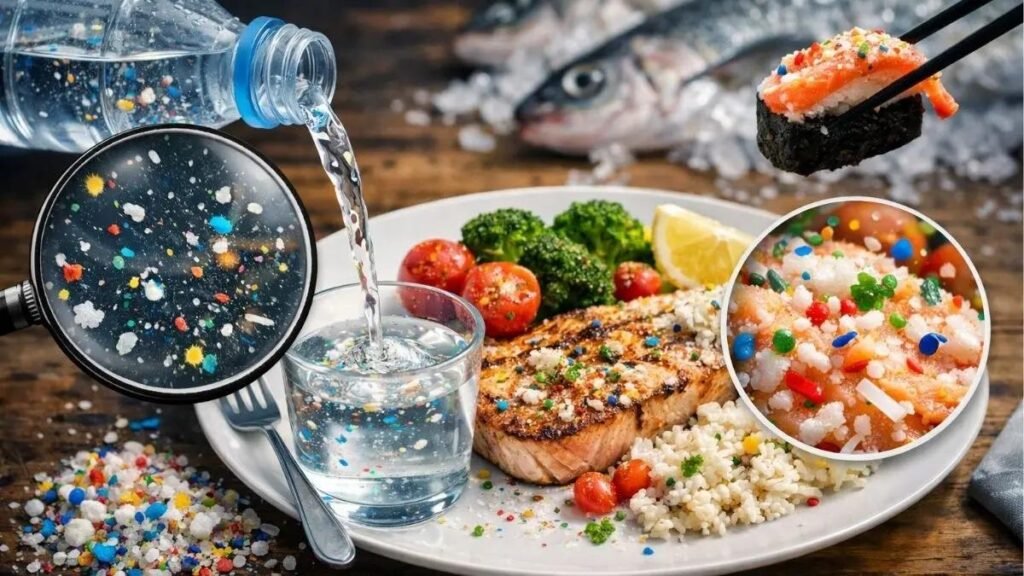
1. Use glass or stainless steel for hot food and drinks
Consider transferring freshly cooked food into glass, ceramic, or stainless-steel containers rather than placing it directly into disposable plastic packaging.
These materials provide useful alternatives when they are suitable for food contact.
Make sure glass containers are appropriate for the temperatures involved.
This is a practical precaution, not proof that a plastic meal container automatically creates harmful exposure.
2. Avoid heating food in unsuitable plastic containers
Heat can affect the properties of certain plastic materials.
For hot meals and reheating, use microwave-safe glass or ceramic where practical.
Never assume a takeaway container is designed for repeated heating.
Follow the manufacturer’s food-contact and temperature instructions.
Research into particle release from food-contact plastics is developing, but the degree of release varies by material and usage conditions.
3. Replace badly damaged food containers
Inspect reusable containers occasionally.
If a container is badly scratched, cracked, warped, or visibly deteriorating, replace it.
Avoid scraping hot food from damaged plastic surfaces using sharp utensils.
This is a reasonable food-handling precaution, although no universal particle-release threshold exists for determining when every plastic container must be discarded.
4. Consider alternatives to plastic cutting boards
Repeated chopping can wear down cutting-board surfaces.
Scientific studies have investigated the release of particles from food-contact articles under friction and repeated use.
If you wish to minimise plastic contact, a well-maintained wooden cutting board can be an alternative.
However, food hygiene is equally important.
Clean boards thoroughly, separate raw meat from ready-to-eat foods where appropriate, and replace any board that becomes difficult to sanitise.
5. Choose loose-leaf tea when convenient
If you regularly use tea bags containing plastic-based materials, loose tea leaves with a stainless-steel strainer offer a simple alternative.
This reduces reliance on disposable tea bags without requiring an expensive lifestyle change.
Not all tea bags use the same materials, and scientific findings about one product should not automatically be applied to every brand.
6. Use an appropriate water source, not just a different bottle
Choose drinking water that meets local safety requirements.
Where tap water is not reliably safe, continue using an appropriate purification or treatment system.
Do not stop essential water treatment simply because some bottled-water samples were found to contain microplastics.
Different filtration technologies have different capabilities, and not every household filter has been independently verified for nanoplastic removal.
A reusable stainless-steel or glass bottle may help reduce reliance on single-use plastic without compromising hydration.
7. Wash fruits and vegetables properly
Rinse fresh produce under clean running water to remove dirt and some surface contaminants.
Follow established food-safety recommendations.
Washing cannot be assumed to remove all microscopic particles or any particles incorporated into plant tissues.
But good produce hygiene remains valuable for more established food-safety reasons.
8. Reduce unnecessary disposable packaging
Where convenient, favour reusable containers and purchase formats that minimise excessive packaging.
Consider carrying a reusable water bottle and food container when travelling or working outside the home.
The immediate reduction in individual microplastic ingestion may be difficult to quantify.
Nevertheless, reducing disposable plastic use can help address the environmental pollution that contributes to the problem.
9. Avoid products promising to detoxify microplastics
There is currently no established medical treatment or supplement proven to remove ingested microplastics from healthy individuals.
Claims that particular herbal drinks, juices, powders, or detox regimens eliminate plastic particles should be treated sceptically unless supported by rigorous human clinical evidence.
Healthy eating, adequate hydration, physical activity, and sufficient sleep remain valuable, but they should not be marketed as proven microplastic-removal techniques.
10. Keep the bigger health priorities in perspective
Reducing unnecessary plastic exposure can be worthwhile.
But it should not come at the expense of established health practices.
Continue eating vegetables, fruits, whole grains, and other nutritious foods.
Prioritise safe drinking water, proper cooking, food hygiene, adequate sleep, physical activity, and avoidance of tobacco.
These interventions have much stronger evidence for protecting health than expensive products marketed as plastic-free solutions.
A simple seven-day household challenge
You do not need to replace everything in your kitchen overnight.
Try one manageable improvement each day.
| Day | Small change |
|---|---|
| Monday | Carry a reusable water bottle |
| Tuesday | Reheat food in suitable glass or ceramic |
| Wednesday | Check containers for visible damage |
| Thursday | Try loose-leaf tea |
| Friday | Review how hot takeaway food is stored |
| Saturday | Reduce one unnecessary disposable item |
| Sunday | Review which changes are practical long term |
The aim is not to build a completely plastic-free household.
It is to make thoughtful, sustainable decisions without turning everyday eating into a source of anxiety.
5. What Does the Future of Microplastics Research Look Like?
Research into microplastics has progressed rapidly, but major questions remain unresolved.
Better ways to measure particles
One of the biggest challenges is detection.
Different laboratories may use different instruments and identify different particle sizes.
A study that detects only relatively large microplastics cannot be compared directly with one that measures much smaller nanoplastics.
Scientists therefore need more standardised procedures for collection, analysis, quality control, and reporting.
Understanding realistic human exposure
Researchers also need to determine how much plastic people actually ingest over time.
This requires information about food concentrations, dietary habits, contamination pathways, particle sizes, and differences between populations.
Simply multiplying the particle count from one bottle of water by the number of bottles a person drinks does not accurately describe lifetime exposure across an entire population.
Studying long-term health effects
Many existing toxicology experiments investigate short-term responses.
Stronger evidence will require well-designed human studies that examine exposure levels, biological mechanisms, and long-term outcomes.
Scientists must also account for other environmental exposures and lifestyle factors that may affect health.
Improving food packaging and material design
Food packaging remains important for preventing contamination, preserving products, and reducing food waste.
The future challenge is to develop materials and handling systems that minimise unnecessary particle release while continuing to protect food safety.
A wholesale rejection of plastic packaging without considering hygiene, affordability, and food preservation could create other problems.
Better evidence should guide better design.
A broader environmental responsibility
Microplastic pollution is not solely an individual consumer problem.
Waste management, industrial manufacturing, textile production, agricultural practices, and environmental regulation all influence how many particles enter ecosystems.
Individuals can make thoughtful choices, but large-scale prevention also requires improvements in infrastructure, product design, and pollution control.
Frequently Asked Questions About Microplastics in Food
1. Are microplastics found in almost all foods?
Microplastics have been reported in numerous food categories, but scientists have not demonstrated that every food contains them. Detection depends on the product, environment, sampling method, and analytical technique.
2. Can microplastics cause cancer?
Current scientific evidence does not establish that ordinary dietary exposure to microplastics causes cancer in humans. Researchers are investigating possible biological mechanisms and long-term effects, but findings from laboratory studies should not be treated as proof of human cancer risk.
3. Does boiling water remove microplastics?
Some experimental research has investigated reducing particle concentrations through boiling under particular water-chemistry conditions followed by separation of precipitates. However, boiling alone should not be presented as a universally reliable method for removing microplastics or nanoplastics. Boiling remains useful for inactivating many waterborne pathogens when recommended by public-health authorities.
4. Is bottled water more dangerous than tap water?
Both may contain plastic particles, and concentrations vary between sources and studies. Current evidence does not establish a general health-risk ranking based solely on microplastics. The most important priority is choosing microbiologically and chemically safe drinking water.
5. Are glass bottles completely free from microplastics?
No material or packaging format should automatically be described as guaranteeing zero contamination. Although glass does not shed plastic from its body, caps, seals, processing equipment, and environmental sources may still contribute particles.
6. Can our bodies naturally remove microplastics?
Some ingested particles are eliminated through the digestive system. Scientists are still studying how smaller particles may be absorbed, distributed, retained, or cleared. There is no proven detox diet that guarantees removal.
7. Should we stop eating fish and seafood?
No. Existing evidence does not justify avoiding all seafood because of microplastics. Nutritional benefits, appropriate species selection, food preparation, and established contamination guidance remain important.
8. Are plastic food containers always unsafe?
No. Food-contact plastics are designed for particular uses, and risks vary with material, condition, temperature, and exposure. Avoid unsuitable heating and damaged containers, but do not assume that every properly used plastic container is harmful.
9. Can children and pregnant women be affected by microplastics?
Potential effects during pregnancy and childhood are being investigated, but reliable human risk estimates remain limited. Families should prioritise established food and water safety practices and avoid unsupported detox products or restrictive diets.
10. Is it possible to live completely microplastic-free?
Complete avoidance is not currently realistic because microplastic particles are widespread in the environment. The practical goal is to reduce unnecessary exposure while maintaining healthy, sustainable habits.
Final Thoughts: Awareness Matters More Than Fear
Microplastics have changed the way researchers think about pollution.
They illustrate how materials used for convenience can gradually spread into environments far beyond their original purpose.
The discovery of tiny plastic particles in food and drinking water raises legitimate questions.
But the scientific community is still determining what these discoveries mean for human health.
Detection is not the same as danger. Uncertainty is not the same as safety. And alarming laboratory findings do not automatically describe the risks of everyday eating.
For now, a sensible approach is to reduce avoidable plastic contact, use suitable food containers, minimise unnecessary disposable packaging, and continue following well-established nutrition and food-safety recommendations.
You do not need a perfect kitchen or a completely plastic-free life to make meaningful changes.
The goal is not to fear every meal. It is to understand the evidence, make informed choices, and encourage a cleaner food environment for the future.
This article provides general educational information and does not replace advice from qualified medical or public-health professionals.
The article draws on recent authoritative food-safety reviews, including EFSA’s October 21, 2026 update, the FDA’s scientific assessment, and peer-reviewed studies of food-contact materials. Current human-health evidence remains incomplete, so the practical recommendations are intentionally precautionary rather than claims of proven disease prevention.
Read More Interesting Content in My Blog Section.
Scientific References and Further Reading
US Food and Drug Administration (FDA). Microplastics and Nanoplastics in Foods. Guidance and research overview.
https://www.fda.gov/food/environmental-contaminants-food/microplastics-and-nanoplastics-foodsWorld Health Organization (WHO). (2022). Dietary and Inhalation Exposure to Nano- and Microplastic Particles and Potential Implications for Human Health.
https://www.who.int/publications/i/item/9789240054608National Institutes of Health (NIH). (2024). Plastic Particles in Bottled Water.
https://www.nih.gov/news-events/nih-research-matters/plastic-particles-bottled-waterEuropean Food Safety Authority (EFSA). Microplastics and Nanoplastics in Food. Updated October 2026.
https://www.efsa.europa.eu/en/topics/microplastics-and-nanoplastics-foodZimmermann, L., et al. (2025). Food Contact Articles as Source of Micro- and Nanoplastics: A Systematic Evidence Map. npj Science of Food.
https://www.nature.com/articles/s41538-025-00470-3Pehlivan, N., & Gedik, K. (2026). Microplastic Release from Plastic Tea Bags versus Bulk Tea and Migration of Bisphenol A and Plasticizer Esters. npj Science of Food.
https://www.nature.com/articles/s41538-026-01175-x