
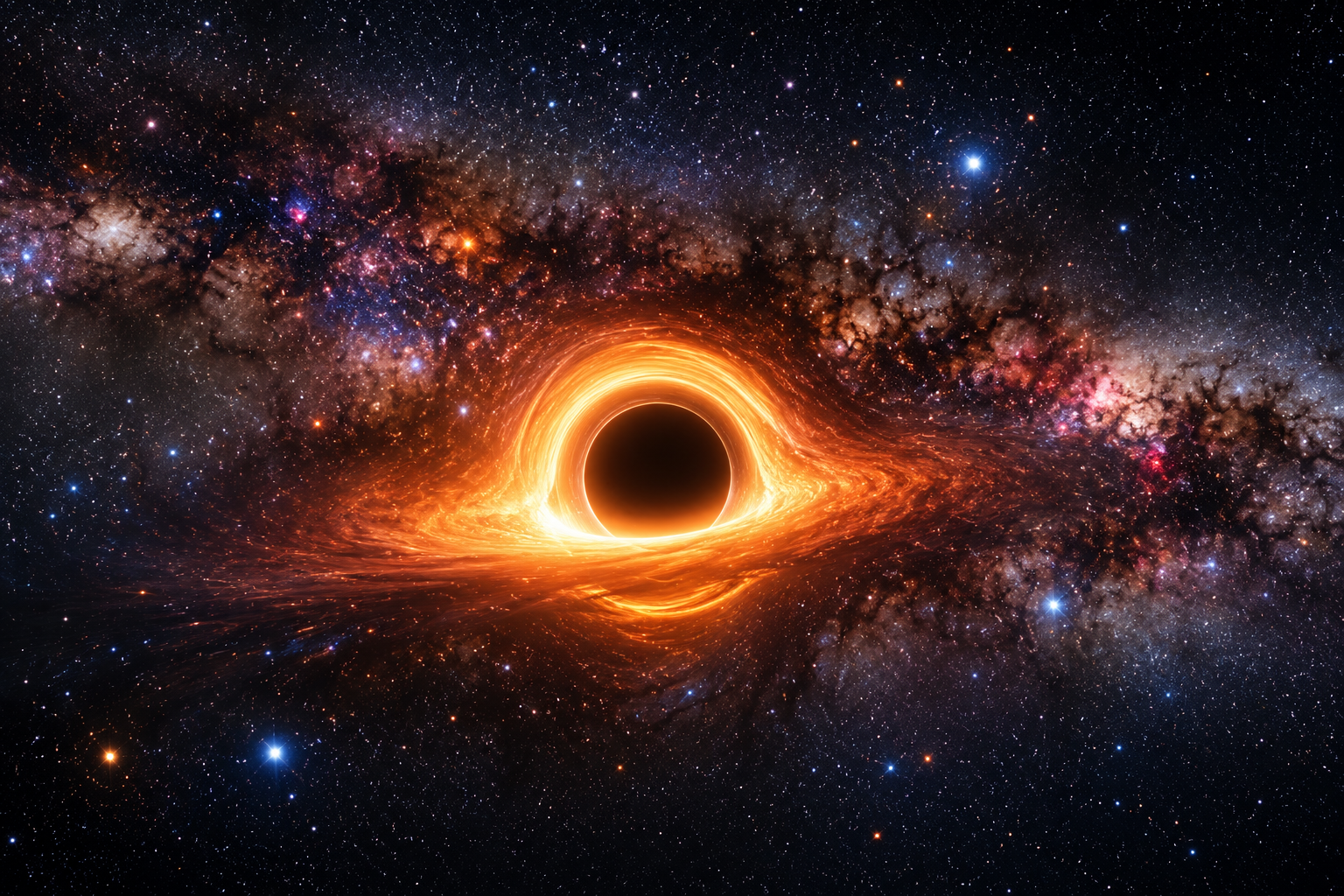

At the center of the Milky Way, hidden behind thick clouds of cosmic dust and glowing gas, there is an invisible monster controlling the motion of millions of stars. It does not shine like a star, does not have a surface like a planet, and cannot be seen directly with ordinary telescopes. Yet its gravitational power is so strong that entire star systems dance around it.
This mysterious object is called Sagittarius A*, often written as Sgr A* and pronounced “Sagittarius A-star.”
It is the supermassive black hole at the heart of our galaxy — the deep gravitational anchor around which the Milky Way has evolved for billions of years. Scientists estimate that Sagittarius A has a mass of about 4 million times the mass of our Sun, yet it is located around 26,000 to 27,000 light-years away from Earth, hidden in the direction of the constellation Sagittarius.
But Sagittarius A* is not just another scientific object. It is one of the most fascinating mysteries in modern astronomy because it helps us understand black holes, gravity, galaxy formation, Einstein’s theory of relativity, and perhaps even the deep structure of space-time itself.
What Is Sagittarius A*?
Sagittarius A* is the name given to the compact radio source located at the center of the Milky Way galaxy. For decades, astronomers suspected that this region contained something extremely massive and extremely compact. The evidence came not from seeing the black hole directly, but from watching nearby stars orbit around something invisible at extraordinary speeds.
Imagine standing in a dark room and seeing several people running in perfect circles around an empty chair. Even if you cannot see what is on the chair, their motion tells you that something powerful must be there. That is almost how scientists discovered Sagittarius A*. They tracked stars near the center of the Milky Way and found that they were moving as if they were trapped by a huge invisible mass.
Over time, the evidence became overwhelming. The object at the center had to be extremely massive, extremely compact, and dark. No known star cluster, gas cloud, or ordinary object could explain it. The best explanation was clear: Sagittarius A* is a supermassive black hole.
The work of astronomers Reinhard Genzel and Andrea Ghez, who studied stars orbiting the Milky Way’s center for decades, became so important that they shared the 2020 Nobel Prize in Physics for discoveries related to the supermassive compact object at the center of our galaxy.
Why Is It Called Sagittarius A*?
The name may sound unusual, but it has a simple meaning. Sagittarius A is a strong radio source in the direction of the constellation Sagittarius. The asterisk, or “star” symbol, was added to identify the bright and compact source inside that region.
So, Sagittarius A* does not mean it is a normal star. In fact, it is the opposite. It is a black hole — a region where gravity is so intense that not even light can escape once it crosses the event horizon.
The name is poetic in a strange way. We call it “A-star,” but it is not a star. It is the dark ruler of stars.
The First Image of Sagittarius A*
For years, Sagittarius A* was known mostly through indirect evidence. Scientists could observe the effects of its gravity, but they could not capture an image of the black hole’s immediate environment.
That changed in 2022.
The Event Horizon Telescope Collaboration released the first image of Sagittarius A*, showing a glowing ring-like structure around the black hole’s shadow. This was not an ordinary photograph. It was created using a global network of radio telescopes working together like one Earth-sized telescope. The same project had earlier produced the first-ever image of a black hole, M87*, in 2019.
The image of Sagittarius A* looked like a glowing orange ring surrounding a dark center. The dark center represents the black hole’s shadow, while the glowing ring comes from superheated gas moving near the event horizon.
The reason this image was so difficult to produce is fascinating. Sagittarius A* changes very quickly because it is much smaller than M87*. Gas near it moves around in minutes, which makes imaging it like trying to photograph a fast-moving storm from across the galaxy. The Event Horizon Telescope team had to process enormous amounts of data and use complex models to reconstruct the final image.
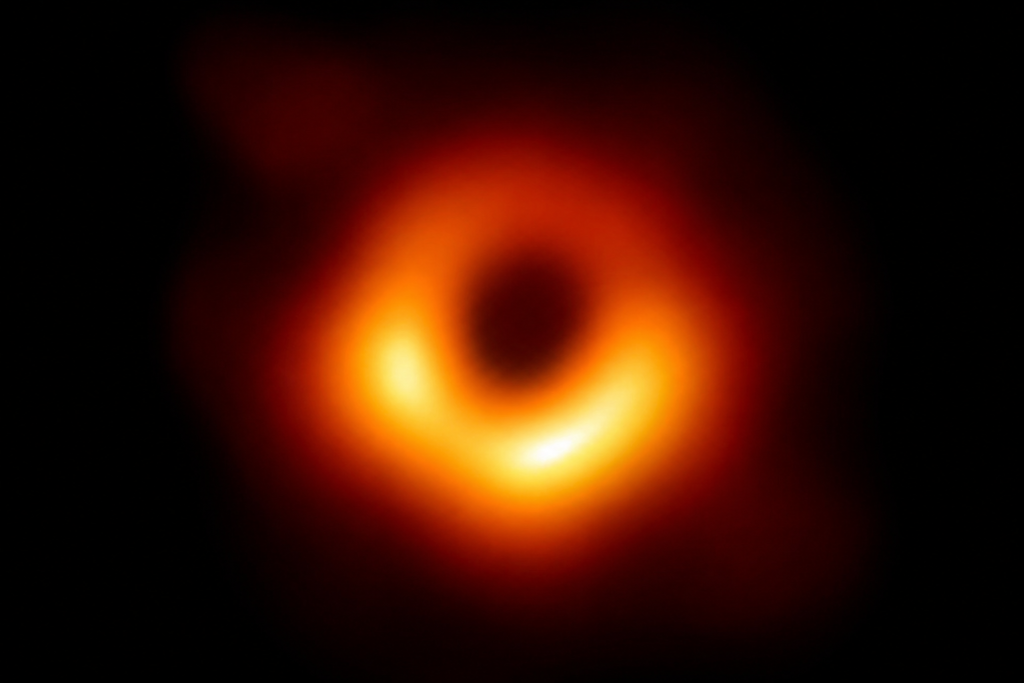
The first direct image of the Milky Way’s central black hole was released by the Event Horizon Telescope’s first image of Sagittarius A*, giving humanity its clearest visual evidence of the supermassive black hole at our galaxy’s center.
How Big Is Sagittarius A*?
Sagittarius A* is often called a monster black hole, but its size is difficult to imagine.
In terms of mass, it is enormous — about 4 million Suns packed into one region. But compared to the scale of the galaxy, its event horizon is surprisingly compact. If placed in our solar system, the black hole’s central region would occupy only a relatively small area compared with the vast distances between planets.
This is one of the strangest things about black holes. They can contain unbelievable mass, but that mass is compressed into a region so dense that ordinary physics starts to break down.
Sagittarius A* is not the biggest black hole in the universe. Some supermassive black holes are billions of times the mass of the Sun. M87*, the first black hole ever imaged, is far more massive than Sagittarius A*. But Sagittarius A* is special because it is our black hole — the one at the center of our own galaxy.
It is the closest supermassive black hole available for detailed study.
Stars Dancing Around an Invisible Giant
One of the most beautiful ways scientists proved the existence of Sagittarius A* was by watching stars orbit around it.
Near the Milky Way’s center, there are stars known as S-stars. These stars orbit the black hole at incredible speeds. One famous star, called S2, has been especially important because its orbit brings it very close to Sagittarius A*. By tracking S2’s motion, astronomers tested Einstein’s theory of general relativity in one of the most extreme gravitational environments available to us.
In 2020, observations of S2 confirmed a prediction of Einstein’s theory: the star’s orbit shifts over time in a rosette-like pattern instead of following a perfect closed ellipse. This effect, known as relativistic precession, gave scientists another powerful confirmation that Einstein’s ideas work even near a supermassive black hole.
This is what makes Sagittarius A* so valuable. It is not just a cosmic object. It is a natural laboratory where scientists can test the deepest laws of physics.
Is Sagittarius A* Dangerous for Earth?
This is a common question: If there is a supermassive black hole at the center of the Milky Way, should we be worried?
The answer is no.
Sagittarius A* is extremely far away from us — around 26,000 to 27,000 light-years. Its gravity affects the structure of the galaxy, but it does not threaten Earth directly. Our solar system is safely located far from the galactic center, in one of the Milky Way’s spiral arms.
A black hole does not “suck in” everything in the galaxy like a vacuum cleaner. Objects fall into a black hole only if they come very close to it. Stars far away can orbit safely, just as planets orbit the Sun.
So, Sagittarius A* is powerful, but it is not a danger to us. It is more like a distant cosmic anchor than a hungry monster chasing Earth.
Why Is Sagittarius A* So Quiet?
One surprising thing about Sagittarius A* is that it is relatively quiet compared with many other supermassive black holes.
Some black holes are extremely active. They pull in huge amounts of gas and dust, creating brilliant disks of radiation and powerful jets that can shine across the universe. These are called active galactic nuclei. Compared with them, Sagittarius A* is calm.
It does not currently consume much material. There is gas and dust around it, but not enough to make it extremely bright. That is why our galaxy does not have a blazing active center like some distant galaxies.
However, Sagittarius A* is not completely silent. It sometimes produces flares in X-ray and infrared light. These flares may happen when small amounts of material fall toward the black hole or when magnetic fields near it suddenly reconnect and release energy. NASA’s Chandra X-ray Observatory has observed high-energy activity around Sagittarius A*, including studies of unusual emissions and possible energetic particle production near the galactic center.
This quietness is actually useful for scientists. Because Sagittarius A* is not constantly blasting huge amounts of radiation, researchers can study its environment in more detail.
What Would It Look Like If You Could Travel Near It?
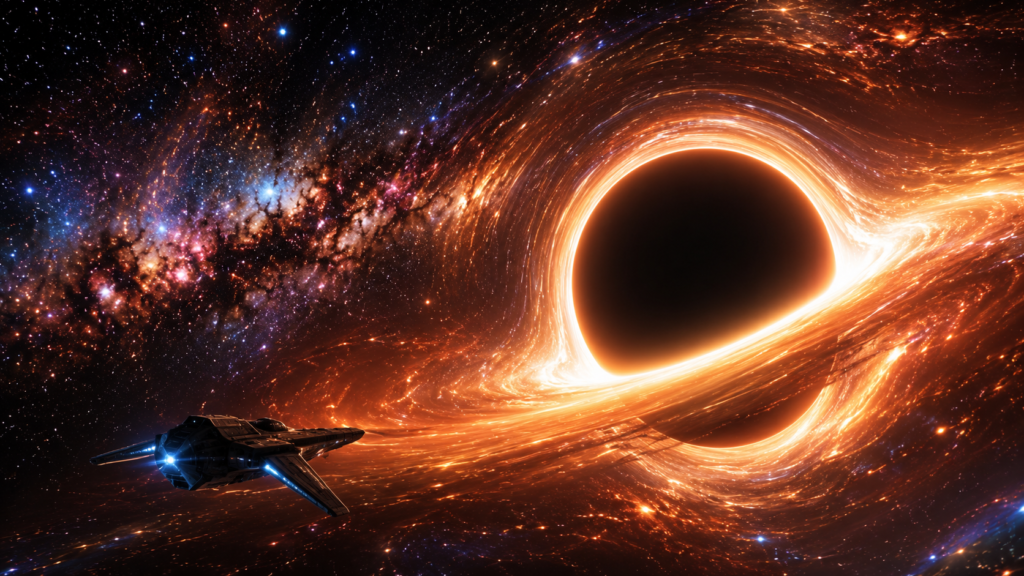
If a spacecraft could safely travel near Sagittarius A*, the view would be terrifying and beautiful.
The sky would be crowded with stars. The galactic center is much denser than our neighborhood of the Milky Way, so the night sky would look far brighter. Near the black hole, light itself would bend. Stars behind the black hole might appear distorted, stretched, or multiplied because of gravitational lensing.
As you moved closer, time would behave differently. According to general relativity, strong gravity slows time. A clock near Sagittarius A* would tick differently compared with a clock far away.
If you crossed the event horizon, there would be no return. The event horizon is the boundary beyond which escape becomes impossible. From outside, you would appear to freeze and fade near the edge. From your own point of view, you would continue inward toward the unknown.
This is where science reaches its limits. We understand black holes very well from the outside, but what happens inside remains one of the deepest mysteries in physics.
For more deep-space mysteries, black hole stories, and cosmic discoveries, visit our Space & Universe section.
Why Sagittarius A* Matters for the Milky Way
Sagittarius A* may seem small compared with the entire galaxy, but it plays an important role in the Milky Way’s history.
Supermassive black holes are believed to influence how galaxies evolve. In some galaxies, active black holes can heat surrounding gas, regulate star formation, and shape the galactic environment. Our black hole is quiet today, but it may have been more active in the past.
Some evidence suggests that the Milky Way’s center experienced more energetic phases long ago. If Sagittarius A* consumed more gas in the past, it may have released powerful radiation and shaped the inner galaxy.
This makes Sagittarius A* a kind of cosmic archive. By studying it, scientists are not only learning about black holes, but also about the history of the Milky Way itself.
The Spiritual Feeling of Looking Toward the Galactic Center
There is something deeply emotional about Sagittarius A*. We live in a galaxy with hundreds of billions of stars, and at the center of it all is darkness — not empty darkness, but powerful, structured, mathematical darkness.
It is invisible, yet stars reveal it.
It is silent, yet radio telescopes hear it.
It is far away, yet it controls the heart of our galaxy.
This is why Sagittarius A* is more than a scientific topic. It reminds us that the universe is not always understood through light. Sometimes, the most powerful truths are discovered through what cannot be seen directly.
Humanity once looked at the night sky and imagined gods, demons, cosmic oceans, and celestial kingdoms. Today, we look deeper and find black holes, gravitational fields, quantum puzzles, and space-time curvature. The language has changed, but the wonder remains the same.
Sagittarius A* stands at the boundary between knowledge and mystery.
What Scientists Still Want to Know
Even after the first image, many questions remain:
How fast is Sagittarius A* spinning?
How exactly does gas move around it?
Why is it so quiet today?
Was it more active in the past?
How do magnetic fields behave near its event horizon?
Can future telescopes create sharper images of its shadow?
Can Sagittarius A* help us connect general relativity with quantum physics?
These questions matter because black holes are places where our best theories collide. General relativity explains gravity on large scales. Quantum mechanics explains the tiny world of particles. But inside black holes, both theories seem necessary — and we still do not have a complete theory that unites them.
Sagittarius A* may help scientists move closer to that answer.
Conclusion
Sagittarius A* is one of the most important objects in the universe for us because it sits at the heart of our own galaxy. It is massive, mysterious, quiet, and powerful. It bends space-time, controls nearby stars, and gives scientists a rare chance to test the deepest laws of physics.
It is not a threat to Earth. It is not a cosmic monster waiting to swallow us. Instead, it is a reminder that the universe is far stranger, deeper, and more beautiful than our everyday experience suggests.
At the center of the Milky Way, hidden behind dust and distance, Sagittarius A* continues to sit in silence — a dark heart surrounded by stars, holding the galaxy’s secrets in its gravity.
To understand the universe at an even deeper level, readers can also explore What Happened Before the Big Bang? The Untold Beginning of the Universe, where we discuss the mysteries of cosmic origin, time, and existence.
Read More Interesting Content in My Blog Section.
FAQ
1. What is Sagittarius A*?
Sagittarius A*, also called Sgr A*, is the supermassive black hole located at the center of the Milky Way galaxy. It has a mass of about 4 million Suns and acts as the powerful gravitational center of our galaxy.
2. Where is Sagittarius A* located?
Sagittarius A* is located at the center of the Milky Way, in the direction of the constellation Sagittarius. It is around 26,000 to 27,000 light-years away from Earth.
3. Is Sagittarius A* dangerous for Earth?
No, Sagittarius A* is not dangerous for Earth. It is extremely far away from our solar system. Black holes do not pull everything into them like vacuum cleaners; objects must come very close to be captured.
4. Why is it called Sagittarius A*?
It is called Sagittarius A* because it was discovered as a strong radio source in the Sagittarius region of the sky. The asterisk, or “star” symbol, was added to identify the compact and powerful source inside that region.
5. Can we see Sagittarius A* directly?
We cannot see the black hole itself because no light escapes from it. However, scientists captured an image of its shadow and glowing surrounding gas using the Event Horizon Telescope in 2022.
6. How big is Sagittarius A*?
Sagittarius A* contains about 4 million times the mass of the Sun. Its event horizon is much smaller than the Milky Way itself, but its gravity strongly affects stars near the galactic center.
7. Who discovered Sagittarius A*?
Sagittarius A* was identified through radio astronomy, but its black hole nature was confirmed by decades of observations of stars orbiting the Milky Way’s center. Scientists Reinhard Genzel and Andrea Ghez received the 2020 Nobel Prize in Physics for related discoveries.
8. Why is Sagittarius A* important?
Sagittarius A* helps scientists study black holes, gravity, galaxy formation, and Einstein’s theory of general relativity. It is one of the best natural laboratories for understanding extreme physics.
9. Is Sagittarius A* active or quiet?
Sagittarius A* is relatively quiet compared with many other supermassive black holes. It does not consume large amounts of material today, but it sometimes produces flares in X-ray and infrared light.
10. What would happen if something fell into Sagittarius A*?
If an object came too close and crossed the event horizon of Sagittarius A*, it could never escape. From outside, the object would appear to slow down and fade, while from its own perspective, it would continue inward toward the black hole’s unknown interior.