


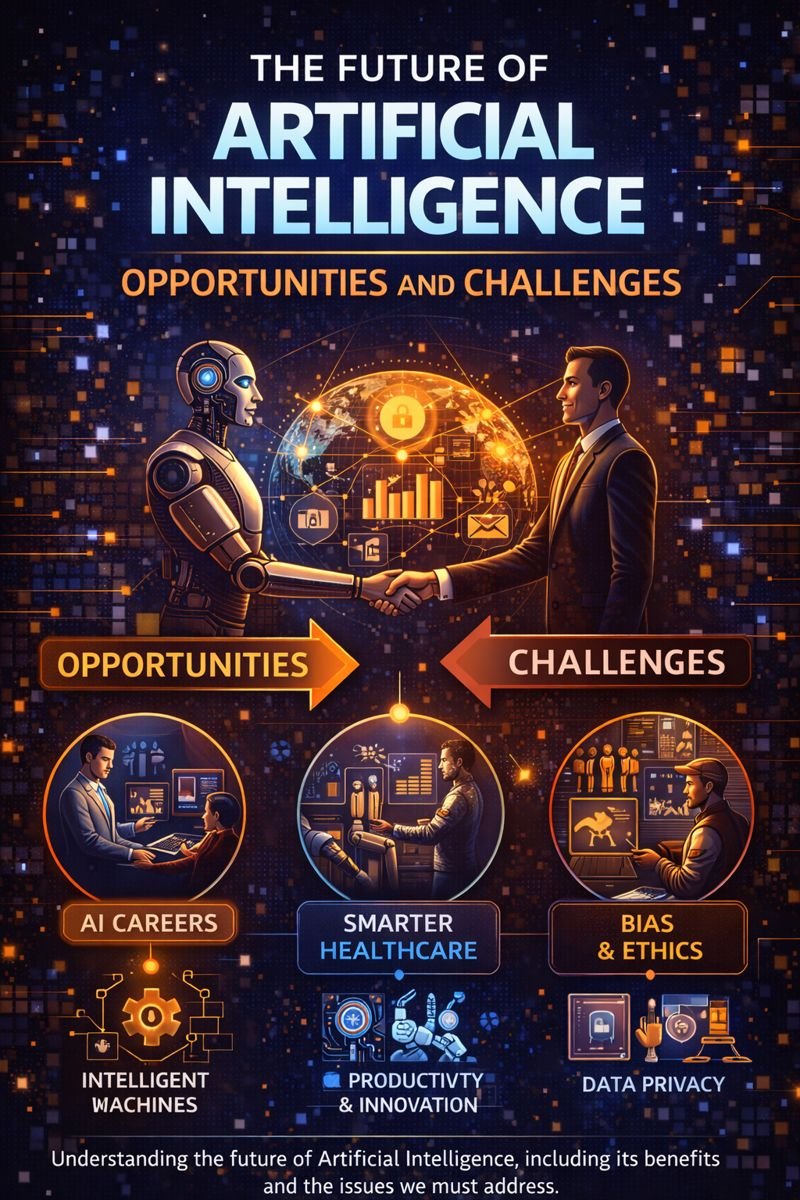


Artificial Intelligence is no longer a distant concept—it is shaping the future of industries, jobs, education, and everyday life. While AI brings enormous opportunities, it also raises serious challenges that society must address responsibly.
Opportunities AI Will Create
1. New Career Opportunities
AI will not replace all jobs—it will transform them. Roles such as:
AI Analysts
Data Scientists
AI Product Managers
Automation Consultants
AI Ethics Specialists
will see massive demand across industries.
2. Smarter Healthcare
AI can help doctors:
Detect diseases earlier
Analyze medical scans faster
Predict health risks using data
This improves accuracy and saves lives, especially in regions with limited medical resources.
3. Productivity Across Industries
From manufacturing to finance, AI helps:
Reduce repetitive manual work
Improve decision-making
Cut operational costs
AI acts as a support system, not just an automation tool.
4. Personalized Education
AI can customize learning based on:
Student strengths
Learning speed
Weak areas
This means education will become more inclusive and effective, especially for self-learners.
Challenges We Must Address
1. Job Displacement
Some routine jobs may reduce due to automation.
The real challenge is reskilling people, not stopping AI.
Those who learn AI-related skills will stay ahead.
2. Bias and Fairness
AI systems learn from data—and biased data can create biased outcomes.
This raises concerns in:
Hiring
Loan approvals
Law enforcement
Ethical AI development is critical.
3. Data Privacy and Security
AI systems rely heavily on data.
If misused, this can threaten:
Personal privacy
Financial security
Digital trust
Governments and organizations must enforce strong regulations.
4. Overdependence on AI
AI should assist human intelligence, not replace critical thinking.
Blind reliance on AI decisions can be dangerous in sensitive areas.
What This Means for Students and Professionals
The future belongs to people who:
Understand AI basics
Learn how AI works
Use AI as a tool, not a crutch
AI literacy will soon be as important as computer literacy.
Now that we understand where AI is heading, the most important question is:
How can you start learning AI—even if you have zero background?
This article is part of our complete AI guide. Explore the full pillar page here: All About Artificial Intelligence