


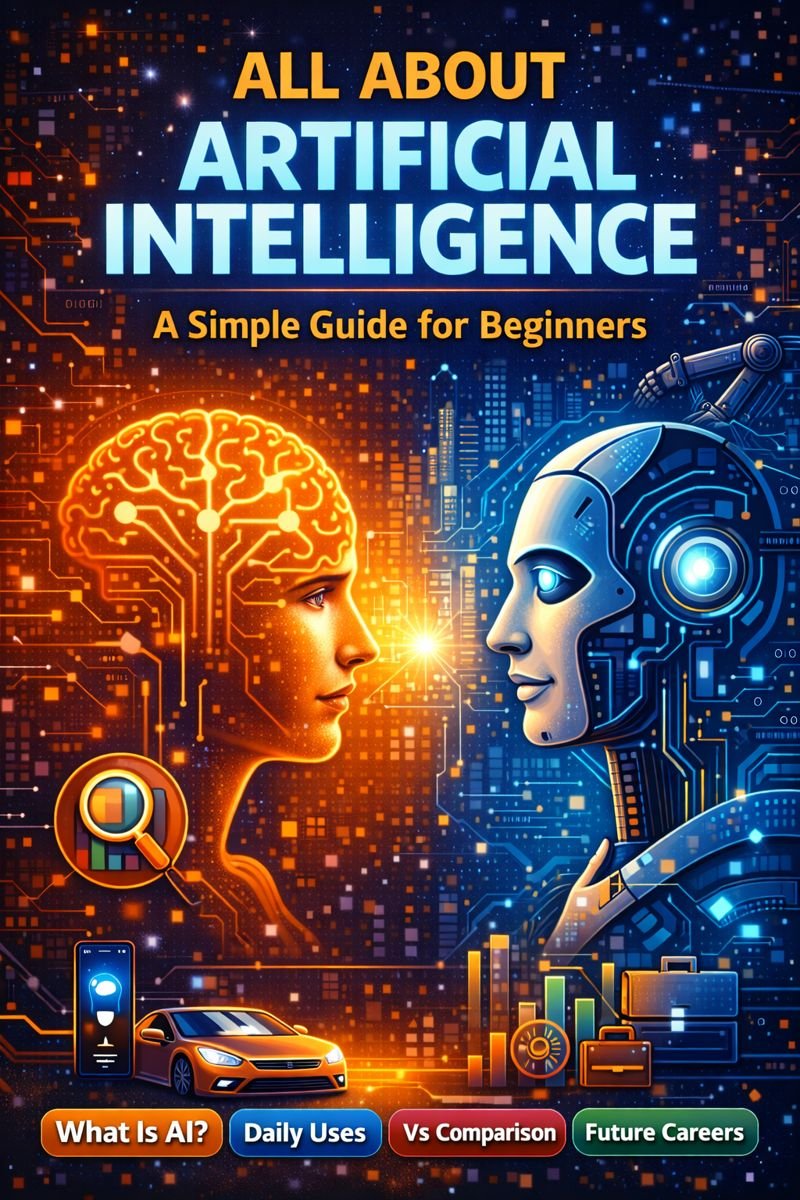


Introduction: Why Everyone Is Talking About AI
Artificial Intelligence (AI) is no longer limited to science fiction or advanced research labs. Today, AI is part of our everyday life — from search engines and smartphones to online recommendations and navigation apps.
Students, professionals, and even non-technical users are hearing about AI everywhere, but many find it confusing or intimidating. This guide is created to explain Artificial Intelligence in simple, clear language, without technical jargon.
On this page, you’ll get a high-level understanding of AI, how it is used, how it differs from human intelligence, and why it matters for the future. Each section briefly introduces a topic, with links to explore deeper explanations separately.
What Is Artificial Intelligence?
Artificial Intelligence refers to the ability of machines or software to perform tasks that normally require human intelligence, such as learning from data, recognising patterns, and making decisions.
Unlike traditional programs that follow fixed instructions, AI systems can learn and improve over time based on data and experience.
In simple terms:
AI makes machines “smart”
It helps systems learn from data
It supports better and faster decision-making
🔗 Read more: What Is Artificial Intelligence? Explained Simply
Artificial Intelligence Basics Everyone Should Know
Think of AI as a smart digital assistant that learns from examples.
Just like a student improves by practising and learning from mistakes, AI systems learn by analysing large amounts of data. The more data they see, the better they become at specific tasks.
AI does not think, feel, or understand emotions like humans. It only processes information logically and efficiently.
🔗 Read more: Artificial Intelligence Basics Everyone Should Know
How AI Is Used in Everyday Life
You don’t need to work in technology to use AI. Most people interact with AI every day without realising it.
AI is commonly used in:
Smartphone cameras and face recognition
Search engines like Google
Video and music recommendations
Navigation and traffic prediction apps
Customer support chatbots
AI works quietly in the background to improve convenience and accuracy.
🔗 Read more: How AI Is Used in Everyday Life (Real Examples)
AI vs Human Intelligence: What’s the Real Difference?
AI and human intelligence are fundamentally different.
Humans can:
Think creatively
Feel emotions
Understand context deeply
Make moral judgments
AI can:
Analyse data quickly
Identify patterns
Perform specific tasks efficiently
AI is powerful in speed and accuracy but depends entirely on human design and data.
🔗 Read more: AI vs Human Intelligence: A Clear Comparison
Difference Between AI, Machine Learning, and Data Science
AI, Machine Learning, and Data Science are closely related but not the same.
At a high level:
Artificial Intelligence is the broader concept of smart machines
Machine Learning is a method that allows AI systems to learn from data
Data Science focuses on analysing data to gain insights and support decisions
Understanding this difference helps remove confusion for beginners.
🔗 Read more: Difference Between AI, ML, and Data Science
AI and the Future: Should We Be Worried or Excited?
AI is changing how industries work, but it is not here to replace humans entirely. Instead, it is transforming jobs, automating repetitive tasks, and creating new opportunities.
Those who understand AI will be better prepared for future careers, while those who ignore it may find adaptation harder.
The key is learning how to work with AI, not compete against it.
🔗 Read more: The Future of AI: Opportunities and Challenges
AI and Future Careers: What Students Should Know
AI is influencing careers across many fields — not just technology.
AI-related opportunities exist in:
Technology and analytics
Healthcare and education
Finance and business
Research and innovation
Students don’t need to master coding immediately. Understanding concepts, data thinking, and problem-solving skills is a strong starting point.
🔗 Read more: AI and Future Careers: A Guide for Students
How to Learn AI: From Beginner to Confident Learner
Learning AI does not require an advanced technical background.
A beginner-friendly approach includes:
Understanding basic concepts first
Learning how data is used
Exploring simple tools gradually
Building curiosity before complexity
AI learning is a journey, not a race.
🔗 Read more: How to Learn AI: From Zero to Hero

Final Thoughts: Understanding AI Is No Longer Optional
Artificial Intelligence is becoming a foundational part of modern life. You don’t need to be an expert, but basic awareness of AI is essential for students and professionals alike.
This page serves as a starting point. As you explore the linked topics, you’ll gain deeper clarity and confidence in understanding AI and its role in shaping the future.
Visit For Latest Content: Blog