

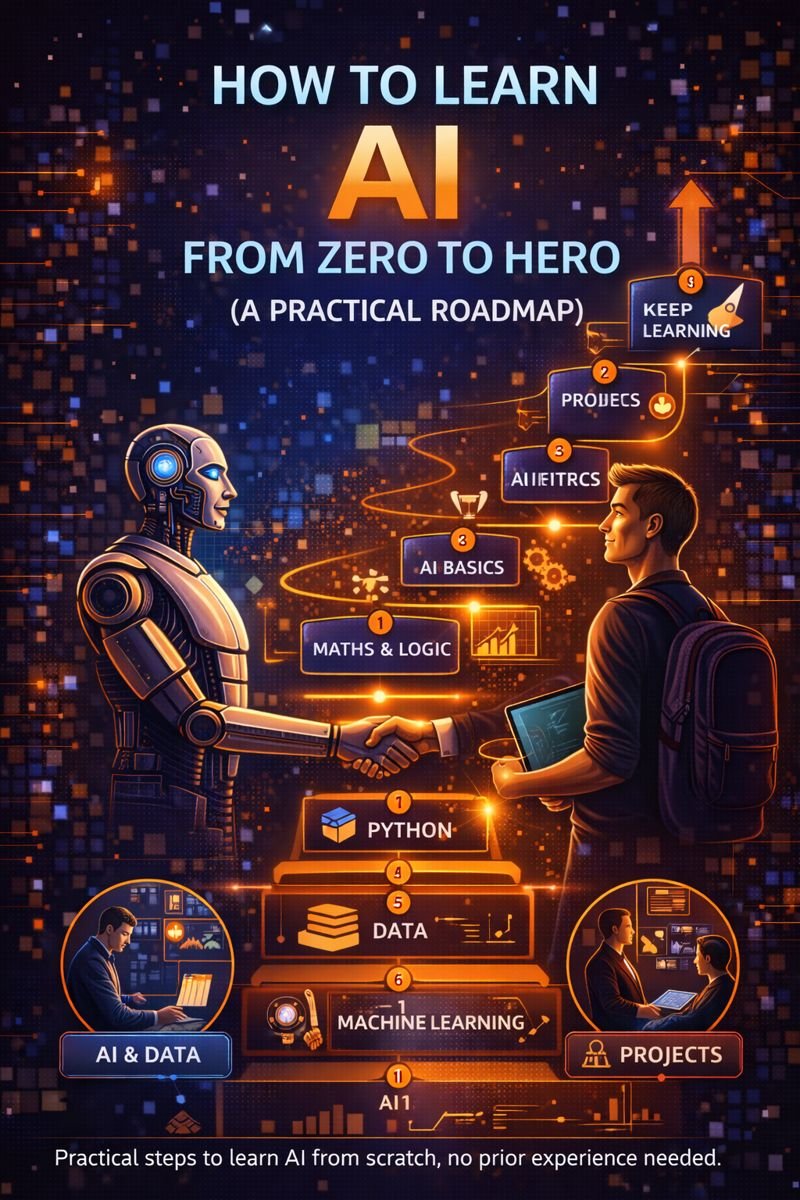


Learning Artificial Intelligence may seem overwhelming at first, especially if you come from a non-technical background. The truth is, anyone can learn AI step by step—provided they follow the right path and focus on fundamentals instead of shortcuts.
This roadmap is designed for absolute beginners and gradually moves toward advanced understanding.
Step 1: Build the Right Mindset (Before You Start)
Before learning tools or coding, understand this clearly:
You don’t need to be a genius
You don’t need advanced maths initially
You don’t need expensive courses
What you do need:
Willingness to learn continuously
AI is a long-term skill, not a crash course.
Step 2: Understand AI Basics (No Coding Yet)
Start by learning:
What Artificial Intelligence really is
Where AI is used in real life
Difference between AI, ML, and Data Science
What AI can and cannot do
👉 At this stage, focus on conceptual clarity, not tools.
Recommended approach:
Read beginner-friendly AI blogs
Watch explainer videos
Follow tech education platforms
Step 3: Learn Basic Mathematics & Logic (Only What’s Needed)
You don’t need deep maths, but some basics help:
Percentages & averages
Probability (basic)
Graphs and trends
Logical thinking
This step builds confidence and improves problem-solving ability.
Step 4: Learn One Programming Language (Python Preferred)
Python is the most popular language for AI and Data Science.
Focus on:
Variables & data types
Loops and conditions
Functions
Working with basic data
👉 Don’t rush. Even basic Python is enough at this stage.
Step 5: Enter the World of Data
AI learns from data. So you must learn:
What data is
Types of data (structured & unstructured)
Basic data analysis
Data cleaning concepts
You can start with simple tools like:
Excel / Google Sheets
Basic Python libraries (later)
Step 6: Learn Machine Learning Fundamentals
Now comes Machine Learning (ML), where machines learn from data.
Focus on:
What is Machine Learning
Supervised vs Unsupervised learning
Basic ML models (conceptual understanding)
Don’t try to master everything at once. Understand how ML works logically.
Step 7: Work on Small Practical Projects
Projects are more important than certificates.
Start with:
Simple prediction models
Data analysis dashboards
AI-based automation ideas
Even small projects show:
Your understanding
Your problem-solving skills
Your practical exposure
Step 8: Learn AI Ethics & Responsible Use
This step is often ignored—but very important.
Understand:
Bias in AI
Data privacy
Ethical decision-making
Human control over AI
This knowledge is highly valued in real-world AI roles.
Step 9: Choose Your AI Direction
After basics, decide your path:
AI + Data Science
AI + Business / Management
AI + Automation
AI + Research
👉 You don’t need to do everything. One focused direction is enough.
Step 10: Keep Learning & Adapting
AI evolves rapidly. Successful learners:
Stay updated
Practice regularly
Learn from mistakes
Use AI as a tool, not a shortcut
AI rewards consistent learners, not quick quitters.
Final Message for Beginners
You don’t need to become an AI expert overnight.
You just need to start today.
Even learning 1 hour a day can transform your career in the next few years.
This article is part of our complete AI guide. Explore the full pillar page here: All About Artificial Intelligence
Nice content