
The AI Era Has Already Started
Students today are preparing for a career world that is changing faster than ever before. Artificial intelligence is no longer limited to science fiction, research labs, or big technology companies. It is now entering offices, schools, hospitals, banks, factories, marketing teams, software companies, design studios, customer service departments, and even small businesses.
This means one important thing for students: the future career race will not be won only by those who score marks. It will be won by students who can learn continuously, use technology smartly, think creatively, solve problems, communicate clearly, and adapt to change.
The World Economic Forum’s Future of Jobs Report 2025 says that AI and big data are among the fastest-growing skills for 2025–2030, along with networks and cybersecurity, technology literacy, creative thinking, resilience, flexibility, curiosity, and lifelong learning.
This does not mean every student must become an AI engineer. It means every student must understand how AI will affect their field. Whether a student wants to become a doctor, engineer, lawyer, teacher, designer, entrepreneur, accountant, civil servant, journalist, or manager, AI awareness will become a career advantage.
The good news is that students do not need to become experts overnight. They need the right direction, the right skills, and the right mindset.
1. First Understand What the AI Era Really Means
Many students hear the word “AI” and immediately think of robots or coding. But the AI era is much bigger than that. It means machines and software are becoming capable of doing tasks that earlier required human intelligence.
AI can write drafts, summarize documents, analyze data, create images, generate code, answer questions, detect fraud, recommend products, support doctors, help teachers, improve customer service, and automate routine work.
This creates both opportunity and risk. Some repetitive jobs may reduce. Some job roles may change. New careers may appear. Existing careers may require new skills.
For example, a marketing student may need to learn AI-based content tools. A finance student may need to understand data analytics and automation. A law student may need to use AI for research support. A medical student may need to understand AI diagnostics. A management student may need to know how AI changes business strategy.
So the first step is simple: students should stop seeing AI as only a “computer science topic.” AI is becoming a career topic for almost everyone.
2. Build Strong Basics Before Running Behind Advanced Tools
A common mistake students make is that they start using advanced AI tools without building strong basics. AI can help you learn faster, but it cannot replace your foundation.
A student who does not understand basic mathematics will struggle with data science. A student who cannot write clearly will misuse AI writing tools. A student who lacks subject knowledge may blindly trust wrong AI answers.
So before going deep into AI, students should strengthen these basics:
Communication skills
Basic computer knowledge
Logical thinking
Mathematics and statistics basics
English writing and speaking
Research skills
Problem-solving ability
Digital safety awareness
Subject knowledge in their chosen field
This foundation will help students use AI properly. Otherwise, AI becomes a shortcut instead of a learning partner.
A strong career in the AI era is not built by copying AI answers. It is built by combining human understanding with AI support.
3. Learn AI Literacy Even If You Are Not From a Technical Background
AI literacy means understanding the basic idea of artificial intelligence, how it works, where it is used, what its limitations are, and how to use it responsibly.
Students do not need to start with complex algorithms. They can begin with simple questions:
What is artificial intelligence?
What is machine learning?
What is generative AI?
What is prompt engineering?
How do AI tools generate answers?
Why can AI make mistakes?
How can AI be used ethically?
How is AI changing jobs?
This basic understanding will help students in every field. For example, a commerce student can use AI to analyze business trends. A humanities student can use AI for research and writing support. A science student can use AI to understand complex concepts. A management student can use AI for presentations, market research, and decision-making.
Students who are new to AI can first read our beginner-friendly guide on All About Artificial Intelligence, where we explain AI, machine learning, data science, and future possibilities in simple language.
4. Develop Skills That AI Cannot Easily Replace
AI can automate many tasks, but it cannot fully replace human judgment, emotional intelligence, ethics, creativity, leadership, empathy, and real-world understanding.
This is why students should not focus only on technical skills. They must also build human skills.
Some of the most important future-proof skills are:
Critical thinking
Creativity
Communication
Leadership
Teamwork
Adaptability
Emotional intelligence
Ethical decision-making
Problem-solving
Curiosity and lifelong learning
The World Economic Forum highlights creative thinking, resilience, flexibility, agility, curiosity, and lifelong learning as rising skills for the 2025–2030 period.
This means students who can think deeply, learn quickly, and work well with others will remain valuable even as AI becomes more powerful.
For example, AI can generate a business plan, but a human must understand the customer. AI can write a speech, but a human must connect emotionally with the audience. AI can analyze data, but a human must decide what action should be taken.
The future will not belong to students who compete against AI. It will belong to students who know how to work with AI.
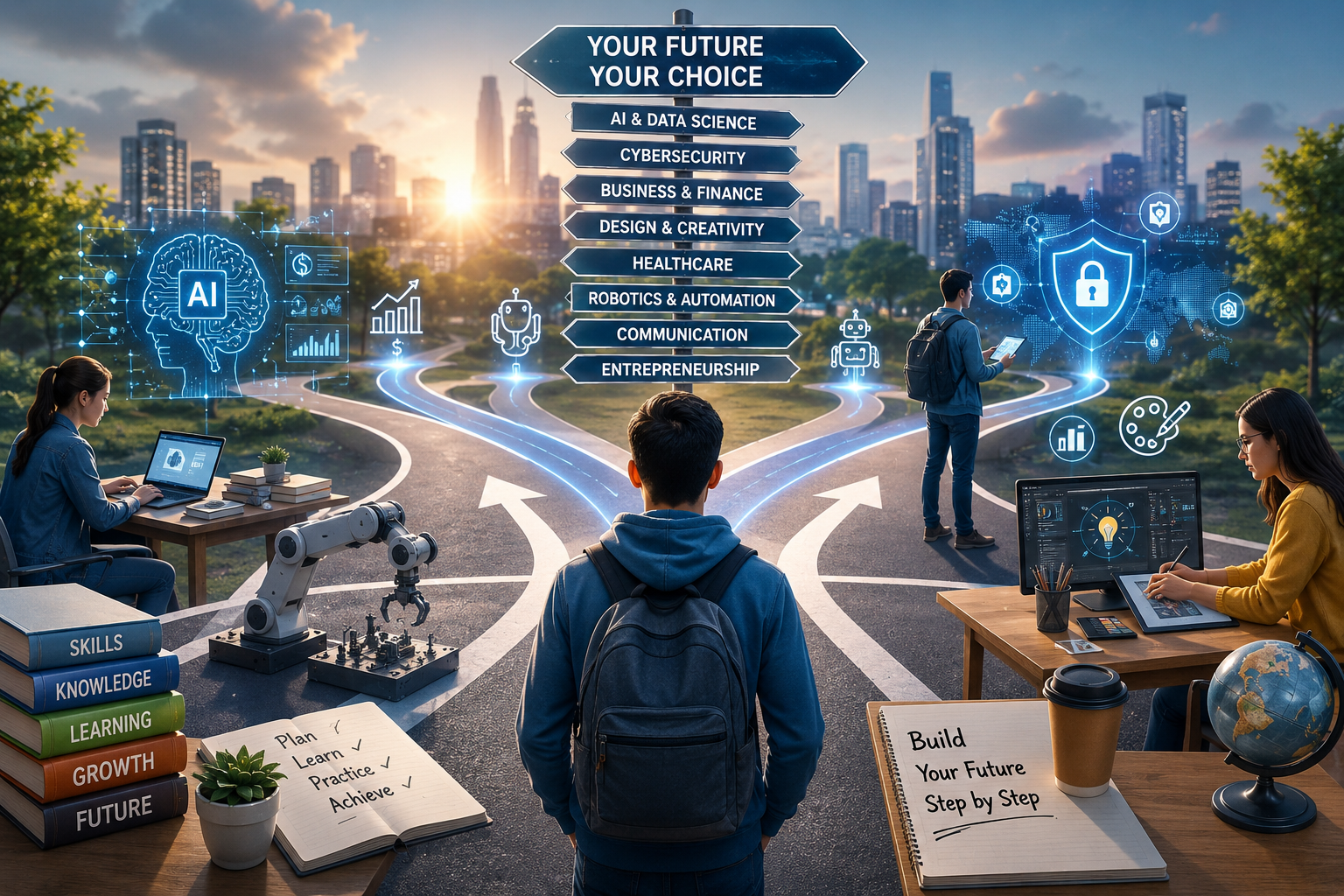
5. Choose a Career Direction, But Stay Flexible
Many students feel pressure to choose one perfect career path early. But in the AI era, career paths may change more often. A student may start in one field and later move into another related area.
For example:
A mechanical engineering student can move into robotics or industrial automation.
A commerce student can move into business analytics or fintech.
A biology student can move into bioinformatics or health data analytics.
A law student can move into legal technology.
A design student can move into AI-assisted UX design.
A management student can move into AI strategy or product management.
The goal is not to predict the perfect job title. The goal is to build a flexible skill stack.
A good skill stack includes:
One core subject skill
One digital skill
One communication skill
One problem-solving skill
One AI tool skill
One portfolio project
For example, a student interested in marketing can build this stack:
Marketing basics
Canva and analytics tools
Content writing
Consumer psychology
AI content and research tools
A sample campaign portfolio
This kind of combination makes a student more employable.
6. Learn Data Skills Early
Data is the fuel of the AI era. Students who understand data will have an advantage in many careers.
This does not mean every student must become a data scientist. But students should learn basic data literacy.
Data literacy means knowing how to:
Read charts
Understand percentages
Use spreadsheets
Interpret trends
Compare numbers
Identify misleading data
Create simple dashboards
Make decisions using evidence
Students can start with Microsoft Excel or Google Sheets. Later, they can learn basic SQL, Python, Power BI, Tableau, or data visualization depending on their career direction.
For commerce and management students, data skills can help in finance, marketing, HR, operations, and analytics. For science and engineering students, data skills can help in research, automation, AI, and technical roles.
In the coming years, “I am not good with data” may become a career weakness. Every student should become at least comfortable with basic data.
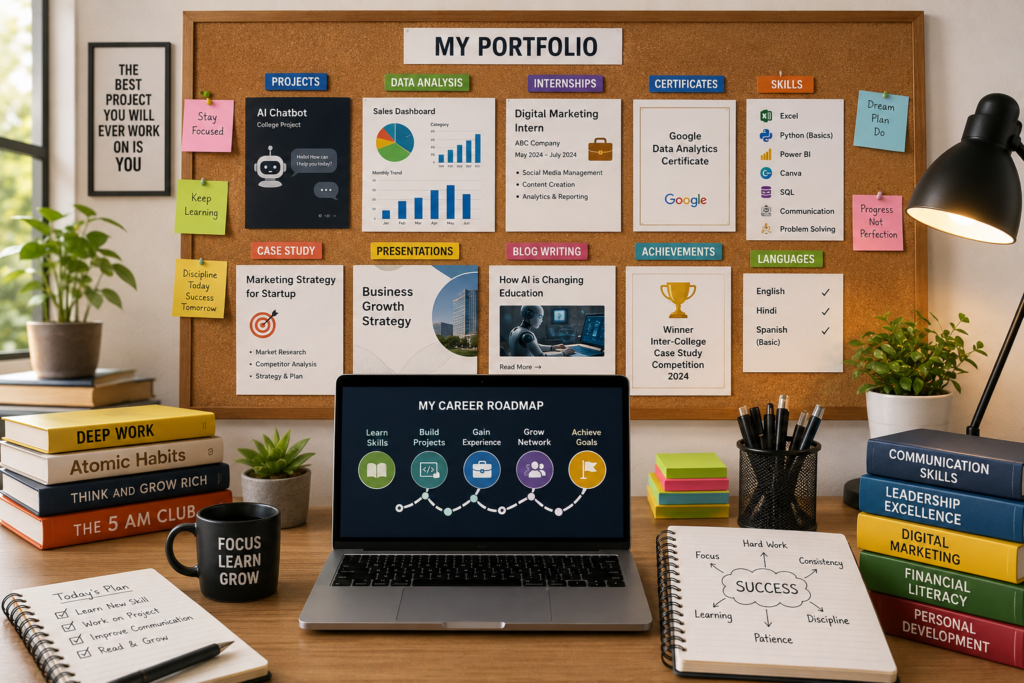
7. Build a Portfolio, Not Just a Resume
A resume tells people what you claim to know. A portfolio shows what you can actually do.
In the AI era, students should start building a simple portfolio early. This does not need to be complicated. It can include:
Projects
Case studies
Internship work
Presentations
Research summaries
Design samples
Coding projects
Blog posts
Data dashboards
Certificates
Competition participation
For example, a student interested in AI and business can create a small project on “How AI is changing customer service.” A student interested in data can create a dashboard using sample data. A student interested in content can publish blog posts. A student interested in design can create sample posters or website layouts.
This is very important because employers increasingly look for practical proof. They want to see whether a student can apply knowledge.
A student with average marks but strong projects may stand out more than a student with only marks and no practical work.
8. Use AI Tools to Learn, Not to Cheat
AI tools can help students study faster, write better, research smarter, and prepare more effectively. But they must be used ethically.
Students should use AI to:
Understand difficult topics
Create study plans
Generate practice questions
Improve grammar
Summarize notes
Prepare presentation outlines
Brainstorm project ideas
Practice interviews
Learn coding logic
Students should avoid using AI to:
Copy assignments directly
Create fake references
Submit work they do not understand
Hide plagiarism
Misrepresent their skills
Avoid actual learning
This matters because the goal is not just to pass exams. The goal is to build ability.
If students use AI only for shortcuts, they may pass today but struggle tomorrow. If they use AI as a learning assistant, they can become stronger.
For a practical list of useful tools, students can also read our detailed guide on AI Tools Every Student Must Use in 2026.
9. Learn Prompting as a Basic Career Skill
Prompting means giving clear instructions to AI tools. A good prompt can produce a useful answer. A weak prompt can produce a poor or confusing answer.
Students should learn how to ask better questions.
Instead of writing:
“Explain AI.”
A better prompt is:
“Explain artificial intelligence in simple language for a Class 12 student. Include 5 examples from daily life and 5 possible career paths.”
Instead of writing:
“Make notes.”
A better prompt is:
“Create concise revision notes from this topic with key definitions, examples, common exam questions, and a 10-point summary.”
Prompting teaches students clarity. It forces them to define what they want. This is useful not only for AI tools but also for communication, leadership, and workplace productivity.
In the AI era, students who can ask better questions will learn faster.
10. Focus on Internships, Freelancing, and Real-World Exposure
Classroom learning is important, but real-world exposure is equally important. Students should look for internships, live projects, volunteering work, freelance tasks, competitions, and industry interactions.
Even small experiences can teach big lessons.
A student can try:
Content writing internships
Digital marketing internships
Data entry and analysis projects
Social media projects
NGO volunteering
College club leadership
Research assistant roles
Freelance design projects
Coding practice projects
Campus ambassador programs
The goal is to understand how real work happens. Students learn deadlines, communication, responsibility, teamwork, and client expectations.
AI may change job roles, but real-world problem-solving will always matter. A student who has worked on practical projects will understand the gap between theory and execution.
11. Build Communication and Personal Branding
In the AI era, knowledge alone is not enough. Students must also know how to present themselves.
Communication skills include:
Speaking clearly
Writing professionally
Explaining ideas simply
Giving presentations
Writing emails
Participating in discussions
Listening carefully
Asking thoughtful questions
Personal branding does not mean showing off. It means creating a professional identity.
Students can start with:
A clean LinkedIn profile
A simple resume
A portfolio folder
Published articles or projects
Certificates and achievements
A professional email ID
A short introduction about themselves
For example, a student can write on LinkedIn:
“I am a B.Com student interested in finance, data analytics, and AI tools for business decision-making.”
This immediately gives direction to their profile.
Students who communicate well often get better opportunities because people understand their value faster.
12. Learn Continuously Through Online Courses
The AI era rewards continuous learners. Students should not wait for college syllabus updates. Many traditional courses move slowly, while technology changes quickly.
Online learning platforms can help students learn skills such as AI basics, data analytics, coding, design, marketing, cybersecurity, communication, project management, and business strategy.
Coursera’s Global Skills Report 2025 says it draws insights from more than 170 million learners and covers skills across business, data, and technology, showing how people are building essential skills and micro-credentials worldwide.
Students can use platforms such as Coursera, edX, Google Skillshop, Microsoft Learn, IBM SkillsBuild, freeCodeCamp, Khan Academy, YouTube learning channels, and university open courses.
But students should avoid collecting certificates without building skills. One completed project is more valuable than ten certificates that were never applied.
The best method is:
Learn one skill
Practise it
Create one small project
Add it to your portfolio
Then move to the next skill
This creates real growth.
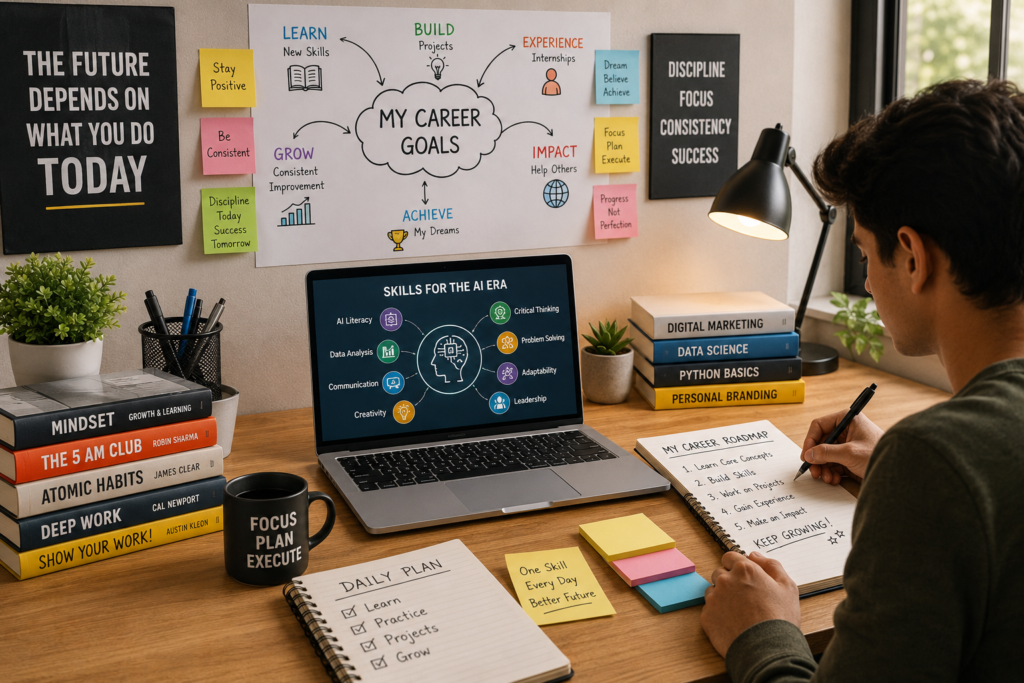
13. Prepare for AI-Related Career Paths
Students who want to directly enter AI-related careers can explore many paths. Some require coding and mathematics, while others are business, design, or management-focused.
Popular AI-era career paths include:
AI engineer
Data analyst
Data scientist
Machine learning engineer
Cybersecurity analyst
AI product manager
Prompt engineer
Business analyst
Cloud engineer
Robotics engineer
UX designer for AI products
Digital marketing strategist
AI ethics specialist
Automation consultant
EdTech specialist
Students should choose based on their interest, background, and strengths.
A student who loves coding may explore machine learning. A student who loves business may explore AI product management. A student who loves writing may explore AI-assisted content strategy. A student who loves psychology may explore human-AI interaction.
To understand where advanced AI may go in the future, readers can also explore our article on Artificial General Intelligence and the future of advanced machine intelligence.
14. Do Not Ignore Cybersecurity and Digital Safety
As AI grows, cybersecurity will also become more important. Students use smartphones, online banking, social media, email, cloud storage, AI tools, and learning platforms. This makes digital safety essential.
Students should learn:
Strong password habits
Two-factor authentication
How phishing works
Safe browsing
Data privacy basics
How to avoid fake job offers
How to protect personal documents
How to identify suspicious links
Safe use of public Wi-Fi
The World Economic Forum has also identified networks and cybersecurity among fast-growing skills for the coming years.
This means cybersecurity is not only for technical students. Every student needs basic digital safety knowledge.
A smart student in the AI era must be productive and careful.
15. Build the Right Mindset: Adaptability Is the Real Superpower
The most important career skill in the AI era is adaptability. Tools will change. Jobs will change. Platforms will change. Some skills may become outdated. New skills will become valuable.
Students should not fear this change. They should build the habit of learning.
A good AI-era mindset includes:
I can learn new tools.
I will not depend only on my degree.
I will build practical skills.
I will stay curious.
I will use AI responsibly.
I will improve my communication.
I will keep updating my career direction.
This mindset is more powerful than any single tool.
Students who remain flexible will not panic when technology changes. They will adjust, learn, and move forward.
16. A Simple 12-Month Career Plan for Students
Here is a practical 12-month plan students can follow:
Month 1–2: Learn AI basics and digital productivity tools.
Month 3–4: Improve communication, writing, and presentation skills.
Month 5–6: Learn Excel, data basics, and simple analytics.
Month 7–8: Choose one career direction and complete one online course.
Month 9–10: Build one practical project or internship experience.
Month 11: Create a resume, LinkedIn profile, and portfolio.
Month 12: Apply for internships, competitions, freelance work, or entry-level roles.
This simple plan can help students move from confusion to clarity.
The key is consistency. Even one hour of focused learning every day can create a major difference in one year.
Students Must Become AI-Ready, Not AI-Dependent
The AI era is not coming in the future. It has already started. Students who ignore it may struggle later, while students who understand it early can build a strong advantage.
But becoming AI-ready does not mean depending blindly on AI. It means building strong basics, learning digital skills, improving communication, understanding data, developing human skills, creating a portfolio, and using AI responsibly.
Marks are important, but marks alone are not enough. Degrees are important, but degrees alone are not enough. The future belongs to students who can combine knowledge, skills, creativity, technology, and adaptability.
AI will change jobs, but it will also create new opportunities. Students who prepare wisely can build successful, meaningful, and future-proof careers.
The best time to start is now. Learn one tool. Build one skill. Create one project. Improve one habit. Step by step, students can prepare themselves for a career world where AI is not a threat, but a powerful partner.
According to the World Economic Forum’s Future of Jobs Report 2025, AI and big data, technology literacy, creative thinking, resilience, flexibility, and lifelong learning are among the important skills shaping the future job market.
Read More Interesting Content in My Blog Section.
FAQ
1. How can students prepare for careers in the AI era?
Students can prepare by learning AI basics, improving communication skills, building data literacy, using AI tools responsibly, creating practical projects, and developing adaptability for changing job markets.
2. Does every student need to learn coding for an AI-era career?
No, every student does not need to become a coder. Coding is useful for technical careers, but students from commerce, management, arts, law, design, and science can also benefit by learning AI literacy, data skills, and digital productivity tools.
3. What are the most important skills for students in the AI era?
The most important skills include communication, critical thinking, creativity, data literacy, digital skills, problem-solving, adaptability, teamwork, ethical decision-making, and lifelong learning.
4. Can AI replace student jobs in the future?
AI may automate some repetitive tasks, but it will also create new roles. Students who build strong human skills and learn how to work with AI will have better career opportunities.
5. How can students build a portfolio?
Students can build a portfolio by adding projects, presentations, research work, internships, dashboards, blog posts, coding samples, design work, certificates, and practical case studies.