
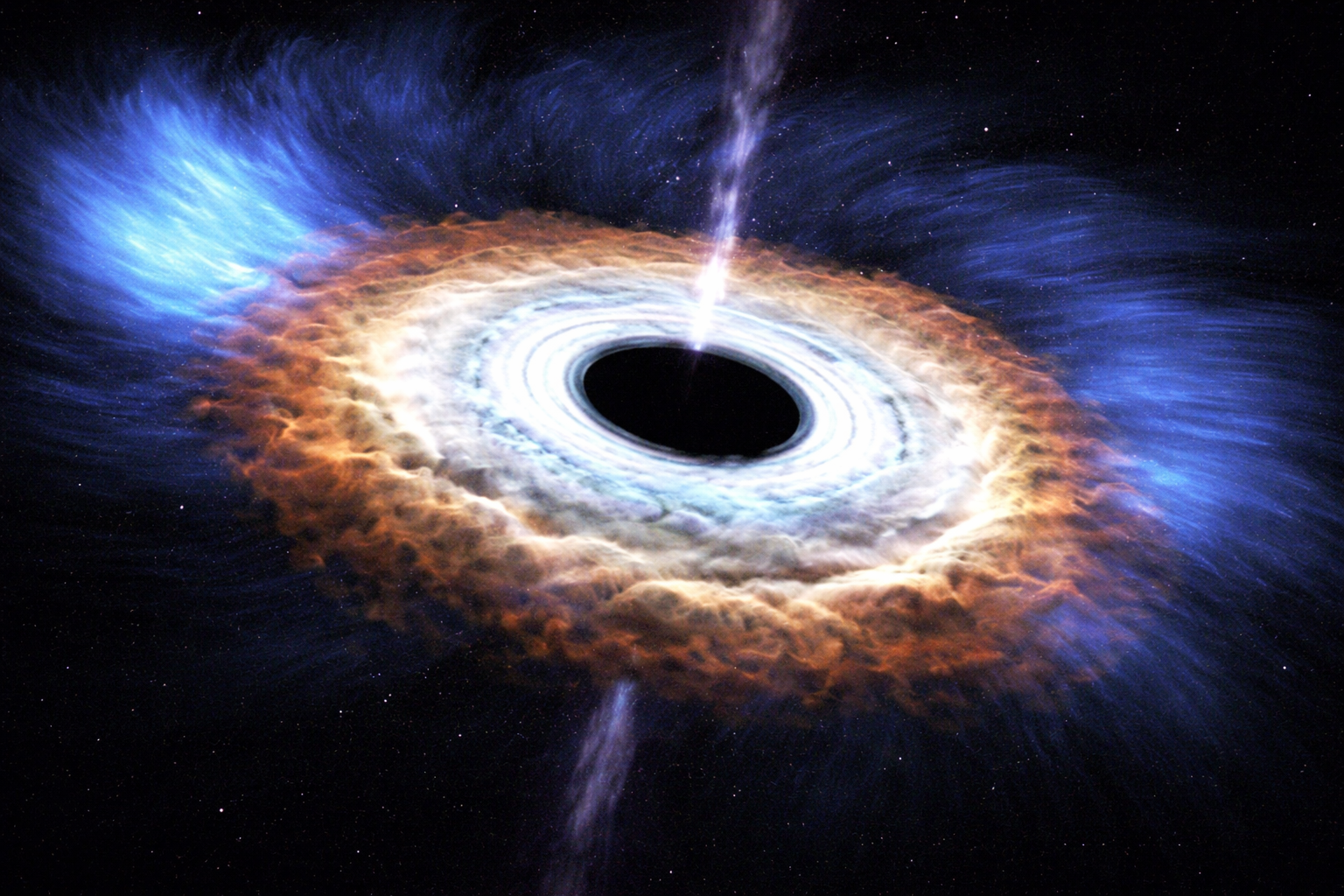

Black holes are among the most mysterious and fascinating objects in the universe. They represent regions of space where gravity becomes so intense that nothing—not even light—can escape their pull. For decades, scientists have studied black holes through advanced telescopes, mathematical models, and theoretical physics.
Yet despite all our knowledge, the greatest mystery remains unanswered:
What actually happens inside a black hole?
The moment something crosses the boundary known as the event horizon, it disappears from the observable universe. Beyond this point, physics as we understand it begins to break down. Theories suggest extreme phenomena—matter being stretched into cosmic threads, time slowing dramatically, and the possibility of entirely new universes forming.
Understanding what happens inside a black hole could reveal some of the deepest secrets of the cosmos, potentially reshaping our understanding of gravity, time, and the very structure of reality.
“To truly understand black holes, scientists also study the moment the universe began according to the Big Bang theory, because the physics of the early universe helps explain how cosmic structures formed.”
The Event Horizon: The Point of No Return
The event horizon is the invisible boundary surrounding a black hole. Once an object crosses this threshold, escape becomes impossible.
From an outside observer’s perspective, something approaching the event horizon appears to slow down dramatically. Due to intense gravitational effects, time itself becomes distorted. The object seems to freeze at the edge, fading slowly as its light becomes increasingly redshifted.
However, for the object falling into the black hole, the experience would feel very different. According to Einstein’s theory of relativity, the falling object would cross the event horizon without noticing anything unusual at that exact moment.
But what lies beyond that boundary remains one of physics’ biggest unanswered questions.
Spaghettification: When Gravity Tears Matter Apart
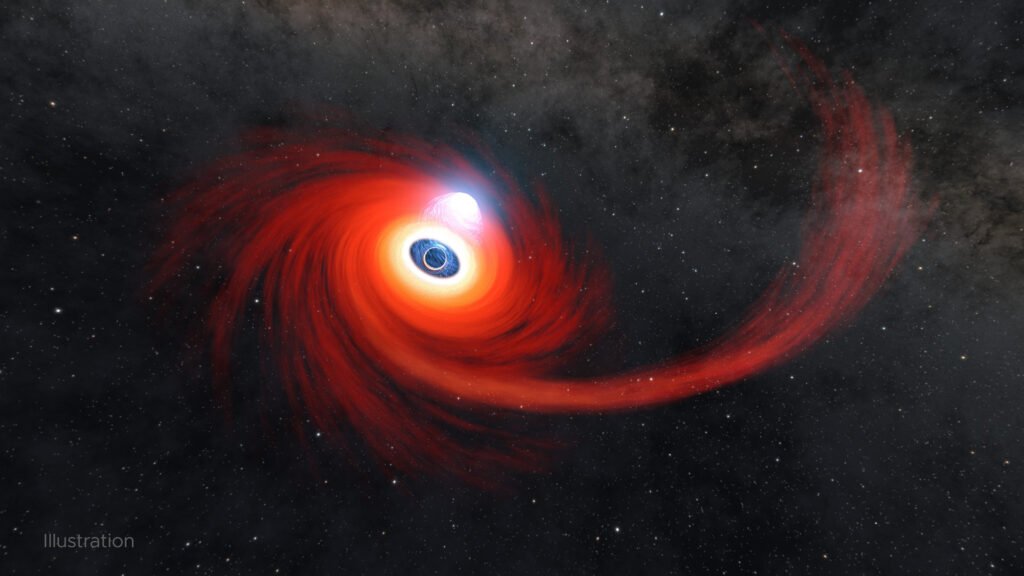
One of the most dramatic predicted effects near a black hole is known as spaghettification.
Black holes exert incredibly strong gravitational forces, and this force changes dramatically over short distances. The side of an object closer to the black hole feels a much stronger gravitational pull than the side farther away.
This difference creates extreme tidal forces that stretch objects into long, thin shapes—similar to strands of spaghetti.
If a spacecraft or a person approached a black hole:
Their feet would be pulled far more strongly than their head
The body would stretch enormously
Eventually, atoms themselves could be torn apart
While this sounds terrifying, it is a natural consequence of extreme gravity.
Interestingly, supermassive black holes—such as those found at the centers of galaxies—may allow objects to cross the event horizon before spaghettification occurs, meaning the real mystery lies deeper inside.
One of the most fascinating questions in astrophysics is how black holes form when massive stars collapse, a process that transforms dying stars into some of the most powerful gravitational objects in the universe.
The Singularity: Where Physics Breaks Down
At the heart of every black hole lies what scientists call a singularity.
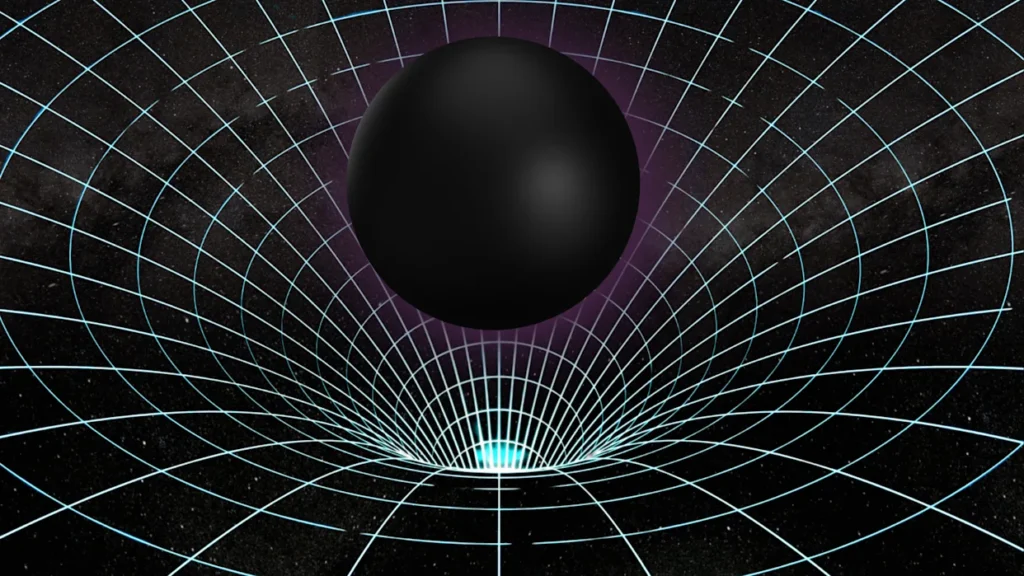
A singularity is a point where density becomes infinite and the known laws of physics collapse. Space and time themselves become infinitely curved.
Current theories suggest that:
All the mass of the black hole is compressed into a single point
Gravity becomes infinitely strong
Our existing physical laws cannot describe what happens there
This is where one of the greatest conflicts in physics arises.
Einstein’s General Relativity explains gravity and black holes extremely well on large cosmic scales. However, Quantum Mechanics, which describes the behavior of particles at the smallest scales, contradicts many predictions near a singularity.
Because of this conflict, scientists believe that understanding singularities will require a future theory of quantum gravity—a unified theory combining relativity and quantum physics.
The Black Hole Information Paradox
One of the biggest puzzles surrounding black holes is known as the information paradox.
According to quantum physics, information about particles can never truly be destroyed. But if matter falls into a black hole and disappears forever, where does that information go?
This question troubled physicists for decades.
In the 1970s, physicist Stephen Hawking proposed that black holes slowly emit radiation—now called Hawking radiation. Over extremely long periods of time, this radiation could cause a black hole to evaporate.
But if a black hole eventually disappears, what happens to all the information that fell inside it?
Several possibilities have been proposed:
Information is encoded in Hawking radiation
Information remains stored on the event horizon
Information escapes through unknown quantum processes
Solving this paradox could fundamentally reshape our understanding of the universe.
first image of a black hole captured by the Event Horizon Telescope
Could Black Holes Lead to Other Universes?
Some of the most fascinating theories suggest that black holes might not simply destroy matter—they might connect to other regions of space or even entirely new universes.
These ideas include:
Wormholes
A wormhole is a hypothetical tunnel connecting two distant points in space-time. Some theories propose that black holes could act as one entrance to such a tunnel.
However, wormholes remain purely theoretical and may be extremely unstable.
White Holes
A white hole is the theoretical opposite of a black hole. Instead of pulling matter inward, it would push matter outward.
Some physicists suggest that material entering a black hole could reappear from a white hole somewhere else in the universe.
Baby Universes
Another radical theory proposes that black holes might create new universes inside them. These universes would be disconnected from our own, expanding independently beyond the singularity.
While speculative, such theories demonstrate how black holes challenge our understanding of reality itself.
Observing Black Holes Without Entering Them
Since we cannot directly see inside a black hole, scientists study them through indirect observations.
Important discoveries include:
The first image of a black hole, captured in 2019 by the Event Horizon Telescope
Gravitational waves detected from black hole mergers
Stars orbiting invisible massive objects at the centers of galaxies
These observations confirm that black holes truly exist and behave largely as predicted by Einstein’s equations.
However, the deep interior of a black hole remains hidden, protected by the event horizon.
Interestingly, the behavior of galaxies around black holes is also influenced by the invisible substance known as dark matter that shapes galaxies, which scientists believe makes up most of the universe’s mass.
Why Black Holes Are So Important to Science
Black holes are not just cosmic curiosities. They represent natural laboratories for extreme physics.
Studying them could help scientists:
Discover a theory of quantum gravity
Understand how galaxies evolve
Explore the nature of space and time
Solve fundamental mysteries about the universe
In many ways, black holes sit at the intersection of the two greatest theories in physics—relativity and quantum mechanics.
The answer to what happens inside them may unlock the next revolution in science.
Conclusion
Black holes challenge the limits of human knowledge. They represent places where gravity dominates, time behaves strangely, and the laws of physics themselves may collapse.
From the terrifying process of spaghettification to the mysterious singularity and the unresolved information paradox, black holes push scientists to rethink the very foundations of reality.
While modern telescopes and theoretical models have revealed much about these cosmic giants, the true nature of what lies beyond the event horizon remains hidden.
Perhaps one day, future discoveries in quantum gravity will finally reveal what happens inside a black hole. Until then, they remain one of the most profound and fascinating mysteries in the universe.
Read More Interesting Content in My Blog Section.
FAQ
What happens when something enters a black hole?
When matter crosses the event horizon, it cannot escape. Extreme gravitational forces stretch and compress the matter, potentially leading it toward the singularity at the center.
Can humans survive entering a black hole?
Most likely not. The intense tidal forces would stretch the body in a process known as spaghettification, eventually destroying it at the atomic level.
Are black holes portals to other universes?
Some theoretical models suggest black holes could connect to wormholes or new universes, but there is currently no observational evidence supporting this idea.
Do black holes eventually disappear?
Yes. According to Hawking radiation theory, black holes slowly lose energy over extremely long periods of time and may eventually evaporate.
Wow that’s nice