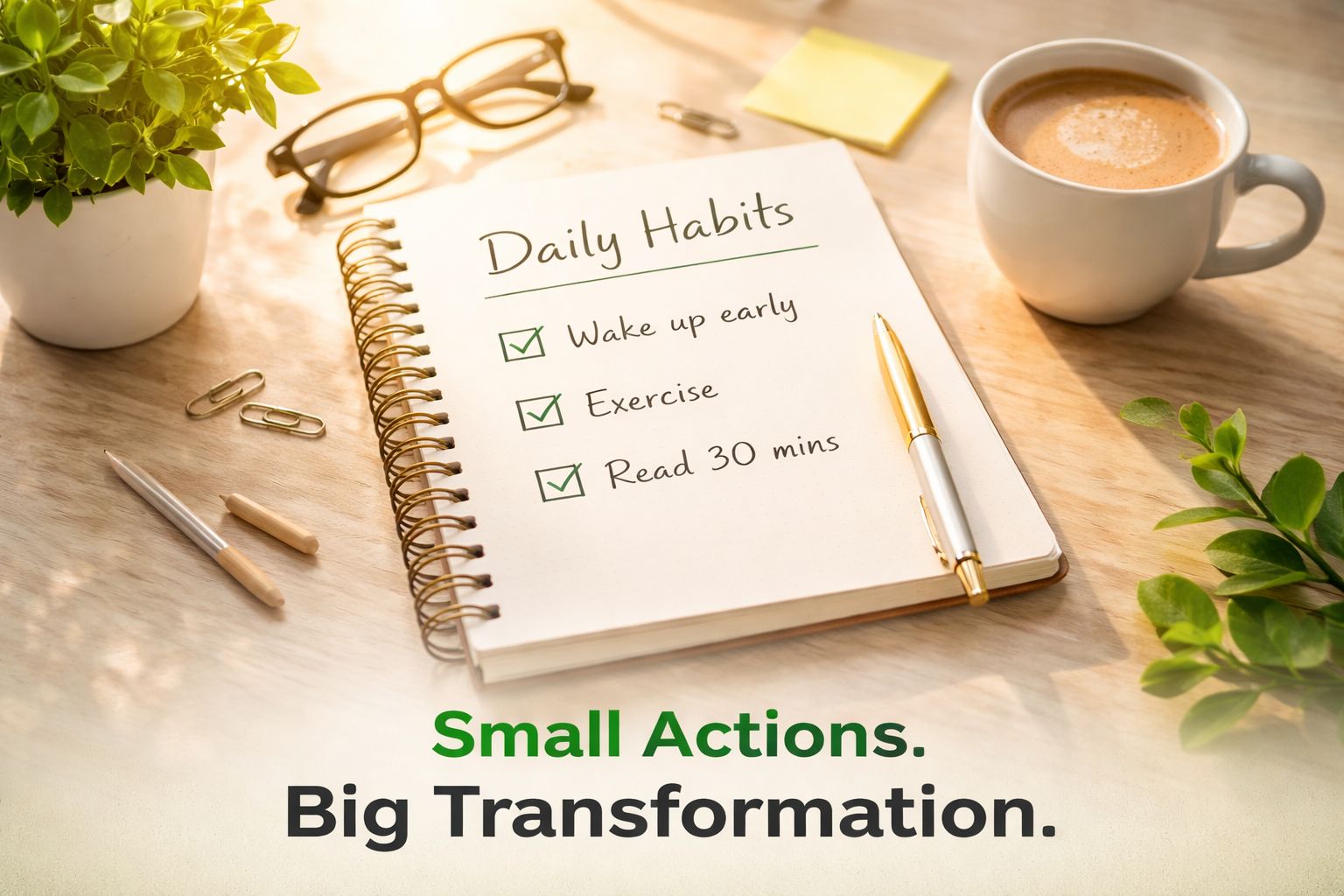

In every area of life — health, productivity, relationships, or personal growth — long-term success is rarely the result of one dramatic decision. Instead, it is the outcome of small daily actions repeated consistently over time. These repeated behaviors, known as habits, quietly shape the trajectory of our lives.
But habits are not just motivational concepts. They are deeply rooted in neuroscience, psychology, and behavioral science. Understanding how habits work gives us the power to redesign our routines intentionally rather than living on autopilot.
Let’s explore the science behind habit formation and how small daily actions can transform your life.
What Is a Habit, Scientifically Speaking?
A habit is a behavior that becomes automatic through repetition. Over time, the brain builds neural pathways that allow certain actions to occur with minimal conscious effort.
This process primarily involves a region of the brain called the basal ganglia, which plays a key role in routine behaviors and automatic responses. When a behavior is repeated frequently in a stable context, the brain starts to “chunk” it into an automatic pattern.
This is why brushing your teeth, checking your phone, or drinking tea at a specific time feels effortless. Your brain has optimized the process.
Habits conserve mental energy. Instead of making hundreds of conscious decisions daily, your brain automates recurring behaviors, allowing you to focus on more complex tasks.
The Habit Loop: Cue, Routine, Reward
Researchers describe habit formation using a simple three-step loop:
Cue – A trigger that tells your brain to initiate a behavior.
Routine – The behavior itself.
Reward – The benefit or satisfaction that reinforces the habit.
For example:
Cue: Feeling stressed
Routine: Scrolling social media
Reward: Temporary distraction and dopamine release
Over time, the brain begins to anticipate the reward when it detects the cue, making the routine more automatic.
The powerful insight here is this:
You don’t eliminate habits — you replace routines while keeping the cue and reward structure intact.
“Ancient systems like Ayurveda also emphasize daily discipline as the foundation of balanced living, encouraging structured routines that align body and mind”.
Why Small Actions Matter More Than Big Goals
Many people focus on setting ambitious goals: lose 10 kg, read 50 books, start a business. Goals are important, but they are outcomes. Habits are systems.
A 30-minute workout once a month will not change your body.
A 20-minute daily walk for a year absolutely will.
Small behaviors repeated consistently lead to compound results. Just as small financial investments grow through compounding, small behavioral investments grow through repetition.
Consistency reshapes identity. When you repeat an action daily, you begin to see yourself differently:
You don’t “try to exercise” — you become someone who exercises.
You don’t “try to read” — you become a reader.
You don’t “try to focus” — you become disciplined.
Identity-based habits are the most powerful kind.
The Neuroscience of Repetition and Automaticity
Studies in behavioral psychology suggest that habit automaticity increases gradually with repetition. While popular culture often claims habits form in 21 days, research indicates the time varies significantly depending on complexity and consistency.
Simple behaviors may become automatic in a few weeks. More complex routines may take months. The key factor is not speed — it is repetition in a consistent environment.
Each repetition strengthens neural pathways. The more you perform a behavior in the same context, the less mental effort it requires.
This is why environment design matters. If healthy food is visible, you’re more likely to eat it. If your phone is on your desk, you’re more likely to check it. Your surroundings influence your habits more than willpower alone.

Breaking Bad Habits: A Scientific Approach
To change a habit, focus on the cue and the environment rather than relying solely on motivation.
Instead of saying:
“I need more discipline.”
Try asking:
“What triggers this behavior?”
If late-night scrolling is triggered by boredom in bed, the solution may be:
Charging your phone in another room
Keeping a book beside your bed
Behavioral science consistently shows that reducing friction for good habits and increasing friction for bad ones is highly effective.
Small environmental adjustments produce disproportionately large results.
How to Build Positive Daily Habits
Here is a practical, science-backed approach:
1. Start Extremely Small
Make the habit so small it feels almost effortless.
For example:
One push-up
One page of reading
Five minutes of journaling
Small actions reduce resistance.
2. Attach It to an Existing Routine
Link your new habit to something you already do.
Example:
After brushing my teeth, I will meditate for two minutes.
This uses an existing cue to build a new routine.
3. Track Progress Visually
A calendar, checklist, or journal creates a sense of momentum.
Consistency becomes motivating.
4. Focus on Identity
Instead of saying:
“I want to write more.”
Say:
“I am becoming someone who writes daily.”
Identity-based framing strengthens long-term commitment.
The Long-Term Impact of Daily Micro-Actions
When viewed individually, daily habits seem insignificant. But over years, they determine:
Physical health
Mental clarity
Financial stability
Emotional resilience
Professional growth
Every day is a vote for the person you are becoming.
Small, consistent behaviors shape character. Character shapes destiny.
Final Reflection
Success is not built in a single breakthrough moment. It is built quietly in ordinary days through small repeated actions.
Habits are not restrictive routines — they are powerful tools for intentional living.
If you want to transform your life, don’t look for dramatic change.
Look at your daily systems.
Because ultimately, your habits become your identity — and your identity shapes your future.
Read More Interesting Content in My Blog Section.
Related Reading:
10 Simple Morning Habits to Boost Your Energy and Focus