
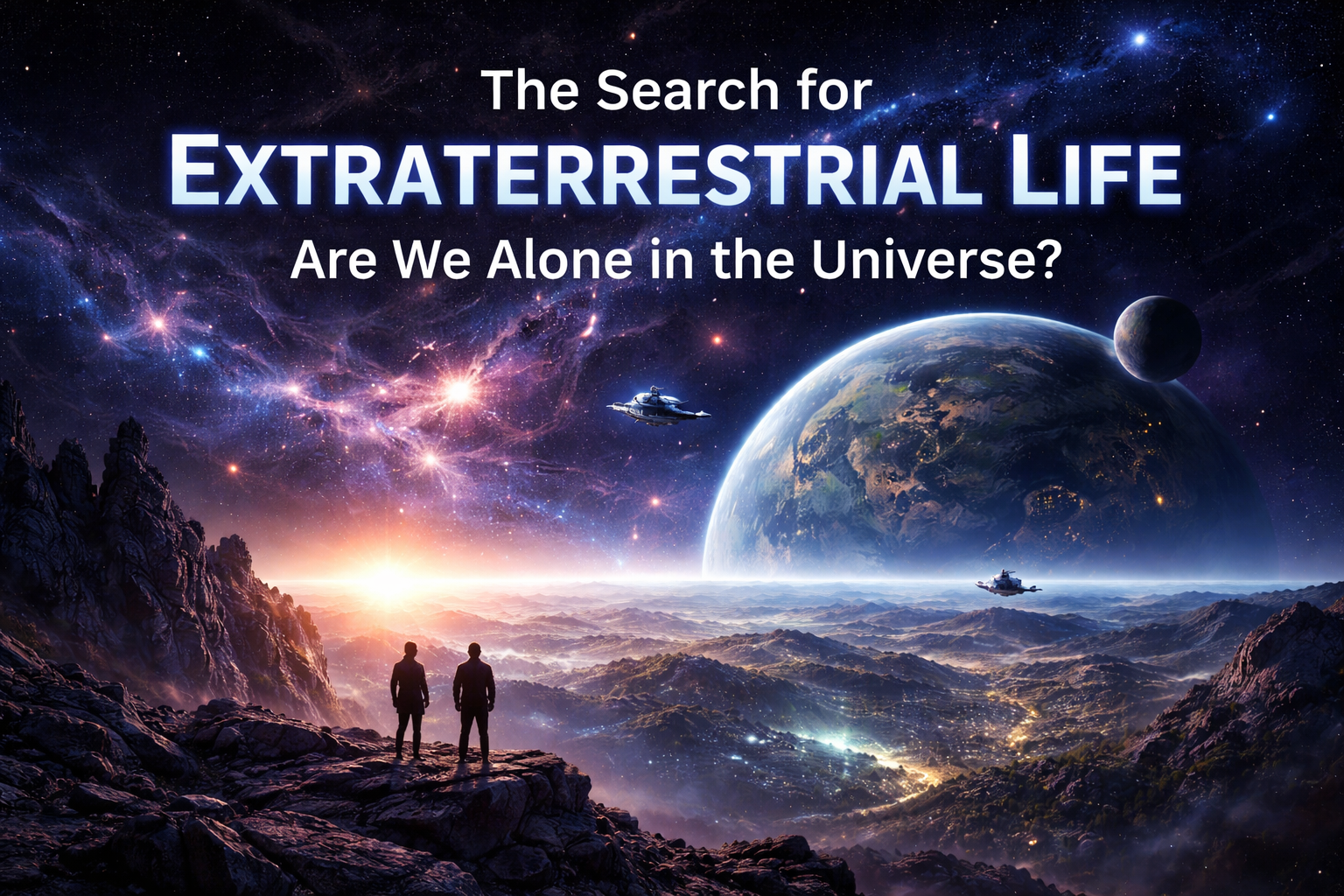

For centuries, humanity has looked up at the stars and asked a simple yet profound question:
Are we alone?
The universe contains billions of galaxies. Each galaxy contains billions of stars. Many of those stars host planets. Statistically, it seems almost impossible that Earth is the only place where life exists.
And yet — we have no confirmed evidence of extraterrestrial life.
This paradox sits at the heart of modern astronomy.
The Scale of the Universe: A Numbers Perspective
Our Milky Way galaxy alone contains an estimated 100–400 billion stars. Recent discoveries show that most stars host planetary systems.
NASA’s Kepler Space Telescope confirmed thousands of exoplanets, revealing something astonishing:
Planets are common.
Many of these planets lie within their star’s “habitable zone,” where temperatures may allow liquid water to exist — a key ingredient for life as we know it.
And that’s just one galaxy.
There are over two trillion galaxies in the observable universe.
Even if life is rare, the numbers suggest it should exist somewhere.
The Drake Equation: Estimating Alien Civilizations
In 1961, astronomer Frank Drake proposed an equation to estimate the number of technologically advanced civilizations in our galaxy.
The equation considers factors such as:
Rate of star formation
Fraction of stars with planets
Number of habitable planets
Probability of life emerging
Probability of intelligent life developing
Longevity of civilizations
While many variables remain uncertain, even conservative estimates suggest we may not be alone.
But if alien civilizations exist, why haven’t we detected them?
The Fermi Paradox: “Where Is Everybody?”
Physicist Enrico Fermi famously asked:
“If the universe is so vast and life should be common… where is everybody?”
This contradiction between high probability and zero evidence is known as the Fermi Paradox.
Possible explanations include:
1. Life Is Extremely Rare
Maybe Earth is a cosmic accident.
2. Intelligent Life Self-Destructs
Advanced civilizations may destroy themselves before achieving interstellar communication.
3. We Are Too Early
The universe is 13.8 billion years old. Intelligent life elsewhere may not have evolved yet.
4. We Are Not Looking Correctly
Perhaps alien signals use communication methods beyond our detection capabilities.
5. The “Great Filter”
There may be a nearly impossible evolutionary barrier that very few species overcome.
The paradox remains one of science’s most fascinating mysteries.
Exoplanets: The Most Promising Clues
The discovery of exoplanets changed everything.
Some notable examples include:
Kepler-452b (Earth-like size in habitable zone)
TRAPPIST-1 system (seven Earth-sized planets)
Proxima Centauri b (closest known exoplanet to Earth)
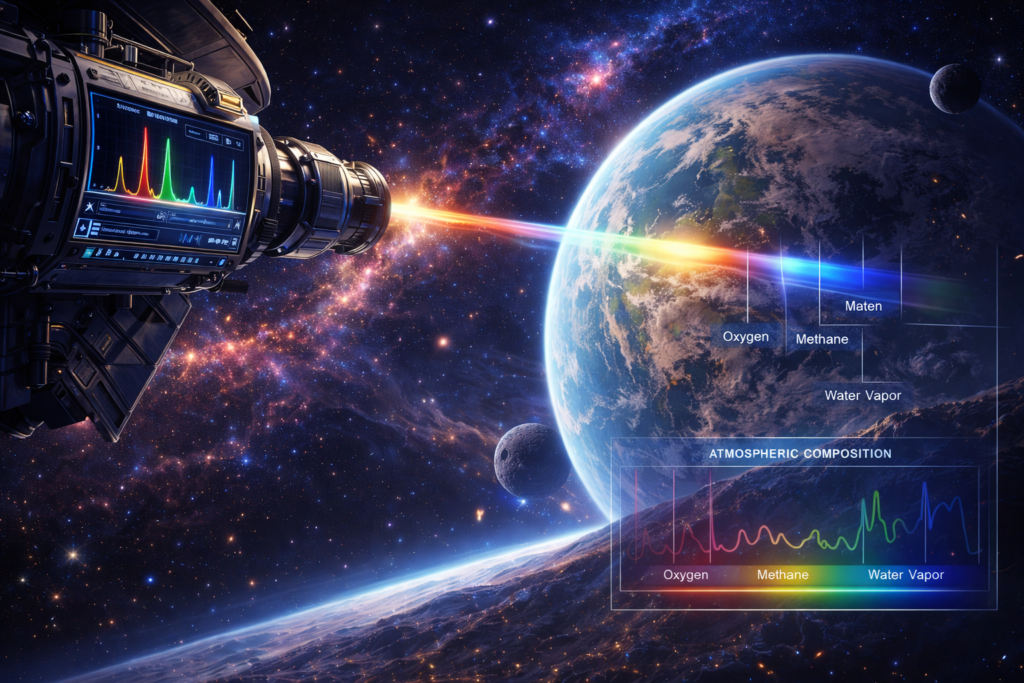
The James Webb Space Telescope has begun analyzing exoplanet atmospheres for biosignatures — chemical indicators like oxygen, methane, or water vapor.
If we detect atmospheric imbalances that cannot be explained naturally, it could indicate life.
The Role of Astrobiology
Astrobiology is the scientific study of life in the universe.
Scientists search for life not just on distant planets, but closer to home:
Mars (ancient riverbeds suggest past water)
Europa (Jupiter’s moon with subsurface ocean)
Enceladus (Saturn’s moon ejecting water vapor)
Even microbial life would be revolutionary.
It would mean life is not unique to Earth.
Could Alien Life Be Very Different?
When we imagine aliens, we often picture humanoid creatures.
But life elsewhere may be radically different.
Silicon-based organisms instead of carbon
Life thriving in extreme temperatures
Microbial ecosystems under thick ice layers
Non-biological machine intelligence
Just as understanding the moment when nothing became everything reshaped cosmology, discovering alien life would reshape biology forever.
The SETI Program: Listening to the Cosmos
The Search for Extraterrestrial Intelligence (SETI) scans the sky for artificial radio signals.
Modern telescopes monitor millions of stars for unusual transmissions.
So far, no confirmed alien signal has been detected.
But absence of evidence is not evidence of absence.
The universe is vast. Our search has barely begun.
Artificial Intelligence in the Search
The massive amount of astronomical data requires advanced computing tools.
Machine learning systems similar to how artificial intelligence is used in everyday life now help analyze telescope data for unusual patterns.
AI can identify anomalies humans might miss.
Ironically, artificial intelligence may help us discover non-human intelligence.
What If We Find Life?
The discovery of extraterrestrial life would:
Redefine religion and philosophy
Transform biology and evolutionary theory
Alter geopolitical priorities
Unite humanity under a shared cosmic identity
It would be the most significant scientific discovery in history.
What If We Don’t?
If decades pass with no evidence, that possibility is equally profound.
It could mean:
Intelligent life is incredibly rare.
Earth is extraordinarily special.
The responsibility of preserving life rests heavily on us.
In that scenario, humanity may be the universe becoming conscious of itself.
Why This Question Matters
The search for extraterrestrial life is not just about aliens.
It is about understanding our place in the cosmos.
It forces us to ask:
How unique are we?
How fragile is civilization?
What does it mean to be intelligent?
As telescopes grow more powerful and exploration continues, we move closer to an answer.
The universe is vast.
And somewhere among the stars, the answer may already exist.
Read More Interesting Content in My Blog Section.