
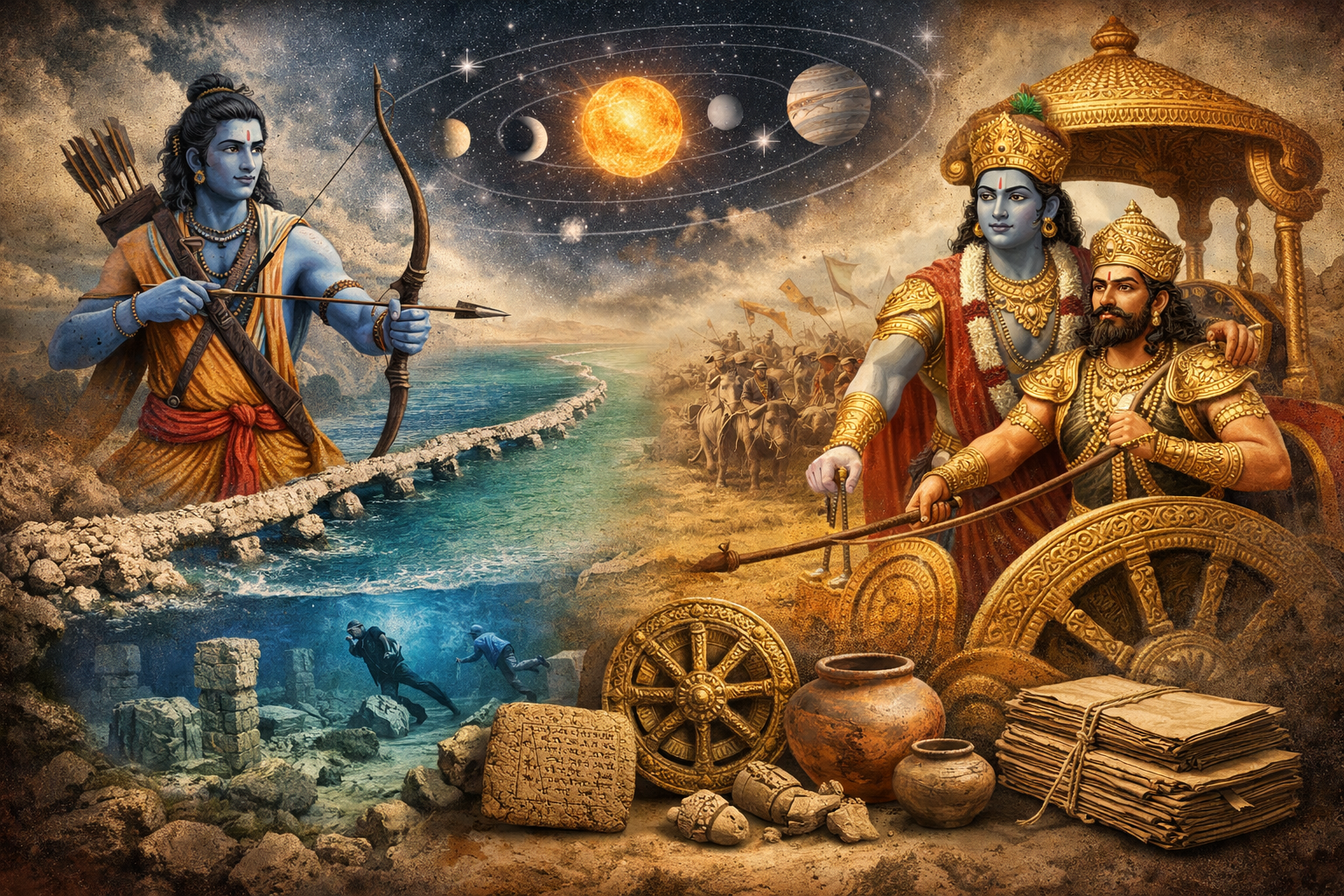

Myth or Preserved History?
For generations, a common narrative has been repeated—that the Ramayana and Mahabharata are merely mythological stories.
But when we begin to examine these epics closely, a very different picture starts to emerge.
These are not vague tales set in imaginary worlds.
They are deeply rooted in real geography, preserved traditions, astronomical precision, archaeological findings, and continuous cultural memory.
When multiple independent forms of evidence begin to align, the question is no longer whether they are stories.
👉 The real question becomes:
Can something so deeply connected with reality truly be dismissed as fiction?
1. Archaeological Evidence: Dwarka
👉 Key Insight:
Submerged remains of Dwarka strongly align with descriptions in the Mahabharata.
Detailed Explanation:
Marine archaeological explorations off the coast of Gujarat have revealed submerged structures believed to be part of an ancient city. Findings include stone anchors, structural remains, and settlement patterns beneath the sea.
These discoveries closely match the Mahabharata’s description of Dwarka—Krishna’s capital—which is said to have eventually submerged into the ocean.
This is not a vague connection. It is a direct overlap between textual description and physical evidence.
While debates continue regarding exact dating, the existence of such a submerged city at the culturally identified location of Dwarka makes it extremely difficult to dismiss the narrative as pure fiction.
Marine archaeological explorations have uncovered submerged structures near Dwarka, as documented in official underwater archaeology research by the Archaeological Survey of India.
2. Real Geography: Not Imaginary, But Existing Locations
👉 Key Insight:
Every major location described in the epics exists even today.
Detailed Explanation:
The Ramayana and Mahabharata are uniquely tied to real, traceable geography:
- Ayodhya (birthplace of Lord Rama)
- Kurukshetra (battlefield of Mahabharata)
- Chitrakoot, Panchavati, Rameshwaram
- Dwarka (Krishna’s city)
- Lanka (identified with present-day Sri Lanka)
These are not symbolic or abstract places—they are real locations with ongoing cultural, religious, and historical significance.
Unlike fictional literature, which often invents locations, these epics are deeply anchored in real-world geography that has been continuously recognized for centuries.
3. Ram Setu: A Physical Structure Matching the Narrative
👉 Key Insight:
A visible structure exists exactly where the Ramayana describes a bridge.
Detailed Explanation:
Ram Setu is a chain of limestone shoals connecting India and Sri Lanka.
Satellite imagery clearly shows:
- A bridge-like formation
- Continuous alignment across the sea
- Location matching the Ramayana’s description
While scientific debate continues regarding whether it is natural or man-made, one undeniable fact remains:
👉 A structure exists precisely where the Ramayana describes a constructed bridge.
This alignment between text and geography significantly strengthens the argument that the narrative is rooted in reality.
4. Astronomical Evidence: Events Recorded in the Sky
👉 Key Insight:
Precise planetary positions described in the texts can be scientifically analyzed.
Detailed Explanation:
Both epics contain highly detailed references to celestial events:
- Planetary alignments
- Solar and lunar eclipses
- Seasonal descriptions
Modern researchers have used astronomical software to recreate ancient skies and match these references with real historical timelines.
Such precision is not characteristic of imaginative storytelling.
It reflects systematic observation and recording of astronomical events, suggesting that the texts are grounded in real-time occurrences rather than fiction.
The precision seen in these astronomical references also connects deeply with broader questions about human perception and awareness, which you can explore further in our detailed post on the mysteries of human consciousness and its deeper dimensions.
5. Genealogies and Structured Narratives
👉 Key Insight:
The epics preserve detailed dynasties and political structures, not simple storytelling.
Detailed Explanation:
The Mahabharata alone contains over 100,000 verses, making it one of the largest epics in human history.
It includes:
- Detailed royal lineages
- Succession patterns
- Political alliances and conflicts
This level of complexity is rarely found in fictional narratives.
Instead, it resembles civilizational record-keeping, where events, rulers, and relationships are preserved over generations.
6. Cultural Continuity: Living Traditions as Evidence
👉 Key Insight:
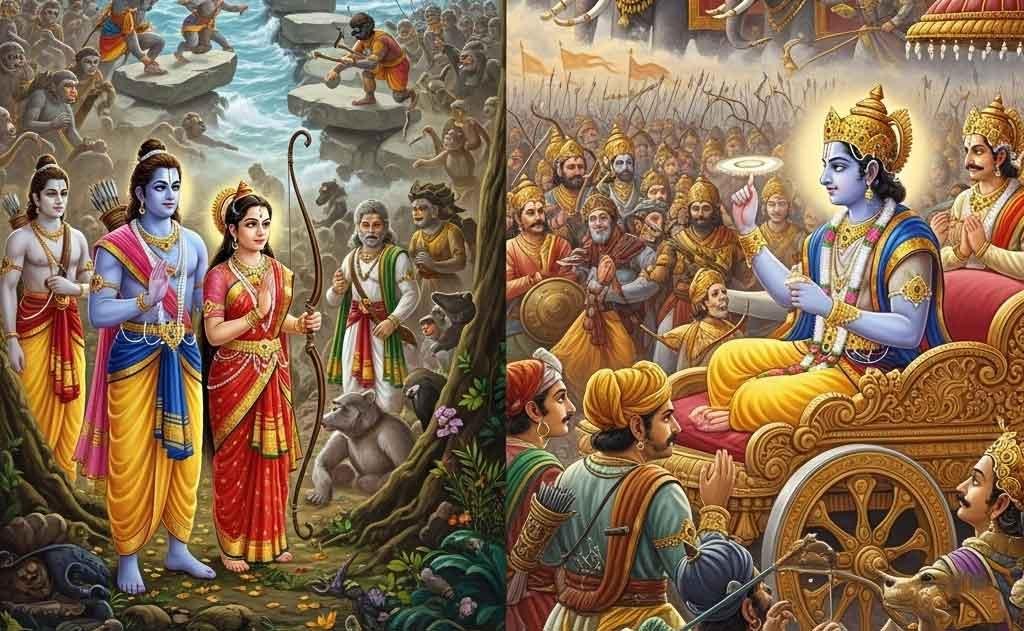
These epics are not just read—they are lived across generations.
Detailed Explanation:
Even today, Indian culture reflects these epics:
- Diwali celebrates Lord Rama’s return
- Pilgrimage routes follow Ramayana paths
- Kurukshetra remains a sacred site
This is not a temporary influence.
It is a continuous civilizational memory sustained for thousands of years.
Fictional stories rarely achieve such deep, long-lasting integration into daily life and identity.
This continuity of knowledge across generations also reflects how ancient wisdom continues to shape modern thinking, as discussed in our article on how intelligence systems evolve from human understanding to modern technology.
7. Supporting Archaeological and Scientific Context
👉 Key Insight:
Ancient discoveries support the existence of advanced civilizations described in the epics.
Detailed Explanation:
Archaeological findings such as:
- Ancient settlements in North India
- Sinauli excavations (warrior culture, chariots, weapons)
- Early urban and societal structures
Demonstrate that ancient India had the level of sophistication described in these epics.
This reinforces that the world depicted in the Ramayana and Mahabharata is historically plausible and contextually accurate.
8. Environmental and River Evidence
👉 Key Insight:
Descriptions of rivers and landscapes align with real environmental history.
Detailed Explanation:
Ancient texts describe rivers like Saraswati and detailed landscapes.
Modern geological and hydrological studies suggest:
- Existence of ancient river systems
- Environmental changes over time
These descriptions are not random—they reflect memory of real ecological conditions, further strengthening historical grounding.
9. Textual Preservation Across Centuries
👉 Key Insight:
A consistent core narrative has been preserved across regions and generations.
Detailed Explanation:
The Mahabharata has been transmitted across India through numerous manuscripts, yet maintains a stable central storyline.
This indicates:
- A deeply respected origin
- Widespread acceptance across regions
Such preservation suggests these narratives were treated as important records, not fictional entertainment.
10. Convergence of Evidence: The Strongest Argument
👉 Key Insight:
When multiple independent forms of evidence align, dismissal becomes unreasonable.
Detailed Explanation:
Individually, each piece of evidence is compelling.
But together, they form a powerful pattern:
- Archaeology (Dwarka)
- Geography (real locations)
- Physical structures (Ram Setu)
- Astronomy (planetary data)
- Cultural continuity
- Textual preservation
This convergence makes it increasingly difficult to classify these epics as mere stories.
Conclusion: A Civilization’s Memory, Not Fiction
The Ramayana and Mahabharata are not casual narratives created for entertainment.
They represent:
- A civilization’s memory
- A structured understanding of life
- Events deeply connected with real-world context
👉 When evidence from multiple domains points in the same direction, the narrative shifts.
Not: “Are these just stories?”
But: “How much of this ancient history are we yet to fully understand?”
Read More Interesting Content in My Blog Section.
FAQ
1. Are Ramayana and Mahabharata real history?
Multiple forms of evidence strongly support their historical roots.
2. What is the strongest evidence?
Dwarka discoveries, Ram Setu, and astronomical references.
3. Why are they called mythology?
Due to symbolic elements and lack of universally accepted conclusions.
4. Can history and symbolism coexist?
Yes, many ancient texts preserve real events through symbolic storytelling.
🙏