

Quantum computing is no longer science fiction. It is emerging as one of the most transformative technologies of the 21st century — with the potential to disrupt cybersecurity, accelerate artificial intelligence, and redefine how governments and corporations protect sensitive information.
While classical computers operate using bits (0s and 1s), quantum computers operate using qubits — and that single difference changes everything.
What Makes Quantum Computing Different from Classical Computing?
Traditional computers process information in binary form — either 0 or 1. Every app, website, encryption protocol, and financial system runs on this logic.
Quantum computers, however, use:
Superposition – A qubit can exist as 0 and 1 simultaneously.
Entanglement – Qubits can be linked in such a way that changing one instantly affects another, even at a distance.
Quantum interference – Enables probability-based computation.
This allows quantum computers to solve certain complex problems exponentially faster than classical machines.
For example:
Factoring massive numbers (used in encryption)
Simulating molecular structures
Optimizing global logistics systems
In simple terms, quantum computing doesn’t just make computers faster — it makes them fundamentally different.
How Quantum Computing Threatens Modern Encryption
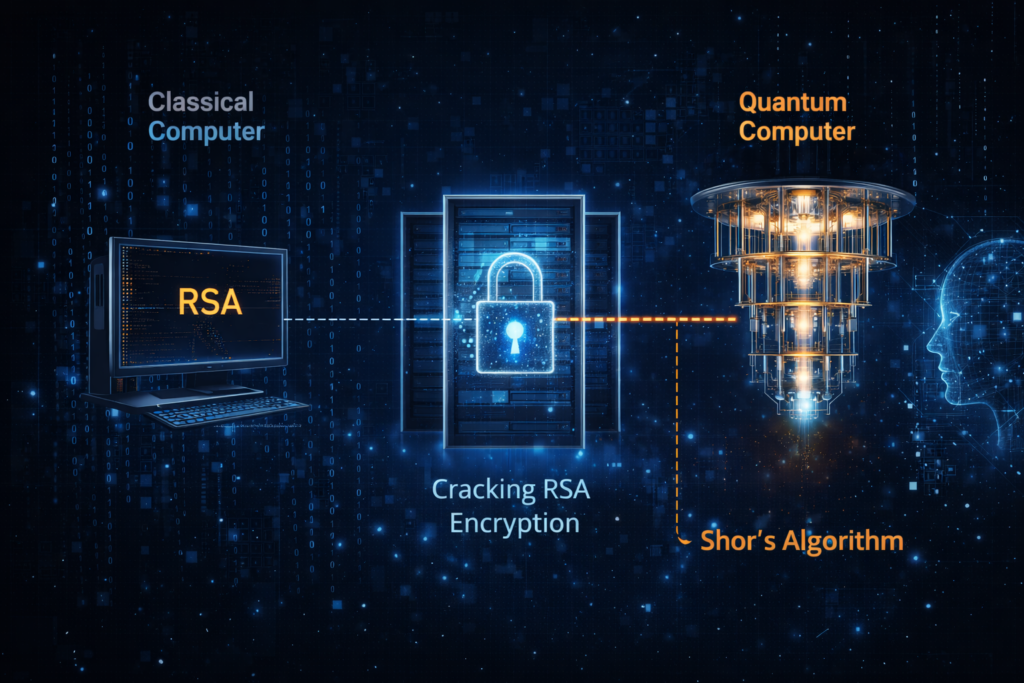
Today’s internet security relies heavily on encryption systems such as RSA and ECC. These systems depend on the difficulty of factoring extremely large prime numbers.
For classical computers, cracking such encryption would take thousands of years.
But a sufficiently powerful quantum computer running Shor’s Algorithm could theoretically break these encryption systems in minutes.
This means:
Banking transactions
Military communications
Government secrets
Cryptocurrency wallets
Secure messaging apps
could become vulnerable in a post-quantum world.
That’s why global tech leaders and governments are already developing Post-Quantum Cryptography (PQC) — encryption methods resistant to quantum attacks.
The transition has already begun.
Quantum Computing and Artificial Intelligence
Quantum computing isn’t just a cybersecurity threat — it’s also an opportunity.
AI systems require immense computational power for:
Training deep neural networks
Optimizing large datasets
Running complex simulations
Quantum computing could:
Speed up AI training dramatically
Improve optimization in logistics and finance
Enhance drug discovery models
Enable breakthroughs in climate modeling
Some researchers believe quantum-enhanced AI could unlock solutions to problems that are currently unsolvable using classical systems.
However, this also raises ethical concerns. Ultra-powerful AI systems combined with quantum computation could shift technological power toward nations and corporations that control this infrastructure.
“As quantum systems evolve, their integration with how artificial intelligence is used in everyday life could dramatically enhance machine learning speed and predictive capabilities.”
Global Race: Who Is Leading the Quantum Revolution?
Quantum computing is now part of geopolitical strategy.
Major players include:
United States (private sector + government funding)
China (massive state-backed research programs)
European Union (Quantum Flagship initiative)
India (National Quantum Mission launched with multi-billion funding)
India’s push into quantum research could significantly impact its cybersecurity infrastructure, fintech innovation, and defense technology.
This is not just a tech race — it is a national security race.
Surprising Facts About Quantum Computing
A quantum computer does not replace classical computers — they work together.
The temperature inside many quantum systems is colder than outer space.
Current quantum machines are still in early stages (called NISQ era – Noisy Intermediate-Scale Quantum).
Full-scale quantum advantage is likely still several years away — but progress is accelerating.
“At its core, quantum computing operates at scales similar to engineering reality at the atomic scale, where physics behaves very differently from the classical world.”
The Future: Should We Be Excited or Concerned?
Quantum computing represents both disruption and opportunity.
It could:
✔ Revolutionize medicine
✔ Accelerate AI innovation
✔ Optimize energy systems
✔ Transform materials science
But it could also:
⚠ Break current encryption
⚠ Create cyber instability
⚠ Shift global power dynamics
The real transformation will depend on how responsibly this technology is developed and regulated.
One thing is certain — quantum computing will not be a niche innovation. It will influence finance, defense, AI, and digital security for decades to come.
“Understanding quantum behavior may also provide deeper insights into cosmic mysteries, including theories surrounding the moment when nothing became everything.”
Read More Interesting Content in Blog Section.