
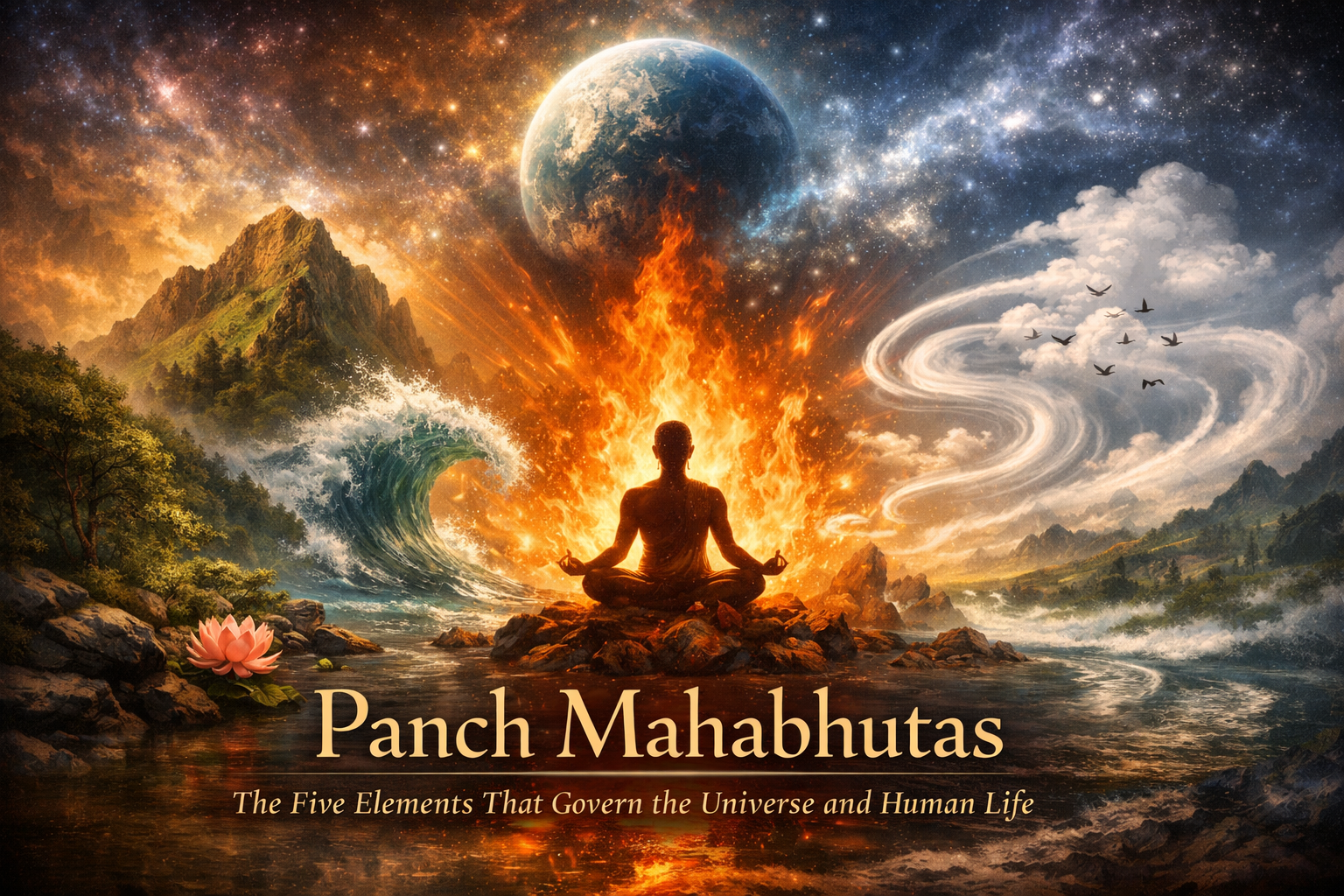

Since ancient times, Indian philosophy has described the universe not as a collection of random matter but as a beautifully balanced system built upon fundamental natural principles. One of the most profound concepts that emerged from the Vedas and ancient Indian sciences is the idea of Panch Mahabhutas, or the five great elements.
According to Vedic philosophy, everything that exists in the universe—whether it is a star, a mountain, a tree, or the human body—is composed of five essential elements:
Prithvi (Earth)
Jala (Water)
Agni (Fire)
Vayu (Air)
Akasha (Space or Ether)
These five elements are not merely physical substances. They represent fundamental energies and principles that govern the structure, functioning, and balance of both the cosmos and living beings.
The concept of Panch Mahabhutas forms the foundation of Ayurveda, Yoga, and many spiritual sciences developed in ancient India.
The Origin of Panch Mahabhutas in Vedic Knowledge
The idea of the five elements appears in several ancient scriptures, including the Upanishads, Samkhya philosophy, and Ayurveda texts such as the Charaka Samhita and Sushruta Samhita.
According to Vedic cosmology, the universe begins with Akasha (space). From space emerges Vayu (air), from air comes Agni (fire), from fire arises Jala (water), and finally Prithvi (earth) is formed.
This sequence represents the gradual solidification of energy into matter.
Modern science surprisingly reflects a similar concept. In physics, matter evolves from energy, and the universe gradually forms structures from fundamental particles. Although the language differs, the philosophical essence is strikingly similar.
1. Prithvi – The Element of Earth
Prithvi represents solidity, stability, and structure. It symbolizes everything that is solid and tangible in the universe.
Examples of Earth element include:
Mountains and soil
Plants and trees
Rocks and minerals
Bones, muscles, and tissues in the human body
In Ayurveda, the Earth element is associated with strength, stability, endurance, and grounding.
When the Earth element is balanced within a person, it produces qualities such as:
Physical strength
Emotional stability
Patience
Reliability
However, when it becomes excessive or imbalanced, it may lead to heaviness, sluggishness, or attachment.
2. Jala – The Element of Water
Jala, or water, represents fluidity, cohesion, and adaptability. It allows substances to flow, connect, and maintain harmony.
Water is present in almost every living system:
Oceans and rivers
Blood and lymph
Plant sap
Bodily fluids
Interestingly, the human body itself is composed of about 60–70% water, emphasizing the significance of this element.
In Ayurveda, the water element governs:
Emotions
Lubrication within the body
Balanced water energy promotes calmness and emotional harmony, while imbalance may cause emotional instability or excessive attachment.
3. Agni – The Element of Fire
Agni represents transformation, energy, and metabolism. Fire is the force that converts one form of matter into another.
Examples of the fire element include:
The sun’s heat
Digestion in the human body
Chemical reactions
Metabolic processes
In Ayurveda, Agni is considered the most important element for health because it governs digestion and metabolism.
When Agni is balanced, a person experiences:
Strong digestion
Sharp intelligence
Motivation and enthusiasm
Healthy metabolism
But excessive fire can lead to:
Anger
Inflammation
Aggression
Burnout
Thus, the fire element must be carefully balanced for optimal health.
4. Vayu – The Element of Air
Vayu symbolizes motion, movement, and life force. Air is invisible but extremely powerful, controlling many dynamic processes in nature.
Examples include:
Wind patterns in the atmosphere
Breathing in living organisms
Nerve impulses in the human body
Circulation of energy
In Ayurveda and Yoga, Vayu governs the movement of prana (life energy).
Balanced air energy creates:
Creativity
Quick thinking
Flexibility
Vitality
However, excess Vayu may result in:
Anxiety
Restlessness
Instability
Nervous disorders
Practices such as pranayama and meditation help regulate the air element within the body.
5. Akasha – The Element of Space
Akasha, or ether, is the most subtle of the five elements. It represents space, expansion, and the field in which everything exists.
Without space, nothing could exist or move.
Akasha is present in:
The vast universe
The gaps between atoms
The space within the human body
The mind and consciousness
In spiritual philosophy, Akasha is associated with:
Awareness
Creativity
Higher consciousness
Spiritual expansion
When balanced, it leads to clarity, intuition, and wisdom.
Panch Mahabhutas and the Human Body
According to Ayurveda, the human body is a miniature reflection of the universe. This idea is known as “Yatha Pinde Tatha Brahmande”, meaning “as is the microcosm, so is the macrocosm.”
The five elements combine to form the three doshas:
| Dosha | Elements |
|---|---|
| Vata | Air + Space |
| Pitta | Fire + Water |
| Kapha | Earth + Water |
These doshas control different physiological functions such as:
Digestion
Circulation
Growth
Immunity
Mental balance
Maintaining harmony among these elements is essential for physical and mental well-being.
Fascinating Facts About the Five Elements
The concept of five elements is not unique to India. Many ancient civilizations developed similar ideas.
For example:
Greek philosophy described earth, water, air, and fire.
Chinese philosophy identified wood, fire, earth, metal, and water.
Japanese philosophy included five elements similar to the Vedic system.
However, the Indian Panch Mahabhutas system is deeply integrated with medicine, yoga, and spirituality, making it one of the most comprehensive natural philosophies ever developed.
Modern science also recognizes that matter exists in different states—solid, liquid, gas, plasma, and space, which resembles the ancient classification of elements.
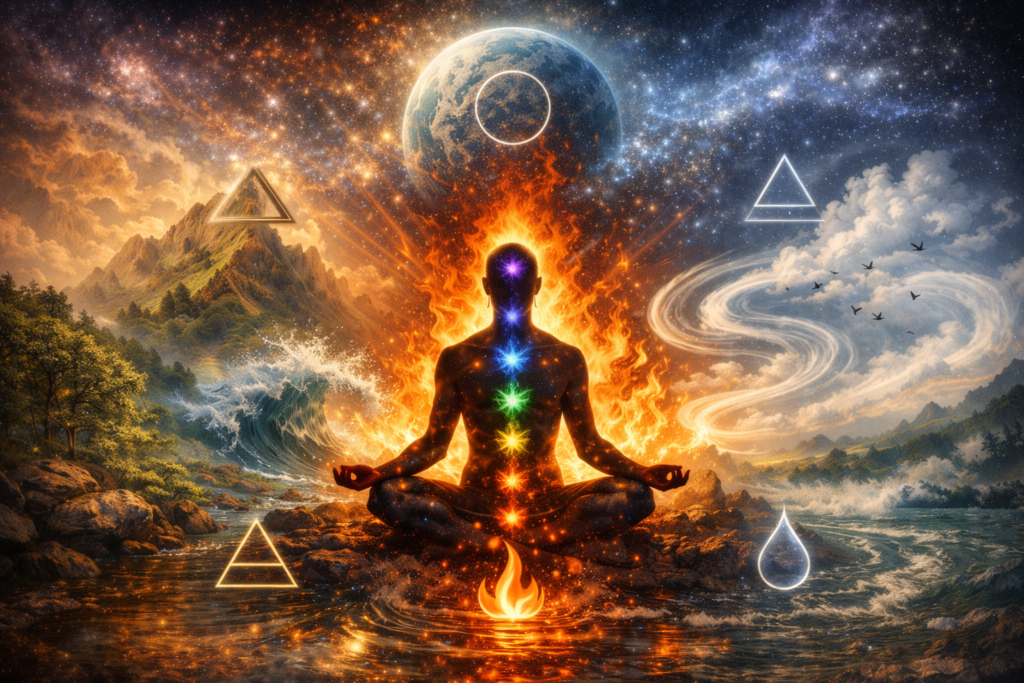
“The concept of Panch Mahabhutas is also deeply connected with the principles of Ayurveda, the ancient science of natural healing.”
Balancing the Five Elements in Daily Life
Ancient yogic traditions emphasize that human health depends on balancing the five elements within the body.
Some ways to maintain balance include:
Connecting with Earth
Walking barefoot on grass or soil can help stabilize the body’s energy.
Hydration and Emotional Balance
Drinking sufficient water and maintaining emotional harmony supports the water element.
Sunlight and Digestion
Exposure to sunlight and proper nutrition strengthens the fire element.
Breathing Practices
Pranayama and deep breathing help regulate the air element.
Meditation and Silence
Meditation cultivates the space element and promotes inner clarity.
Why the Concept of Panch Mahabhutas Still Matters Today
In today’s fast-paced technological world, people often forget the deep connection between human life and natural forces.
The philosophy of Panch Mahabhutas reminds us that:
Humans are part of nature, not separate from it.
Balance is the key to health and harmony.
Physical, mental, and spiritual well-being are interconnected.
Ancient wisdom like this continues to influence modern fields such as holistic medicine, environmental science, and wellness practices.
Conclusion
The concept of Panch Mahabhutas offers a profound understanding of how the universe and human life are interconnected. These five elements—Earth, Water, Fire, Air, and Space—represent the fundamental forces that shape existence.
From the structure of the human body to the vast cosmic order, everything reflects the interplay of these elements.
By recognizing and balancing these energies in our daily lives, we can move toward greater health, awareness, and harmony with the natural world.
Ancient sages understood something that modern science is gradually rediscovering: the universe is a balanced system, and we are an integral part of it.
“Ancient Ayurvedic philosophy also describes the human body through the interaction of natural elements, and modern researchers have explored the scientific perspective of the five elements in Ayurveda.”
Read More Interesting Content in Blog Section.
FAQ:-
What are Panch Mahabhutas?
Panch Mahabhutas are the five fundamental elements in Vedic philosophy—Earth, Water, Fire, Air, and Space—that form the foundation of the universe and human body.
Why are the five elements important in Ayurveda?
Ayurveda explains that these five elements combine to form the three doshas—Vata, Pitta, and Kapha—which regulate physical and mental health.
How can we balance the five elements in daily life?
Practices like meditation, yoga, breathing exercises, balanced nutrition, and spending time in nature help maintain harmony among the five elements.