


The World You Cannot See Controls the World You Live In
A single human hair is about 80,000–100,000 nanometers wide.
A nanometer is:
1nm=10−9m1 nm = 10^{-9} m1nm=10−9m
One billionth of a meter.
At this scale, physics behaves differently.
Materials change properties.
Gold becomes red.
Carbon becomes stronger than steel.
Gravity becomes irrelevant.
Quantum mechanics dominates.
Nanotechnology is not miniaturization.
It is manipulation of matter at the atomic and molecular level.
And it is quietly reshaping the future.
⚛️ Why the Nanoscale Is Different
At everyday scale, classical physics governs behavior.
At nanoscale:
Surface area dominates over volume
Quantum tunneling becomes significant
Electrical conductivity changes
Chemical reactivity increases dramatically
Consider surface-to-volume ratio.
For a sphere:
SurfaceArea=4πr2Surface Area = 4\pi r^2SurfaceArea=4πr2 Volume=43πr3Volume = \frac{4}{3}\pi r^3Volume=34πr3
As radius decreases, surface area-to-volume ratio increases rapidly.
This is why nanoparticles are extremely reactive.
Small size = massive power.
🧬 Nanotechnology in Medicine: Healing from Within
One of the most revolutionary applications is nanomedicine.
Researchers are developing:
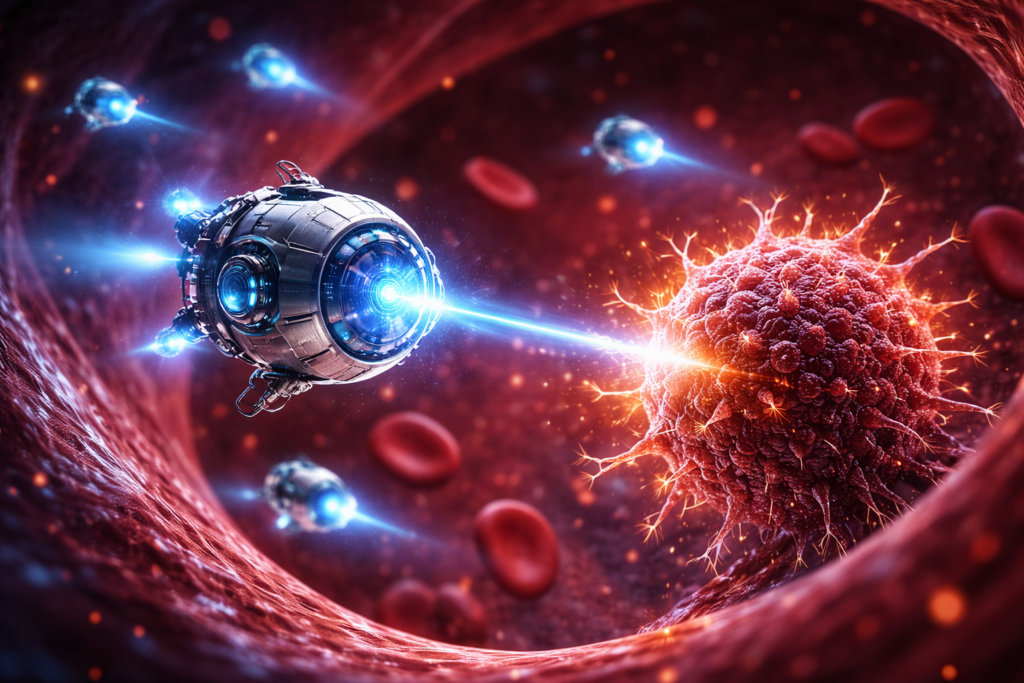
Nanorobots that deliver drugs directly to cancer cells
Nanoparticles that detect tumors early
Targeted therapy with minimal side effects
Instead of flooding the entire body with chemotherapy, nanoscale carriers can attack specific cells.
Precision over aggression.
The future of medicine may not be stronger drugs —
but smarter delivery systems.
🏗️ Materials Stronger Than Steel
Carbon nanotubes and graphene are among the strongest materials ever discovered.
Graphene is a single layer of carbon atoms arranged in a hexagonal lattice.
It is:
200 times stronger than steel
Extremely lightweight
Highly conductive
It could transform:
Aerospace engineering
Energy storage
Flexible electronics
Wearable technology
We are entering an era where materials are engineered atom by atom.
⚡ Energy Revolution at the Nanoscale
Nanotechnology could redefine energy systems:
More efficient solar panels
High-density batteries
Supercapacitors
Hydrogen storage materials
Quantum dots — nanoscale semiconductor particles — can improve solar cell efficiency dramatically.
The global energy crisis may be solved not by discovering new fuel,
but by optimizing matter at nanoscale.
🤖 Nanoelectronics: The Invisible Brain of Modern Technology
Every smartphone chip today is built using nanoscale fabrication.
Transistors are now only a few nanometers in size.
Moore’s Law — the doubling of transistor density — depends on nanotechnology.
Without nanoscale engineering:
AI wouldn’t advance
Smartphones wouldn’t exist
Cloud computing would collapse
Modern civilization runs on invisible nanostructures.
🧠 Power at the Smallest Scale
There is something deeply symbolic about nanotechnology.
The smallest structures create the biggest changes.
Civilizations are built not only by massive structures,
but by atomic precision.
Just as:
DNA encodes life at nanoscale
Quantum particles define matter
Neural synapses define thought
Nanotechnology reveals a pattern:
The universe hides its power in the smallest places.
⚖️ The Risks and Ethical Concerns
With power comes uncertainty.
Concerns include:
Nanoparticle toxicity
Environmental contamination
Military applications
Autonomous nano-systems
There are theoretical discussions about “grey goo” scenarios — self-replicating nanomachines consuming resources uncontrollably.
While largely speculative, responsible development is essential.
Technology always moves faster than regulation.
🚀 The Future: Building at the Atomic Level
The next frontier is molecular manufacturing.
Imagine:
Self-healing materials
Buildings grown rather than constructed
Medical nanobots repairing cells
Spacecraft built from ultra-light atomic lattices
This is not science fiction.
Research labs are actively developing programmable matter.
The 21st century may be defined not by AI alone,
but by nanotechnology combined with AI.
Smart systems building at atomic scale.
“At the atomic scale, nanotechnology manipulates matter with extraordinary precision — a concept that mirrors how genetics operates at the molecular level to shape living organisms”.
Final Reflection: The Invisible Architects of Tomorrow
Nanotechnology teaches us something profound:
The world is not solid.
It is structured emptiness — atoms arranged precisely.
When we learn to rearrange those atoms,
we do not just create new products.
We redefine possibility.
The future will not be built by bigger machines.
It will be built by smaller ones.
And most people will never see them.
Read More Interesting Content in My Blog Section.
Related Readings: