
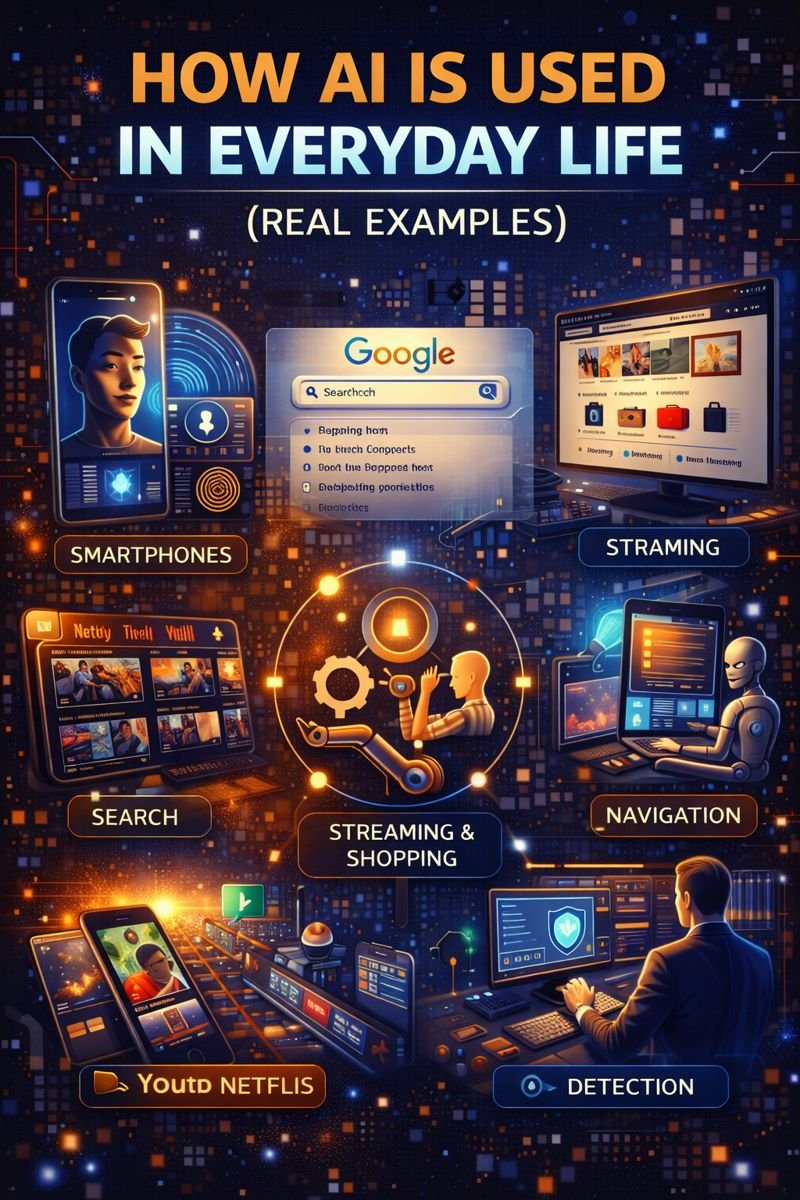

Artificial Intelligence is often discussed as a future technology, but the reality is very different. AI is already deeply integrated into our daily routines, quietly working in the background to make life easier, faster, and more efficient.
From the moment you wake up until you go to sleep, AI plays a role in how you communicate, travel, shop, learn, and consume information — often without you noticing it.
This article explains real, practical examples of how AI is used in everyday life, in simple terms.
Smartphones and Mobile Devices
Modern smartphones rely heavily on AI.
AI is used to:
Improve photo quality automatically
Enable face and fingerprint recognition
Predict text while typing
Optimize battery usage
Your phone continuously learns from your usage patterns to improve performance and personalization.
Search Engines Like Google
Every time you search on Google, AI helps:
Understand search intent
Correct spelling mistakes
Rank the most relevant results
Suggest related searches
AI analyses billions of searches to deliver accurate and meaningful results within seconds.
YouTube, Netflix, and Content Recommendations
Streaming platforms use AI to recommend content based on:
What you watch
How long you watch
What you skip
These recommendation systems are powered by AI models trained on user behaviour data, helping platforms personalize content for each user.
Online Shopping and E-commerce
When shopping online, AI helps:
Suggest products you may like
Show personalized deals
Predict demand and manage inventory
Detect fraudulent transactions
This improves customer experience and helps businesses operate efficiently.
Maps, Navigation, and Traffic Prediction
Navigation apps use AI to:
Predict traffic congestion
Suggest faster routes
Estimate arrival time accurately
AI continuously processes live data from thousands of users to update routes in real time.
Voice Assistants and Smart Devices
Voice assistants like Alexa, Google Assistant, and Siri use AI to:
Understand voice commands
Answer questions
Control smart home devices
They improve over time as they learn from user interactions.
Customer Support and Chatbots
Many websites and apps use AI-powered chatbots to:
Answer common questions
Provide 24×7 support
Reduce response time
These systems are trained on large databases of customer queries and responses.
Banking, Payments, and Fraud Detection
AI is widely used in banking to:
Detect suspicious transactions
Prevent fraud
Assess credit risk
Improve customer service
AI systems can identify unusual patterns much faster than humans.
Education and Learning Platforms
AI helps personalize learning by:
Recommending study material
Tracking learning progress
Identifying weak areas
This makes education more adaptive and student-focused.
Why AI in Daily Life Matters
AI is not replacing humans in daily life — it is supporting human decision-making.
By automating routine tasks and analysing large data sets, AI allows people to focus on creativity, strategy, and problem-solving.
“While artificial intelligence is transforming industries, personal growth still depends on the simple human discipline of building strong daily habits“.
Final Thoughts
Artificial Intelligence is already part of everyday life, even if we don’t always see it. Understanding how AI works around us helps remove fear, builds awareness, and prepares us for a technology-driven future.
AI is not a distant future concept — it is today’s reality.
This article is part of our complete AI guide. Read the full overview here: All About Artificial Intelligence