
You Are 3 Billion Letters Long
Inside every cell of your body lies a molecule so powerful that it determines:
The color of your eyes
The shape of your face
Your risk for diseases
Your height potential
Even aspects of your behavior
That molecule is DNA.
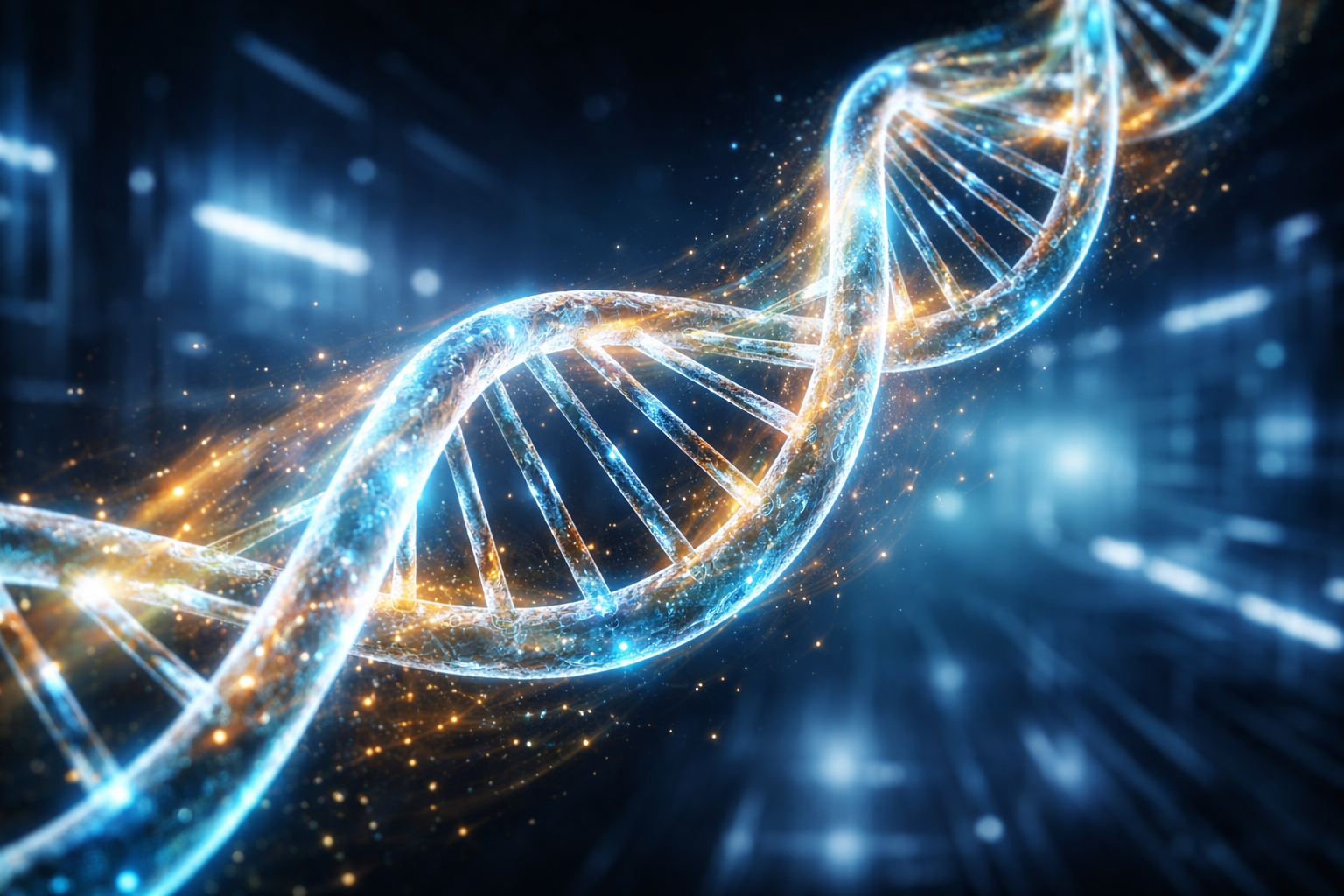
The human genome contains approximately 3.2 billion base pairs — a four-letter code (A, T, C, G) that functions like a biological programming language.
If written as text, your DNA would fill thousands of books.
You are not just flesh and bone.
You are encoded information.
🧬 The Structure of Life: The Double Helix
In 1953, James Watson and Francis Crick (building on Rosalind Franklin’s X-ray diffraction work) revealed DNA’s double-helix structure.
DNA consists of complementary base pairing:
Adenine (A) pairs with Thymine (T)
Cytosine (C) pairs with Guanine (G)
This pairing ensures precise replication during cell division.
The genetic code translates into proteins through a system called the central dogma of molecular biology:
DNA → RNA → Protein
Proteins then perform nearly all biological functions in the body.
Life is chemistry organized by information.
🔬 How Small Changes Create Big Differences
A single mutation — one letter change in 3 billion — can alter life dramatically.
For example:
Sickle cell anemia results from a single base substitution.
Some cancers begin with just one genetic error.
Yet mutation is also the engine of evolution.
Without genetic variation, there would be:
No diversity
No adaptation
No evolution
Every species on Earth is a result of billions of years of genetic trial and error.
🧠 Genetics and Human Behavior: Nature vs Nurture?
Modern research shows genetics influences:
Intelligence potential
Personality tendencies
Mental health susceptibility
Risk tolerance
But genes are not destiny.
This is where epigenetics changes the conversation.
Epigenetics studies how environmental factors switch genes on or off without altering the DNA sequence.
Stress, nutrition, trauma, and lifestyle can influence gene expression.
Your choices can influence how your genes behave.
This means biology is dynamic, not fixed.
🧬 CRISPR: Editing the Code of Life
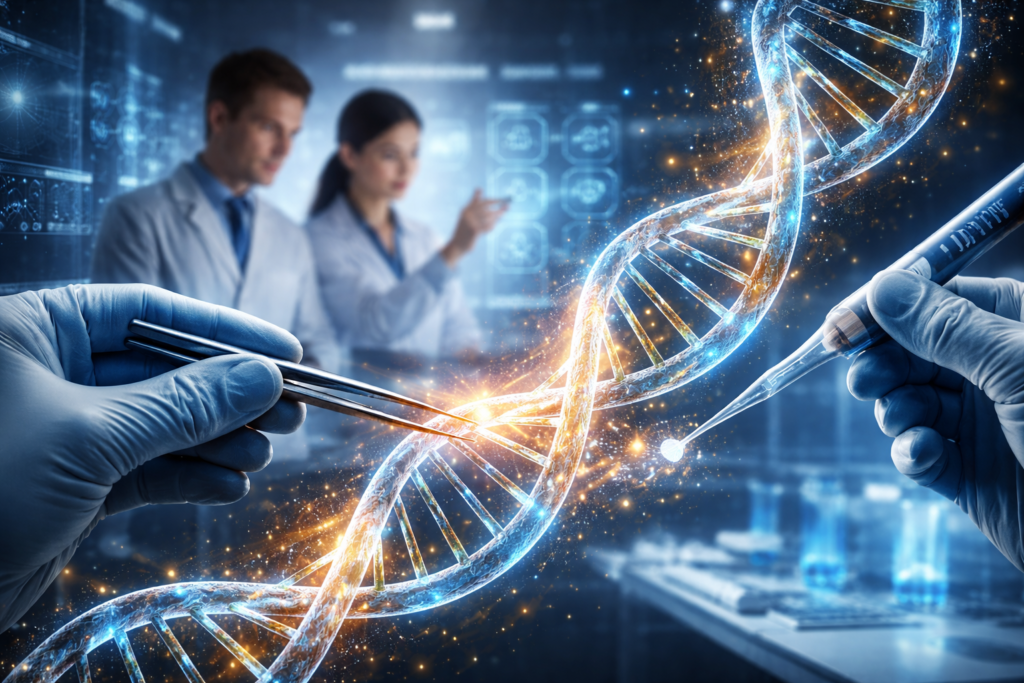
In the last decade, science moved from reading DNA to editing it.
CRISPR-Cas9 technology allows scientists to:
Remove defective genes
Insert beneficial genes
Modify DNA with precision
It has already shown promise in treating:
Genetic blood disorders
Certain cancers
Rare inherited diseases
For the first time in history, humanity can rewrite its own genetic code.
But should we?
⚖️ The Ethical Crossroads
Genetic engineering opens powerful possibilities:
Eliminating hereditary diseases
Enhancing immunity
Extending lifespan
But also raises serious ethical concerns:
Designer babies
Genetic inequality
Bioengineering misuse
Unintended long-term consequences
We are standing at a civilizational threshold.
The same technology that cures disease could redefine humanity.
Science moves faster than ethics.
That is both exciting and dangerous.
“Just as genetics decodes the blueprint of life on Earth, space research seeks to understand whether similar biological patterns might exist beyond our planet”.
🧬 The Human Genome Project: Mapping Ourselves
Completed in 2003, the Human Genome Project decoded the entire human genetic sequence.
One surprising discovery:
Humans share approximately 99.9% of their DNA with each other.
That 0.1% difference creates all visible diversity among 8 billion people.
This changes how we think about race, identity, and difference.
Biologically, humanity is astonishingly unified.
🌍 Genetics and the Future of Medicine
The next era is personalized medicine.
Instead of treating diseases generically, doctors will analyze your genome to:
Predict health risks
Tailor treatments
Optimize drug response
Your DNA will guide your medical decisions.
Healthcare will become predictive instead of reactive.
🧠 Are We Just Code?
Here’s the deeper question.
If your personality, intelligence, and health are influenced by DNA —
Where does free will begin?
Are we biological algorithms?
Or is consciousness something beyond genetics?
Science explains the mechanism of life.
It does not yet explain awareness.
Genetics may define your body.
It does not define your meaning.
🚀 The Next Evolution: Self-Directed Humanity
For billions of years, evolution was random.
Now, for the first time, evolution may become intentional.
Humanity could:
Eliminate genetic diseases
Increase resilience
Extend lifespan
Adapt for space travel
We are no longer passive products of evolution.
We may become its architects.
And that changes everything.
Final Thought: The Code and the Consciousness
Inside you is a molecular script written billions of years ago.
It survived ice ages, asteroid impacts, extinctions, and evolutionary leaps.
That code shaped your body.
But your consciousness — your awareness — interprets that code.
Genetics explains how life is built.
It does not explain why life wonders.
And that is the frontier science has yet to decode.
Read More Interesting Content in My Blog Section
Related Readings: Black Holes: The Dark Giants That Shape the Universe