


For centuries, humanity has wondered whether Earth is the only planet that supports life in the universe. Ancient philosophers speculated about other worlds, but it was only in the last few decades that science began discovering real planets beyond our solar system. These distant worlds are known as exoplanets.
An exoplanet is a planet that orbits a star outside our solar system. While our solar system contains eight known planets, astronomers have now discovered thousands of exoplanets scattered across the Milky Way galaxy.
Some of these planets are massive gas giants, while others appear to be rocky worlds similar to Earth. The discovery of exoplanets has transformed our understanding of the universe and brought scientists closer to answering one of humanity’s most profound questions:
What Are Exoplanets?
Exoplanets, short for extrasolar planets, are planets that orbit stars other than the Sun. Because they are extremely far away, detecting them is incredibly challenging. Most exoplanets cannot be seen directly because the light from their parent stars overwhelms them.
Instead, astronomers use advanced techniques and space telescopes to detect indirect signals that reveal the presence of these distant worlds.
The first confirmed exoplanet around a Sun-like star was discovered in 1995, a breakthrough that opened a new era in astronomy. Since then, missions such as NASA’s Kepler Space Telescope and the James Webb Space Telescope have dramatically expanded the search.
Today, scientists have confirmed more than 5,000 exoplanets, and the number continues to grow.
Why Scientists Search for Exoplanets
The search for exoplanets is not just about counting planets. Scientists want to understand:
How planetary systems form
Whether Earth-like planets are common
Whether conditions suitable for life exist elsewhere
Some exoplanets exist in what astronomers call the “habitable zone.”
This is the region around a star where temperatures may allow liquid water to exist on the planet’s surface. Since water is essential for life as we know it, planets in this zone are considered the most promising candidates for life.
The idea that there may be billions of habitable planets in our galaxy is one of the most exciting discoveries in modern science.
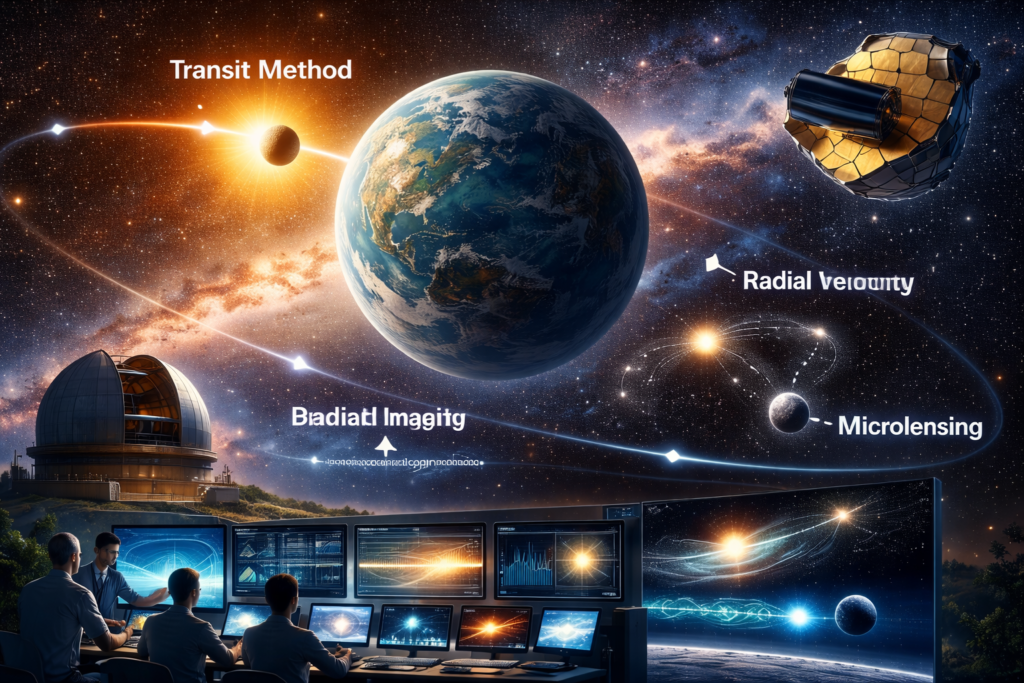
How Scientists Detect Exoplanets
Because exoplanets are so distant, astronomers rely on clever techniques to detect them.
1. Transit Method
The transit method is the most widely used technique. It works when a planet passes in front of its star from our point of view.
As the planet crosses the star, it blocks a tiny portion of the star’s light. This causes a small dip in brightness that telescopes can detect.
NASA’s Kepler mission used this method to discover thousands of planets.
2. Radial Velocity Method
Another technique is the radial velocity method, also known as the Doppler method.
Planets exert gravitational forces on their stars, causing the star to wobble slightly as the planet orbits it. By measuring changes in the star’s light spectrum, astronomers can detect this motion and infer the presence of a planet.
3. Direct Imaging
Although difficult, astronomers sometimes capture direct images of exoplanets using powerful telescopes and advanced imaging techniques.
This method works best for large planets orbiting far from their stars, where the glare from the star is less overwhelming.
4. Gravitational Microlensing
Gravitational microlensing occurs when a star passes in front of another distant star. The gravity of the closer star acts like a lens, magnifying the light of the background star.
If the foreground star has a planet, the planet can produce a small but detectable change in the magnified light.
This technique allows astronomers to discover planets that other methods might miss.
Famous Exoplanets Discovered So Far
Over the years, several fascinating exoplanets have captured scientific and public attention.
Proxima Centauri b
Located about 4.2 light-years away, this planet orbits the closest star to our solar system. It is roughly the size of Earth and lies within the star’s habitable zone.
Kepler-452b
Often called “Earth’s cousin,” Kepler-452b orbits a star similar to our Sun and may have conditions suitable for life.
TRAPPIST-1 System
One of the most exciting discoveries is the TRAPPIST-1 planetary system, which contains seven Earth-sized planets orbiting a small star.
Several of these planets lie within the habitable zone, making the system one of the most promising places to search for life beyond Earth.
Could Life Exist on Exoplanets?
The discovery of exoplanets has significantly increased the possibility that life might exist elsewhere in the universe.
However, finding life is extremely difficult. Scientists look for signs known as biosignatures, which may include:
Oxygen in a planet’s atmosphere
Methane produced by biological processes
Chemical imbalances that suggest living organisms
New telescopes, especially the James Webb Space Telescope, are beginning to analyze the atmospheres of distant planets to search for these clues.
According to NASA’s exoplanet research, thousands of planets have already been identified beyond our solar system.
You can explore the latest discoveries through NASA’s Exoplanet Exploration Program
The Future of Exoplanet Exploration
The search for exoplanets is advancing rapidly. Upcoming missions and telescopes aim to detect smaller, Earth-like planets and analyze their atmospheres in greater detail.
Future technologies may allow scientists to:
Identify planets with oceans
Detect atmospheric signs of life
Capture clearer images of distant worlds
Some researchers even speculate that within the next few decades, humanity might discover a planet that truly resembles Earth.
Such a discovery would revolutionize science and reshape our understanding of life in the universe.
“Understanding how planets form also connects to the larger story of how the universe began after the Big Bang.”
Why Exoplanets Fascinate Humanity
The search for exoplanets is more than a scientific quest—it touches something deeply human.
For thousands of years, people have looked at the night sky and wondered whether other worlds exist beyond our own. Today, modern astronomy is finally beginning to answer that question.
Each newly discovered planet reminds us that the universe is vast, mysterious, and full of possibilities.
And somewhere among the billions of stars in our galaxy, there may be another world where life has also begun its journey.
Conclusion
The discovery of exoplanets has opened one of the most exciting chapters in modern astronomy. These distant planets reveal that planetary systems are common throughout the universe and that Earth may not be unique.
With powerful telescopes and innovative techniques, scientists continue to search for habitable worlds and signs of life beyond our solar system.
The journey has only just begun—but every new discovery brings humanity closer to understanding our place in the cosmos.
Read More Interesting Content in My Blog Section.
FAQ:-
What is an exoplanet?
An exoplanet is a planet that orbits a star outside our solar system. Astronomers have discovered thousands of exoplanets across the Milky Way galaxy, some of which may have conditions suitable for life.
How do scientists discover exoplanets?
Scientists use several methods to detect exoplanets, including the transit method, radial velocity technique, direct imaging, and gravitational microlensing. These techniques allow astronomers to identify planets that are too distant to observe directly.
How many exoplanets have been discovered?
As of today, astronomers have confirmed more than 5,000 exoplanets beyond our solar system. Ongoing missions from NASA and other space agencies continue to discover new planets every year.