
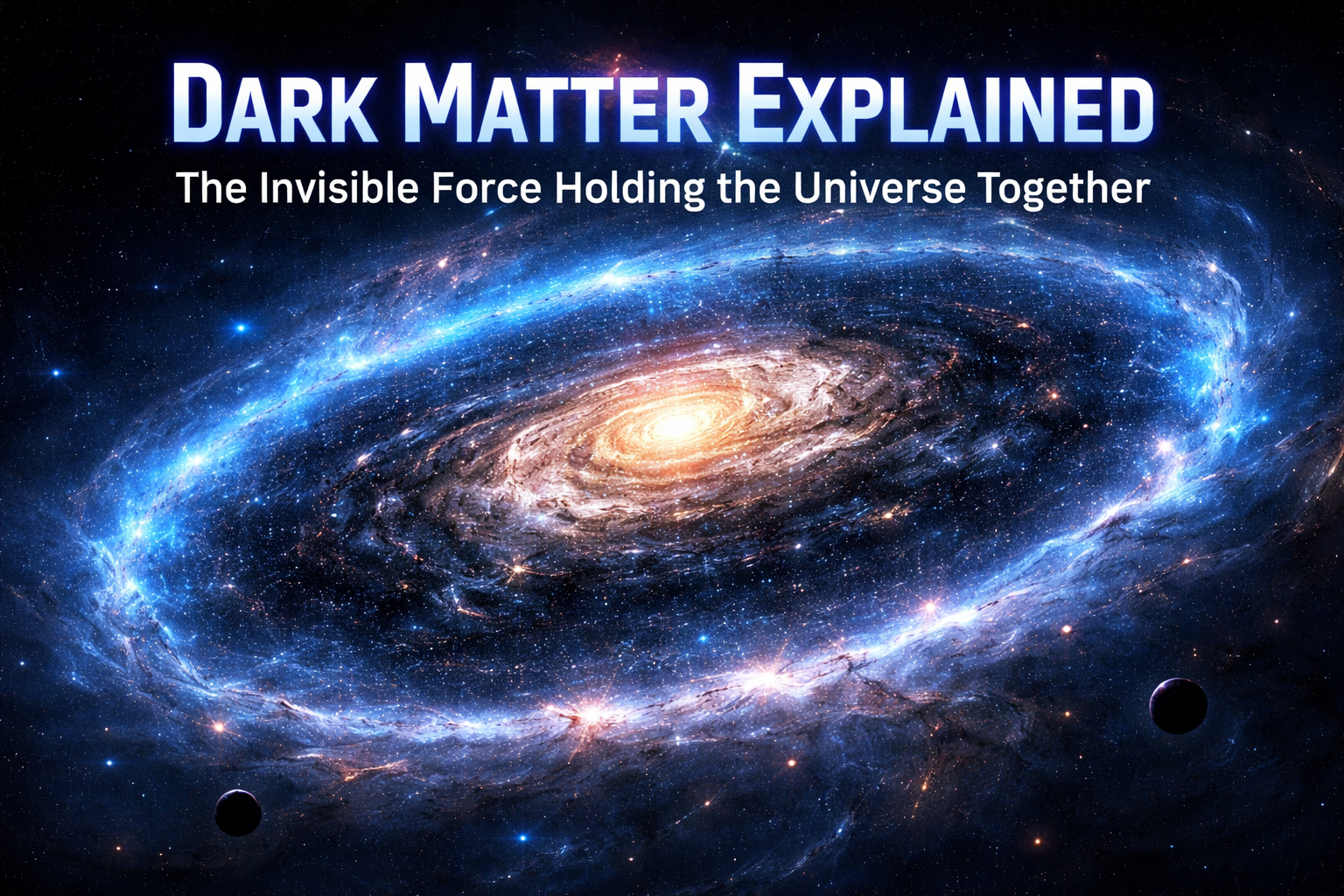

When we look at the night sky, we see stars, galaxies, glowing nebulae, and distant cosmic light. It feels vast, powerful, and complete. Yet what we see — every star, planet, asteroid, black hole, and cloud of gas — makes up only about 5% of the universe.
The remaining 95%?
It is mostly invisible.
Among that invisible majority lies one of the greatest scientific mysteries of modern cosmology: dark matter — a form of matter that does not emit, absorb, or reflect light, yet exerts gravitational influence strong enough to shape the entire universe.
Dark matter may be the silent architect of cosmic structure — the hidden scaffolding holding galaxies together.
What Is Dark Matter?
Dark matter is a type of matter that cannot be detected through electromagnetic radiation (light, radio waves, X-rays). Unlike normal matter, it does not glow, shine, or interact with light in any measurable way.
But we know it exists because of gravity.
Astronomers first noticed something strange in the 1930s when studying galaxy clusters. The visible mass of galaxies was not enough to account for the gravitational forces observed. Galaxies were moving too fast — fast enough that they should have torn themselves apart.
Yet they remained intact.
Something unseen was providing additional gravitational pull.
That “something” was later named dark matter.
The Galaxy Rotation Problem: The First Major Clue
In the 1970s, astronomer Vera Rubin made a groundbreaking observation. She studied how stars move inside spiral galaxies.
According to classical Newtonian physics, stars farther from the center of a galaxy should orbit more slowly — similar to how planets farther from the Sun move more slowly.
But that’s not what she observed.
Stars at the outer edges of galaxies were moving just as fast as those near the center.
This could only mean one thing:
There was far more mass present than what we could see.
Dark matter forms a massive “halo” around galaxies, providing the extra gravitational force needed to prevent them from flying apart.
Without dark matter, galaxies — including our own Milky Way — would not exist in their current structure.
Gravitational Lensing: Seeing the Invisible
If dark matter does not interact with light, how can we detect it?
One powerful method is gravitational lensing.
According to Einstein’s theory of relativity, massive objects bend the fabric of spacetime. When light from distant galaxies passes near a massive cluster, it bends around it.
Astronomers observe distorted or stretched images of background galaxies — like looking through a cosmic magnifying glass.
The amount of bending reveals how much mass is present.
And time after time, measurements show more mass than visible matter can account for.
Dark matter leaves fingerprints — not through light, but through gravity.
What Could Dark Matter Be?
Despite decades of research, we still don’t know what dark matter is made of.
Several leading candidates include:
1. WIMPs (Weakly Interacting Massive Particles)
Hypothetical particles that interact only through gravity and possibly the weak nuclear force.
2. Axions
Extremely light particles predicted by quantum theories that could explain dark matter behavior.
3. Sterile Neutrinos
A hypothetical heavier cousin of the neutrino.
4. Modified Gravity Theories
Some scientists propose that perhaps gravity behaves differently at large scales — though most evidence supports actual unseen matter.
The mystery deepens because no direct detection experiment has yet conclusively confirmed dark matter particles.
It remains one of the greatest unsolved problems in physics.
Dark Matter and the Birth of the Universe
Dark matter is not just important for galaxies — it played a critical role in the formation of the universe itself.
After the moment when nothing became everything, tiny fluctuations in density began forming. Normal matter alone would not have clumped together fast enough to create galaxies within the universe’s lifetime.
Dark matter provided the gravitational scaffolding that allowed matter to cluster and form cosmic structures.
Without it, stars may never have formed. Planets might not exist. Life would be impossible.
In that sense, dark matter may have indirectly enabled our existence.
How Dark Matter Connects to Quantum Physics
Although dark matter is studied at cosmic scales, its explanation likely lies in subatomic physics.
Understanding dark matter may require breakthroughs in quantum field theory — the same foundation that drives research in engineering reality at the atomic scale.
Large particle accelerators like the Large Hadron Collider search for clues, attempting to recreate conditions similar to those moments after the Big Bang.
If dark matter is a new type of particle, it could revolutionize our understanding of fundamental physics.
Surprising Facts About Dark Matter
Dark matter outweighs visible matter roughly five to one.
It does not form stars or planets.
It passes through ordinary matter without noticeable interaction.
Earth is constantly moving through dark matter.
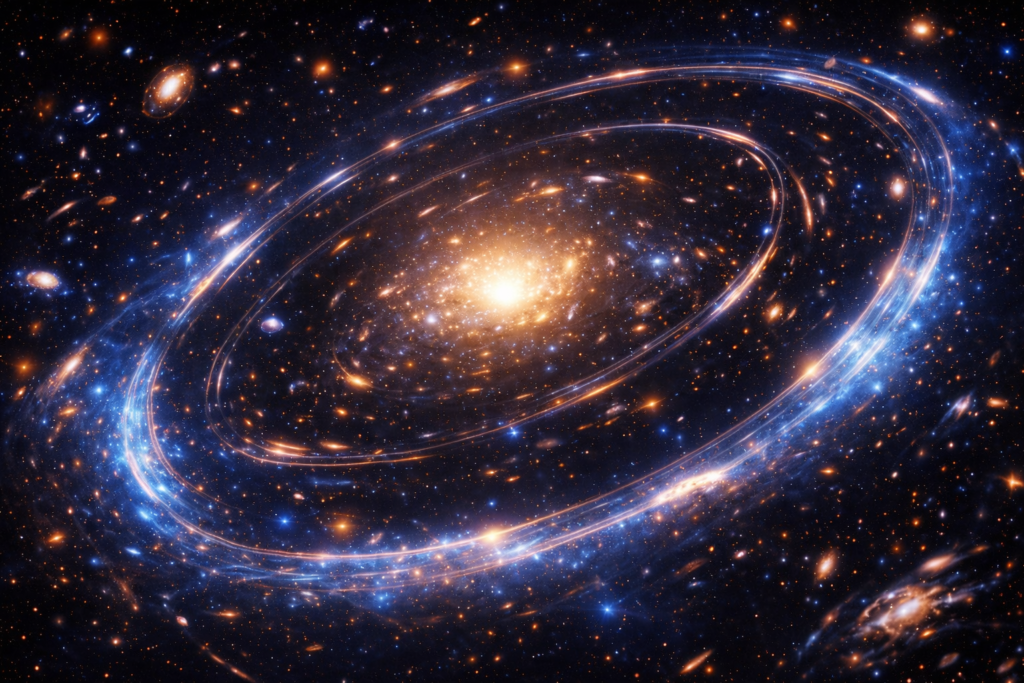
Entire galaxies are embedded in massive dark matter halos.
One of the most astonishing discoveries was the Bullet Cluster, where two galaxy clusters collided. Observations showed visible matter separating from gravitational mass — strong evidence that dark matter behaves as a distinct entity.
“Some physicists believe the true nature of dark matter may only be uncovered through advances in quantum field theories — similar to the breakthroughs discussed in Quantum Computing Explained: Future of Encryption & AI.”
Could Dark Matter Be Dangerous?
Some wonder whether dark matter could pose a threat.
The answer: highly unlikely.
Dark matter interacts so weakly with normal matter that trillions of dark matter particles pass through your body every second without effect.
It influences the universe on large scales — not at the human level.
The Future of Dark Matter Research
Scientists around the world are conducting experiments deep underground to detect dark matter particles. These laboratories are shielded from cosmic radiation to reduce interference.
Upcoming space telescopes and advanced observatories will also map dark matter distribution with greater precision.
The next breakthrough could:
Rewrite particle physics
Reveal new forces of nature
Change our understanding of gravity
Transform cosmology textbooks
Dark matter may not remain “dark” forever.
Why Dark Matter Changes How We See Reality
Perhaps the most profound implication of dark matter is philosophical.
It reminds us that:
Most of reality is invisible.
Human perception is limited.
Scientific progress depends on questioning what we assume to be complete.
Just as the discovery of atoms reshaped chemistry, and quantum mechanics reshaped physics, understanding dark matter may redefine our cosmic perspective.
We live in a universe largely composed of something we cannot see — yet its gravitational hand shapes everything.
The stars shine, galaxies spin, and cosmic structures form — all guided by an unseen force.
Dark matter is not just a scientific curiosity.
It is the hidden framework of existence.
Read More Interesting Content in Blog Section.