
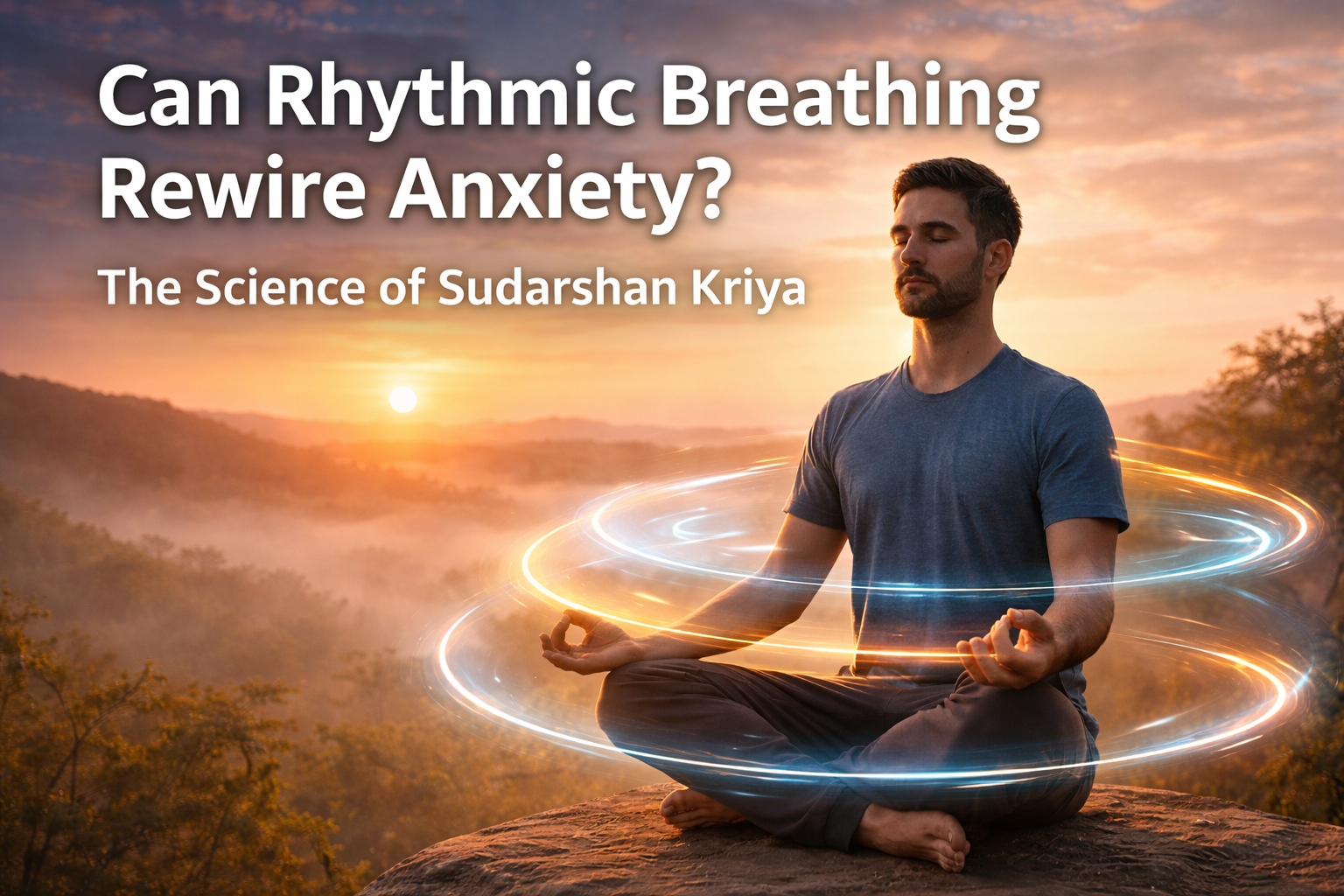

Sudarshan Kriya is a structured rhythmic breathing practice that research suggests may reduce stress, regulate the nervous system, and improve emotional resilience. But how does it work, and what makes it different from traditional pranayam?
Anxiety feels mental.
But biologically, it is rhythmic.
Your heartbeat accelerates.
Your breath shortens.
Your thoughts race in patterns.
What if the way out of anxiety is not through thought control — but through breath rhythm?
This is where Sudarshan Kriya enters the conversation.
What Is Sudarshan Kriya?
Sudarshan Kriya (often abbreviated as SKY) is a cyclical, rhythmic breathing technique developed within yogic traditions and popularized globally through structured programs.
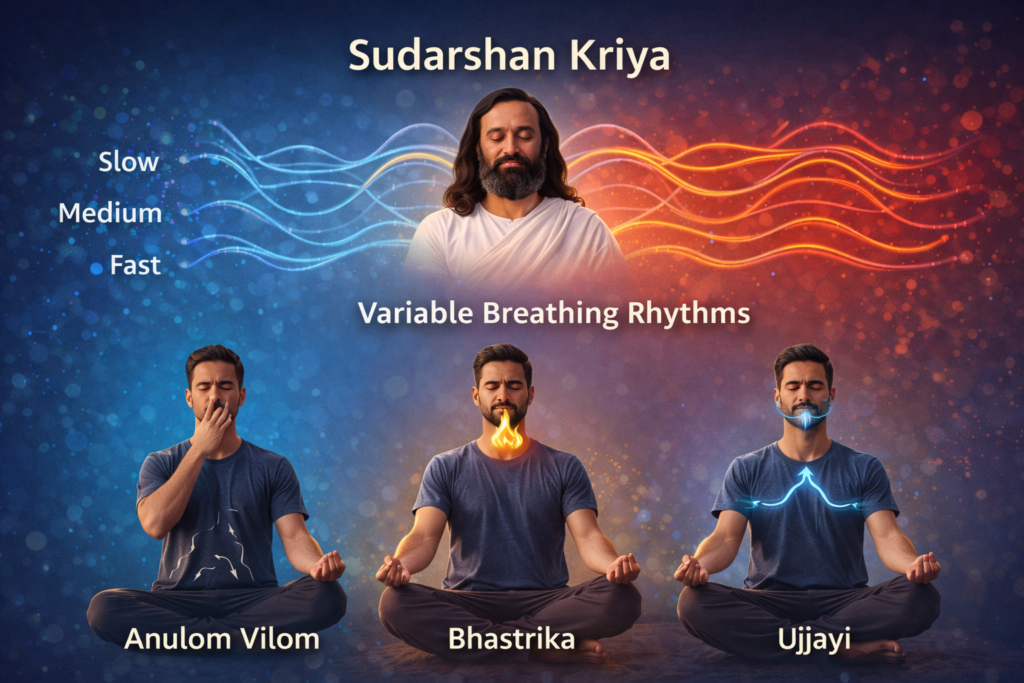
Unlike single-pattern breathing methods, Sudarshan Kriya uses:
Slow breathing
Medium-paced breathing
Fast rhythmic breathing
These cycles are performed in a specific guided sequence after preparatory breathing exercises.
The word “Sudarshan” roughly translates to “proper vision” or “clear perception,” and “Kriya” means “purifying action.”
But beyond terminology, what makes it intriguing is that modern research has begun studying its measurable physiological effects.
What Makes It Different from Regular Pranayam?
Most traditional pranayam techniques focus on one breathing style at a time:
Anulom Vilom → alternate nostril balance
Bhastrika → forceful breath
Ujjayi → slow oceanic breath
Sudarshan Kriya, however, uses variable rhythmic cycles.
This variability appears to:
Engage different branches of the autonomic nervous system
Shift brainwave patterns
Influence emotional processing
Surprising fact:
Some researchers suggest that rhythmic breathing patterns can synchronize neural oscillations in the brain — meaning breath rhythm may influence how brain cells fire together.
Instead of calming the system gradually, cyclical breathing may create a stronger reset effect.
Scientific Research on Sudarshan Kriya
Multiple peer-reviewed studies have examined Sudarshan Kriya’s impact.
Research has reported:
Reduction in cortisol (stress hormone)
Improved heart rate variability (HRV)
Decreased symptoms of anxiety and depression
Positive effects in individuals with PTSD
Enhanced antioxidant levels
One surprising finding from certain studies:
Regular practice has been associated with changes in gene expression related to stress response and immune function.
That suggests breath rhythm may influence the body at a cellular level — not just psychologically.
However, it is important to note:
Sudarshan Kriya is considered complementary wellness support and not a replacement for medical treatment.
How It Works Physiologically
To understand the mechanism, we must look at the nervous system.
Anxiety activates the sympathetic nervous system (fight-or-flight mode).
Rhythmic breathing influences:
The vagus nerve
Carbon dioxide balance
Blood oxygen levels
Heart rate variability
The alternating breath speeds may:
Activate the system (fast cycles)
Release stored tension
Shift dominance toward parasympathetic calm
In simple terms:
It first stirs the nervous system —
Then guides it toward regulation.
This may explain why some practitioners report emotional release during sessions.
Breath rhythm influences limbic system activity, especially the amygdala (fear center).
A Safe Simplified Rhythmic Practice (Inspired Version)
⚠️ Important:
The full Sudarshan Kriya technique is taught through certified programs and should be learned under trained guidance.
Official reference:
https://www.artofliving.org/in-en/sudarshan-kriya
Below is a gentle, simplified rhythmic breathing practice inspired by the concept, not the official protocol.
Step 1: Preparation (2–3 minutes)
Sit comfortably with straight spine
Breathe slowly through nose
Inhale 4 seconds, exhale 6 seconds
Step 2: Medium Rhythm (2 minutes)
Inhale and exhale evenly at moderate pace
About 2 seconds in, 2 seconds out
Keep breathing relaxed, not forceful
Step 3: Faster Light Rhythm (1 minute)
Short, controlled breaths
Do NOT hyperventilate
Stay aware and calm
Step 4: Slow Recovery (3–5 minutes)
Return to long, slow breathing
Observe sensations
Let breath naturally settle
Stop immediately if you feel dizzy or uncomfortable.
This simplified pattern can gently introduce rhythmic breathing without attempting the full structured technique.
Final Reflection
Sudarshan Kriya sits at an interesting intersection:
Ancient breathwork.
Modern neuroscience.
Measurable physiological effects.
The most surprising idea may be this:
Anxiety is rhythmic.
And breath can rewrite rhythm.
Whether one chooses structured programs or simplified practice, the core insight remains powerful:
Breath is not just survival.
It is regulation.
And sometimes, rhythm is the bridge back to calm.
Read More Interesting Content in the Blog Section.