
Anxiety is not just a mental state — it is a nervous system response. Controlled breathing techniques, especially pranayam, directly influence the vagus nerve and help shift the body from stress mode to calm within minutes.
Modern anxiety often feels psychological. Racing thoughts, restlessness, irritability.
But beneath those thoughts lies something biological.
Anxiety is primarily a nervous system state.
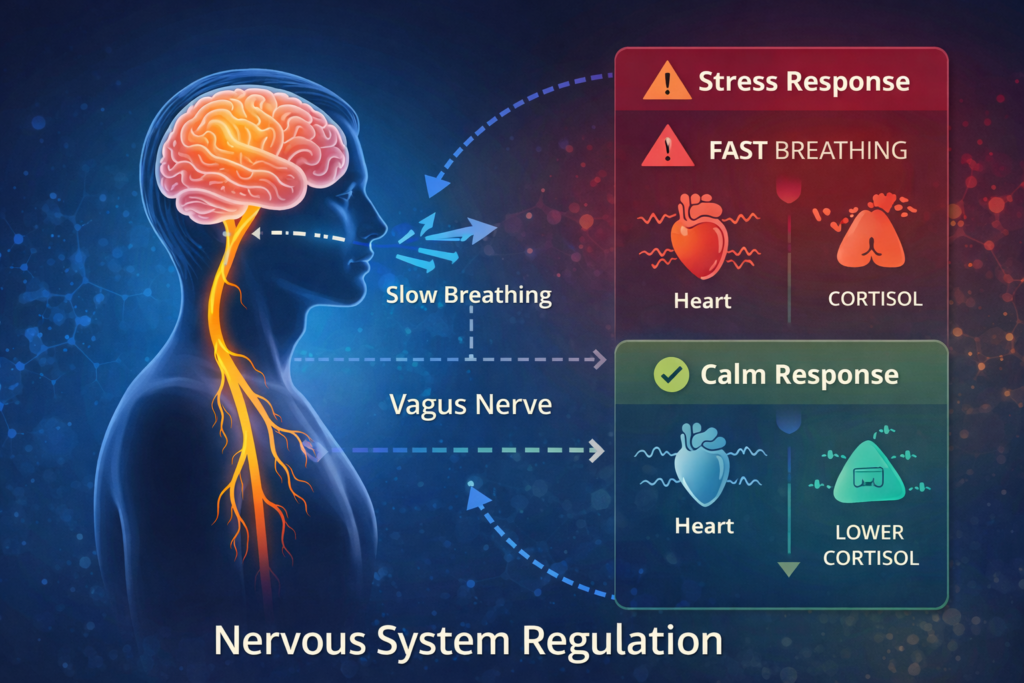
When you feel anxious, your sympathetic nervous system — the body’s “fight or flight” mechanism — becomes dominant. Heart rate rises. Breathing becomes shallow. Muscles tighten. Cortisol increases.
The mind reacts to what the body signals.
And here is the key:
Breathing is the only automatic body function you can consciously control.
That makes it a powerful regulatory tool.
Stress Is a Physiological Loop
When stressed, breathing becomes:
Faster
Shallower
Upper-chest dominant
This reduces carbon dioxide tolerance in the blood and increases physical tension. The brain interprets this as threat.
The more shallow you breathe, the more anxious you feel.
The more anxious you feel, the more shallow you breathe.
Pranayam interrupts this loop.
How Breathing Talks to Your Brain
Breathing directly influences the vagus nerve, a major nerve connecting the brain to the heart, lungs, and digestive system.
Slow, controlled breathing:
Activates the parasympathetic nervous system
Lowers heart rate
Reduces cortisol
Stabilizes blood pressure
Improves heart rate variability (HRV)
When exhalation is longer than inhalation, the body receives a signal:
“There is no threat.”
Within minutes, physiology shifts.
Pranayam: Ancient Nervous System Technology
Pranayam is not just spiritual tradition. It is structured breath regulation.
Ancient yogic systems recognized something modern neuroscience now confirms — breath controls mental state.
Certain pranayam techniques align closely with what research today calls “coherent breathing” or “resonance breathing,” often around 5–6 breaths per minute.
This rate optimizes vagal tone and autonomic balance.
The brilliance lies in simplicity.
Three Powerful Pranayam Techniques for Anxiety
1️⃣ Anulom Vilom (Alternate Nostril Breathing)
This technique balances hemispheric brain activity and regulates airflow.
Benefits include:
Improved oxygen exchange
Reduced sympathetic overactivation
Increased calm focus
Even 5 minutes can stabilize scattered mental energy.
2️⃣ Bhramari (Humming Breath)
Bhramari involves slow inhalation followed by humming during exhalation.
The vibration:
Stimulates the vagus nerve
Increases nitric oxide production
Reduces amygdala hyperactivity
The humming sound itself creates internal resonance, often producing rapid calming effects.
3️⃣ Extended Exhale Breathing
Inhale for 4 seconds, exhale for 6–8 seconds.
The longer exhale:
Activates parasympathetic dominance
Signals safety to the brain
Reduces heart rate
This is one of the fastest ways to reduce acute anxiety.
Why It Works So Quickly
Most anxiety interventions target thoughts.
Breathing targets biology.
You can debate with thoughts for hours.
But you cannot argue with your nervous system.
When breath slows:
Heart rhythm stabilizes
Brain waves shift
Muscle tension decreases
Hormonal stress response reduces
Calm is not “forced.”
It is induced physiologically.
When Breathwork Doesn’t Work
Breathing techniques may feel ineffective if:
You expect instant perfection
You breathe too forcefully
You are sleep-deprived
You practice inconsistently
Like any regulatory tool, breath training improves with repetition.
The nervous system adapts.
Breath and Modern Lifestyle
Our modern environment constantly triggers mild stress:
Notifications
Artificial lighting
Information overload
Sedentary routines
Pranayam provides a portable reset.
No equipment.
No cost.
No external dependency.
Just awareness and controlled airflow.
A Practical Daily Integration
You don’t need 45-minute sessions.
Try this structure:
Morning: 5 minutes Anulom Vilom
Midday stress: 3 minutes extended exhale
Evening wind-down: 5 minutes Bhramari
Consistency trains the nervous system toward baseline calm.
Over time, anxiety intensity reduces not just during practice — but overall.
Final Reflection
Anxiety feels complex.
But its entry point is simple.
Breath is the bridge between mind and body.
Pranayam is structured breath awareness.
And calm is not something you chase.
It is something you regulate.
In a world that overstimulates your nervous system daily, controlled breathing may be the most underestimated mental health tool available.
Read More Interesting Content in the Blog Section.