
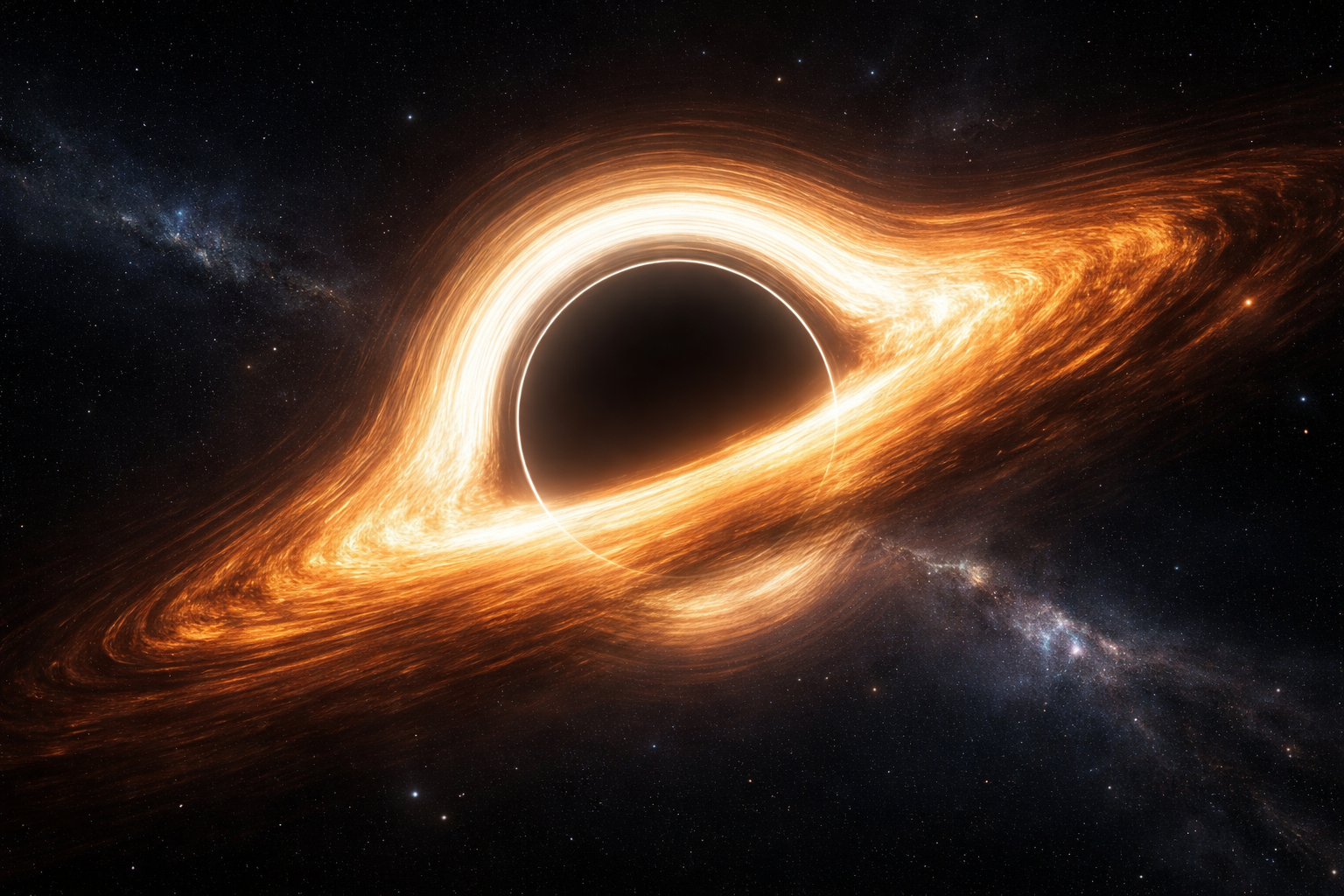

The Most Mysterious Objects in Existence
Imagine an object so powerful that not even light can escape it.
No sound.
No reflection.
No return.
Black holes are not science fiction — they are scientifically proven cosmic structures predicted by Einstein’s General Relativity and confirmed by modern astronomy.
They are invisible architects of galaxies, cosmic engines of energy, and possibly gateways to new physics.
Let’s explore what black holes really are, how they form, what happens inside them, and why they may hold the key to understanding reality itself.
🌟 How Black Holes Are Born
Black holes form when massive stars reach the end of their life cycle.
When a star much larger than our Sun exhausts its nuclear fuel, gravity overwhelms the outward pressure of fusion, causing a catastrophic collapse called a supernova explosion.
If the remaining core mass is sufficiently large, it collapses infinitely inward — forming a singularity.
The boundary around it is called the Event Horizon — the point of no return.
The size of this boundary is defined by the Schwarzschild radius:
Rs=2GM/c2R_s = 2GM/c^2Rs=2GM/c2
Where:
G = gravitational constant
M = mass of the object
c = speed of light
This formula shows something astonishing:
The bigger the mass, the larger the event horizon.
Black holes are not “holes” — they are incredibly dense objects with extreme gravity.
🌌 Types of Black Holes
Scientists classify black holes into four categories:
1. Stellar-Mass Black Holes
Formed from collapsing massive stars.
Typically 5–100 times the mass of our Sun.
2. Intermediate Black Holes
Rare and still being studied.
3. Supermassive Black Holes
Found at the center of almost every galaxy.
Our Milky Way hosts one called Sagittarius A* — about 4 million times the Sun’s mass.
4. Primordial Black Holes (Theoretical)
Possibly formed during the early universe.
🌀 What Happens Inside a Black Hole?
Here’s where physics becomes extreme.
Inside the event horizon lies the singularity — a point where density becomes infinite and space-time curvature becomes extreme.
Einstein’s field equations predict that gravity bends space-time itself.
Near a black hole:
Time slows down dramatically.
Light bends around it.
Matter stretches in a process called spaghettification.
Time dilation near a black hole can be understood through relativity principles — gravity affects time itself.
If you were near a black hole, time for you would move slower compared to someone far away.
Black holes are not just about gravity — they are about the distortion of reality.
🔭 Scientific Breakthrough: The First Image
In 2019, the Event Horizon Telescope captured the first-ever image of a black hole in galaxy M87.
In 2022, Sagittarius A* was imaged.
These images confirmed Einstein’s predictions made in 1915.
What was once theoretical became visible.
That is the power of human curiosity.
⚡ Do Black Holes Destroy Everything?
Not exactly.
Black holes do not “suck” everything randomly.
Their gravitational pull behaves like any other object of similar mass — unless you cross the event horizon.
If our Sun were replaced by a black hole of the same mass (hypothetically), Earth would continue orbiting normally.
The danger exists only at close proximity.
🌠 Hawking Radiation: Black Holes Can Evaporate
In 1974, Stephen Hawking made a revolutionary discovery.
Black holes are not completely black.
Due to quantum effects near the event horizon, they emit tiny amounts of radiation — now known as Hawking Radiation.
Over incredibly long timescales, this causes black holes to slowly lose mass and eventually evaporate.
This bridges quantum mechanics and general relativity — two pillars of physics that scientists are still trying to unify.
Black holes may be the key to a “Theory of Everything.”
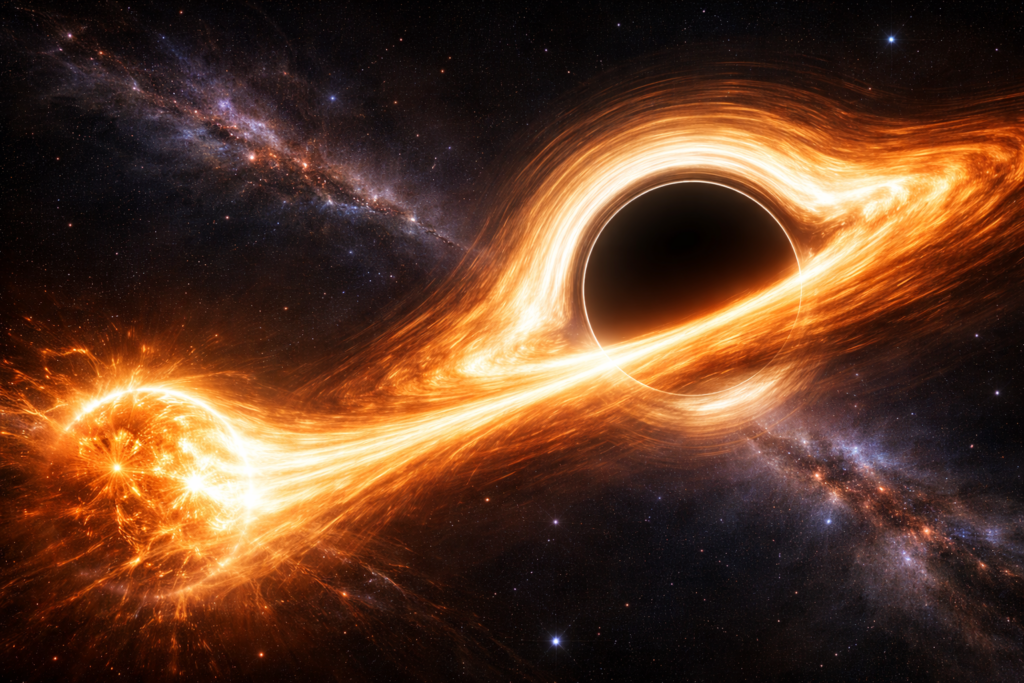
🌌 The Role of Black Holes in Galaxy Formation
Supermassive black holes are not just destructive.
They regulate galaxy growth.
When matter falls into them, massive energy jets are released, influencing star formation and galactic evolution.
Without black holes, galaxies may not have formed in the structured way we observe today.
They are cosmic sculptors.
🧠 Philosophical Reflection: The Edge of Understanding
Black holes challenge human comprehension.
They force us to ask:
What happens to information inside them?
Does space-time break?
Are wormholes possible?
Could they connect different universes?
Physicists are exploring ideas like:
Information paradox
Holographic principle
Quantum gravity
The universe becomes more mysterious the deeper we investigate.
🚀 The Future of Black Hole Research
Upcoming research areas:
Gravitational wave astronomy (LIGO detections of black hole mergers)
James Webb observations of early supermassive black holes
Quantum gravity theories
Event Horizon Telescope upgrades
The next 20 years may redefine physics.
🌌 Final Thought: The Darkness That Illuminates
Black holes are not symbols of destruction.
They are boundaries of knowledge.
They represent:
The limits of physics
The edge of time
The distortion of reality
The humility of science
They remind us that the universe is far more complex than we imagine.
And perhaps, in studying the darkest objects in existence, we discover the brightest truths about reality.
Read more Interesting content in the Blog Section.