
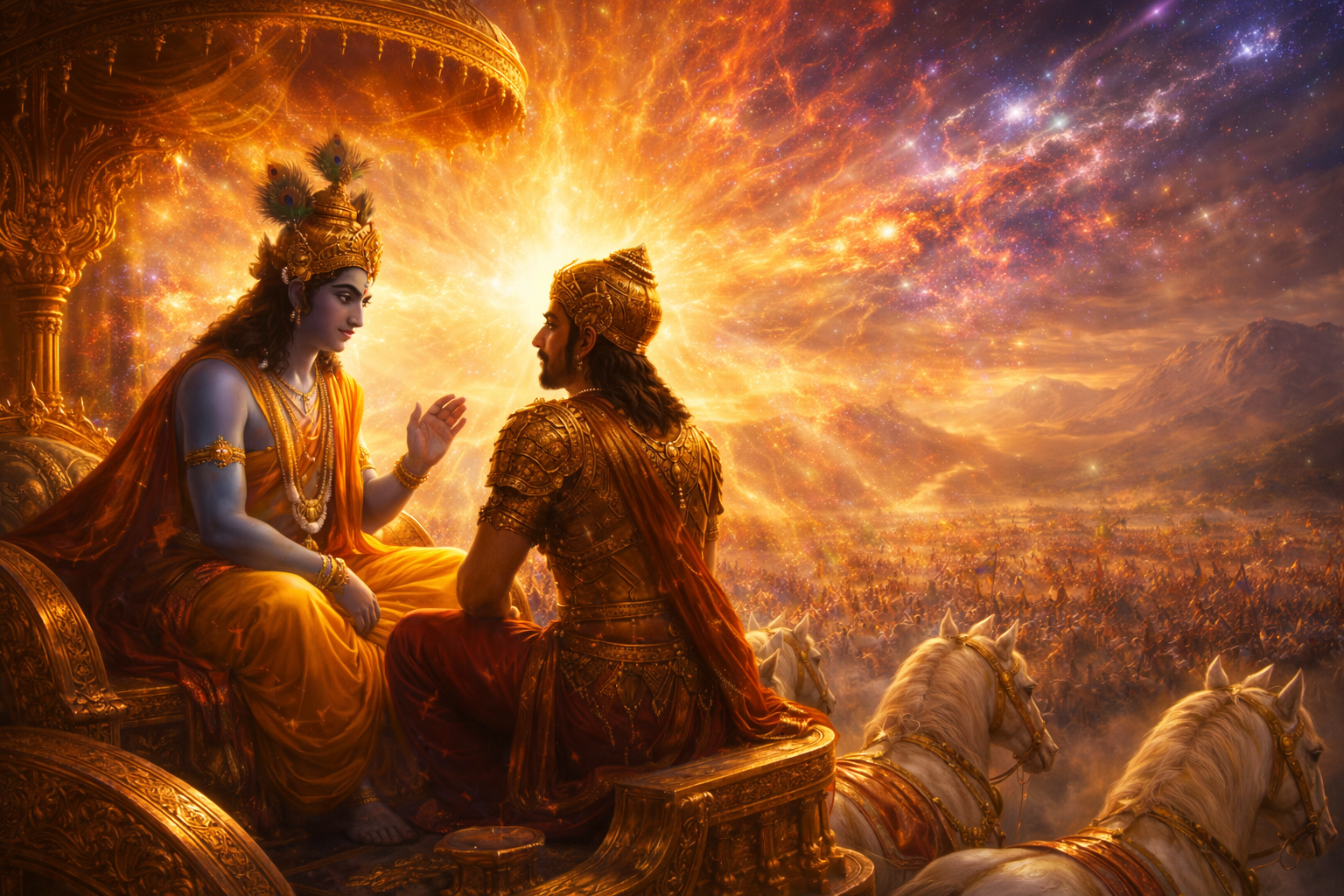

The Bhagavad Gita is not merely a religious scripture, nor is it only a philosophical treatise. In the Indian tradition, it is Itihasa — history.
It is a sacred dialogue that took place on the battlefield of Kurukshetra, just before the great war described in the Mahabharata. The conversation between Krishna and Arjuna addresses the deepest crisis of human existence — moral confusion, fear, duty, attachment, and the nature of reality itself.
This is not simply a conversation before war.
It is a manual for life.
1. Structural Overview of the Bhagavad Gita
The Bhagavad Gita appears in the Bhishma Parva of the Mahabharata.
Key Structural Information:
Total Chapters: 18
Total Verses: 700
Primary Speakers:
~574 verses spoken by Krishna
84 by Arjuna
41 by Sanjaya
1 by Dhritarashtra
The Three Traditional Divisions
The 18 chapters are traditionally grouped into three sections:
Chapters 1–6: Karma Yoga (Path of Action)
Chapters 7–12: Bhakti Yoga (Path of Devotion)
Chapters 13–18: Jnana Yoga (Path of Knowledge)
Each chapter is called a Yoga, meaning a path to union with the Supreme Reality.
This structure reveals that the Gita is a systematically arranged spiritual science — not an accidental dialogue.
2. Historical Evidence Related to Kurukshetra
Kurukshetra is a real geographical location in present-day Haryana, India.
Important traditional sites include:
Brahma Sarovar
Jyotisar, believed to be the place where Krishna delivered the Gita
Excavations in regions such as Hastinapur and surrounding Indus-Saraswati areas have revealed:
Painted Grey Ware (PGW) culture artifacts
Settlement layers dating to the late second millennium BCE
These findings indicate the presence of advanced civilization consistent with the era described in the Mahabharata.
3. Dating of the Mahabharata War
The dating of the Mahabharata war remains debated, but several approaches have been used.
Astronomical References
The Mahabharata contains detailed descriptions of:
Solar and lunar eclipses
Planetary alignments
Nakshatra (constellation) positions
Modern astronomical simulations have proposed dates ranging from:
Around 3102 BCE (traditional Kali Yuga reference)
Around 1500–1000 BCE (academic estimations)
While interpretations vary, the presence of precise celestial observations suggests historical memory rather than pure mythology.
Genealogical Records
Ancient Indian texts preserve royal lineages tracing back to the Mahabharata period, supporting its placement in deep antiquity.
4. Archaeological Findings
Archaeology does not provide a single inscription declaring “Mahabharata War,” yet it offers contextual support:
Flood destruction layers found at Hastinapur
Cultural transitions matching epic descriptions
Submerged structures discovered off the coast of Dwarka, traditionally associated with Krishna’s kingdom
These findings reinforce the possibility that the Mahabharata preserves civilizational history layered with spiritual symbolism.
5. The Psychological Battlefield
The Gita begins with Arjuna’s collapse.
He is not afraid of death.
He is afraid of moral wrongdoing.
The battlefield becomes a metaphor for the inner war between:
Duty and attachment
Courage and fear
Knowledge and confusion
Thus, the Gita is fundamentally a dialogue about human consciousness.
6. Deeper Spiritual Meaning
The symbolic dimensions of the Gita are profound:
Kurukshetra — The field of life
Pandavas — Higher tendencies
Kauravas — Lower tendencies
Arjuna — The questioning human soul
Krishna — Divine wisdom
The Gita harmonizes:
Selfless action (Karma)
Devotion (Bhakti)
Knowledge (Jnana)
Its teachings transcend time, religion, and geography.
7. Universal Relevance Across Ages
The Gita addresses:
Ethical leadership
Decision-making under pressure
Detachment in success and failure
Self-mastery
Emotional resilience
It has influenced thinkers, leaders, reformers, and spiritual seekers worldwide.
For a student, professional, parent, or leader — its relevance remains timeless.
“Just as Krishna teaches mastery over the restless mind, modern readers can explore practical techniques like guided breathing and meditation practices for mental clarity.”
8. The Enduring Significance of the Bhagavad Gita
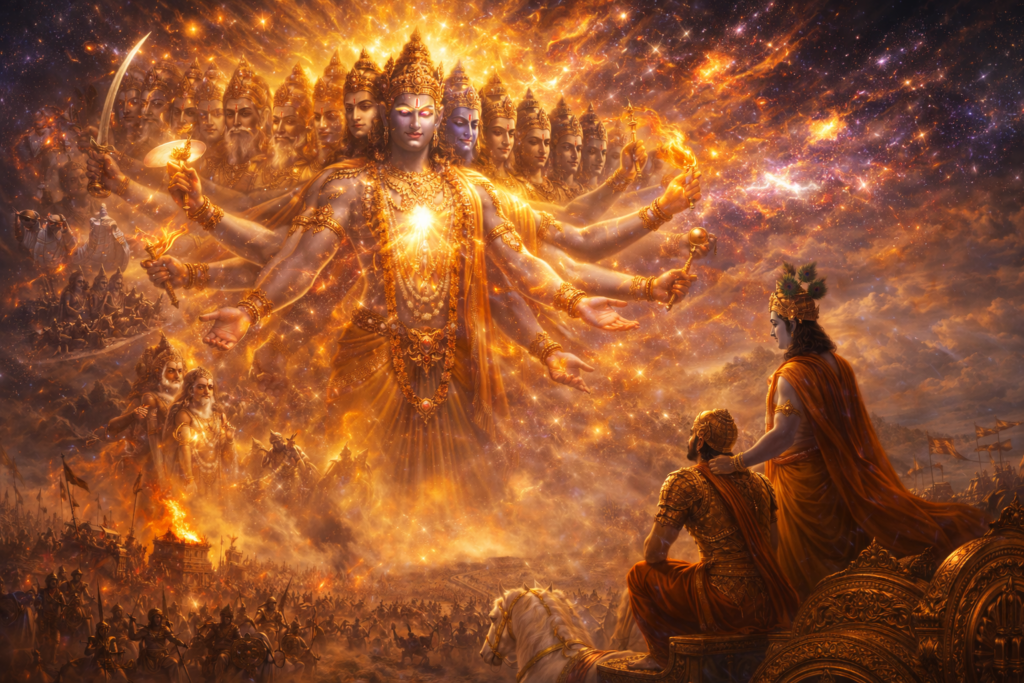
The Bhagavad Gita is not meant merely to be worshipped — it is meant to be understood and lived.
Krishna does not demand blind obedience.
At the conclusion of the dialogue, He invites Arjuna to reflect deeply and then decide freely.
This intellectual freedom, combined with spiritual depth, is what makes the Gita eternal.
It is not dogma.
It is guidance.
9. The 18 Chapters of the Bhagavad Gita
This foundational article marks the beginning of a deeper journey. The Bhagavad Gita consists of the following 18 chapters:
Arjuna Vishada Yoga – The Yoga of Arjuna’s Despair
Sankhya Yoga – The Yoga of Knowledge
Karma Yoga – The Yoga of Action
Jnana Karma Sanyasa Yoga – The Yoga of Knowledge and Renunciation of Action
Karma Sanyasa Yoga – The Yoga of Renunciation
Dhyana Yoga – The Yoga of Meditation
Jnana Vijnana Yoga – The Yoga of Knowledge and Realization
Akshara Brahma Yoga – The Yoga of the Imperishable Absolute
Raja Vidya Raja Guhya Yoga – The Yoga of Royal Knowledge and Royal Secret
Vibhuti Yoga – The Yoga of Divine Manifestations
Vishvarupa Darshana Yoga – The Yoga of the Vision of the Universal Form
Bhakti Yoga – The Yoga of Devotion
Kshetra Kshetrajna Vibhaga Yoga – The Yoga of the Field and the Knower of the Field
Gunatraya Vibhaga Yoga – The Yoga of the Division of the Three Gunas
Purushottama Yoga – The Yoga of the Supreme Person
Daivasura Sampad Vibhaga Yoga – The Yoga of the Divine and Demoniac Qualities
Shraddhatraya Vibhaga Yoga – The Yoga of the Threefold Faith
Moksha Sanyasa Yoga – The Yoga of Liberation and Renunciation
In the coming series, each chapter — and eventually each verse — can be explored in depth, context, and practical relevance.
“The Gita’s emphasis on purity and inner balance also resonates with traditional remedies such as natural lifestyle practices rooted in Indian healing traditions.”
In our upcoming series, we will provide a complete verse-by-verse explanation of all 18 chapters of the Bhagavad Gita for deeper understanding and practical application in modern life.
You Can Continue Your Bhagavad Gita Journey with Bhagavad Gita: Chapter 1 – Arjuna Vishada Yoga
For More Interesting Content Read My Blog Section.