
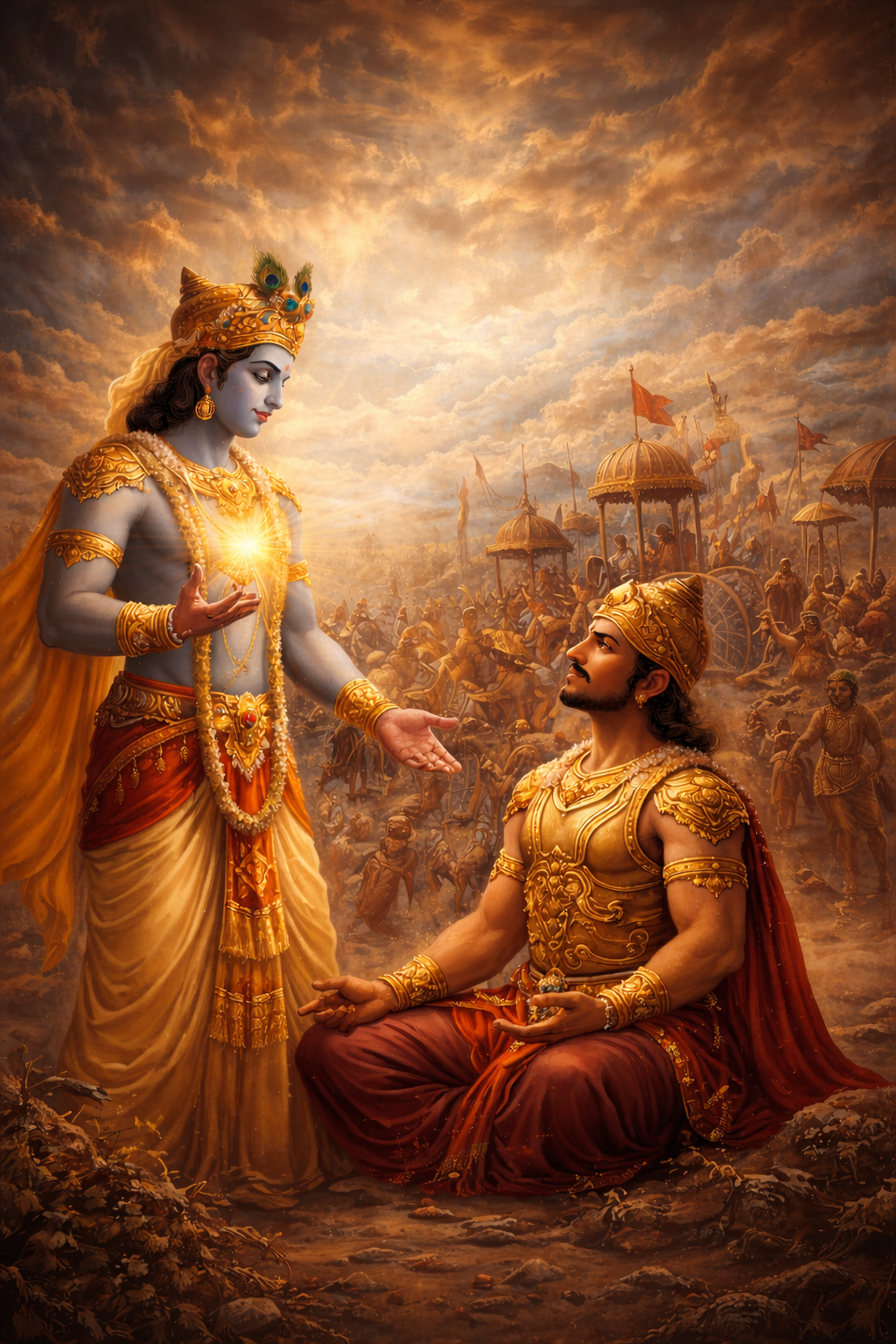

Bhagavad Gita Chapter 5 explains Karma Sanyasa Yoga — the balance between renouncing action and performing action. Lord Krishna resolves Arjuna’s confusion by explaining that true renunciation does not mean abandoning work, but performing it without attachment.
After understanding Karma Yoga in Chapter 3 and the power of knowledge in Chapter 4, Arjuna still wonders:
👉 Is it better to renounce action completely or to continue performing duties?
This chapter answers that question clearly.
Krishna teaches that both paths — renunciation and action — can lead to liberation, but selfless action performed with detachment is easier and more practical for most people.
This chapter shows how a person can live in the world, perform duties, and still remain spiritually free.
“This chapter teaches that true renunciation is not leaving action, but leaving attachment to results while continuing to perform one’s duty.”
Arjuna’s Question About Renunciation vs Action
Verse 5.1
Sanskrit Shloka
अर्जुन उवाच
संन्यासं कर्मणां कृष्ण पुनर्योगं च शंससि।
यच्छ्रेय एतयोरेकं तन्मे ब्रूहि सुनिश्चितम्॥
Translation
Arjuna said:
O Krishna, you praise renunciation of actions and also the path of action. Please tell me clearly which one is better.
Explanation
Arjuna is still confused after hearing Krishna’s teachings in earlier chapters.
He sees two paths — renouncing action and performing action — and cannot decide which is superior.
This reflects a common human dilemma: whether to withdraw from responsibilities or engage with them.
Arjuna sincerely seeks clarity so he can follow the right path.
Krishna Clarifies the Two Paths
Verse 5.2
Sanskrit Shloka
श्रीभगवानुवाच
संन्यासः कर्मयोगश्च निःश्रेयसकरावुभौ।
तयोस्तु कर्मसंन्यासात्कर्मयोगो विशिष्यते॥
Translation
The Blessed Lord said:
Both renunciation and Karma Yoga lead to liberation, but Karma Yoga is superior.
Explanation
Krishna clearly states that both paths are valid and can lead to spiritual progress.
However, renouncing action completely is difficult for most people.
Performing one’s duties without attachment is a more practical and effective path.
This makes Karma Yoga the preferred approach for everyday life.
Verse 5.3
Sanskrit Shloka
ज्ञेयः स नित्यसंन्यासी यो न द्वेष्टि न काङ्क्षति।
निर्द्वन्द्वो हि महाबाहो सुखं बन्धात्प्रमुच्यते॥
Translation
One who neither hates nor desires is a true renunciate and becomes free from bondage.
Explanation
Krishna redefines renunciation — it is not about leaving work but leaving inner attachment.
A person who is free from likes and dislikes becomes peaceful and balanced.
Such a person is not affected by external situations.
This inner detachment leads to true freedom.
Verse 5.4
Sanskrit Shloka
सांख्ययोगौ पृथग्बालाः प्रवदन्ति न पण्डिताः।
एकमप्यास्थितः सम्यगुभयोर्विन्दते फलम्॥
Translation
Only the ignorant see knowledge and action as different; the wise see them as one.
Explanation
Krishna explains that Jnana Yoga (knowledge) and Karma Yoga (action) are not separate paths.
They ultimately lead to the same goal — liberation.
The difference is only in approach, not in result.
A wise person understands their unity and follows them accordingly.
Verse 5.5
Sanskrit Shloka
यत्सांख्यैः प्राप्यते स्थानं तद्योगैरपि गम्यते।
एकं सांख्यं च योगं च यः पश्यति स पश्यति॥
Translation
The goal achieved through knowledge is also achieved through action. One who sees this truly understands.
Explanation
Krishna reinforces that both paths lead to the same destination.
Whether through deep contemplation or through selfless action, the end result is liberation.
Understanding this removes confusion and doubt.
It allows a person to follow their path with confidence.
Why Action Is Easier Than Renunciation
Verse 5.6
Sanskrit Shloka
संन्यासस्तु महाबाहो दुःखमाप्तुमयोगतः।
योगयुक्तो मुनिर्ब्रह्म नचिरेणाधिगच्छति॥
Translation
Renunciation is difficult without Yoga, but one who is engaged in Karma Yoga quickly attains Brahman.
Explanation
Krishna explains that simply renouncing action without inner discipline is very difficult.
If the mind is not purified, external renunciation can lead to frustration.
However, a person who performs actions with detachment (Karma Yoga) progresses naturally.
This path gradually purifies the mind and leads to realization more easily.
Verse 5.7
Sanskrit Shloka
योगयुक्तो विशुद्धात्मा विजितात्मा जितेन्द्रियः।
सर्वभूतात्मभूतात्मा कुर्वन्नपि न लिप्यते॥
Translation
One who is disciplined, pure, self-controlled, and sees all beings as one is not bound by actions.
Explanation
Krishna describes the qualities of a Karma Yogi.
Such a person has control over the mind and senses and sees unity in all beings.
Even while performing actions, they remain unaffected internally.
This shows that freedom comes from inner purity, not from external inactivity.
Verse 5.8 – 5.9
Sanskrit Shloka
नैव किंचित्करोमीति युक्तो मन्येत तत्त्ववित्।
पश्यन्शृण्वन्स्पृशन्जिघ्रन्नश्नन्गच्छन्स्वपंश्वसन्॥
प्रलपन्विसृजन्गृह्णन्नुन्मिषन्निमिषन्नपि।
इन्द्रियाणीन्द्रियार्थेषु वर्तन्त इति धारयन्॥
Translation
A wise person understands that they do nothing at all, even while seeing, hearing, touching, eating, moving, and acting.
Explanation
Krishna explains a very subtle concept here.
A realized person knows that the senses are acting according to nature, not the self.
They remain internally detached even while performing everyday actions.
This awareness prevents ego and attachment from developing.
Verse 5.10
Sanskrit Shloka
ब्रह्मण्याधाय कर्माणि सङ्गं त्यक्त्वा करोति यः।
लिप्यते न स पापेन पद्मपत्रमिवाम्भसा॥
Translation
One who performs actions without attachment, offering them to the Divine, remains unaffected like a lotus leaf in water.
Explanation
Krishna gives a beautiful metaphor — the lotus leaf stays untouched by water.
Similarly, a person who performs actions without attachment remains unaffected by karma.
Offering actions to the Divine removes ego and expectation.
This transforms ordinary work into spiritual practice.
Verse 5.11
Sanskrit Shloka
कायेन मनसा बुद्ध्या केवलैरिन्द्रियैरपि।
योगिनः कर्म कुर्वन्ति सङ्गं त्यक्त्वात्मशुद्धये॥
Translation
Yogis perform actions with body, mind, and intellect, without attachment, for self-purification.
Explanation
Krishna explains the purpose of action in Karma Yoga.
Actions are not for gaining results but for purifying the inner self.
When done without attachment, work becomes a tool for spiritual growth.
This shifts the focus from outcome to inner development.
Verse 5.12
Sanskrit Shloka
युक्तः कर्मफलं त्यक्त्वा शान्तिमाप्नोति नैष्ठिकीम्।
अयुक्तः कामकारेण फले सक्तो निबध्यते॥
Translation
One who gives up attachment to results attains peace, while one who is attached becomes bound.
Explanation
Krishna highlights the difference between attachment and detachment.
Attachment to results creates stress, anxiety, and bondage.
Letting go of expectations brings peace and stability.
This is one of the most practical teachings of the Gita.
The Inner State of a Realized Person
Verse 5.13
Sanskrit Shloka
सर्वकर्माणि मनसा संन्यस्यास्ते सुखं वशी।
नवद्वारे पुरे देही नैव कुर्वन्न कारयन्॥
Translation
One who mentally renounces all actions lives happily, realizing that the self does not act.
Explanation
Krishna explains that true renunciation happens in the mind.
A realized person understands that the body acts, but the soul remains unaffected.
This creates a sense of inner freedom and peace.
Such a person lives without stress or attachment.
Verse 5.14
Sanskrit Shloka
न कर्तृत्वं न कर्माणि लोकस्य सृजति प्रभुः।
न कर्मफलसंयोगं स्वभावस्तु प्रवर्तते॥
Translation
The Divine does not create actions or their results; nature is responsible for all activity.
Explanation
Krishna clarifies that actions are governed by nature (prakriti).
The Divine is not directly responsible for individual actions.
Understanding this removes blame and confusion.
It helps a person act wisely without ego.
Verse 5.15
Sanskrit Shloka
नादत्ते कस्यचित्पापं न चैव सुकृतं विभुः।
अज्ञाननेनावृतं ज्ञानं तेन मुह्यन्ति जन्तवः॥
Translation
The Divine does not take anyone’s sin or virtue; ignorance covers knowledge, causing confusion.
Explanation
Krishna explains that ignorance is the root cause of suffering.
When knowledge is covered, people make wrong decisions.
The Divine remains neutral — it is our understanding that shapes our experience.
Removing ignorance brings clarity and freedom.
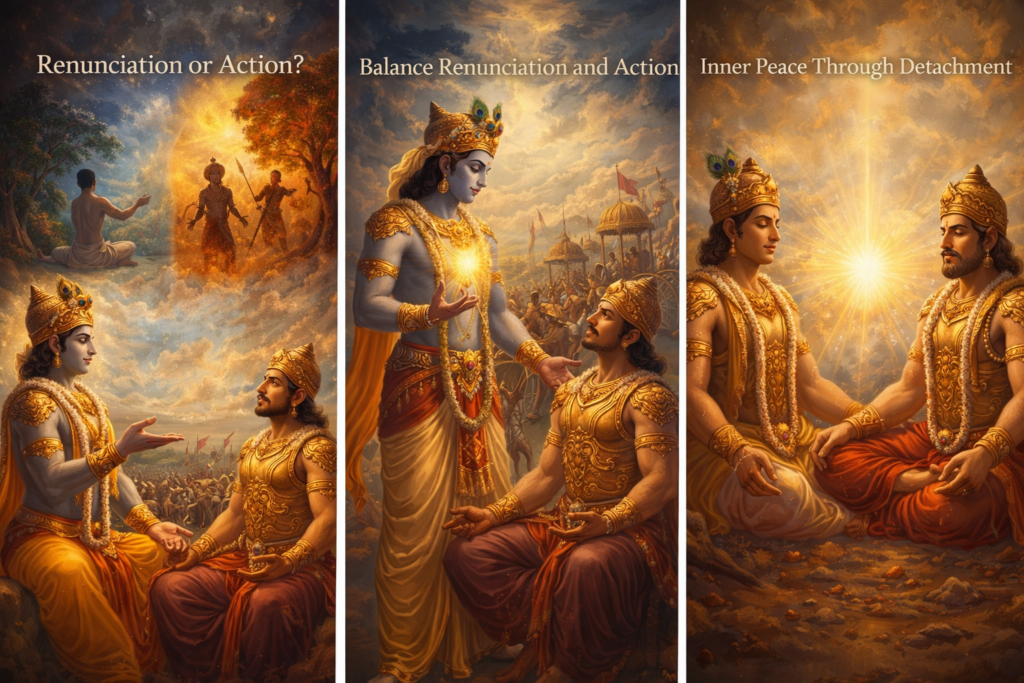
Knowledge Removes Ignorance
Verse 5.16
Sanskrit Shloka
ज्ञानेन तु तदज्ञानं येषां नाशितमात्मनः।
तेषामादित्यवज्ज्ञानं प्रकाशयति तत्परम्॥
Translation
For those whose ignorance is destroyed by knowledge, their wisdom shines like the sun.
Explanation
Krishna explains that knowledge removes ignorance just like sunlight removes darkness.
When true understanding arises, confusion disappears completely.
Such a person sees reality clearly without distortion.
This clarity leads to confidence, peace, and right action.
Verse 5.17
Sanskrit Shloka
तद्बुद्धयस्तदात्मानस्तन्निष्ठास्तत्परायणाः।
गच्छन्त्यपुनरावृत्तिं ज्ञाननिर्धूतकल्मषाः॥
Translation
Those who are focused on knowledge, devoted to it, and purified by it attain liberation.
Explanation
Krishna describes the mindset of a spiritually evolved person.
Their thoughts, identity, and focus are aligned with higher truth.
This deep connection removes impurities and past conditioning.
Such a person becomes free from the cycle of birth and death.
Seeing Equality in All
Verse 5.18
Sanskrit Shloka
विद्याविनयसम्पन्ने ब्राह्मणे गवि हस्तिनि।
शुनि चैव श्वपाके च पण्डिताः समदर्शिनः॥
Translation
The wise see equally a learned person, a cow, an elephant, a dog, and even an outcast.
Explanation
Krishna teaches the principle of equality (samadarshana).
A wise person sees the same divine essence in all beings.
External differences like status, form, or background do not affect their vision.
This understanding leads to compassion and respect for all.
Verse 5.19
Sanskrit Shloka
इहैव तैर्जितः सर्गो येषां साम्ये स्थितं मनः।
निर्दोषं हि समं ब्रह्म तस्माद्ब्रह्मणि ते स्थिताः॥
Translation
Those whose minds are established in equality conquer the world and attain Brahman.
Explanation
Krishna explains that equality of vision leads to spiritual success.
When a person rises above bias and duality, they become stable and peaceful.
Such a mind is already liberated while living.
This is the foundation of true wisdom.
Verse 5.20
Sanskrit Shloka
न प्रहृष्येत्प्रियम्प्राप्य नोद्विजेत्प्राप्य चाप्रियम्।
स्थिरबुद्धिरसम्मूढो ब्रह्मविद्ब्रह्मणि स्थितः॥
Translation
One who is not disturbed by happiness or distress and remains steady is established in Brahman.
Explanation
Krishna describes emotional stability.
A realized person does not get overly excited by success or disturbed by failure.
Their peace comes from within, not from external events.
This stability is a sign of true spiritual maturity.
Inner Joy and Detachment
Verse 5.21
Sanskrit Shloka
बाह्यस्पर्शेष्वसक्तात्मा विन्दत्यात्मनि यत्सुखम्।
स ब्रह्मयोगयुक्तात्मा सुखमक्षयमश्नुते॥
Translation
One who is not attached to external pleasures finds joy within and experiences lasting happiness.
Explanation
Krishna shifts focus from external enjoyment to inner fulfillment.
External pleasures are temporary, but inner peace is permanent.
A person who discovers inner joy becomes independent of circumstances.
This leads to true and lasting happiness.
Verse 5.22
Sanskrit Shloka
ये हि संस्पर्शजा भोगा दुःखयोनय एव ते।
आद्यन्तवन्तः कौन्तेय न तेषु रमते बुधः॥
Translation
Pleasures arising from senses are temporary and lead to suffering; the wise do not indulge in them.
Explanation
Krishna warns about sensory pleasures.
They may appear enjoyable initially but often lead to dissatisfaction.
Since they are temporary, they cannot provide lasting fulfillment.
A wise person understands this and seeks deeper happiness.
Verse 5.23
Sanskrit Shloka
शक्नोतीहैव यः सोढुं प्राक्शरीरविमोक्षणात्।
कामक्रोधोद्भवं वेगं स युक्तः स सुखी नरः॥
Translation
One who controls desire and anger before death is a true yogi and happy person.
Explanation
Krishna emphasizes control over emotions like desire and anger.
These forces disturb the mind and lead to wrong actions.
Mastering them brings peace and clarity.
Such a person lives a balanced and happy life.
The State of a Realized Yogi
Verse 5.24
Sanskrit Shloka
योऽन्तःसुखोऽन्तरारामस्तथान्तर्ज्योतिरेव यः।
स योगी ब्रह्मनिर्वाणं ब्रह्मभूतोऽधिगच्छति॥
Translation
One who finds joy within, rests within, and is illuminated within attains liberation.
Explanation
Krishna describes the highest state of inner realization.
Such a person is completely self-sufficient and peaceful.
They do not depend on external validation or pleasure.
This leads to liberation and union with the Divine.
Verse 5.25
Sanskrit Shloka
लभन्ते ब्रह्मनिर्वाणमृषयः क्षीणकल्मषाः।
छिन्नद्वैधा यतात्मानः सर्वभूतहिते रताः॥
Translation
Sages free from impurities, doubt, and ego attain liberation and work for the welfare of all.
Explanation
Krishna highlights the qualities of enlightened individuals.
They are free from inner conflicts and selfishness.
Their actions are focused on the well-being of others.
This shows that true spirituality leads to compassion.
Verse 5.26
Sanskrit Shloka
कामक्रोधवियुक्तानां यतीनां यतचेतसाम्।
अभितो ब्रह्मनिर्वाणं वर्तते विदितात्मनाम्॥
Translation
Those who are free from desire and anger and have self-control attain liberation.
Explanation
Krishna reinforces the importance of emotional discipline.
Freedom from desire and anger creates inner peace.
Such a person remains calm and focused.
This state naturally leads to spiritual realization.
The Path of Meditation and Peace
Verse 5.27 – 5.28
Sanskrit Shloka
स्पर्शान्कृत्वा बहिर्बाह्यांश्चक्षुश्चैवान्तरे भ्रुवोः।
प्राणापानौ समौ कृत्वा नासाभ्यन्तरचारिणौ॥
यतेन्द्रियमनोबुद्धिर्मुनिर्मोक्षपरायणः।
विगतेच्छाभयक्रोधो यः सदा मुक्त एव सः॥
Translation
By controlling senses, focusing between the eyebrows, and regulating breath, one becomes free from desire, fear, and anger.
Explanation
Krishna introduces meditation practices here.
Controlling breath and senses helps stabilize the mind.
This leads to emotional balance and clarity.
Such discipline prepares a person for liberation.
Verse 5.29
Sanskrit Shloka
भोक्तारं यज्ञतपसां सर्वलोकमहेश्वरम्।
सुहृदं सर्वभूतानां ज्ञात्वा मां शान्तिमृच्छति॥
Translation
Knowing Me as the ultimate enjoyer, the supreme lord, and the well-wisher of all beings, one attains peace.
Explanation
Krishna concludes the chapter with a powerful realization.
Understanding God as the ultimate controller and friend removes fear and ego.
This creates deep trust and surrender.
Such understanding brings lasting peace.
Final Understanding of Chapter 5
- True renunciation is internal, not external
- Karma Yoga is the most practical path
- Knowledge brings clarity and freedom
- Inner peace comes from detachment and self-control
- Equality and compassion are signs of wisdom
The concept of performing action without attachment, highlighted here, is strongly rooted in the teachings of bhagavad-gita-chapter-3-karma-yoga
Arjuna now moves toward a deeper level of understanding, seeking clarity on the path of inner discipline:
“How can the restless mind be controlled, and how can one remain steady in meditation?”
This question leads to the next teaching of Krishna.
Bhagavad Gita: Chapter 6 – Dhyana Yoga (The Yoga of Meditation and Mind Control)
To understand the historical background, structure, and deeper context of this sacred dialogue, read our complete guide on Bhagavad Gita – History, Structure, and Timeless Wisdom.
Read More interesting Content in my Blog Section.