
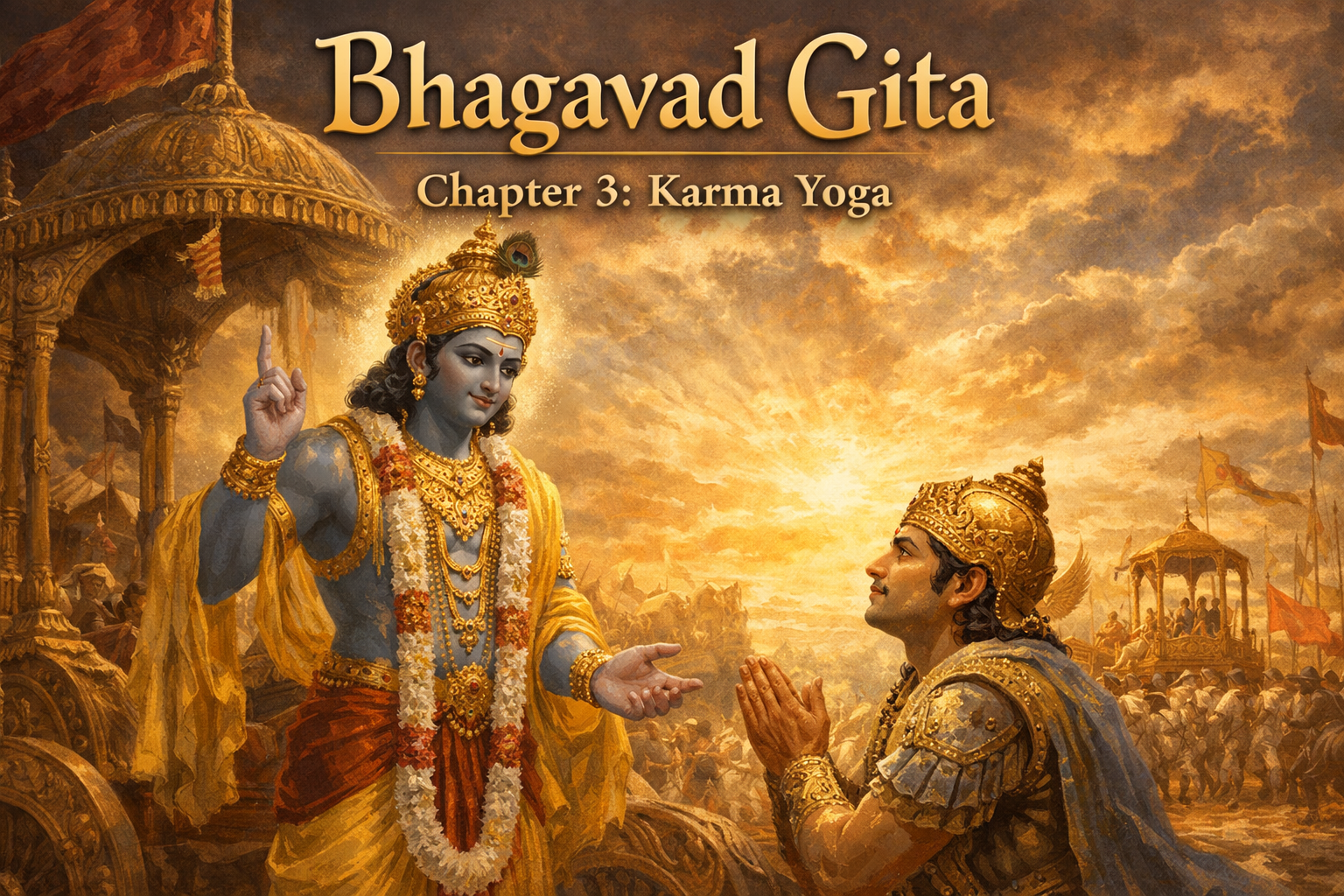

After hearing the profound philosophical teachings of Sankhya Yoga in Chapter 2, Arjuna becomes confused about the path he should follow. Krishna has explained the importance of knowledge and self-realization, but at the same time He urges Arjuna to perform his duty as a warrior.
Arjuna now wonders: If knowledge is superior to action, why should he engage in a terrible war?
This question leads to Chapter 3 of the Bhagavad Gita, where Lord Krishna introduces the concept of Karma Yoga — the Yoga of Selfless Action.
Krishna explains that no human being can remain without action even for a moment. Instead of abandoning action, one must perform duties with the right attitude — without attachment to the results.
This chapter teaches that when actions are performed selflessly and offered to the Divine, they lead not to bondage but to spiritual freedom.
“This chapter teaches that when actions are performed selflessly and offered to the Divine, they lead not to bondage but to spiritual freedom. For a deeper traditional interpretation of these teachings, you can explore Bhagavad Gita Chapter 3 Karma Yoga explained.”
Arjuna’s Question About Action
Verse 3.1
Sanskrit Shloka
अर्जुन उवाच
ज्यायसी चेत्कर्मणस्ते मता बुद्धिर्जनार्दन ।
तत्किं कर्मणि घोरे मां नियोजयसि केशव ॥
Translation
Arjuna said:
O Janardana (Krishna), if you consider knowledge superior to action, then why do you urge me to engage in this terrible action of war?
Explanation
Arjuna is confused by Krishna’s earlier teachings. Krishna spoke about the importance of wisdom and inner realization, which made Arjuna think that renouncing action might be better than fighting.
Now Arjuna questions Krishna: if spiritual knowledge is superior, why must he participate in the battle?
This question represents a common human dilemma — should one withdraw from difficult responsibilities or face them with courage?
Verse 3.2
Sanskrit Shloka
व्यामिश्रेणेव वाक्येन बुद्धिं मोहयसीव मे ।
तदेकं वद निश्चित्य येन श्रेयोऽहमाप्नुयाम् ॥
Translation
Your words seem to confuse my understanding. Please tell me clearly which path is truly beneficial for me.
Explanation
Arjuna feels that Krishna’s teachings appear contradictory. On one hand Krishna praises wisdom and renunciation, and on the other hand He encourages Arjuna to fight.
Arjuna sincerely asks Krishna to explain one clear path that will lead him toward spiritual welfare.
This moment shows Arjuna’s humility and genuine desire to understand the truth.
Krishna Explains the Two Paths
Verse 3.3
Sanskrit Shloka
श्रीभगवानुवाच
लोकेऽस्मिन्द्विविधा निष्ठा पुरा प्रोक्ता मयानघ ।
ज्ञानयोगेन सांख्यानां कर्मयोगेन योगिनाम् ॥
Translation
The Blessed Lord said:
O sinless Arjuna, in this world there are two kinds of spiritual paths — the path of knowledge (Jnana Yoga) for the contemplative and the path of action (Karma Yoga) for those who are active.
Explanation
Krishna clarifies that spiritual progress can occur through two complementary paths:
Jnana Yoga – the path of knowledge and contemplation
Karma Yoga – the path of selfless action
Different people follow different paths depending on their nature. For individuals who are actively engaged in the world, Karma Yoga is the appropriate path.
Krishna is preparing Arjuna to understand that his duty as a warrior must be fulfilled through Karma Yoga.
Why Action Cannot Be Avoided
Verse 3.4
Sanskrit Shloka
न कर्मणामनारम्भान्नैष्कर्म्यं पुरुषोऽश्नुते ।
न च संन्यसनादेव सिद्धिं समधिगच्छति ॥
Translation
A person does not achieve freedom from action by merely avoiding work, nor does one attain perfection simply by renouncing action.
Explanation
Krishna explains an important principle: true renunciation does not mean escaping responsibilities.
Merely refusing to act does not lead to spiritual liberation. In fact, avoiding duties can create further confusion and stagnation.
Spiritual growth comes not from inactivity, but from performing actions with the right consciousness.
Verse 3.5
Sanskrit Shloka
न हि कश्चित्क्षणमपि जातु तिष्ठत्यकर्मकृत् ।
कार्यते ह्यवशः कर्म सर्वः प्रकृतिजैर्गुणैः ॥
Translation
No one can remain without performing action even for a moment. Everyone is compelled to act according to the qualities born of nature.
Explanation
Krishna reveals a fundamental truth about human existence: action is unavoidable.
Even if someone decides to remain inactive, the mind continues to think, desire, and plan. These mental activities are also forms of action.
Human beings are influenced by the three qualities of nature (gunas):
Sattva – purity and harmony
Rajas – activity and passion
Tamas – inertia and ignorance
Because of these forces, every person is naturally driven to act.
Therefore, the solution is not to stop acting but to transform action into a spiritual practice through Karma Yoga.
Arjuna’s confusion in this chapter begins from the moment of Arjuna’s emotional breakdown before the Kurukshetra war, when he refused to fight after seeing his own relatives and teachers standing on the battlefield.
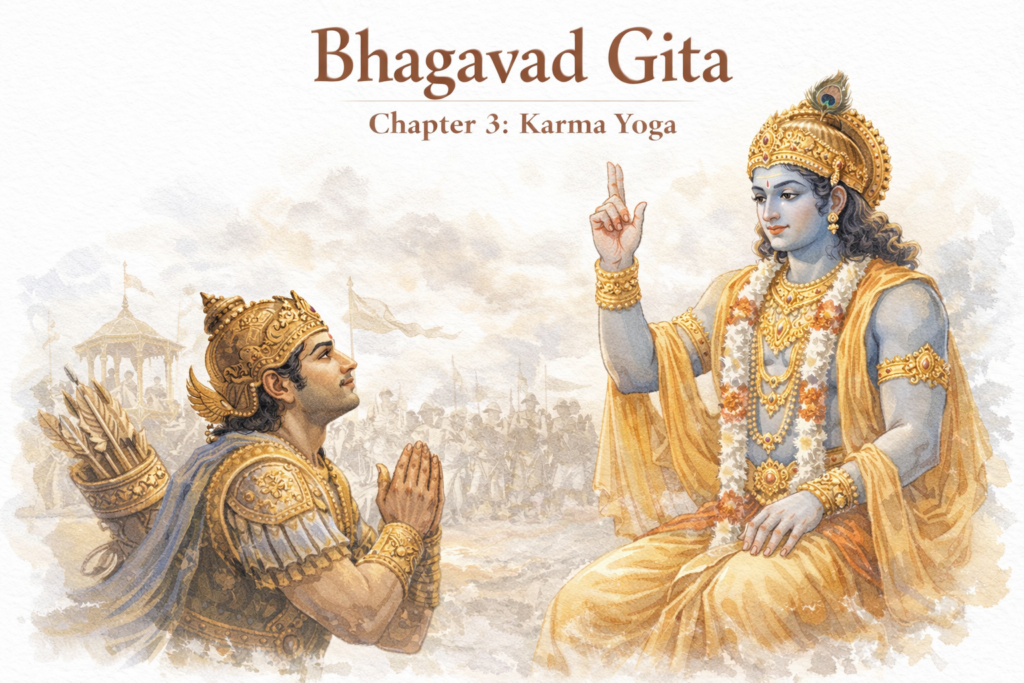
“Earlier, Krishna had already revealed Krishna’s teaching about the immortality of the soul, explaining that the Self is eternal and cannot be destroyed.”
The Danger of False Renunciation
Verse 3.6
Sanskrit Shloka
कर्मेन्द्रियाणि संयम्य
य आस्ते मनसा स्मरन् ।
इन्द्रियार्थान्विमूढात्मा
मिथ्याचारः स उच्यते ॥
Translation
One who restrains the organs of action but continues to dwell on sense objects in the mind is deluded and is called a hypocrite.
Explanation
Krishna warns Arjuna against false renunciation. A person may outwardly appear disciplined by avoiding action, but if the mind constantly thinks about desires and pleasures, such restraint is not genuine.
This type of behavior is hypocrisy because the external behavior does not match the internal state of the mind.
True spiritual discipline requires control of both actions and thoughts, not merely physical withdrawal.
Verse 3.7
Sanskrit Shloka
यस्त्विन्द्रियाणि मनसा
नियम्यारभतेऽर्जुन ।
कर्मेन्द्रियैः कर्मयोगम्
असक्तः स विशिष्यते ॥
Translation
But one who controls the senses with the mind and performs action through the organs of work without attachment excels.
Explanation
Krishna now explains the correct approach.
Instead of abandoning work, a person should:
control the senses
discipline the mind
perform duties without attachment
Such a person practices Karma Yoga, transforming ordinary work into a path of spiritual growth.
This is the ideal path Krishna recommends for Arjuna.
The Importance of Performing Duty
Verse 3.8
Sanskrit Shloka
नियतं कुरु कर्म त्वं
कर्म ज्यायो ह्यकर्मणः ।
शरीरयात्रापि च ते
न प्रसिद्ध्येदकर्मणः ॥
Translation
Perform your prescribed duty, for action is better than inaction. Even the maintenance of your body would not be possible without action.
Explanation
Krishna emphasizes that action is necessary for life itself.
Even basic survival—such as eating, working, and caring for the body—requires action.
Therefore, abandoning duties is neither practical nor spiritually beneficial.
Instead, Krishna encourages Arjuna to perform his responsibilities sincerely and responsibly.
The Principle of Sacred Action (Yajna)
Verse 3.9
Sanskrit Shloka
यज्ञार्थात्कर्मणोऽन्यत्र
लोकोऽयं कर्मबन्धनः ।
तदर्थं कर्म कौन्तेय
मुक्तसंगः समाचर ॥
Translation
Work performed as a sacrifice for the Divine does not cause bondage. But work done for selfish purposes binds one to the cycle of action.
Explanation
Here Krishna introduces the important concept of Yajna, which means sacrifice or sacred offering.
Actions performed only for personal gain create attachment and bondage. However, when work is performed as an offering to the Divine or for the welfare of society, it becomes spiritually purifying.
This teaching forms the core principle of Karma Yoga:
Work selflessly and dedicate the results to a higher purpose.
Creation and the Cycle of Duty
Verse 3.10
Sanskrit Shloka
सहयज्ञाः प्रजाः सृष्ट्वा
पुरोवाच प्रजापतिः ।
अनेन प्रसविष्यध्वम्
एष वोऽस्त्विष्टकामधुक् ॥
Translation
In the beginning of creation, the Creator created humanity along with the principle of sacrifice and said: “By this shall you prosper, and this shall fulfill your desires.”
Explanation
Krishna explains that the principle of Yajna was established at the very beginning of creation.
The universe functions through a system of mutual cooperation and sacrifice. Humans, nature, and divine forces are interconnected.
When individuals perform their duties selflessly and contribute to the welfare of the world, harmony and prosperity arise.
But when people act purely out of selfish desire, this natural balance is disturbed.
Thus Krishna teaches that selfless action sustains the order of the universe.
The Cosmic Cycle of Duty and Harmony
Verse 3.11
Sanskrit Shloka
देवान्भावयतानेन
ते देवा भावयन्तु वः ।
परस्परं भावयन्तः
श्रेयः परमवाप्स्यथ ॥
Translation
By performing sacrifice, nourish the gods, and they will in turn nourish you. Thus supporting one another, you shall achieve the highest good.
Explanation
Krishna explains the principle of mutual cooperation between humans and the natural forces of the universe.
When humans perform duties selflessly and live in harmony with nature, the natural world provides prosperity in return.
This teaching highlights the importance of balance, gratitude, and responsibility toward nature and society.
When cooperation replaces selfishness, collective well-being arises.
Verse 3.12
Sanskrit Shloka
इष्टान्भोगान्हि वो देवा
दास्यन्ते यज्ञभाविताः ।
तैर्दत्तानप्रदायैभ्यो
यो भुङ्क्ते स्तेन एव सः ॥
Translation
The gods, nourished by sacrifice, will grant you desired blessings. But one who enjoys these gifts without offering anything in return is truly a thief.
Explanation
Krishna teaches that taking from the world without giving back is a form of spiritual theft.
Nature provides humans with food, resources, and life itself. When people consume these blessings without contributing to the welfare of others, they disrupt the natural order.
The message is clear: life should be based on contribution, not only consumption.
Verse 3.13
Sanskrit Shloka
यज्ञशिष्टाशिनः सन्तो
मुच्यन्ते सर्वकिल्बिषैः ।
भुञ्जते ते त्वघं पापा
ये पचन्त्यात्मकारणात् ॥
Translation
The righteous who eat food offered first in sacrifice are freed from all sins. But those who cook for their own selfish pleasure consume only sin.
Explanation
Krishna emphasizes the importance of gratitude and selfless intention.
When people recognize that everything comes from a higher source and share their resources with others, their actions become spiritually pure.
However, when individuals live only for their own pleasure and ignore the welfare of others, their actions create negative consequences.
This verse reminds us that sharing and gratitude purify human life.
Verse 3.14
Sanskrit Shloka
अन्नाद्भवन्ति भूतानि
पर्जन्यादन्नसम्भवः ।
यज्ञाद्भवति पर्जन्यो
यज्ञः कर्मसमुद्भवः ॥
Translation
All living beings depend on food. Food is produced from rain. Rain comes from sacrifice, and sacrifice arises from righteous action.
Explanation
Krishna now explains the cycle that sustains life on Earth.
Living beings depend on food
Food depends on rain
Rain depends on harmonious natural balance
That balance is maintained through righteous actions and sacrifice
This verse highlights the deep connection between human behavior and the natural environment.
Responsible living sustains the world, while selfish actions disrupt this balance.
Verse 3.15
Sanskrit Shloka
कर्म ब्रह्मोद्भवं विद्धि
ब्रह्माक्षरसमुद्भवम् ।
तस्मात्सर्वगतं ब्रह्म
नित्यं यज्ञे प्रतिष्ठितम् ॥
Translation
Know that action arises from sacred duty, and sacred duty originates from the eternal truth. Therefore the Supreme reality is always present in acts of sacrifice.
Explanation
Krishna reveals that the principle of duty is not merely social—it is rooted in the cosmic order.
The universe itself operates according to divine law. When humans perform their duties selflessly, they align themselves with this universal order.
Thus, selfless action becomes a way of connecting with the Divine.
Verse 3.16
Sanskrit Shloka
एवं प्रवर्तितं चक्रं
नानुवर्तयतीह यः ।
अघायुरिन्द्रियारामो
मोघं पार्थ स जीवति ॥
Translation
One who does not follow this cycle of duty and cooperation lives a sinful life, delighting only in the senses and living in vain.
Explanation
Krishna concludes this section by emphasizing that the cycle of duty and sacrifice must be maintained.
When individuals live only for personal pleasure and ignore their responsibilities toward society and nature, their lives lose higher purpose.
A meaningful life is one that contributes to the greater harmony of the universe.
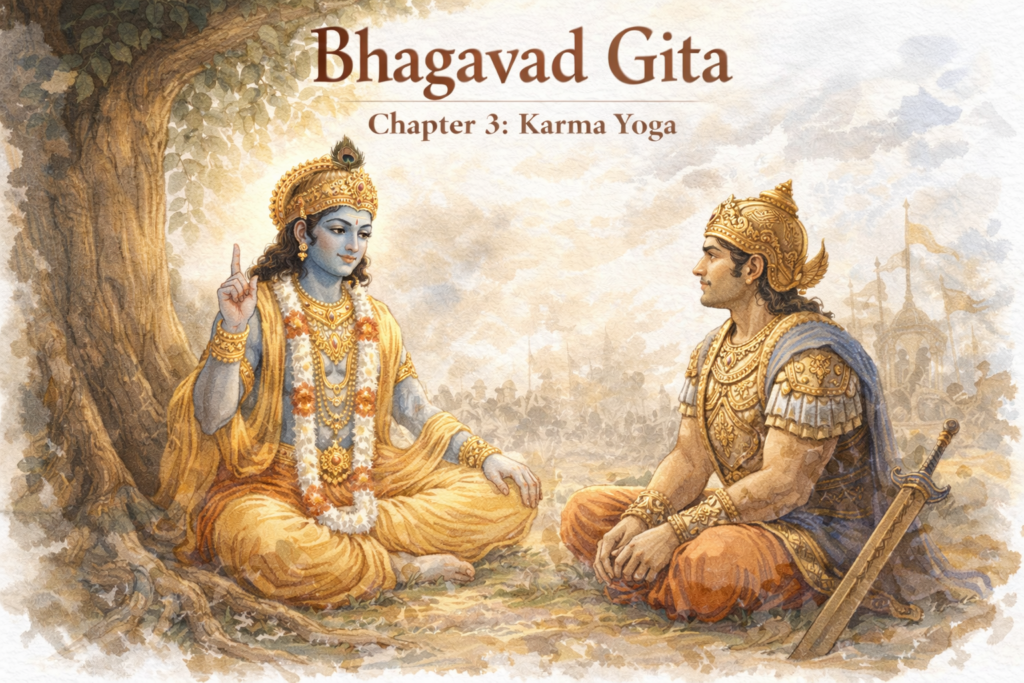
“The concept of Karma Yoga becomes clearer when we connect it with the wisdom of Sankhya Yoga explained by Krishna, where detachment from the results of action is emphasized.”
The Role of the Self-Realized Person
Verse 3.17
Sanskrit Shloka
यस्त्वात्मरतिरेव स्यादात्मतृप्तश्च मानवः ।
आत्मन्येव च सन्तुष्टस्तस्य कार्यं न विद्यते ॥
Translation
But a person who rejoices in the Self, who is satisfied in the Self and content within the Self alone, has no duty to perform.
Explanation
Krishna describes the state of a self-realized individual.
Such a person finds happiness within the inner Self rather than external possessions or achievements. Since their fulfillment is internal, they are not driven by desires or ambitions.
However, this does not mean that they avoid action. Instead, they act without personal motivation, simply because it is right.
Verse 3.18
Sanskrit Shloka
नैव तस्य कृतेनार्थो
नाकृतेनेह कश्चन ।
न चास्य सर्वभूतेषु
कश्चिदर्थव्यपाश्रयः ॥
Translation
For such a person there is nothing to gain by performing action, nor anything to lose by avoiding action. They do not depend on any living being for their fulfillment.
Explanation
A realized soul is independent of external outcomes.
Ordinary people perform actions to gain success, wealth, recognition, or happiness. But one who has realized the Self is already fulfilled and therefore does not depend on external achievements.
Still, such a person may continue to act for the benefit of society.
The Power of Selfless Action
Verse 3.19
Sanskrit Shloka
तस्मादसक्तः सततं
कार्यं कर्म समाचर ।
असक्तो ह्याचरन्कर्म
परमाप्नोति पूरुषः ॥
Translation
Therefore, perform your duty without attachment. By working without attachment, a person attains the Supreme.
Explanation
This verse is one of the central teachings of Karma Yoga.
Krishna advises Arjuna to perform his duty sincerely but without attachment to the results.
When actions are performed selflessly, they purify the mind and lead to spiritual growth.
This teaching applies to every aspect of life—work, leadership, service, and daily responsibilities.
Verse 3.20
Sanskrit Shloka
कर्मणैव हि संसिद्धिमास्थिता जनकादयः ।
लोकसंग्रहमेवापि सम्पश्यन्कर्तुमर्हसि ॥
Translation
King Janaka and others attained perfection through action alone. Therefore you should act to guide society and maintain social order.
Explanation
Krishna gives an example of King Janaka, a wise ruler who achieved spiritual perfection while performing his worldly duties.
This example shows that spiritual realization does not require abandoning responsibilities.
Instead, duties performed with the right attitude can lead to liberation.
Leaders Set the Standard for Society
Verse 3.21
Sanskrit Shloka
यद्यदाचरति श्रेष्ठस्तत्तदेवेतरो जनः ।
स यत्प्रमाणं कुरुते लोकस्तदनुवर्तते ॥
Translation
Whatever a great person does, others follow. The standards they set become the example for the world.
Explanation
Krishna explains the powerful influence of leaders and role models.
People naturally imitate those they admire or respect. Therefore, individuals in positions of influence must act responsibly and ethically.
Their actions shape the behavior and values of society.
This teaching is extremely relevant for leaders, teachers, and professionals.
Verse 3.22
Sanskrit Shloka
न मे पार्थास्ति कर्तव्यं
त्रिषु लोकेषु किञ्चन ।
नानवाप्तमवाप्तव्यं
वर्त एव च कर्मणि ॥
Translation
O Arjuna, there is nothing in the three worlds that I must achieve, nor anything unattained for Me. Yet I continue to perform action.
Explanation
Krishna explains that although He has nothing to gain, He still performs actions.
This demonstrates that action performed for the welfare of the world is noble and necessary.
Krishna acts not for personal benefit but to maintain harmony and order in the universe.
Verse 3.23
Sanskrit Shloka
यदि ह्यहं न वर्तेयं
जातु कर्मण्यतन्द्रितः ।
मम वर्त्मानुवर्तन्ते
मनुष्याः पार्थ सर्वशः ॥
Translation
If I did not perform action carefully, people would follow My example and stop acting as well.
Explanation
Krishna explains that His actions influence the world.
If He stopped acting, others might also abandon their responsibilities. Therefore, He continues to perform duties as an example.
This emphasizes that responsibility grows with influence.
Verse 3.24
Sanskrit Shloka
उत्सीदेयुरिमे लोका
न कुर्यां कर्म चेदहम् ।
सङ्करस्य च कर्ता स्याम्
उपहन्यामिमाः प्रजाः ॥
Translation
If I did not perform action, these worlds would perish. I would cause disorder and destroy these beings.
Explanation
Krishna concludes this section by explaining the importance of maintaining social and cosmic order.
If responsible individuals abandon their duties, confusion and disorder will spread.
Therefore, people must perform their responsibilities sincerely to preserve harmony in the world.
Guiding Society Through Action
Verse 3.25
Sanskrit Shloka
सक्ताः कर्मण्यविद्वांसो
यथा कुर्वन्ति भारत ।
कुर्याद्विद्वांस्तथासक्तः
चिकीर्षुर्लोकसंग्रहम् ॥
Translation
Just as the ignorant act with attachment to work, O Arjuna, the wise should also act but without attachment, for the welfare of the world.
Explanation
Krishna explains that ordinary people often work with selfish motives such as profit, recognition, or personal success.
However, a wise person should continue performing actions without attachment, not for personal gain but for the welfare of society.
By doing so, they help maintain social harmony and inspire others to follow righteous conduct.
Verse 3.26
Sanskrit Shloka
न बुद्धिभेदं जनयेदज्ञानां
कर्मसङ्गिनाम् ।
जोषयेत्सर्वकर्माणि
विद्वान्युक्तः समाचरन् ॥
Translation
The wise should not disturb the minds of those who are attached to action. Instead, they should encourage them to perform their duties properly.
Explanation
Krishna advises the wise not to create confusion among people who are still learning.
Rather than criticizing or discouraging them, wise individuals should guide others through example and encouragement.
Leadership through patience and understanding helps society progress gradually.
Nature and Human Action
Verse 3.27
Sanskrit Shloka
प्रकृतेः क्रियमाणानि
गुणैः कर्माणि सर्वशः ।
अहङ्कारविमूढात्मा
कर्ताहमिति मन्यते ॥
Translation
All actions are carried out by the qualities of nature. But a person whose mind is deluded by ego believes, “I am the doer.”
Explanation
Krishna explains that human actions are influenced by the three gunas (qualities of nature):
Sattva – purity and wisdom
Rajas – activity and passion
Tamas – inertia and ignorance
These forces shape human behavior. However, due to ego, people believe they alone are responsible for their actions.
True wisdom arises when one understands the deeper forces of nature at work.
Verse 3.28
Sanskrit Shloka
तत्त्ववित्तु महाबाहो
गुणकर्मविभागयोः ।
गुणा गुणेषु वर्तन्त
इति मत्वा न सज्जते ॥
Translation
But one who understands the truth about the qualities of nature and their actions knows that the senses interact with sense objects and therefore does not become attached.
Explanation
A wise person recognizes that many actions arise from natural tendencies rather than personal control.
Understanding this helps them remain detached from ego and pride.
Such individuals perform their duties calmly without being disturbed by success or failure.
Respecting the Natural Path
Verse 3.29
Sanskrit Shloka
प्रकृतेर्गुणसम्मूढाः
सज्जन्ते गुणकर्मसु ।
तानकृत्स्नविदो मन्दान्
कृत्स्नविन्न विचालयेत् ॥
Translation
Those who are deluded by the qualities of nature become attached to their actions. The wise should not disturb such people who lack full understanding.
Explanation
Krishna again emphasizes patience and understanding.
Many people act according to their natural tendencies. Instead of criticizing them harshly, wise individuals should guide them gently.
True leadership involves wisdom, compassion, and patience.
Surrendering Actions to the Divine
Verse 3.30
Sanskrit Shloka
मयि सर्वाणि कर्माणि
संन्यस्याध्यात्मचेतसा ।
निराशीर्निर्ममो भूत्वा
युध्यस्व विगतज्वरः ॥
Translation
Dedicate all your actions to Me with a focused mind on the Self. Free from desire and selfishness, fight without anxiety.
Explanation
Krishna directly instructs Arjuna to perform his duty as a warrior while surrendering the results to the Divine.
When actions are performed with:
no selfish desire
no ego
no anxiety about results
they become spiritually pure.
This is the essence of Karma Yoga.
The Benefits of Following This Teaching
Verse 3.31
Sanskrit Shloka
ये मे मतमिदं नित्यम्
अनुतिष्ठन्ति मानवाः ।
श्रद्धावन्तोऽनसूयन्तो
मुच्यन्ते तेऽपि कर्मभिः ॥
Translation
Those who faithfully follow these teachings without doubt become free from the bondage of action.
Explanation
Krishna assures Arjuna that individuals who sincerely practice Karma Yoga gradually become liberated from the cycle of karma.
Faith, discipline, and sincerity help transform ordinary actions into a path toward spiritual freedom.
Verse 3.32
Sanskrit Shloka
ये त्वेतदभ्यसूयन्तो
नानुतिष्ठन्ति मे मतम् ।
सर्वज्ञानविमूढांस्तान्
विद्धि नष्टानचेतसः ॥
Translation
But those who criticize these teachings and do not follow them remain deluded and lost in ignorance.
Explanation
Krishna warns that ignoring spiritual wisdom can lead to confusion and suffering.
People who reject higher knowledge may remain trapped in selfish desires and negative actions.
Understanding and applying wisdom is essential for personal and spiritual growth.
The Power of One’s Own Nature
Verse 3.33
Sanskrit Shloka
सदृशं चेष्टते स्वस्याः
प्रकृतेर्ज्ञानवानपि ।
प्रकृतिं यान्ति भूतानि
निग्रहः किं करिष्यति ॥
Translation
Even a wise person acts according to their own nature. All beings follow their natural tendencies. What can repression accomplish?
Explanation
Krishna acknowledges that every individual has a unique nature shaped by their qualities and experiences.
Instead of forcibly suppressing natural tendencies, one should understand and channel them positively.
Spiritual progress involves transforming one’s nature rather than denying it.
Verse 3.34
Sanskrit Shloka
इन्द्रियस्येन्द्रियस्यार्थे
रागद्वेषौ व्यवस्थितौ ।
तयोर्न वशमागच्छेत्
तौ ह्यस्य परिपन्थिनौ ॥
Translation
Attraction and aversion exist in relation to the senses and their objects. One should not come under their control, for they are obstacles.
Explanation
Krishna explains that human senses naturally develop likes and dislikes.
However, blindly following these impulses leads to imbalance and suffering.
A wise person maintains control over desires and emotions instead of becoming their servant.
The Principle of Swadharma (One’s Own Duty)
Verse 3.35
Sanskrit Shloka
श्रेयान्स्वधर्मो विगुणः
परधर्मात्स्वनुष्ठितात् ।
स्वधर्मे निधनं श्रेयः
परधर्मो भयावहः ॥
Translation
It is better to perform one’s own duty imperfectly than to perform another’s duty perfectly. Following another’s path is dangerous.
Explanation
Krishna introduces the powerful concept of Swadharma — one’s own duty or path in life.
Every individual has unique responsibilities based on their nature and circumstances.
Trying to imitate someone else’s path may lead to confusion and failure.
Therefore, it is better to follow one’s own purpose and responsibilities, even if imperfectly.
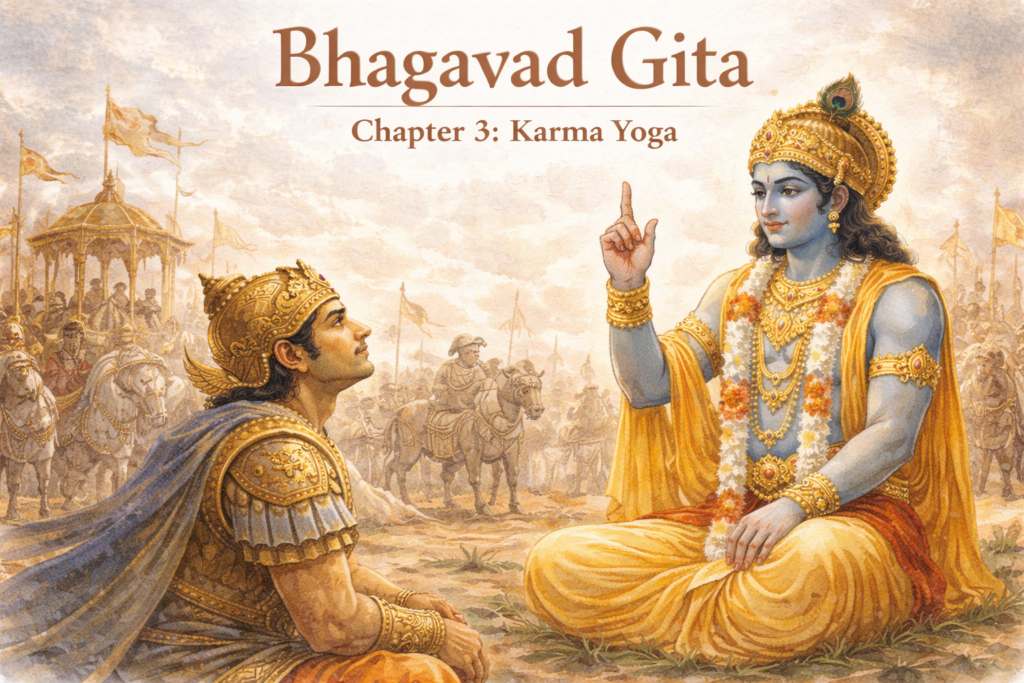
Arjuna’s Question About Sin
Verse 3.36
Sanskrit Shloka
अर्जुन उवाच
अथ केन प्रयुक्तोऽयं
पापं चरति पुरुषः ।
अनिच्छन्नपि वार्ष्णेय
बलादिव नियोजितः ॥
Translation
Arjuna said:
O Krishna, what is it that forces a person to commit sin, even unwillingly, as if compelled by force?
Explanation
Arjuna asks a very practical question. Many people know what is right but still act wrongly. Arjuna wonders what inner force drives human beings toward harmful actions.
This question leads Krishna to explain the true enemy of human beings — uncontrolled desire and anger.
The Enemy: Desire and Anger
Verse 3.37
Sanskrit Shloka
श्रीभगवानुवाच
काम एष क्रोध एष
रजोगुणसमुद्भवः ।
महाशनो महापाप्मा
विद्ध्येनमिह वैरिणम् ॥
Translation
The Blessed Lord said:
It is desire, born of the quality of passion, which later turns into anger. Know this as the great enemy that destroys wisdom.
Explanation
Krishna explains that desire (Kama) arises from the quality of Rajas, the force of passion and activity.
When desires are fulfilled, they create attachment. When they are frustrated, they turn into anger (Krodha).
This cycle leads to confusion, loss of wisdom, and destructive actions. Therefore, Krishna identifies desire as the great enemy of spiritual growth.
Verse 3.38
Sanskrit Shloka
धूमेनाव्रियते वह्निर्यथादर्शो मलेन च ।
यथोल्बेनावृतो गर्भस्तथा तेनेदमावृतम् ॥
Translation
Just as fire is covered by smoke, a mirror by dust, and an embryo by the womb, knowledge is covered by desire.
Explanation
Krishna uses three powerful metaphors to explain how desire hides wisdom.
Smoke covers fire
Dust covers a mirror
The womb covers an embryo
Similarly, desire covers human intelligence and prevents people from seeing truth clearly.
When desire becomes strong, judgment becomes clouded.
Verse 3.39
Sanskrit Shloka
आवृतं ज्ञानमेतेन
ज्ञानिनो नित्यवैरिणा ।
कामरूपेण कौन्तेय
दुष्पूरेणानलेन च ॥
Translation
O Arjuna, knowledge is covered by this eternal enemy in the form of desire, which is like an insatiable fire.
Explanation
Krishna explains that desire is never fully satisfied.
The more it is fed, the stronger it becomes — like a fire that grows when fuel is added.
Because of this endless craving, human beings often lose clarity and peace.
Therefore controlling desire is essential for mental balance and spiritual progress.
Where Desire Resides
Verse 3.40
Sanskrit Shloka
इन्द्रियाणि मनो बुद्धिरस्याधिष्ठानमुच्यते ।
एतैर्विमोहयत्येष ज्ञानमावृत्य देहिनम् ॥
Translation
The senses, the mind, and the intellect are said to be the places where desire resides. Through them, desire confuses a person and obscures wisdom.
Explanation
Krishna explains that desire operates through three levels:
Senses – attraction to objects
Mind – thoughts and emotional attachment
Intellect – distorted reasoning
When these are influenced by desire, a person loses clarity and wisdom.
Understanding this helps individuals identify where inner discipline must begin.
Controlling Desire
Verse 3.41
Sanskrit Shloka
तस्मात्त्वमिन्द्रियाण्यादौ
नियम्य भरतर्षभ ।
पाप्मानं प्रजहि ह्येनं
ज्ञानविज्ञाननाशनम् ॥
Translation
Therefore, O Arjuna, control the senses first and destroy this sinful force of desire which destroys knowledge and wisdom.
Explanation
Krishna advises that the first step toward mastering desire is controlling the senses.
If the senses are disciplined, the mind becomes calmer and the intellect becomes clearer.
This discipline protects wisdom and prevents destructive behavior.
Verse 3.42
Sanskrit Shloka
इन्द्रियाणि पराण्याहुरिन्द्रियेभ्यः परं मनः ।
मनसस्तु परा बुद्धिर्यो बुद्धेः परतस्तु सः ॥
Translation
The senses are superior to the body, the mind is superior to the senses, the intellect is superior to the mind, and the Self is superior to the intellect.
Explanation
Krishna explains the hierarchy of human consciousness:
Body → Senses → Mind → Intellect → Self
The Self (Atman) is the highest and most powerful.
By strengthening the intellect and realizing the Self, a person can gain mastery over desires and emotions.
Final Instruction of Chapter 3
Verse 3.43
Sanskrit Shloka
एवं बुद्धेः परं बुद्ध्वा
संस्तभ्यात्मानमात्मना ।
जहि शत्रुं महाबाहो
कामरूपं दुरासदम् ॥
Translation
Knowing the Self to be superior to the intellect, control the mind through the Self and conquer this difficult enemy called desire.
Explanation
Krishna concludes Chapter 3 by reminding Arjuna that desire is the true enemy that leads to suffering and confusion.
By developing self-awareness, discipline, and spiritual understanding, a person can overcome this enemy.
When desire is controlled and actions are performed selflessly, one becomes established in Karma Yoga, the path of righteous action.
Chapter 3 Conclusion
Bhagavad Gita Chapter 3 — Karma Yoga teaches that:
Action is unavoidable in human life
Duties should be performed without attachment to results
Selfless action purifies the mind
Leaders must act responsibly for the welfare of society
Desire and anger are the main obstacles to wisdom
Krishna ultimately guides Arjuna to understand that true freedom comes not from abandoning action, but from performing action selflessly and with spiritual awareness.
Arjuna now asks another profound question:
“If actions must be performed without attachment, what is the deeper knowledge behind this wisdom?”
This question leads to the next teaching of Krishna.
Bhagavad Gita: Chapter 4 – Jnana Karma Sanyasa Yoga (The Yoga of Knowledge and Renunciation of Action)
To understand the historical background, structure, and deeper context of this sacred dialogue, read our complete guide on Bhagavad Gita – History, Structure, and Timeless Wisdom.
Read More interesting Content in my Blog Section.