
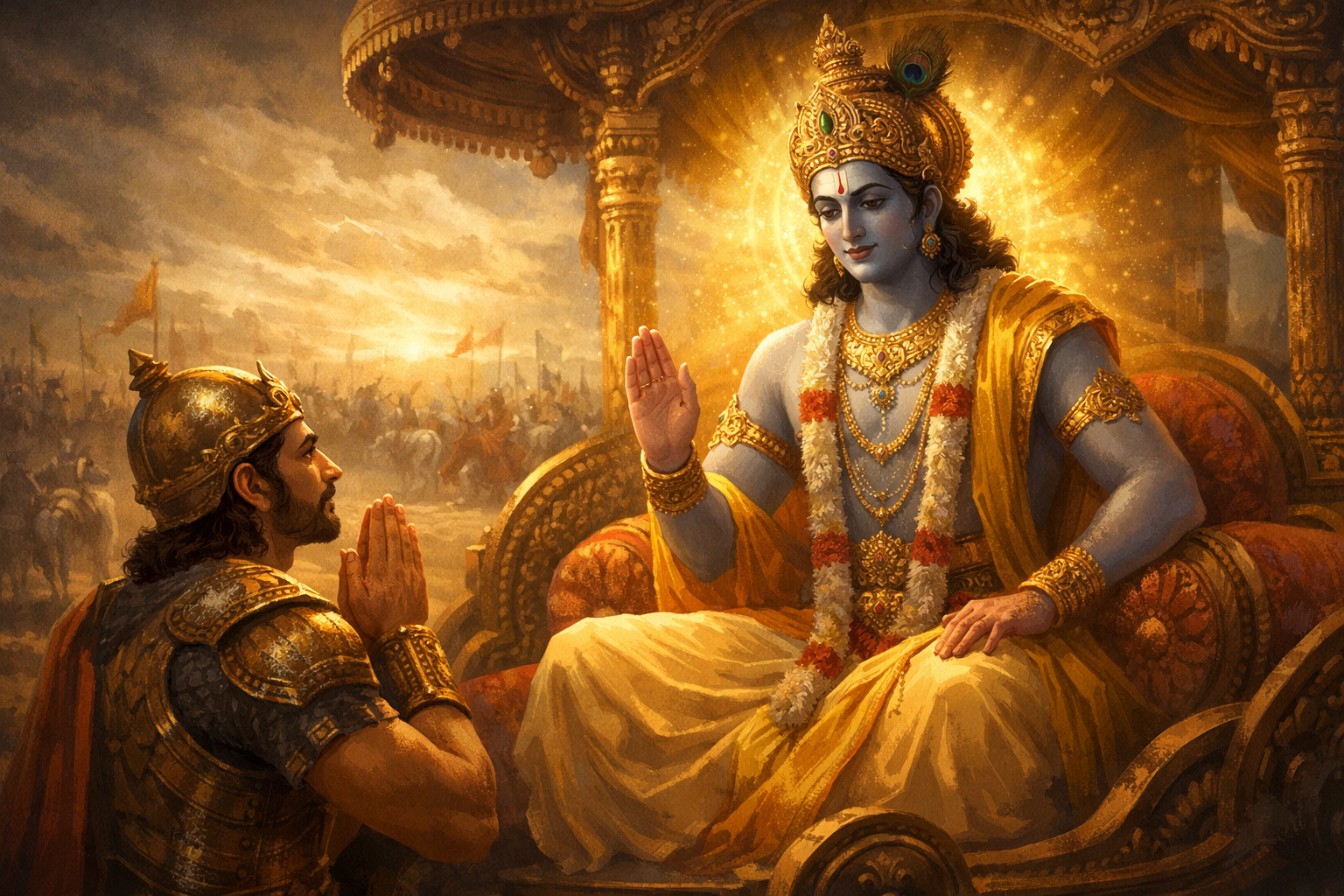

Section 1: Arjuna Surrenders (Verses 1–10)
🔹 Verse 2.1
Sanskrit Shloka
संजय उवाच ।
तं तथा कृपयाविष्टमश्रुपूर्णाकुलेक्षणम् ।
विषीदन्तमिदं वाक्यमुवाच मधुसूदनः ॥ २.१ ॥
Simple Translation
Sanjaya said:
Seeing Arjuna overwhelmed with compassion and sorrow, his eyes filled with tears, Lord Krishna spoke these words.
Context Explanation
Krishna has remained silent until now.
He allowed Arjuna to express:
Fear
Moral confusion
Emotional breakdown
Now the divine response begins.
Deeper Meaning
Wisdom speaks only when the ego stops arguing.
Krishna did not interrupt Arjuna.
He waited for surrender.
Modern Relevance
True guidance enters when:
We admit,
“I am confused.”
As long as we think we know everything,
wisdom does not enter.
🔹 Verse 2.2
Sanskrit Shloka
श्रीभगवानुवाच ।
कुतस्त्वा कश्मलमिदं विषमे समुपस्थितम् ।
अनार्यजुष्टमस्वर्ग्यमकीर्तिकरमर्जुन ॥ २.२ ॥
Simple Translation
The Supreme Lord said:
“My dear Arjuna, how has this weakness come upon you at such a critical time? It is not befitting a noble person. It does not lead to higher worlds, and it brings dishonor.”
Context Explanation
Krishna does not begin with comfort.
He begins with challenge.
He calls Arjuna’s state:
Weakness
Unworthy of a noble warrior
Dishonorable
This is tough love.
Deeper Meaning
Spiritual guidance is not always soft.
Sometimes awakening requires confrontation.
Krishna is not insulting Arjuna —
He is shaking him out of emotional fog.
Modern Relevance
Great mentors do not always say:
“It’s okay, just relax.”
Sometimes they say:
“You are better than this.”
That awakening moment changes everything.
🔹 Verse 2.3
Sanskrit Shloka
क्लैब्यं मा स्म गमः पार्थ नैतत्त्वय्युपपद्यते ।
क्षुद्रं हृदयदौर्बल्यं त्यक्त्वोत्तिष्ठ परन्तप ॥ २.३ ॥
Simple Translation
“O Arjuna, do not yield to weakness. This does not suit you. Give up this petty faint-heartedness and arise, O conqueror of enemies!”
Context Explanation
Krishna reminds Arjuna of his true identity.
He calls him:
“Parantapa” – Destroyer of enemies.
Krishna is reminding him:
This is not who you are.
Deeper Meaning
The Gita’s psychology is profound.
When we forget our higher self,
we collapse into emotional weakness.
Krishna’s message:
Remember who you truly are.
Modern Relevance
When someone loses confidence:
They forget their strength.
Sometimes the most powerful therapy is:
Identity reminder.
“You are capable.”
“You are strong.”
“You are not your fear.”
🔹 Verse 2.4
Sanskrit Shloka
अर्जुन उवाच ।
कथं भीष्ममहं सङ्ख्ये द्रोणं च मधुसूदन ।
इषुभिः प्रतियोत्स्यामि पूजार्हावरिसूदन ॥ २.४ ॥
Simple Translation
Arjuna said:
“O Krishna, how can I fight against Bhishma and Drona, who are worthy of my worship?”
Context Explanation
Arjuna still argues.
He sees:
His grandfather
His teacher
He cannot separate duty from emotion.
Deeper Meaning
Attachment to role conflicts with role responsibility.
He is a warrior.
But he is also a student and grandson.
This inner conflict defines human life.
Modern Relevance
In professional life:
Sometimes we must oppose those we respect.
It creates emotional paralysis.
🔹 Verse 2.5
Sanskrit Shloka
गुरूनहत्वा हि महानुभावान्
श्रेयो भोक्तुं भैक्ष्यमपीह लोके ।
हत्वार्थकामांस्तु गुरूनिहैव
भुञ्जीय भोगान् रुधिरप्रदिग्धान् ॥ २.५ ॥
Simple Translation
“It is better to live by begging than to kill these noble teachers. If we kill them, our pleasures will be stained with their blood.”
Context Explanation
Arjuna still sees only the surface consequence.
He fears moral guilt.
Deeper Meaning
He assumes action equals sin.
Krishna will soon reveal:
Intent and duty matter more than emotion.
🔹 Verse 2.6
Sanskrit Shloka
न चैतद्विद्मः कतरन्नो गरीयो
यद्वा जयेम यदि वा नो जयेयुः ।
यानेव हत्वा न जिजीविषामः
तेऽवस्थिताः प्रमुखे धार्तराष्ट्राः ॥ २.६ ॥
Simple Translation
“We do not know which is better — to conquer them or to be conquered by them. If we kill the sons of Dhritarashtra, we would not wish to live. Yet they stand before us.”
Context Explanation
Arjuna is completely confused.
He says:
-
I don’t know what is right.
-
I don’t know which outcome is better.
-
Even victory feels meaningless.
This is total mental fog.
Deeper Meaning
This verse represents existential crisis.
When clarity disappears,
every option feels wrong.
This is the exact moment where transformation becomes possible.
Modern Relevance
Many people reach this point in life:
-
Career confusion
-
Relationship conflict
-
Moral dilemma
“I don’t know what is right anymore.”
This is not weakness.
This is the doorway to wisdom.
🔹 Verse 2.7
Sanskrit Shloka
कार्पण्यदोषोपहतस्वभावः
पृच्छामि त्वां धर्मसम्मूढचेताः ।
यच्छ्रेयः स्यान्निश्चितं ब्रूहि तन्मे
शिष्यस्तेऽहं शाधि मां त्वां प्रपन्नम् ॥ २.७ ॥
Simple Translation
“My nature is overcome by weakness, and I am confused about my duty. I ask You — tell me clearly what is truly good for me. I am Your disciple. Please instruct me.”
Context Explanation
This is the most important verse of surrender.
Arjuna says:
“I am your disciple.”
Until now, he was speaking as friend.
Now he speaks as student.
The Gita truly begins here.
Deeper Meaning
Spiritual transformation begins with humility.
Arjuna does three things:
-
Accepts confusion
-
Seeks guidance
-
Surrenders ego
Without surrender, knowledge cannot enter.
Modern Relevance
Real growth begins when we say:
“I need guidance.”
Not when we pretend to know everything.
🔹 Verse 2.8
Sanskrit Shloka
न हि प्रपश्यामि ममापनुद्यात्
यच्छोकमुच्छोषणमिन्द्रियाणाम् ।
अवाप्य भूमावसपत्नमृद्धं
राज्यं सुराणामपि चाधिपत्यम् ॥ २.८ ॥
Simple Translation
“I do not see what can remove this sorrow that is drying up my senses — even if I gain a prosperous kingdom on earth or sovereignty over the gods.”
Context Explanation
Arjuna now admits:
No external success can cure inner sorrow.
Not wealth.
Not power.
Not victory.
Deeper Meaning
This verse destroys material illusion.
Outer achievement does not fix inner emptiness.
The problem is not outside.
It is inside.
Modern Relevance
Many people think:
“If I get promotion…”
“If I earn more…”
“If I win…”
But internal confusion remains untouched.
Arjuna recognizes this.
🔹 Verse 2.9
Sanskrit Shloka
संजय उवाच ।
एवमुक्त्वा हृषीकेशं गुडाकेशः परन्तप ।
न योत्स्य इति गोविन्दमुक्त्वा तूष्णीं बभूव ह ॥ २.९ ॥
Simple Translation
Sanjaya said:
Having spoken thus to Krishna, Arjuna said, “I will not fight,” and fell silent.
Context Explanation
This is the final collapse.
Arjuna clearly declares:
“I will not fight.”
Then he becomes silent.
Deeper Meaning
Silence after surrender is powerful.
The mind has exhausted its arguments.
Now space is created for wisdom.
Modern Relevance
After emotional breakdown,
there is often silence.
That silence can either lead to depression —
or awakening.
For Arjuna, it leads to awakening.
🔹 Verse 2.10
Sanskrit Shloka
तमुवाच हृषीकेशः प्रहसन्निव भारत ।
सेनयोरुभयोर्मध्ये विषीदन्तमिदं वचः ॥ २.१० ॥
Simple Translation
Krishna, smiling gently, spoke to the sorrowful Arjuna between the two armies.
Context Explanation
Krishna smiles.
Why?
Because Arjuna is finally ready.
The battlefield remains.
The armies remain.
But now the teaching begins.
Deeper Meaning
The smile represents divine assurance.
Crisis is not the end.
It is preparation.
Krishna sees what Arjuna cannot yet see:
This moment will lead to enlightenment.
Modern Relevance
Sometimes life smiles at our breakdown.
Because what feels like collapse
is actually reconstruction.

Section 2: Immortality of the Soul (2.11–2.30)
🔹 Verse 2.11
Sanskrit Shloka
श्रीभगवानुवाच ।
अशोच्यानन्वशोचस्त्वं प्रज्ञावादांश्च भाषसे ।
गतासूनगतासूंश्च नानुशोचन्ति पण्डिताः ॥ २.११ ॥
Simple Translation
The Supreme Lord said:
“You are grieving for those who should not be grieved for, yet you speak words of wisdom. The wise do not mourn for the living or the dead.”
Context Explanation
Krishna immediately addresses the core issue:
Arjuna’s grief is based on misunderstanding.
He thinks death is the end.
Krishna challenges that assumption.
Deeper Meaning
This is radical.
Krishna is not dismissing compassion.
He is correcting ignorance.
Grief based on illusion binds.
Wisdom based on truth liberates.
Modern Relevance
Much of human fear revolves around:
Loss
Death
Separation
Krishna’s teaching begins by redefining death itself.
🔹 Verse 2.12
Sanskrit Shloka
न त्वेवाहं जातु नासं
न त्वं नेमे जनाधिपाः ।
न चैव न भविष्यामः
सर्वे वयमतः परम् ॥ २.१२ ॥
Simple Translation
“There was never a time when I did not exist, nor you, nor these kings. Nor shall we ever cease to exist in the future.”
Context Explanation
Krishna introduces the concept of eternal existence.
He states clearly:
The Self does not begin.
The Self does not end.
Deeper Meaning
This verse destroys the fear of non-existence.
Consciousness is continuous.
The body changes.
The Self remains.
Modern Relevance
Identity crisis arises when we equate ourselves with roles and bodies.
Krishna teaches:
You are not temporary identity.
You are eternal awareness.
🔹 Verse 2.13
Sanskrit Shloka
देहिनोऽस्मिन्यथा देहे
कौमारं यौवनं जरा ।
तथा देहान्तरप्राप्तिः
धीरस्तत्र न मुह्यति ॥ २.१३ ॥
Simple Translation
Just as the soul passes from childhood to youth to old age within this body, similarly it passes into another body at death. The wise are not confused by this.
Context Explanation
Krishna uses simple observation:
Childhood body ≠ Youth body ≠ Old body
Yet “I” remains the same.
Death is another transition.
Deeper Meaning
Change is constant.
Self is constant.
Confusion arises when we identify with the changing.
Modern Relevance
We accept aging.
But we fear death.
Krishna says:
Both are transitions.
🔹 Verse 2.14
Sanskrit Shloka
मात्रास्पर्शास्तु कौन्तेय
शीतोष्णसुखदुःखदाः ।
आगमापायिनोऽनित्याः
तांस्तितिक्षस्व भारत ॥ २.१४ ॥
Simple Translation
O son of Kunti, contact of senses with objects produces cold and heat, pleasure and pain. These are temporary — endure them patiently.
Context Explanation
Krishna now shifts from soul to endurance.
Pleasure and pain are sensory reactions.
They come and go.
Deeper Meaning
Emotional states are temporary.
Reacting strongly to temporary waves causes suffering.
Modern Relevance
Anxiety, sadness, excitement —
all pass.
The stable mind observes without being destroyed by them.
🔹 Verse 2.15
Sanskrit Shloka
यं हि न व्यथयन्त्येते
पुरुषं पुरुषर्षभ ।
समदुःखसुखं धीरं
सोऽमृतत्वाय कल्पते ॥ २.१५ ॥
Simple Translation
The person who is not disturbed by happiness or distress and remains steady becomes eligible for immortality.
Context Explanation
Krishna introduces the ideal human:
Steady.
Balanced.
Unaffected by emotional extremes.
Deeper Meaning
Immortality is not physical.
It is spiritual stability.
Freedom comes from equanimity.
Modern Relevance
Emotional reactivity is the root of stress.
Emotional balance is the beginning of mastery.
🔹 Verse 2.16
Sanskrit Shloka
नासतो विद्यते भावो
नाभावो विद्यते सतः ।
उभयोरपि दृष्टोऽन्तस्त्वनयोस्तत्त्वदर्शिभिः ॥ २.१६ ॥
Simple Translation
The unreal has no existence; the real never ceases to be. The truth of both has been seen by the seers.
Deeper Meaning
Temporary forms are unreal in ultimate sense.
Eternal consciousness alone is real.
This is pure metaphysics.
Modern Relevance
We chase temporary things:
Status.
Wealth.
Fame.
But lasting peace lies in the permanent Self.
🔹 Verse 2.17
Sanskrit Shloka
अविनाशि तु तद्विद्धि
येन सर्वमिदं ततम् ।
विनाशमव्ययस्यास्य
न कश्चित्कर्तुमर्हति ॥ २.१७ ॥
Simple Translation
Know that which pervades the entire body to be indestructible. No one can destroy the imperishable soul.
Deeper Meaning
The Self is indestructible.
Weapons affect body.
Not consciousness.
🔹 Verse 2.18
Sanskrit Shloka
अन्तवन्त इमे देहा
नित्यस्योक्ताः शरीरिणः ।
अनाशिनोऽप्रमेयस्य
तस्माद्युध्यस्व भारत ॥ २.१८ ॥
Simple Translation
The body is temporary, but the soul is eternal. Therefore, fight, O Arjuna.
Context Explanation
Now Krishna reconnects philosophy to action.
Understanding eternity removes fear of death.
Deeper Meaning
Right knowledge restores right action.
Wisdom is not escape.
It is clarity before action.
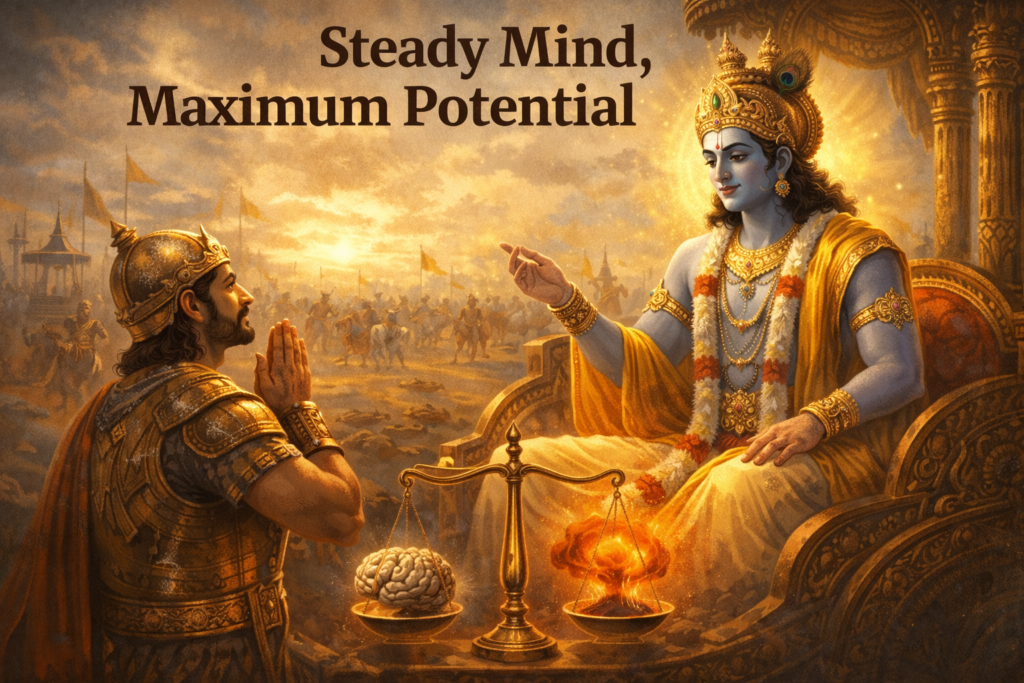
Section 2 Continued: Immortality of the Soul (Verses 2.19–2.30)
🔹 Verse 2.19
Sanskrit Shloka
य एनं वेत्ति हन्तारं
यश्चैनं मन्यते हतम् ।
उभौ तौ न विजानीतो
नायं हन्ति न हन्यते ॥ २.१९ ॥
Simple Translation
He who thinks the soul kills, and he who thinks the soul is killed — both are ignorant. The soul neither kills nor is killed.
Context Explanation
Krishna dismantles the fear of violence at the metaphysical level.
Killing applies to body.
Not to the Self.
Deeper Meaning
Action occurs in the field of matter.
The Self remains untouched.
The real Self is beyond violence.
Modern Relevance
Much of our guilt and fear come from misunderstanding identity.
We think:
“I am the body.”
Krishna says:
“You are consciousness.”
🔹 Verse 2.20
Sanskrit Shloka
न जायते म्रियते वा कदाचिन्
नायं भूत्वा भविता वा न भूयः ।
अजो नित्यः शाश्वतोऽयं पुराणो
न हन्यते हन्यमाने शरीरे ॥ २.२० ॥
Simple Translation
The soul is never born and never dies. It is eternal, ancient, and everlasting. It is not destroyed when the body is destroyed.
Context Explanation
This is one of the most quoted verses in the Gita.
Birth and death apply only to the body.
Deeper Meaning
We fear death because we identify with the temporary.
The eternal cannot experience non-existence.
Modern Relevance
Understanding this transforms fear of mortality.
It shifts identity from form to awareness.
🔹 Verse 2.21
Sanskrit Shloka
वेदाविनाशिनं नित्यं
य एनमजमव्ययम् ।
कथं स पुरुषः पार्थ
कं घातयति हन्ति कम् ॥ २.२१ ॥
Simple Translation
One who knows the soul to be eternal and indestructible — how can such a person kill or cause killing?
Deeper Meaning
True knowledge transforms conduct.
Violence born from ignorance differs from duty aligned with dharma.
Krishna is preparing Arjuna to act without ego.
🔹 Verse 2.22
Sanskrit Shloka
वासांसि जीर्णानि यथा विहाय
नवानि गृह्णाति नरोऽपराणि ।
तथा शरीराणि विहाय जीर्णान्
अन्यानि संयाति नवानि देही ॥ २.२२ ॥
Simple Translation
Just as a person discards old clothes and puts on new ones, the soul discards old bodies and takes on new ones.
Context Explanation
Krishna uses a simple analogy.
Clothes change.
The wearer remains.
Deeper Meaning
Death is transition.
Not extinction.
This verse removes existential terror.
Modern Relevance
Change is natural.
We resist change because we fear loss.
Krishna reframes loss as transformation.
🔹 Verse 2.23
Sanskrit Shloka
नैनं छिन्दन्ति शस्त्राणि
नैनं दहति पावकः ।
न चैनं क्लेदयन्त्यापो
न शोषयति मारुतः ॥ २.२३ ॥
Simple Translation
Weapons cannot cut the soul. Fire cannot burn it. Water cannot wet it. Wind cannot dry it.
Context Explanation
Krishna removes every physical threat.
No element can affect the Self.
Deeper Meaning
The Self is beyond material laws.
This is metaphysical invincibility.
Modern Relevance
When identity shifts from body to consciousness,
fear reduces dramatically.
🔹 Verse 2.24
Sanskrit Shloka
अच्छेद्योऽयमदाह्योऽयम्
अक्लेद्योऽशोष्य एव च ।
नित्यः सर्वगतः स्थाणुरचलोऽयं सनातनः ॥ २.२४ ॥
Simple Translation
The soul cannot be cut, burned, wetted, or dried. It is eternal, all-pervading, stable, immovable, and everlasting.
Deeper Meaning
The Self is:
-
Permanent
-
Unchanging
-
Beyond decay
Stability is its nature.
🔹 Verse 2.25
Sanskrit Shloka
अव्यक्तोऽयमचिन्त्योऽयम्
अविकार्योऽयमुच्यते ।
तस्मादेवं विदित्वैनं
नानुशोचितुमर्हसि ॥ २.२५ ॥
Simple Translation
The soul is invisible, inconceivable, and unchangeable. Knowing this, you should not grieve.
Deeper Meaning
Grief rooted in misunderstanding dissolves with knowledge.
Ignorance creates sorrow.
Knowledge creates freedom.
🔹 Verse 2.26
Sanskrit Shloka
अथ चैनं नित्यजातं
नित्यं वा मन्यसे मृतम् ।
तथापि त्वं महाबाहो
नैवं शोचितुमर्हसि ॥ २.२६ ॥
Simple Translation
Even if you believe the soul is repeatedly born and dies, still you should not grieve.
Context Explanation
Krishna argues from both perspectives.
Even materialistic reasoning does not justify grief.
🔹 Verse 2.27
Sanskrit Shloka
जातस्य हि ध्रुवो मृत्युर्ध्रुवं जन्म मृतस्य च ।
तस्मादपरिहार्येऽर्थे
न त्वं शोचितुमर्हसि ॥ २.२७ ॥
Simple Translation
For one who is born, death is certain; and for one who dies, birth is certain. Therefore, you should not lament over the inevitable.
Deeper Meaning
Resistance to inevitability creates suffering.
Acceptance creates strength.
🔹 Verse 2.28
Sanskrit Shloka
अव्यक्तादीनि भूतानि
व्यक्तमध्यानि भारत ।
अव्यक्तनिधनान्येव
तत्र का परिदेवना ॥ २.२८ ॥
Simple Translation
Beings are unmanifest before birth, manifest in the middle, and unmanifest again after death. Why lament?
Deeper Meaning
Life is a temporary visible phase.
Existence continues beyond visibility.
🔹 Verse 2.29
Sanskrit Shloka
आश्चर्यवत्पश्यति कश्चिदेनम्
आश्चर्यवद्वदति तथैव चान्यः ।
आश्चर्यवच्चैनमन्यः शृणोति
श्रुत्वाप्येनं वेद न चैव कश्चित् ॥ २.२९ ॥
Simple Translation
Some see the soul as amazing; some describe it as amazing; some hear of it as amazing — yet even after hearing, few truly understand it.
Deeper Meaning
Self-realization is rare.
Hearing truth is easy.
Realizing it is profound.
🔹 Verse 2.30
Sanskrit Shloka
देही नित्यमवध्योऽयं
देहे सर्वस्य भारत ।
तस्मात्सर्वाणि भूतानि
न त्वं शोचितुमर्हसि ॥ २.३० ॥
Simple Translation
The soul dwelling in every body is eternal and indestructible. Therefore, you should not grieve for any being.
Context Completion
Krishna completes the immortality argument.
He removes:
-
Fear of death
-
Fear of killing
-
Fear of loss
Now the teaching will shift from metaphysics to duty.
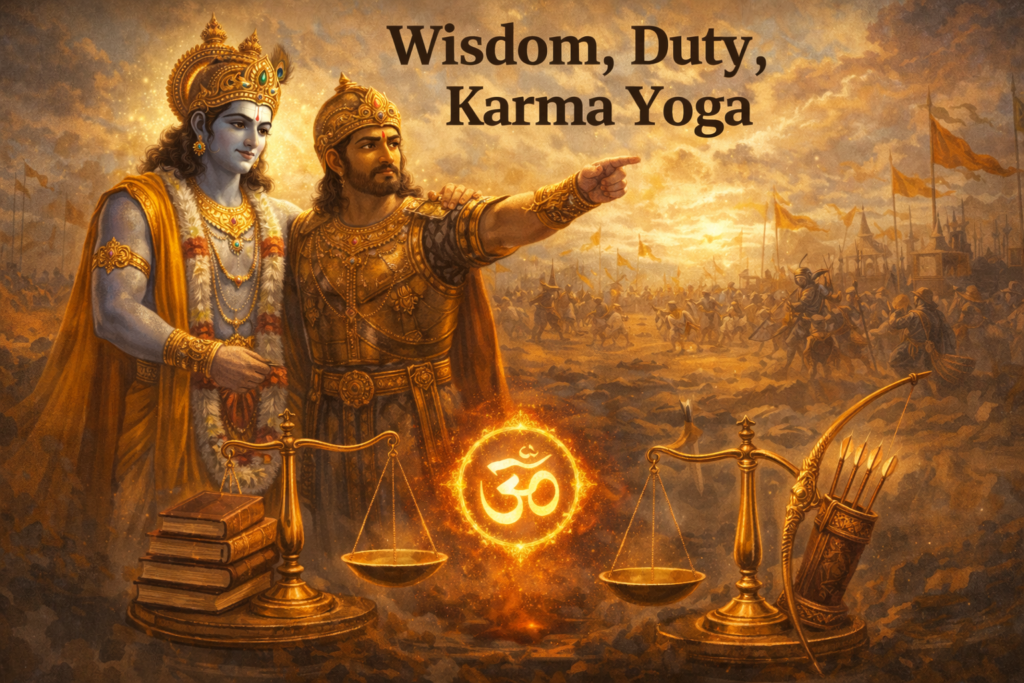
Section 3: The Duty of a Warrior (2.31–2.38)
🔹 Verse 2.31
Sanskrit Shloka
स्वधर्ममपि चावेक्ष्य
न विकम्पितुमर्हसि ।
धर्म्याद्धि युद्धाच्छ्रेयोऽन्यत्
क्षत्रियस्य न विद्यते ॥ २.३१ ॥
Simple Translation
Considering your own duty as a warrior, you should not waver. For a warrior, nothing is higher than a righteous war.
Context Explanation
Krishna now shifts focus.
This is not personal revenge.
This is a dharma-yuddha (righteous war).
Arjuna is a Kshatriya — protector of justice.
Deeper Meaning
Dharma is role-based responsibility.
Avoiding duty due to emotion leads to disorder.
Modern Relevance
Each person has responsibilities:
Parent
Leader
Professional
Citizen
Escaping responsibility because it is uncomfortable leads to long-term damage.
🔹 Verse 2.32
Sanskrit Shloka
यदृच्छया चोपपन्नं
स्वर्गद्वारमपावृतम् ।
सुखिनः क्षत्रियाः पार्थ
लभन्ते युद्धमीदृशम् ॥ २.३२ ॥
Simple Translation
O Arjuna, fortunate are the warriors to whom such a righteous battle comes unsought, opening the gates of higher realms.
Context Explanation
Krishna reframes the situation.
The war was not chosen by Arjuna.
It came to him.
This is duty arriving at one’s doorstep.
Deeper Meaning
Some responsibilities choose us.
We cannot always control circumstances —
but we can control response.
Modern Relevance
Life sometimes presents unavoidable situations:
Ethical crisis
Leadership burden
Family responsibility
Avoidance is not an option.
🔹 Verse 2.33
Sanskrit Shloka
अथ चेत्त्वमिमं धर्म्यं
संग्रामं न करिष्यसि ।
ततः स्वधर्मं कीर्तिं च
हित्वा पापमवाप्स्यसि ॥ २.३३ ॥
Simple Translation
If you refuse this righteous battle, you will abandon your duty and honor, and incur sin.
Context Explanation
Krishna clarifies something important:
Inaction can also be sinful.
Avoiding duty is not neutrality.
Deeper Meaning
Failure to act when necessary is also wrongdoing.
Cowardice disguised as compassion causes harm.
Modern Relevance
When leaders fail to confront injustice:
Damage spreads.
Silence can be participation.
🔹 Verse 2.34
Sanskrit Shloka
अकीर्तिं चापि भूतानि
कथयिष्यन्ति तेऽव्ययाम् ।
संभावितस्य चाकीर्तिः
मरणादतिरिच्यते ॥ २.३४ ॥
Simple Translation
People will speak of your disgrace forever. For one who has been honored, dishonor is worse than death.
Context Explanation
Krishna now appeals to Arjuna’s reputation.
Not out of ego —
but out of responsibility.
Deeper Meaning
Honor reflects integrity.
Losing integrity causes deeper pain than physical loss.
Modern Relevance
Reputation built over years can collapse through one act of avoidance.
Character is tested in crisis.
🔹 Verse 2.35
Sanskrit Shloka
भयाद्रणादुपरतं
मंस्यन्ते त्वां महारथाः ।
येषां च त्वं बहुमतो
भूत्वा यास्यसि लाघवम् ॥ २.३५ ॥
Simple Translation
The great warriors will think you withdrew out of fear, and those who once respected you will lose their regard.
Context Explanation
Krishna highlights perception.
Motives may be pure —
but the world judges actions.
Deeper Meaning
Public duty carries public consequence.
Leadership requires resilience against misunderstanding.
Modern Relevance
In leadership:
Intentions are invisible.
Actions are visible.
Courage must be visible.
🔹 Verse 2.36
Sanskrit Shloka
अवाच्यवादांश्च बहून्
वदिष्यन्ति तवाहिताः ।
निन्दन्तस्तव सामर्थ्यं
ततो दुःखतरं नु किम् ॥ २.३६ ॥
Simple Translation
Your enemies will speak many insulting words, mocking your strength. What could be more painful?
Deeper Meaning
Krishna confronts Arjuna with social reality.
Avoiding duty leads not to peace —
but prolonged humiliation.
Modern Relevance
Avoiding confrontation does not eliminate criticism.
It often increases it.
🔹 Verse 2.37
Sanskrit Shloka
हतो वा प्राप्स्यसि स्वर्गं
जित्वा वा भोक्ष्यसे महीम् ।
तस्मादुत्तिष्ठ कौन्तेय
युद्धाय कृतनिश्चयः ॥ २.३७ ॥
Simple Translation
If you are killed, you attain higher realms; if you win, you enjoy the earth. Therefore arise, resolved to fight.
Context Explanation
Krishna simplifies outcome:
Win → Responsibility fulfilled
Lose → Duty fulfilled
Either way, dharma prevails.
Deeper Meaning
When action is aligned with duty,
fear of outcome disappears.
Attachment to results creates anxiety.
Alignment with dharma creates freedom.
Modern Relevance
If you act with integrity:
Success or failure does not define you.
Your character does.
🔹 Verse 2.38
Sanskrit Shloka
सुखदुःखे समे कृत्वा
लाभालाभौ जयाजयौ ।
ततो युद्धाय युज्यस्व
नैवं पापमवाप्स्यसि ॥ २.३८ ॥
Simple Translation
Treat pleasure and pain, gain and loss, victory and defeat alike — then engage in battle. Thus you will not incur sin.
Context Explanation
This verse introduces equanimity in action.
This is the beginning of Karma Yoga.
Deeper Meaning
Sin is not in action.
Sin is in attachment.
Detached action aligned with duty is pure.
Modern Relevance
This verse applies everywhere:
Business
Career
Parenting
Leadership
Act with integrity.
Detach from outcome.
Maintain balance.
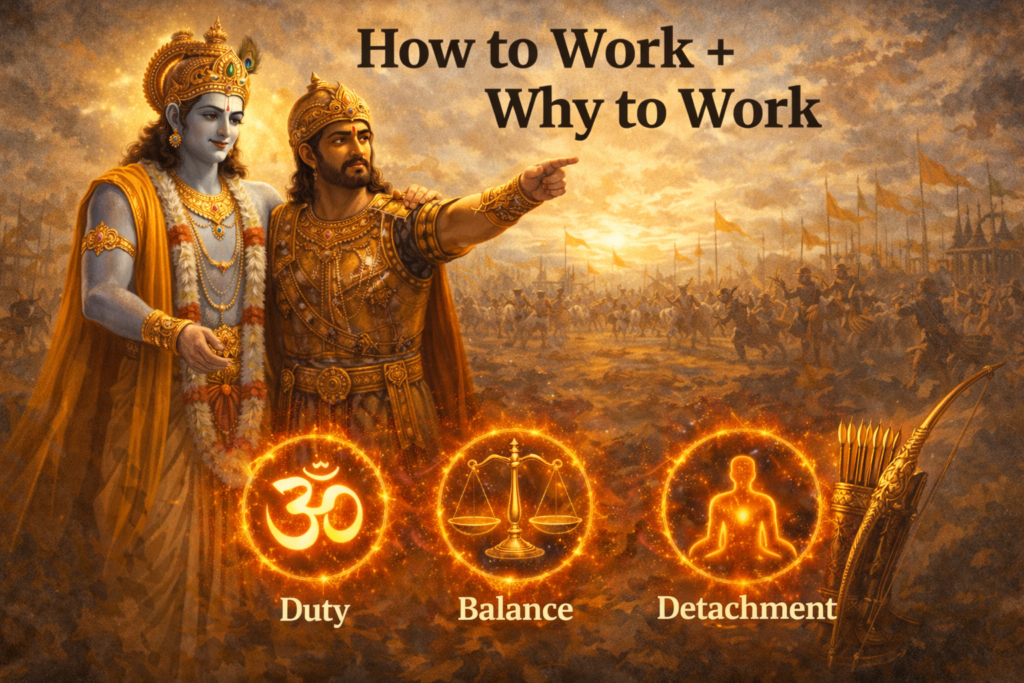
Section 4: Introduction to Karma Yoga (2.39–2.53)
Now we enter one of the most revolutionary teachings in human thought.
From here, Krishna introduces Karma Yoga —
the science of action without bondage.
🔹 Verse 2.39
Sanskrit Shloka
एषा तेऽभिहिता सांख्ये
बुद्धिर्योगे त्विमां शृणु ।
बुद्ध्या युक्तो यया पार्थ
कर्मबन्धं प्रहास्यसि ॥ २.३९ ॥
Simple Translation
Thus far I have explained knowledge (Sankhya). Now hear about Yoga — the path of action. Equipped with this understanding, you shall free yourself from the bondage of action.
Context Explanation
Krishna now shifts from knowledge of the soul
to knowledge of action.
Understanding alone is not enough.
Right action must follow right knowledge.
Deeper Meaning
Knowledge without practice is incomplete.
Action binds when done with attachment.
Action liberates when done with wisdom.
Modern Relevance
Knowing what is right is easy.
Doing it without ego is difficult.
Karma Yoga teaches how to act freely.
🔹 Verse 2.40
Sanskrit Shloka
नेहाभिक्रमनाशोऽस्ति
प्रत्यवायो न विद्यते ।
स्वल्पमप्यस्य धर्मस्य
त्रायते महतो भयात् ॥ २.४० ॥
Simple Translation
In this path, no effort is wasted, and there is no loss. Even a little practice of this dharma protects one from great fear.
Deeper Meaning
Spiritual effort never goes in vain.
Unlike worldly achievements,
inner growth accumulates.
Modern Relevance
Even small steps toward clarity and discipline
reduce anxiety.
Consistency matters more than perfection.
🔹 Verse 2.41
Sanskrit Shloka
व्यवसायात्मिका बुद्धिरेकेह कुरुनन्दन ।
बहुशाखा ह्यनन्ताश्च बुद्धयोऽव्यवसायिनाम् ॥ २.४१ ॥
Simple Translation
Those who are resolute in purpose have focused intellect. The minds of the irresolute are scattered in many directions.
Deeper Meaning
Clarity creates strength.
Distraction creates weakness.
The stable mind is single-pointed.
Modern Relevance
In today’s world of constant distraction,
focus is spiritual power.
Scattered attention weakens decision-making.
🔹 Verse 2.42–2.43
Sanskrit Shloka
यामिमां पुष्पितां वाचं
प्रवदन्त्यविपश्चितः ।
वेदवादरताः पार्थ
नान्यदस्तीति वादिनः ॥ २.४२ ॥
कामात्मानः स्वर्गपरा
जन्मकर्मफलप्रदाम् ।
क्रियाविशेषबहुलां
भोगैश्वर्यगतिं प्रति ॥ २.४३ ॥
Simple Translation
Unwise people speak flowery words, promising heavenly rewards and material enjoyment, believing there is nothing higher than this.
Context Explanation
Krishna criticizes superficial spirituality.
Spirituality focused only on reward
remains materialistic.
Deeper Meaning
Desire-based religion keeps one bound.
True Yoga transcends reward-seeking.
Modern Relevance
Even today, many pursue spirituality for:
Wealth
Success
Power
But Karma Yoga teaches detachment from reward.
🔹 Verse 2.44
Sanskrit Shloka
भोगैश्वर्यप्रसक्तानां
तयापहृतचेतसाम् ।
व्यवसायात्मिका बुद्धिः
समाधौ न विधीयते ॥ २.४४ ॥
Simple Translation
Those attached to pleasure and power cannot develop steady concentration.
Deeper Meaning
Attachment divides attention.
Freedom requires inner simplicity.
Modern Relevance
Overconsumption and constant craving destroy mental stability.
🔹 Verse 2.45
Sanskrit Shloka
त्रैगुण्यविषया वेदा
निस्त्रैगुण्यो भवार्जुन ।
निर्द्वन्द्वो नित्यसत्त्वस्थो
निर्व्योगक्षेम आत्मवान् ॥ २.४५ ॥
Simple Translation
The Vedas deal with the three modes of nature. Rise above these modes, free from dualities, and established in the Self.
Deeper Meaning
Krishna urges transcendence of:
Pleasure and pain
Gain and loss
Fear and desire
Freedom lies beyond duality.
Modern Relevance
Emotional swings dominate modern life.
Transcending extremes creates peace.
🔹 Verse 2.47 (Most Famous Verse)
Sanskrit Shloka
कर्मण्येवाधिकारस्ते
मा फलेषु कदाचन ।
मा कर्मफलहेतुर्भूः
मा ते सङ्गोऽस्त्वकर्मणि ॥ २.४७ ॥
Simple Translation
You have the right to perform your duty, but not to the results. Do not act for the fruits of action, nor be attached to inaction.
Context Explanation
This is the essence of Karma Yoga.
Action is yours.
Result is not.
Deeper Meaning
Attachment to outcome creates anxiety.
Freedom lies in effort without obsession.
Modern Relevance
This verse applies to:
Exams
Business
Career
Parenting
Focus on effort.
Release obsession with results.
🔹 Verse 2.48
Sanskrit Shloka
योगस्थः कुरु कर्माणि
सङ्गं त्यक्त्वा धनंजय ।
सिद्ध्यसिद्ध्योः समो भूत्वा
समत्वं योग उच्यते ॥ २.४८ ॥
Simple Translation
Perform your duty with equanimity, abandoning attachment. Remain the same in success and failure. Such balance is called Yoga.
Deeper Meaning
Yoga = Equanimity in action.
Not escape.
Not renunciation.
Balance.
Modern Relevance
Emotional stability under pressure defines leadership.
🔹 Verse 2.50
Sanskrit Shloka
बुद्धियुक्तो जहातीह
उभे सुकृतदुष्कृते ।
तस्माद्योगाय युज्यस्व
योगः कर्मसु कौशलम् ॥ २.५० ॥
Simple Translation
One endowed with wisdom transcends both good and bad results. Therefore, practice Yoga. Yoga is skill in action.
Deeper Meaning
Yoga is not passivity.
It is mastery in action.
Skill guided by detachment creates excellence.
Modern Relevance
Peak performance requires:
Focus
Detachment
Clarity
This is Karma Yoga in practice.
🔹 Verse 2.53
Sanskrit Shloka
श्रुतिविप्रतिपन्ना ते
यदा स्थास्यति निश्चला ।
समाधावचला बुद्धिः
तदा योगमवाप्स्यसि ॥ २.५३ ॥
Simple Translation
When your intellect becomes steady and undisturbed by conflicting ideas, you will attain Yoga.
Deeper Meaning
Clarity ends confusion.
Stability ends suffering.
“Arjuna’s transformation begins in Bhagavad Gita Chapter 1 – Arjuna Vishada Yoga, where emotional collapse prepares the ground for wisdom.”
Section 5: Sthitaprajna – The Person of Steady Wisdom (2.54–2.72)
🔹 Verse 2.54
Sanskrit Shloka
अर्जुन उवाच ।
स्थितप्रज्ञस्य का भाषा
समाधिस्थस्य केशव ।
स्थितधीः किं प्रभाषेत
किमासीत व्रजेत किम् ॥ २.५४ ॥
Simple Translation
Arjuna said:
“O Krishna, what are the signs of a person whose wisdom is steady and who is absorbed in meditation? How does such a person speak, sit, and walk?”
Context Explanation
After hearing philosophy and Karma Yoga,
Arjuna asks a practical question:
“How does such a person live?”
This is important.
Spirituality must be visible in conduct.
Deeper Meaning
Arjuna now seeks a living model of wisdom.
He wants embodiment — not theory.
Modern Relevance
People today also ask:
“What does a truly balanced person look like?”
This section answers that.
🔹 Verse 2.55
Sanskrit Shloka
श्रीभगवानुवाच ।
प्रजहाति यदा कामान्
सर्वान्पार्थ मनोगतान् ।
आत्मन्येवात्मना तुष्टः
स्थितप्रज्ञस्तदोच्यते ॥ २.५५ ॥
Simple Translation
Krishna said:
When a person gives up all desires born of the mind and is satisfied in the Self alone, he is called a person of steady wisdom.
Deeper Meaning
Stability comes from inner contentment.
When happiness is not dependent on external objects,
mind becomes steady.
Modern Relevance
Constant craving leads to restlessness.
Inner satisfaction creates peace.
🔹 Verse 2.56
Sanskrit Shloka
दुःखेष्वनुद्विग्नमनाः
सुखेषु विगतस्पृहः ।
वीतरागभयक्रोधः
स्थितधीर्मुनिरुच्यते ॥ २.५६ ॥
Simple Translation
One who is not disturbed by sorrow, not attached to pleasure, and free from fear and anger is called a sage of steady mind.
Deeper Meaning
Stability is freedom from emotional extremes.
Fear, anger, attachment — these disturb clarity.
Modern Relevance
Emotional intelligence equals spiritual maturity.
Reactiveness weakens decision-making.
🔹 Verse 2.57
Sanskrit Shloka
यः सर्वत्रानभिस्नेहः
तत्तत्प्राप्य शुभाशुभम् ।
नाभिनन्दति न द्वेष्टि
तस्य प्रज्ञा प्रतिष्ठिता ॥ २.५७ ॥
Simple Translation
One who is unattached everywhere and neither rejoices in good fortune nor hates misfortune has steady wisdom.
Deeper Meaning
Equanimity is not indifference.
It is freedom from emotional slavery.
🔹 Verse 2.58
Sanskrit Shloka
यदा संहरते चायं
कूर्मोऽङ्गानीव सर्वशः ।
इन्द्रियाणीन्द्रियार्थेभ्यः
तस्य प्रज्ञा प्रतिष्ठिता ॥ २.५८ ॥
Simple Translation
Just as a tortoise withdraws its limbs, when a person withdraws the senses from sense objects, his wisdom is steady.
Deeper Meaning
Control of senses leads to control of mind.
External discipline creates internal stability.
Modern Relevance
Digital overload today makes this verse extremely relevant.
Withdraw intentionally to regain clarity.
🔹 Verse 2.62–2.63 (Psychology of Downfall)
Sanskrit Shloka
ध्यायतो विषयान्पुंसः
सङ्गस्तेषूपजायते ।
सङ्गात्संजायते कामः
कामात्क्रोधोऽभिजायते ॥ २.६२ ॥
क्रोधाद्भवति संमोहः
संमोहात्स्मृतिविभ्रमः ।
स्मृतिभ्रंशाद्बुद्धिनाशो
बुद्धिनाशात्प्रणश्यति ॥ २.६३ ॥
Simple Translation
Dwelling on sense objects creates attachment.
Attachment leads to desire.
Desire leads to anger.
Anger leads to delusion.
Delusion leads to loss of memory.
Loss of memory destroys intelligence.
When intelligence is destroyed, one falls completely.
Deeper Meaning
This is a psychological chain reaction.
Thought → Attachment → Desire → Anger → Destruction.
Modern Relevance
This perfectly explains:
Addiction cycles
Obsession
Impulsive decisions
Emotional breakdown
Krishna gives a full psychological model thousands of years ago.
🔹 Verse 2.70
Sanskrit Shloka
आपूर्यमाणमचलप्रतिष्ठं
समुद्रमापः प्रविशन्ति यद्वत् ।
तद्वत्कामा यं प्रविशन्ति सर्वे
स शान्तिमाप्नोति न कामकामी ॥ २.७० ॥
Simple Translation
Just as rivers flow into the ocean, which remains steady and undisturbed, so too the person into whom desires enter without disturbance attains peace — not the one who craves desires.
Deeper Meaning
The ocean does not overflow when rivers enter.
A stable mind does not overflow when desires arise.
Modern Relevance
Desires will come.
Peace comes from not being disturbed by them.
🔹 Verse 2.71
Sanskrit Shloka
विहाय कामान्यः सर्वान्
पुमांश्चरति निःस्पृहः ।
निर्ममो निरहङ्कारः
स शान्तिमधिगच्छति ॥ २.७१ ॥
Simple Translation
One who abandons desires, free from possessiveness and ego, attains peace.
Deeper Meaning
Peace requires:
Reduction of ego
Freedom from “mine”
Simplicity of identity
🔹 Verse 2.72 (Conclusion of Chapter 2)
Sanskrit Shloka
एषा ब्राह्मी स्थिति: पार्थ
नैनां प्राप्य विमुह्यति ।
स्थित्वास्यामन्तकालेऽपि
ब्रह्मनिर्वाणमृच्छति ॥ २.७२ ॥
Simple Translation
This is the state of divine consciousness. Attaining it, one is not deluded. Even at the moment of death, one reaches ultimate peace.
Deeper Meaning
“Brahmi Sthiti” means the state of steady union with Brahman — the highest reality, pure consciousness, the Self beyond ego.
Wisdom is not information — it becomes a state of being.
When a person truly stabilizes in this state, delusion doesn’t return, because the root mistake (identifying as only the body/mind/ego) is dissolved.
Such a person lives with an unshakable inner center:
Praise and insult don’t shake them
Gain and loss don’t disturb them
Pleasure and pain don’t hijack them
Fear of death no longer controls them
“Even at the moment of death…” is extremely important.
Krishna is saying: if one is established in this consciousness, then death is not terror — it is simply a transition, and the person remains in peace, not confusion.
Psychological + Practical Takeaway
A Sthitaprajna is not someone who escapes the world.
It is someone who operates in the world with:
clarity instead of confusion
duty instead of ego
peace instead of panic
truth instead of attachment
So it’s not just about death — it is about how to live so steadily that even death cannot disturb the mind.
“Chapter 2 of the Bhagavad Gita is not merely philosophical instruction — it is a complete blueprint for inner stability. From understanding the immortality of the soul to mastering detached action and emotional balance, Sankhya Yoga transforms confusion into clarity and fear into fearless wisdom.”
Arjuna now becomes confused again:
“If knowledge is superior, why are you pushing me into action?”
Bhagavad Gita: Chapter 3 – Karma Yoga (The Yoga of Action)
To understand the historical background, structure, and deeper context of this sacred dialogue, read our complete guide on Bhagavad Gita – History, Structure, and Timeless Wisdom.
Read More interesting Content in my Blog Section.