
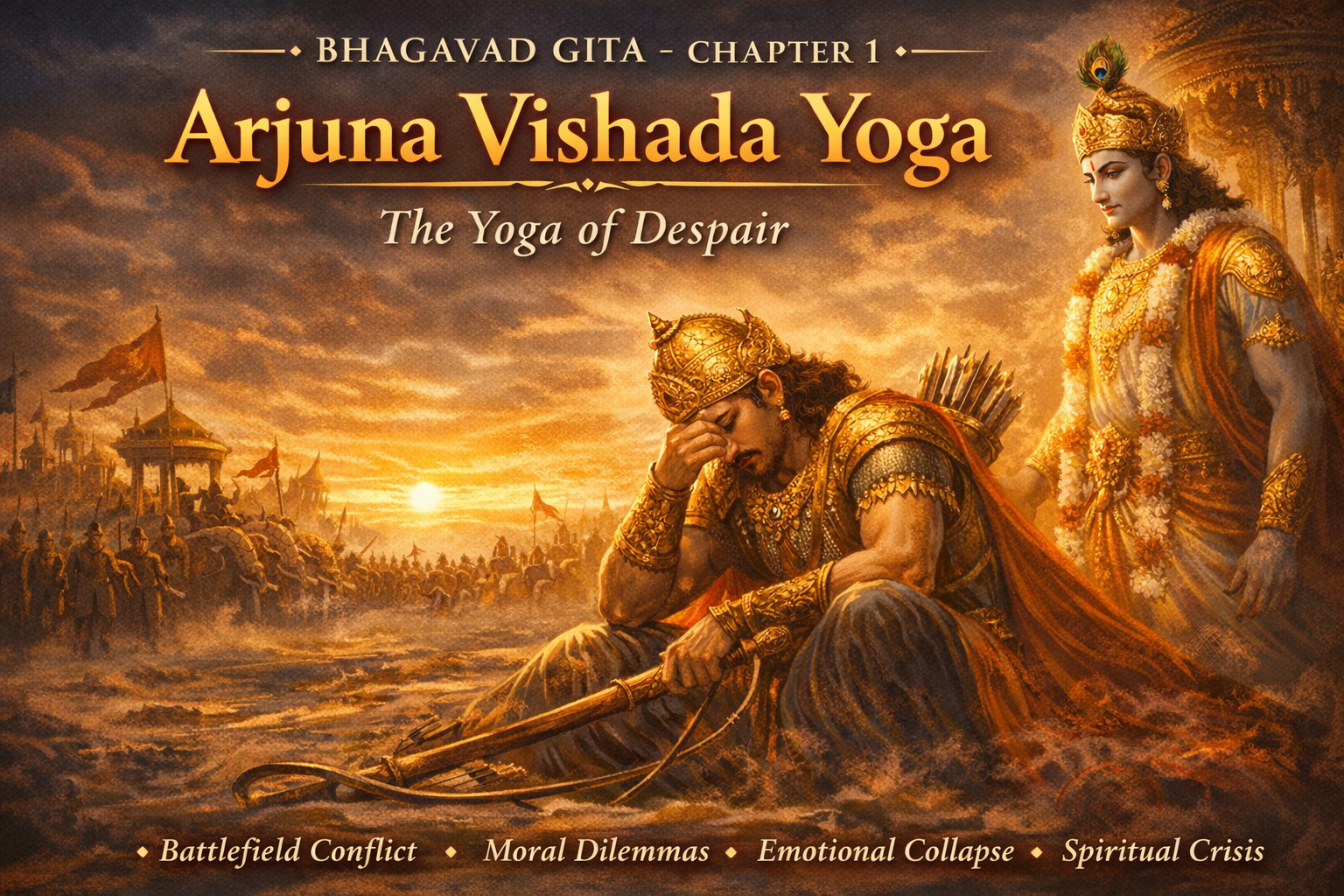

Section 1: Battlefield Setting (Verses 1–20)
🔹 Verse 1.1
Sanskrit Shloka
धृतराष्ट्र उवाच ।
धर्मक्षेत्रे कुरुक्षेत्रे समवेता युयुत्सवः ।
मामकाः पाण्डवाश्चैव किमकुर्वत सञ्जय ॥ १.१ ॥
Simple Translation
Dhritarashtra said:
“O Sanjaya, after assembling on the holy field of Kurukshetra and desiring to fight, what did my sons and the sons of Pandu do?”
Context Explanation
The Gita begins not with Krishna, not with Arjuna — but with Dhritarashtra.
Dhritarashtra is the blind king of Hastinapur.
He cannot see the battlefield, so he asks Sanjaya (who has divine vision) to narrate what is happening.
Notice something important:
He says “my sons” and “the sons of Pandu” — not “our sons.”
Attachment is visible from the first verse.
Deeper Meaning (Psychological / Spiritual)
Dhritarashtra represents:
Blind attachment
Bias
Ego-based identity
The word Dharmakshetra (Field of Dharma) is powerful.
The war is not happening just on any land —
It is happening on a field of righteousness.
Life itself is Dharmakshetra.
Every major decision happens on a field of moral testing.
Modern Relevance
This verse speaks to:
Corporate rivalry
Family disputes
Leadership conflict
Ethical dilemmas
When we say:
“My team vs their team”
“My side vs their side”
We already reveal bias.
The Gita begins by showing how attachment clouds judgment.
🔹 Verse 1.2
Sanskrit Shloka
संजय उवाच ।
दृष्ट्वा तु पाण्डवानीकं व्यूढं दुर्योधनस्तदा ।
आचार्यमुपसंगम्य राजा वचनमब्रवीत् ॥ १.२ ॥
Simple Translation
Sanjaya said:
King Duryodhana, seeing the army of the Pandavas properly arranged in military formation, approached his teacher Drona and spoke these words.
Context Explanation
Now the scene shifts.
Duryodhana — the ambitious and insecure prince — observes the Pandava army.
He sees discipline.
He sees organization.
He sees strength.
Instead of confidently addressing his own army, he goes to Drona, his teacher.
Why?
Because fear has already entered.
Deeper Meaning (Psychological / Spiritual)
Duryodhana represents:
Ego-driven ambition
Hidden insecurity
External confidence, internal fear
Even powerful people feel threatened when they see:
Competence
Unity
Righteous strength
Fear often hides behind arrogance.
Modern Relevance
In corporate or leadership scenarios:
When someone constantly compares themselves to competitors and seeks validation from seniors, it shows internal insecurity.
Duryodhana’s reaction teaches us:
Confidence without righteousness breeds anxiety.
🔹 Verse 1.3
Sanskrit Shloka
पश्यैतां पाण्डुपुत्राणामाचार्य महतीं चमूम् ।
व्यूढां द्रुपदपुत्रेण तव शिष्येण धीमता ॥ १.३ ॥
Simple Translation
“Behold, O teacher, this mighty army of the sons of Pandu, expertly arranged by your intelligent disciple, the son of Drupada.”
Context Explanation
Duryodhana subtly reminds Drona:
“Your disciple has arranged this army.”
There is sarcasm hidden here.
Why?
Because Drupada (father of Dhrishtadyumna) was once Drona’s rival.
Duryodhana is psychologically provoking Drona.
Deeper Meaning
This verse reveals political manipulation.
Duryodhana tries to:
Awaken ego in Drona
Trigger emotional bias
Ensure loyalty
When leaders manipulate by invoking past rivalries, they weaken moral clarity.
Modern Relevance
This happens when:
Managers use past grudges to motivate teams
Leaders create “us vs them” narratives
Ego is used as fuel
But ego-driven motivation is unstable.
🔹 Verse 1.4
Sanskrit Shloka
अत्र शूरा महेष्वासा भीमार्जुनसमा युधि।
युयुधानो विराट द्रुपदश्च महारथः ॥ १.४ ॥
Simple Translation
“In this army there are many heroic bowmen equal in fighting to Bhima and Arjuna; there are also great fighters like Yuyudhana, Virata, and Drupada.”
Context Explanation
Duryodhana continues listing strong warriors in the Pandava army.
Notice:
He repeatedly emphasizes their strength.
Why?
Because fear makes us exaggerate the power of opposition.
Deeper Meaning
When fear dominates the mind:
We inflate the strength of the problem.
Duryodhana sees the Pandava army not as manageable opponents,
but as overwhelming threats.
This is how anxiety functions.
Modern Relevance
In real life:
Exams feel impossible
Competitors seem unbeatable
Problems look gigantic
Often the mind magnifies challenges beyond reality.
🔹 Verse 1.5
Sanskrit Shloka
धृष्टकेतुश्चेकितानः काशिराजश्च वीर्यवान् ।
पुरुजित्कुन्तिभोजश्च शैब्यश्च नरपुङ्गवः ॥ १.५ ॥
Simple Translation
“There are also powerful fighters like Dhrishtaketu, Chekitana, the valiant King of Kashi, Purujit, Kuntibhoja, and Shaibya — all noble warriors.”
Context Explanation
Duryodhana continues listing warriors.
The repetition indicates mental agitation.
A calm mind summarizes.
An anxious mind over-describes.
Deeper Meaning
Listing opponents repeatedly is a psychological defense mechanism.
When insecure:
We focus more on external threats than internal strength.
Modern Relevance
When someone says:
“There are so many problems.”
“So many obstacles.”
“So many competitors.”
It reflects inner anxiety.
Duryodhana’s speech reveals his unstable state — before war even begins.
🔹 Verse 1.6
Sanskrit Shloka
युधामन्युश्च विक्रान्त उत्तमौजाश्च वीर्यवान् ।
सौभद्रो द्रौपदेयाश्च सर्व एव महारथाः ॥ १.६ ॥
Simple Translation
“There are also heroic fighters like Yudhamanyu, the powerful Uttamauja, the son of Subhadra (Abhimanyu), and the sons of Draupadi — all mighty warriors.”
Context Explanation
Duryodhana continues naming warriors from the Pandava side.
Now notice something subtle:
He includes Abhimanyu — a young warrior.
Even youth appears threatening to him.
Fear does not measure age.
It measures potential.
Deeper Meaning
When insecurity dominates:
Even future possibilities feel dangerous.
Duryodhana fears not just present strength,
but what the Pandavas represent — righteousness and continuity.
Modern Relevance
In workplaces or politics:
People often feel threatened not only by current leaders,
but by rising young talent.
Fear of replacement creates agitation.
🔹 Verse 1.7
Sanskrit Shloka
अस्माकं तु विशिष्टा ये तान्निबोध द्विजोत्तम ।
नायका मम सैन्यस्य संज्ञार्थं तान्ब्रवीमि ते ॥ १.७ ॥
Simple Translation
“But for your information, O best of Brahmins, let me tell you about the distinguished leaders of my own army.”
Context Explanation
After describing the strength of the Pandavas,
Duryodhana now turns to describe his own army.
Why did he begin with the opponent?
Because fear made him focus outward first.
Now he tries to restore confidence.
Deeper Meaning
The anxious mind:
Scans threats first.
Reassures itself afterward.
Duryodhana’s speech pattern reflects psychological instability.
Modern Relevance
Before presentations or competitions:
Some people think:
“What if they are better?”
“What if we lose?”
Then they try to convince themselves of their own strengths.
This is exactly what Duryodhana is doing.
🔹 Verse 1.8
Sanskrit Shloka
भवान्भीष्मश्च कर्णश्च कृपश्च समितिंजयः ।
अश्वत्थामा विकर्णश्च सौमदत्तिस्तथैव च ॥ १.८ ॥
Simple Translation
“In my army there are respected leaders like yourself (Drona), Bhishma, Karna, Kripa, Ashvatthama, Vikarna, and the son of Somadatta.”
Context Explanation
Duryodhana now lists powerful warriors on his side.
These are legendary fighters.
But notice:
He emphasizes personalities — not unity.
Deeper Meaning
Strength without moral alignment creates instability.
Though the Kaurava army is strong numerically,
it lacks unity of purpose.
Fear cannot be hidden by listing powerful names.
Modern Relevance
Organizations with big names and big talent still fail when:
Leadership is divided
Values are unclear
Motivation is ego-driven
Quantity is not quality.
🔹 Verse 1.9
Sanskrit Shloka
अन्ये च बहवः शूरा मदर्थे त्यक्तजीविताः ।
नानाशस्त्रप्रहरणाः सर्वे युद्धविशारदाः ॥ १.९ ॥
Simple Translation
“There are many other heroes ready to give up their lives for my sake, armed with various weapons and skilled in warfare.”
Context Explanation
Duryodhana says: “They are ready to die for me.”
This reveals his mindset.
He views the war as centered around himself.
Deeper Meaning
Ego speaks like this:
“They fight for me.”
“They sacrifice for me.”
But true leadership is not self-centered.
Righteous leaders say:
“We fight for dharma.”
Modern Relevance
In toxic environments:
Leaders expect blind loyalty.
In healthy environments:
Leaders inspire shared purpose.
There is a difference between devotion to a person
and commitment to a principle.
🔹 Verse 1.10
Sanskrit Shloka
अपर्याप्तं तदस्माकं बलं भीष्माभिरक्षितम् ।
पर्याप्तं त्विदमेतेषां बलं भीमाभिरक्षितम् ॥ १.१० ॥
Simple Translation
“Our army, protected by Bhishma, is unlimited; whereas the army of the Pandavas, protected by Bhima, is limited.”
Context Explanation
Here comes psychological contradiction.
First Duryodhana exaggerated the strength of the Pandavas.
Now he claims:
“Our strength is unlimited.”
This is overcompensation.
Deeper Meaning
When fear rises:
We swing between:
Overestimating the enemy
Overestimating ourselves
This instability shows internal conflict.
Confidence rooted in truth is steady.
Confidence rooted in ego fluctuates.
Modern Relevance
This verse teaches us about mental imbalance.
In stress situations:
One moment we feel:
“I can’t win.”
Next moment:
“I will crush them.”
This emotional fluctuation indicates lack of inner stability.
🔹 Verse 1.11
Sanskrit Shloka
अयनेषु च सर्वेषु यथाभागमवस्थिताः ।
भीष्ममेवाभिरक्षन्तु भवन्तः सर्व एव हि ॥ १.११ ॥
Simple Translation
“Therefore, all of you stationed in your respective divisions must give full support to Bhishma alone.”
Context Explanation
Duryodhana gives his first direct military instruction:
“Protect Bhishma.”
This is significant.
Bhishma is the strongest warrior on their side — but also elderly.
Duryodhana’s confidence rests on Bhishma.
Deeper Meaning
When leadership depends entirely on one pillar,
it reveals structural weakness.
Duryodhana’s fear shows:
He does not trust collective strength.
He trusts a single hero.
Modern Relevance
Organizations that rely too heavily on:
One CEO
One star performer
One senior leader
become fragile.
True strength lies in distributed stability — not dependency.
🔹 Verse 1.12
Sanskrit Shloka
तस्य सञ्जनयन्हर्षं कुरुवृद्धः पितामहः ।
सिंहनादं विनद्योच्चैः शङ्खं दध्मौ प्रतापवान् ॥ १.१२ ॥
Simple Translation
Then Bhishma, the great elder of the Kurus, roaring like a lion, loudly blew his conch to cheer up Duryodhana.
Context Explanation
Bhishma senses Duryodhana’s anxiety.
To boost morale, he blows his conch loudly.
The war is about to begin — and the sound marks the emotional ignition.
Deeper Meaning
Bhishma represents:
Duty
Loyalty
Discipline
Even when he knows the Kauravas are morally weaker,
he stands by his vow.
This shows the complexity of dharma.
Modern Relevance
Sometimes individuals remain loyal to systems or institutions
even when they internally question them.
Bhishma’s roar is not just war-sound —
it is commitment to oath.
🔹 Verse 1.13
Sanskrit Shloka
ततः शङ्खाश्च भेर्यश्च पणवानकगोमुखाः ।
सहसैवाभ्यहन्यन्त स शब्दस्तुमुलोऽभवत् ॥ १.१३ ॥
Simple Translation
After that, conches, drums, bugles, and horns were blown all at once, creating a tremendous sound.
Context Explanation
The battlefield now becomes loud.
Noise fills the air.
Tension becomes physical.
The external war is beginning.
Deeper Meaning
Noise symbolizes chaos.
When conflict rises:
Inner silence disappears.
Mind becomes turbulent.
This is symbolic of mental disturbance before crisis.
Modern Relevance
Before major events:
Court hearings
Board meetings
Exams
Confrontations
There is mental noise.
Anxiety becomes audible inside.
🔹 Verse 1.14
Sanskrit Shloka
ततः श्वेतैर्हयैर्युक्ते महति स्यन्दने स्थितौ ।
माधवः पाण्डवश्चैव दिव्यौ शङ्खौ प्रदध्मतुः ॥ १.१४ ॥
Simple Translation
Then, seated in their magnificent chariot drawn by white horses, Madhava (Krishna) and Arjuna blew their divine conches.
Context Explanation
Now the focus shifts.
Krishna and Arjuna enter.
White horses symbolize purity.
Their conches are described as divine.
The atmosphere changes.
Deeper Meaning
Krishna’s presence represents:
Calm strength
Divine guidance
Moral clarity
Unlike the noisy chaos earlier,
their sound carries dignity.
Modern Relevance
In moments of chaos:
Some individuals panic.
Some remain composed.
Leadership is defined by calmness during turbulence.
🔹 Verse 1.15
Sanskrit Shloka
पाञ्चजन्यं हृषीकेशो देवदत्तं धनंजयः ।
पौण्ड्रं दध्मौ महाशङ्खं भीमकर्मा वृकोदरः ॥ १.१५ ॥
Simple Translation
Hrishikesha (Krishna) blew the conch Panchajanya; Arjuna blew Devadatta; and Bhima, the mighty warrior, blew his great conch Paundra.
Context Explanation
Each conch has a name.
Names symbolize identity and purpose.
Krishna = Panchajanya
Arjuna = Devadatta
Bhima = Paundra
This is not random noise —
it is a declaration of readiness.
Deeper Meaning
The naming of conches shows:
Every warrior carries a unique vibration.
In life:
Every person has a distinct inner call.
Modern Relevance
When entering a challenge:
You must know:
Who you are
What you stand for
What your strength is
Without identity, action becomes unstable.
🔹 Verse 1.16
Sanskrit Shloka
अनन्तविजयं राजा कुन्तीपुत्रो युधिष्ठिरः ।
नकुलः सहदेवश्च सुघोषमणिपुष्पकौ ॥ १.१६ ॥
Simple Translation
King Yudhishthira, the son of Kunti, blew his conch Anantavijaya; Nakula and Sahadeva blew their conches Sughosha and Manipushpaka.
Context Explanation
Now each Pandava is named individually.
Their conches are named too.
Notice the symbolic names:
Anantavijaya – Endless victory
Sughosha – Sweet sound
Manipushpaka – Jewel-like tone
This is not random description.
The Pandavas’ side is described with harmony and dignity.
Deeper Meaning
Victory rooted in righteousness is called “Anant” — eternal.
When your cause is aligned with truth,
you may suffer temporarily,
but ultimate victory becomes timeless.
Modern Relevance
Success based on manipulation is temporary.
Success rooted in integrity lasts.
This verse reminds us:
Short-term wins are not real victory.
Enduring victory comes from dharma.
🔹 Verse 1.17
Sanskrit Shloka
काश्यश्च परमेष्वासः शिखण्डी च महारथः ।
धृष्टद्युम्नो विराटश्च सात्यकिश्चापराजितः ॥ १.१७ ॥
Simple Translation
The powerful archer King of Kashi, the great warrior Shikhandi, Dhrishtadyumna, Virata, and the undefeated Satyaki also blew their conches.
Context Explanation
The list continues.
But something subtle happens here.
Unlike Duryodhana’s earlier anxious listing,
this narration is calm and descriptive.
There is no insecurity.
Only readiness.
Deeper Meaning
Confidence speaks softly.
Insecurity speaks loudly.
The Pandavas are not boasting.
They are simply present.
Modern Relevance
True strength does not need exaggeration.
When a person is grounded:
They do not shout their achievements.
Their presence speaks.
🔹 Verse 1.18
Sanskrit Shloka
द्रुपदो द्रौपदेयाश्च सर्वशः पृथिवीपते ।
सौभद्रश्च महाबाहुः शङ्खान्दध्मुः पृथक्पृथक् ॥ १.१८ ॥
Simple Translation
Drupada, the sons of Draupadi, and the mighty-armed Abhimanyu also blew their conches from all sides.
Context Explanation
Now the entire Pandava army joins.
The sound spreads everywhere.
It is collective.
It is unified.
Deeper Meaning
Unity multiplies power.
The Pandavas’ strength lies not just in individual heroes,
but in shared purpose.
Modern Relevance
Teams aligned by values outperform teams aligned by ego.
Unity of vision creates unstoppable energy.
🔹 Verse 1.19
Sanskrit Shloka
स घोषो धार्तराष्ट्राणां हृदयानि व्यदारयत् ।
नभश्च पृथिवीं चैव तुमुलो व्यनुनादयन् ॥ १.१९ ॥
Simple Translation
The tremendous sound of the Pandavas’ conches pierced the hearts of the sons of Dhritarashtra and echoed through heaven and earth.
Context Explanation
This is powerful.
The sound shakes the Kauravas internally.
Not physically.
Emotionally.
The battle hasn’t started yet —
but fear has entered their hearts.
Deeper Meaning
Righteous confidence disturbs unjust minds.
When someone stands firmly in truth,
it creates discomfort in those standing on ego.
Modern Relevance
When you act from integrity:
Those who operate from insecurity feel threatened.
Your calm confidence becomes their disturbance.
🔹 Verse 1.20
Sanskrit Shloka
अथ व्यवस्थितान्दृष्ट्वा धार्तराष्ट्रान् कपिध्वजः ।
प्रवृत्ते शस्त्रसंपाते धनुरुद्यम्य पाण्डवः ॥ १.२० ॥
Simple Translation
Then Arjuna, whose chariot bore the emblem of Hanuman, seeing the sons of Dhritarashtra standing ready for battle, lifted his bow as the war was about to begin.
Context Explanation
This is the turning point.
Arjuna raises his bow.
He is ready.
Externally, he is a warrior.
Internally, the storm is about to begin.
The narrative shifts from Duryodhana’s fear
to Arjuna’s awakening crisis.
Deeper Meaning
The real battle of the Gita begins here.
Not on the battlefield —
but inside Arjuna’s mind.
Strength outside.
Confusion inside.
This duality defines human existence.
Modern Relevance
Many people look confident externally:
Executives
Leaders
Soldiers
Professionals
But inside,
they may be conflicted.
The battlefield is set.
The armies are ready.
The sounds have shaken the world.
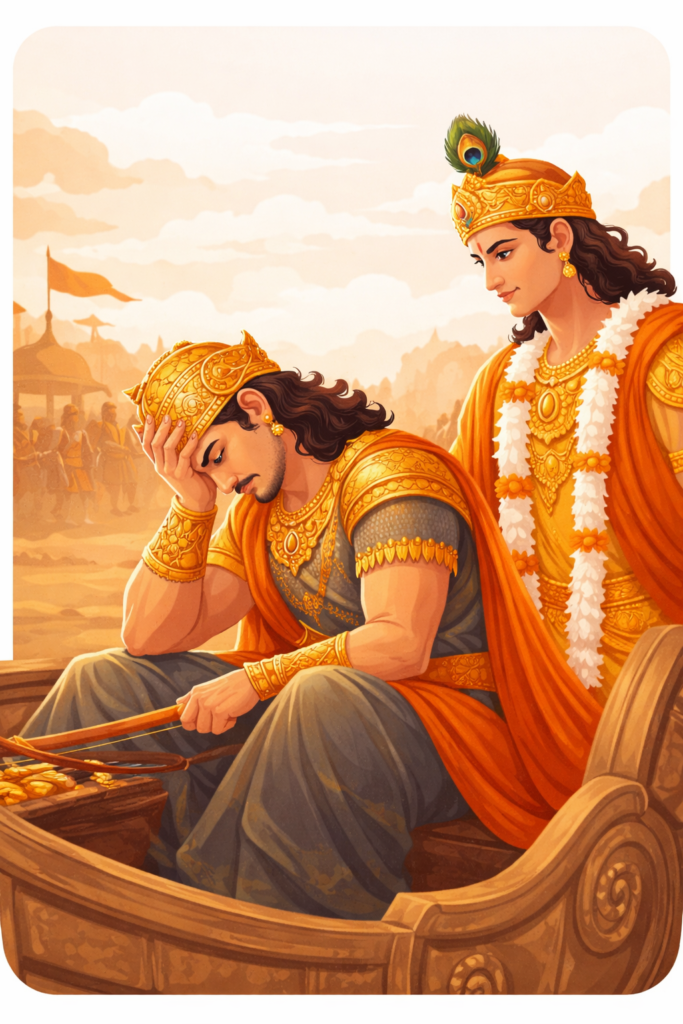
Section 2: Arjuna’s Emotional Collapse (Verses 21–30)
The battlefield outside is ready —
but now the battlefield inside Arjuna begins to shake.
🔹 Verse 1.21
Sanskrit Shloka
अर्जुन उवाच ।
सेनयोरुभयोर्मध्ये रथं स्थापय मेऽच्युत ॥ १.२१ ॥
Simple Translation
Arjuna said:
“O Achyuta (Krishna), please place my chariot between the two armies.”
Context Explanation
Arjuna is confident here.
He does not say:
“Drive forward.”
He says:
“Place me between both armies.”
He wants to observe.
He wants to see clearly before acting.
Deeper Meaning
This verse is psychologically powerful.
Before action,
there must be awareness.
Arjuna represents the thoughtful warrior —
not impulsive.
Modern Relevance
Before making major life decisions:
• Career changes
• Legal battles
• Confrontations
• Ethical decisions
We must pause.
We must observe the full picture.
Impulsive action leads to regret.
🔹 Verse 1.22
Sanskrit Shloka
यावदेतान्निरीक्षेऽहं योद्धुकामानवस्थितान् ।
कैर्मया सह योद्धव्यमस्मिन्रणसमुद्यमे ॥ १.२२ ॥
Simple Translation
“Let me see those who stand here eager to fight, and with whom I must engage in this battle.”
Context Explanation
Arjuna wants clarity:
Who exactly am I fighting?
This question is not strategic.
It is emotional.
Deeper Meaning
Often we rush into conflict without fully understanding:
Who are we opposing?
Why are we fighting?
What are the consequences?
Arjuna seeks awareness before violence.
Modern Relevance
Before entering arguments:
Ask:
Is this fight necessary?
What will this cost me emotionally?
Conscious confrontation is different from reactive aggression.
🔹 Verse 1.23
Sanskrit Shloka
योत्स्यमानानवेक्षेऽहं य एतेऽत्र समागताः ।
धार्तराष्ट्रस्य दुर्बुद्धेर्युद्धे प्रियचिकीर्षवः ॥ १.२३ ॥
Simple Translation
“I wish to see those gathered here who desire to please the evil-minded son of Dhritarashtra by fighting in this war.”
Context Explanation
Arjuna calls Duryodhana “durbuddhi” — misguided.
Yet, he still feels conflicted.
This shows moral complexity.
Deeper Meaning
Arjuna knows the Kauravas are morally wrong.
But moral clarity does not remove emotional pain.
Even when you know you are right,
the heart can hesitate.
Modern Relevance
In legal or ethical conflicts:
Even when you are correct,
it may still hurt to confront loved ones or colleagues.
Truth does not always feel comfortable.
🔹 Verse 1.24
Sanskrit Shloka
संजय उवाच ।
एवमुक्तो हृषीकेशो गुडाकेशेन भारत ।
सेनयोरुभयोर्मध्ये स्थापयित्वा रथोत्तमम् ॥ १.२४ ॥
Simple Translation
Sanjaya said:
Thus addressed by Arjuna, Krishna placed the magnificent chariot between the two armies.
Context Explanation
Krishna does not argue.
He does not stop Arjuna.
He simply fulfills his request.
Divine guidance does not force.
It supports.
Deeper Meaning
Krishna represents inner wisdom.
Wisdom does not impose decisions.
It allows you to see reality clearly.
Modern Relevance
A true mentor:
Does not control you.
Helps you see.
🔹 Verse 1.25
Sanskrit Shloka
भीष्मद्रोणप्रमुखतः सर्वेषां च महीक्षिताम् ।
उवाच पार्थ पश्यैतान्समवेतान्कुरूनिति ॥ १.२५ ॥
Simple Translation
In front of Bhishma, Drona, and all the kings, Krishna said: “O Arjuna, behold these Kurus assembled here.”
Context Explanation
Krishna intentionally stops the chariot where Arjuna can see:
• His teacher
• His grandfather
• Relatives
The emotional storm is about to begin.
Deeper Meaning
Sometimes life forces us to face what we are avoiding.
Krishna does not shield Arjuna from reality.
He makes him look directly at it.
Modern Relevance
Healing begins with confrontation.
Avoidance postpones crisis.
Facing reality begins transformation.
🔹 Verse 1.26
Sanskrit Shloka
तत्रापश्यत्स्थितान्पार्थः पितॄनथ पितामहान् ।
आचार्यान्मातुलान्भ्रातॄन्पुत्रान्पौत्रान्सखींस्तथा ॥ १.२६ ॥
Simple Translation
Arjuna saw standing there fathers, grandfathers, teachers, uncles, brothers, sons, grandsons, and friends.
Context Explanation
The battlefield becomes personal.
This is no longer abstract war.
It is family.
Deeper Meaning
Conflict is easy when it is impersonal.
It becomes unbearable when it involves relationships.
Modern Relevance
Family disputes are the most painful battles.
Emotion overrides logic.
🔹 Verse 1.27
Sanskrit Shloka
श्वशुरान्सुहृदश्चैव सेनयोरुभयोरपि ।
तान्समीक्ष्य स कौन्तेयः सर्वान्बन्धूनवस्थितान् ॥ १.२७ ॥
Simple Translation
He saw fathers-in-law and well-wishers on both sides. Seeing all these relatives assembled, Arjuna felt overwhelmed.
Deeper Meaning
The more personal the conflict,
the weaker the warrior becomes.
Arjuna’s heart begins to soften.
Modern Relevance
Emotional attachment weakens decision-making clarity.
Leadership demands balance between compassion and duty.
🔹 Verse 1.28
Sanskrit Shloka
कृपया परयाविष्टो विषीदन्निदमब्रवीत् ।
दृष्ट्वेमं स्वजनं कृष्ण युयुत्सुं समुपस्थितम् ॥ १.२८ ॥
Simple Translation
Overcome with deep compassion and sorrow, Arjuna said: “O Krishna, seeing my own people ready to fight…”
Context Explanation
Now the collapse begins.
Compassion overtakes warrior spirit.
Deeper Meaning
Compassion without wisdom can paralyze action.
This is the beginning of inner breakdown.
Modern Relevance
Empathy is beautiful —
but if not balanced with clarity,
it creates indecision.
🔹 Verse 1.29
Sanskrit Shloka
सीदन्ति मम गात्राणि मुखं च परिशुष्यति ।
वेपथुश्च शरीरे मे रोमहर्षश्च जायते ॥ १.२९ ॥
Simple Translation
“My limbs are trembling, my mouth is drying up, my body shakes, and my hair stands on end.”
Context Explanation
This is a panic attack description.
Physical symptoms of anxiety.
Deeper Meaning
Even the greatest warriors experience:
• Trembling
• Sweating
• Fear
Strength does not mean absence of emotion.
Modern Relevance
Before big presentations or crises,
people feel similar symptoms.
Anxiety is universal.
🔹 Verse 1.30
Sanskrit Shloka
गाण्डीवं स्रंसते हस्तात्त्वक्चैव परिदह्यते ।
न च शक्नोम्यवस्थातुं भ्रमतीव च मे मनः ॥ १.३० ॥
Simple Translation
“My bow Gandiva slips from my hand, my skin burns, I cannot stand steady, and my mind seems to whirl.”
Context Explanation
The warrior who lifted his bow in confidence
now cannot hold it.
The collapse is complete.
Deeper Meaning
When inner clarity collapses,
external power becomes useless.
This is the real beginning of the Gita.
Without this breakdown,
Krishna’s teaching would not arise.
Modern Relevance
Many people look successful outside,
but inside they are collapsing silently.
The Gita begins where ego ends.
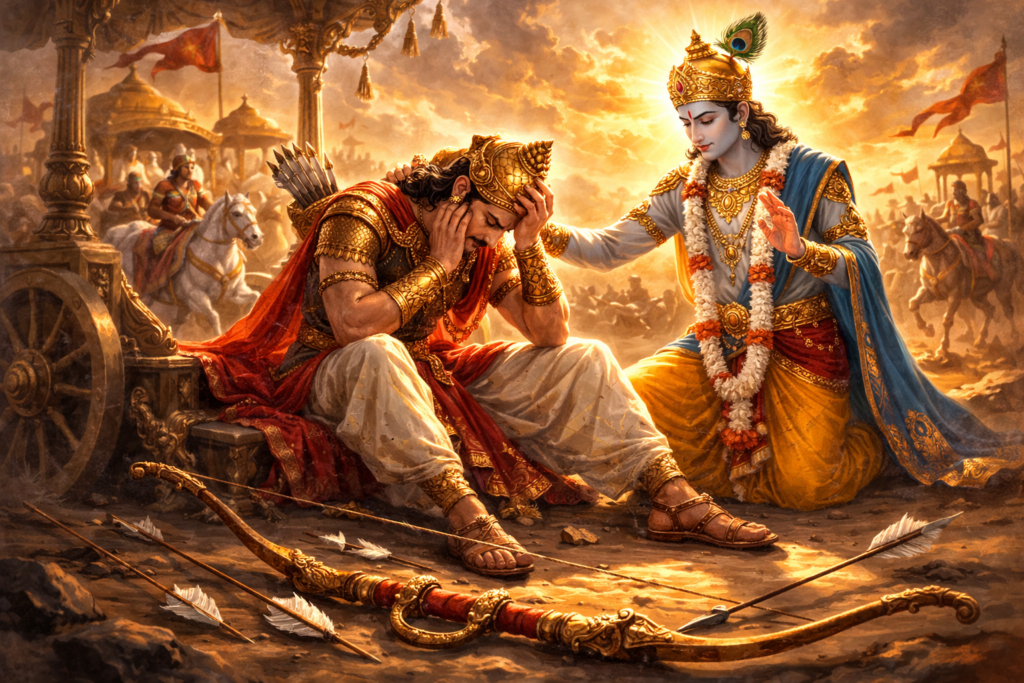
Section 3: Moral Confusion (Verses 31–40)
🔹 Verse 1.31
Sanskrit Shloka
निमित्तानि च पश्यामि विपरीतानि केशव ।
न च श्रेयोऽनुपश्यामि हत्वा स्वजनमाहवे ॥ १.३१ ॥
Simple Translation
“O Krishna, I see only bad omens. I do not foresee any good in killing my own people in this battle.”
Context Explanation
Arjuna now shifts from physical symptoms to rational argument.
He says:
“I see no good outcome.”
He begins justifying withdrawal.
Deeper Meaning
When the heart is disturbed,
the intellect produces supporting logic.
Emotion first.
Rationalization second.
Modern Relevance
When we want to avoid difficult duty:
We often construct intellectual arguments to justify retreat.
🔹 Verse 1.32
Sanskrit Shloka
न काङ्क्षे विजयं कृष्ण न च राज्यं सुखानि च ।
किं नो राज्येन गोविन्द किं भोगैर्जीवितेन वा ॥ १.३२ ॥
Simple Translation
“I do not desire victory, kingdom, or happiness. What is the use of kingdom or pleasures or even life itself, O Govinda?”
Context Explanation
This is dramatic detachment.
Arjuna says he does not want success.
But this is not spiritual renunciation.
It is emotional exhaustion.
Deeper Meaning
True renunciation comes from wisdom.
Temporary rejection comes from pain.
Arjuna is not enlightened here.
He is overwhelmed.
Modern Relevance
After burnout, people say:
“I don’t care about success anymore.”
Often this is not enlightenment —
it is emotional fatigue.
🔹 Verse 1.33–1.34
Sanskrit Shloka
येषामर्थे काङ्क्षितं नो राज्यं भोगाः सुखानि च ।
त इमेऽवस्थिता युद्धे प्राणांस्त्यक्त्वा धनानि च ॥ १.३३ ॥
आचार्याः पितरः पुत्रास्तथैव च पितामहाः ।
मातुलाः श्वशुराः पौत्राः श्यालाः सम्बन्धिनस्तथा ॥ १.३४ ॥
Simple Translation
“For whose sake we desire kingdom and pleasures — they are standing here in battle, ready to give up their lives. Teachers, fathers, sons, grandfathers, uncles, in-laws, grandsons, relatives — all stand before us.”
Context Explanation
Now Arjuna emphasizes relationships again.
He asks:
What is victory worth without loved ones?
Deeper Meaning
Arjuna sees only emotional value.
He temporarily forgets:
The war is about restoring justice.
Attachment narrows vision.
Modern Relevance
When faced with family conflict:
We often choose emotional comfort over moral responsibility.
🔹 Verse 1.35
Sanskrit Shloka
एतान्न हन्तुमिच्छामि घ्नतोऽपि मधुसूदन ।
अपि त्रैलोक्यराज्यस्य हेतोः किं नु महीकृते ॥ १.३५ ॥
Simple Translation
“I do not wish to kill them, even if they kill me, O Madhusudana — not even for sovereignty over the three worlds, let alone this earth.”
Context Explanation
This is extreme compassion.
Arjuna says:
Even if they attack me, I will not retaliate.
Deeper Meaning
This verse raises an important ethical dilemma:
Is non-violence always the highest virtue?
Or is protecting justice sometimes necessary?
This tension sets up Chapter 2.
Modern Relevance
When is resistance necessary?
When is tolerance noble?
When does tolerance become weakness?
These questions remain relevant today.
🔹 Verse 1.36
Sanskrit Shloka
निहत्य धार्तराष्ट्रान्नः का प्रीतिः स्याज्जनार्दन ।
पापमेवाश्रयेदस्मान्हत्वैतानाततायिनः ॥ १.३६ ॥
Simple Translation
“What joy will we gain by killing the sons of Dhritarashtra? Sin alone will overcome us if we kill these aggressors.”
Context Explanation
Arjuna now fears sin.
He calls the Kauravas aggressors —
yet he fears moral consequence.
Deeper Meaning
Compassion mixed with confusion creates moral paralysis.
Arjuna is not wrong in caring.
But he lacks clarity about duty.
Modern Relevance
Many leaders hesitate in difficult decisions because they fear:
“What if I am morally wrong?”
Ethical uncertainty can freeze action.
🔹 Verse 1.37–1.38
Sanskrit Shloka
तस्मान्नार्हा वयं हन्तुं धार्तराष्ट्रान्स्वबान्धवान् ।
स्वजनं हि कथं हत्वा सुखिनः स्याम माधव ॥ १.३७ ॥
यद्यप्येते न पश्यन्ति लोभोपहतचेतसः ।
कुलक्षयकृतं दोषं मित्रद्रोहे च पातकम् ॥ १.३८ ॥
Simple Translation
“Therefore, we should not kill our relatives, the sons of Dhritarashtra. How can we be happy after killing our own people? Even though they, blinded by greed, do not see the fault in destroying family and betraying friends…”
Context Explanation
Arjuna acknowledges the greed of the Kauravas.
Yet he holds himself to higher moral standards.
Deeper Meaning
Here we see genuine ethical awareness.
Arjuna’s conflict is not cowardice —
it is moral struggle.
This is what makes him worthy of Krishna’s teaching.
Modern Relevance
Ethical people suffer more internally.
Those without conscience do not hesitate.
Sensitivity can become suffering without guidance.
🔹 Verse 1.39–1.40
Sanskrit Shloka
कथं न ज्ञेयमस्माभिः पापादस्मान्निवर्तितुम् ।
कुलक्षयकृतं दोषं प्रपश्यद्भिर्जनार्दन ॥ १.३९ ॥
कुलक्षये प्रणश्यन्ति कुलधर्माः सनातनाः ।
धर्मे नष्टे कुलं कृत्स्नमधर्मोऽभिभवत्युत ॥ १.४० ॥
Simple Translation
“How can we not understand the sin of destroying our family? When a family is destroyed, its eternal traditions perish; and when dharma is lost, unrighteousness prevails.”
Context Explanation
Arjuna now expands his argument socially.
He fears:
• Destruction of family structure
• Loss of tradition
• Rise of moral disorder
Deeper Meaning
This is civilizational concern.
Arjuna understands that war affects:
• Social order
• Cultural continuity
• Moral foundations
His reasoning is deep — but incomplete.
Modern Relevance
Wars and conflicts today also destroy:
• Cultural heritage
• Family systems
• Moral continuity
Arjuna’s fear is not selfish —
it is societal.
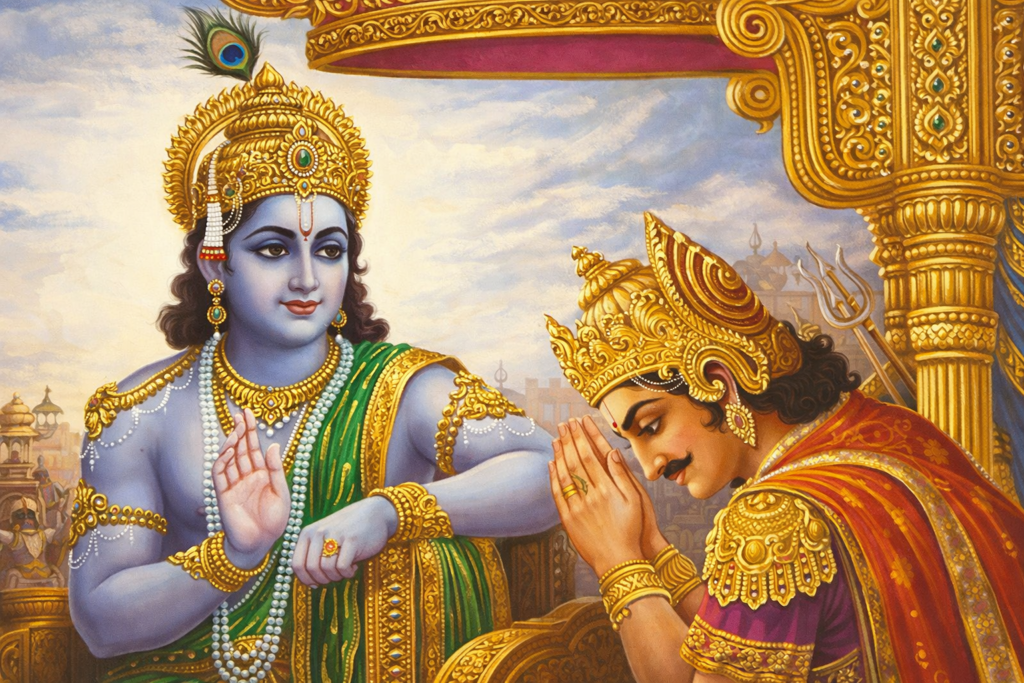
Section 4: Total Breakdown (Verses 41–47)
This is the moment where the warrior falls —
so that the disciple may rise.
🔹 Verse 1.41
Sanskrit Shloka
अधर्माभिभवात्कृष्ण प्रदुष्यन्ति कुलस्त्रियः ।
स्त्रीषु दुष्टासु वार्ष्णेय जायते वर्णसङ्करः ॥ १.४१ ॥
Simple Translation
“O Krishna, when irreligion prevails, the women of the family become corrupted; and when women are corrupted, unwanted social disorder arises.”
Context Explanation
Arjuna continues his civilizational concern.
He fears that war will:
Destroy family protection
Collapse social structure
Create moral instability
This reflects the ancient social framework where family integrity was central to cultural survival.
Deeper Meaning
Arjuna’s fear is not merely personal.
He sees the ripple effect:
Conflict → Family destruction → Social disorder → Cultural collapse.
This shows he is thinking beyond himself.
Modern Relevance
Large-scale conflict today also results in:
Broken families
Social trauma
Generational instability
War is never limited to soldiers.
🔹 Verse 1.42
Sanskrit Shloka
सङ्करो नरकायैव कुलघ्नानां कुलस्य च ।
पतन्ति पितरो ह्येषां लुप्तपिण्डोदकक्रियाः ॥ १.४२ ॥
Simple Translation
Such disorder leads families and destroyers of family traditions to hell. Ancestors fall because sacred rituals cease.
Context Explanation
Arjuna refers to ancestral duties and rituals.
He believes that family destruction will stop sacred traditions.
Deeper Meaning
This verse reflects continuity of lineage and responsibility.
In ancient thought:
Family was not just biological —
it was spiritual continuity.
Modern Relevance
Even today:
When cultural values are neglected,
identity weakens across generations.
Arjuna fears irreversible societal damage.
🔹 Verse 1.43
Sanskrit Shloka
दोषैरेतैः कुलघ्नानां वर्णसङ्करकारकैः ।
उत्साद्यन्ते जातिधर्माः कुलधर्माश्च शाश्वताः ॥ १.४३ ॥
Simple Translation
By these destructive actions, family traditions and social duties are destroyed permanently.
Context Explanation
Arjuna now presents a chain reaction:
War → Family destruction → Loss of dharma → Social chaos.
Deeper Meaning
This is a fear-based projection.
Arjuna is imagining worst-case consequences.
When overwhelmed, the mind amplifies disaster.
Modern Relevance
In anxiety:
We imagine total collapse.
“Everything will be ruined.”
Catastrophic thinking is common during stress.
🔹 Verse 1.44
Sanskrit Shloka
उत्सन्नकुलधर्माणां मनुष्याणां जनार्दन ।
नरकेऽनियतं वासो भवतीत्यनुशुश्रुम ॥ १.४४ ॥
Simple Translation
“O Krishna, we have heard that those whose family traditions are destroyed dwell in misery for a long time.”
Context Explanation
Arjuna now refers to tradition and inherited knowledge.
He bases his reasoning on cultural teachings.
Deeper Meaning
Arjuna is sincere — but emotionally overwhelmed.
His arguments are not entirely wrong.
But they lack complete understanding of dharma.
Modern Relevance
People often use tradition to justify decisions.
But true wisdom requires deeper context.
🔹 Verse 1.45
Sanskrit Shloka
अहो बत महत्पापं कर्तुं व्यवसिता वयम् ।
यद्राज्यसुखलोभेन हन्तुं स्वजनमुद्यताḥ ॥ १.४५ ॥
Simple Translation
“Alas! We are about to commit great sin by being ready to kill our own relatives for the greed of kingdom and pleasure.”
Context Explanation
Arjuna now condemns himself.
He calls the war sinful.
Notice:
He includes himself in blame.
This is humility — but also confusion.
Deeper Meaning
Arjuna mistakes duty for greed.
He forgets that the war was imposed upon them.
Emotional pain clouds clarity.
Modern Relevance
When emotionally disturbed:
We misinterpret our responsibilities as wrongdoing.
Guilt without wisdom becomes self-destruction.
🔹 Verse 1.46
Sanskrit Shloka
यदि मामप्रतीकारमशस्त्रं शस्त्रपाणयः ।
धार्तराष्ट्रा रणे हन्युस्तन्मे क्षेमतरं भवेत् ॥ १.४६ ॥
Simple Translation
“If the sons of Dhritarashtra kill me unarmed and unresisting in battle, that would be better for me.”
Context Explanation
This is total surrender.
Arjuna says:
“I would rather die than fight.”
The warrior spirit collapses completely.
Deeper Meaning
This is emotional burnout.
He chooses passive defeat over active duty.
Compassion has turned into paralysis.
Modern Relevance
When overwhelmed, people sometimes say:
“I’d rather quit.”
“I’ll just accept whatever happens.”
Avoidance feels safer than confrontation.
🔹 Verse 1.47
Sanskrit Shloka
संजय उवाच ।
एवमुक्त्वार्जुनः सङ्ख्ये रथोपस्थ उपाविशत् ।
विसृज्य सशरं चापं शोकसंविग्नमानसः ॥ १.४७ ॥
Simple Translation
Sanjaya said:
Having spoken thus on the battlefield, Arjuna sat down in his chariot, casting aside his bow and arrows, his mind overwhelmed with sorrow.
Context Explanation
The image is powerful:
The greatest warrior of his time —
sits down.
Drops his bow.
Refuses to fight.
The war pauses.
The Gita begins.
Deeper Meaning
Chapter 1 ends in despair.
But this despair is sacred.
Because:
Without confusion,
there is no inquiry.
Without collapse,
there is no transformation.
Arjuna must fall —
so that wisdom may rise.
Modern Relevance
The Gita does not begin with enlightenment.
It begins with breakdown.
Every transformation starts with:
“I don’t know what to do.”
This is the most honest spiritual moment.
To understand the historical background, structure, and deeper context of this sacred dialogue, read our complete guide on Bhagavad Gita – History, Structure, and Timeless Wisdom.
Read More Interesting Content in My Blog Section.
Arjuna’s despair becomes the foundation for divine wisdom in the next chapter — explore how Krishna begins his transformative teaching in Bhagavad Gita Chapter 2 – Sankhya Yoga.