


Health as Harmony, Not Just Healing
Modern medicine defines health as the absence of disease.
Ayurveda defines health as:
A dynamic balance of body, mind, spirit, and environment.
The word Ayurveda comes from Sanskrit:
Ayur = Life
Veda = Knowledge
It means “The Knowledge of Life.”
But Ayurveda is not just ancient herbal treatment.
It is a complete life-science system — one that predates most known medical traditions.
And its roots lie deep within the sacred text of Atharvaveda.
Ayurveda and Atharvaveda: The Vedic Origin
Ayurveda is traditionally considered an Upaveda (subsidiary knowledge system) of the Atharvaveda.
The Atharvaveda contains hymns and knowledge related to:
Healing practices
Herbal remedies
Mantras for physical and mental well-being
Early understanding of disease and imbalance
Unlike the other Vedas which focus primarily on rituals and philosophy, Atharvaveda includes practical life sciences — including medicine.
It reflects an early recognition that:
Disease has natural causes
Herbs possess therapeutic power
Mind and body are interconnected
Ayurveda evolved from this foundation into a structured system through classical texts like:
This makes Ayurveda one of the oldest continuously practiced medical systems in human civilization.
🌍 Is Ayurveda the Origin of Other Medical Systems?
While it would be historically simplistic to say Ayurveda is the direct origin of all medical systems, its influence is undeniable.
Ancient trade and knowledge exchange between India, Greece, Persia, and China suggest that Ayurvedic concepts likely influenced:
Unani medicine
Greek humoral theory (four body fluids concept)
Traditional Tibetan medicine
The idea of body constitution, balance of elements, and natural healing appears across many ancient traditions.
Ayurveda is among the earliest documented systems to formalize these ideas.
In that sense, it stands as one of the foundational pillars of holistic medicine.
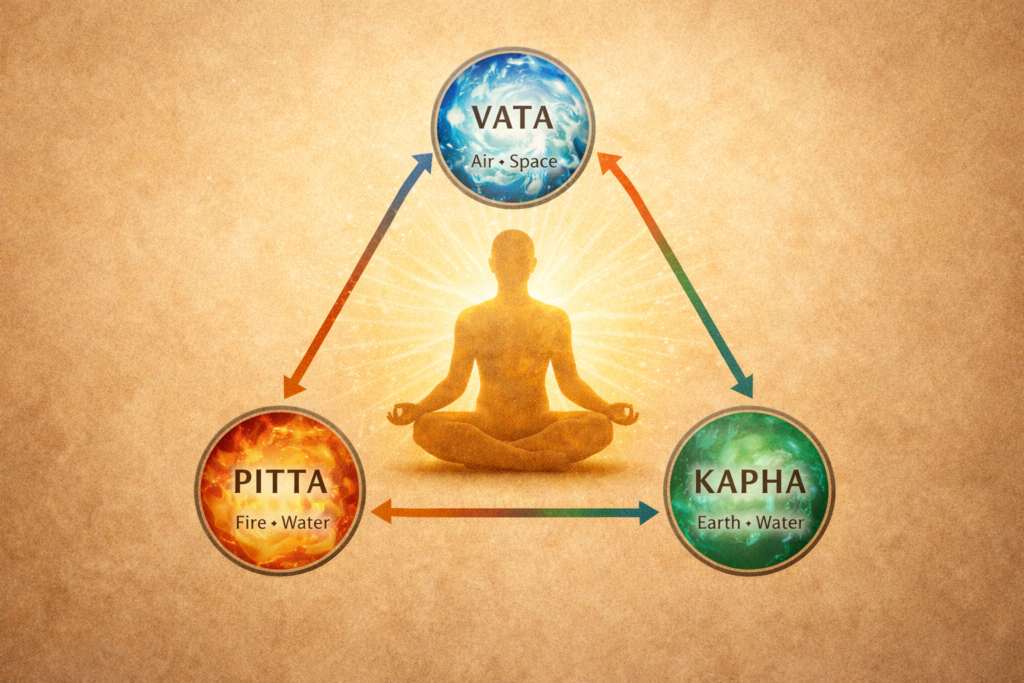
⚖️ The Three Doshas: A Biological Blueprint
Ayurveda describes three governing energies:
Vata (Movement, nervous system, breath)
Pitta (Metabolism, digestion, transformation)
Kapha (Structure, lubrication, immunity)
Each person is born with a unique constitution (Prakriti).
Modern parallels may include:
Genetic predispositions
Metabolic types
Hormonal patterns
Long before genetic sequencing, Ayurveda recognized individualized medicine.
Today, modern medicine calls this “personalized healthcare.”
Ayurveda practiced it thousands of years ago.
🔥 Agni: The Central Intelligence of Digestion
Ayurveda places enormous emphasis on Agni — the digestive fire.
If Agni is strong:
Nutrients are absorbed efficiently
Immunity improves
Energy stabilizes
If Agni is weak:
Toxins (Ama) accumulate
Inflammation develops
Disease manifests
Modern research on gut microbiome, inflammation, and metabolic health now supports this central idea:
Your digestive health influences your entire system.
Ayurveda recognized the gut as the root of health long before laboratory science confirmed it.
🌿 Fascinating Historical Facts About Ayurveda
Here are some powerful facts your audience may not know:
🔹 Sushruta described over 300 surgical procedures and 120 surgical instruments.
🔹 Rhinoplasty (plastic surgery) techniques were documented in ancient India centuries before modern reconstruction surgery.
🔹 Charaka emphasized preventive healthcare and ethical medical practice.
🔹 Ancient Ayurvedic physicians performed cataract surgery using specialized tools.
🔹 Ayurveda categorized diseases based on systemic imbalance rather than isolated symptoms.
This was not primitive herbal folklore.
It was systematic medical reasoning.
🧠 Mind-Body Connection: Centuries Ahead of Modern Psychology
Ayurveda teaches that:
Emotional imbalance creates physical illness.
Chronic stress disrupts internal harmony.
Lifestyle determines long-term health.
Today, psychosomatic medicine, stress biology, and neuroimmunology confirm these connections.
Meditation, breathwork (Pranayama), and daily routines (Dinacharya) were prescribed as medical protocols — not spiritual luxuries.
Ayurveda viewed life as rhythm.
Modern chronobiology now proves the same.
⚖️ Integration with Modern Medicine
Ayurveda does not reject modern medicine.
It complements it.
Modern medicine excels in:
Emergency intervention
Surgery
Acute infection management
Ayurveda excels in:
Chronic lifestyle disorders
Preventive care
Digestive health
Stress-related illness
The future of healthcare may lie in integration — not opposition.
Ancient wisdom guided by scientific validation.
🌿 The Deeper Philosophy: Ecology of the Human Body
Ayurveda sees the body as a microcosm of the universe.
The five elements:
Earth
Water
Fire
Air
Space
exist both externally and internally.
Health arises when internal elements align with external nature.
This ecological perspective feels surprisingly modern in the age of environmental science.
Ayurveda was holistic long before “holistic” became a trend.
“Modern behavioral science now confirms what Ayurveda emphasized centuries ago — that small, consistent daily routines shape long-term physical and mental well-being, much like the principles explained in the science of habit formation”.
Final Reflection: The Intelligence of Balance
Ayurveda does not try to overpower the body.
It tries to understand it.
It assumes the body has innate intelligence.
Disease is not an enemy.
It is a signal of imbalance.
And perhaps that is Ayurveda’s most powerful lesson:
Healing is not domination.
It is restoration of harmony.
In a world obsessed with speed and quick fixes, Ayurveda reminds us:
The body heals when aligned with nature.
And alignment begins with awareness.
Read More Interesting Content in My Blog Section.
Related Readings: