
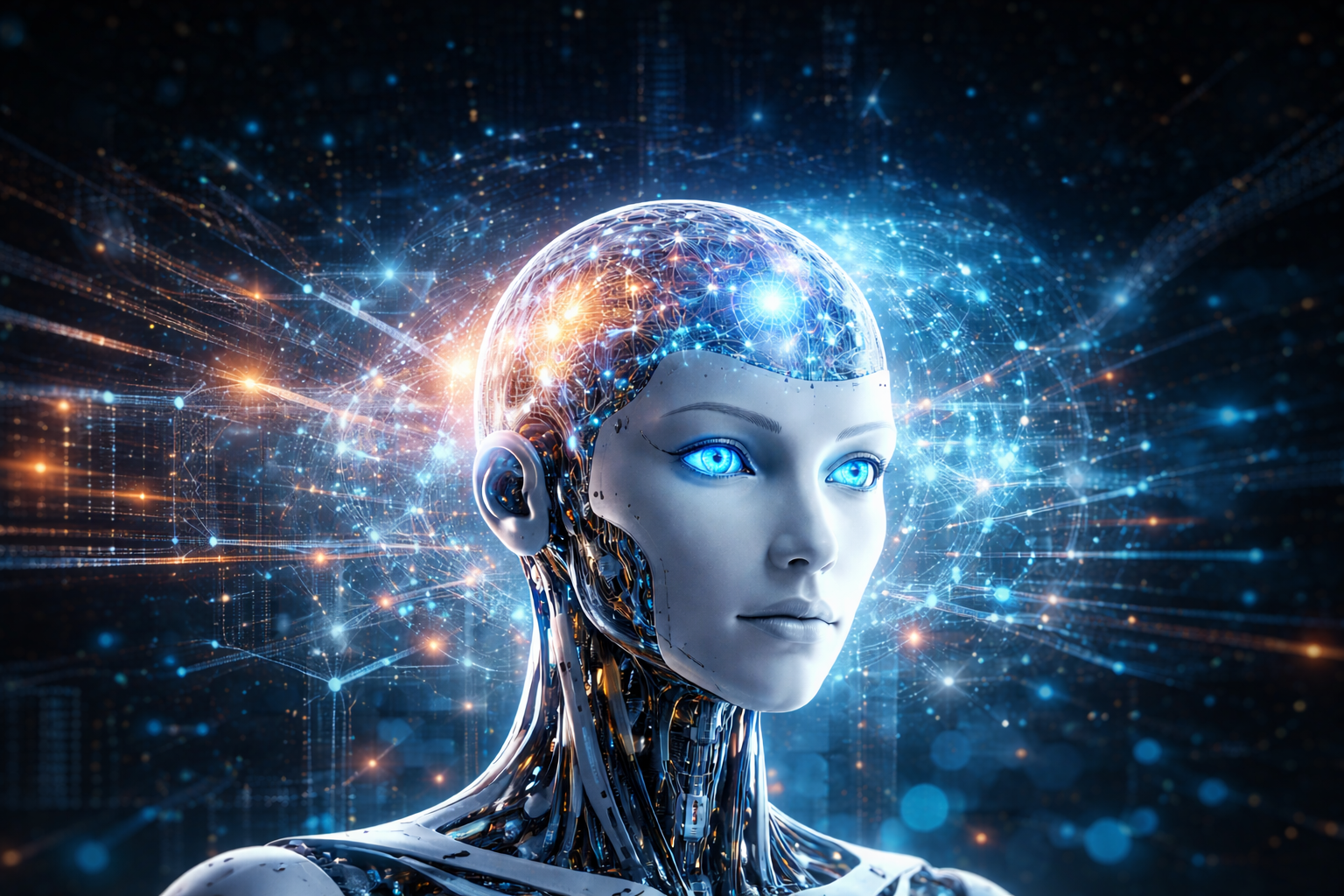

Artificial Intelligence has already transformed many aspects of modern life. From voice assistants and recommendation systems to self-driving technologies, AI is becoming deeply integrated into the way people work, communicate, and make decisions.
However, the AI systems we use today belong to a category known as narrow AI. These systems are designed to perform specific tasks such as recognizing images, translating languages, or predicting trends in data.
Artificial General Intelligence (AGI) represents a much more ambitious goal. AGI refers to a form of intelligence where machines can understand, learn, and apply knowledge across a wide range of tasks — similar to or even beyond human intelligence.
If achieved, AGI could become one of the most transformative technological breakthroughs in human history.
Artificial General Intelligence (AGI) is widely considered the next major milestone in the future of artificial intelligence.
To understand how artificial intelligence already influences modern life, you can explore our article How AI Is Used in Everyday Life, which explains the real-world applications of AI technologies.
What Is Artificial General Intelligence?
Artificial General Intelligence describes a machine capable of performing any intellectual task that a human being can perform.
Unlike current AI systems, AGI would not be limited to a single specialized function. Instead, it would be able to:
reason and solve complex problems
learn new concepts without specific programming
adapt to unfamiliar situations
transfer knowledge between different fields
In other words, AGI would behave more like a general thinking system rather than a specialized tool.
Researchers often compare AGI to the cognitive abilities of the human brain, which can learn new skills, interpret abstract ideas, and apply knowledge creatively.
The Difference Between AI and AGI
Most modern AI systems fall into the category of Artificial Narrow Intelligence (ANI). These systems are extremely powerful but only within specific domains.
For example:
a chess engine can defeat world champions but cannot drive a car
a language model can generate text but cannot repair a machine
an image recognition system cannot understand philosophy
AGI, on the other hand, would combine these abilities into a single intelligent system capable of switching between tasks just as humans do.
This is why many researchers consider AGI to be the next major milestone in artificial intelligence research.
How Close Are We to AGI?
Despite rapid advancements in AI technology, most scientists believe that true AGI has not yet been achieved.
Current AI systems still rely heavily on training data and specialized algorithms designed for specific tasks. They lack true understanding, self-awareness, and the ability to generalize knowledge across completely different domains.
However, progress in several areas is bringing researchers closer to the possibility of AGI:
neural networks inspired by the human brain
reinforcement learning systems
large-scale machine learning models
advanced robotics
Many leading technology companies and research laboratories are investing heavily in AGI research.
Potential Benefits of AGI
If developed responsibly, AGI could help humanity solve some of its most complex challenges.
Possible benefits include:
Scientific Discovery
AGI systems could analyze enormous amounts of data and generate new scientific hypotheses far faster than humans.
Medical Breakthroughs
Advanced AI could accelerate drug discovery, improve disease diagnosis, and develop personalized treatments.
Climate Solutions
AGI could help design new energy technologies and optimize global resource management.
Education Transformation
Intelligent systems could act as highly personalized tutors capable of adapting to each student’s learning style.
These possibilities show why many researchers believe AGI could become a powerful tool for advancing human knowledge.
Technological revolutions often emerge when multiple scientific fields intersect. Our article Nanotechnology: Engineering Reality at the Atomic Scale explores how manipulating matter at the smallest scales could transform industries ranging from medicine to computing.
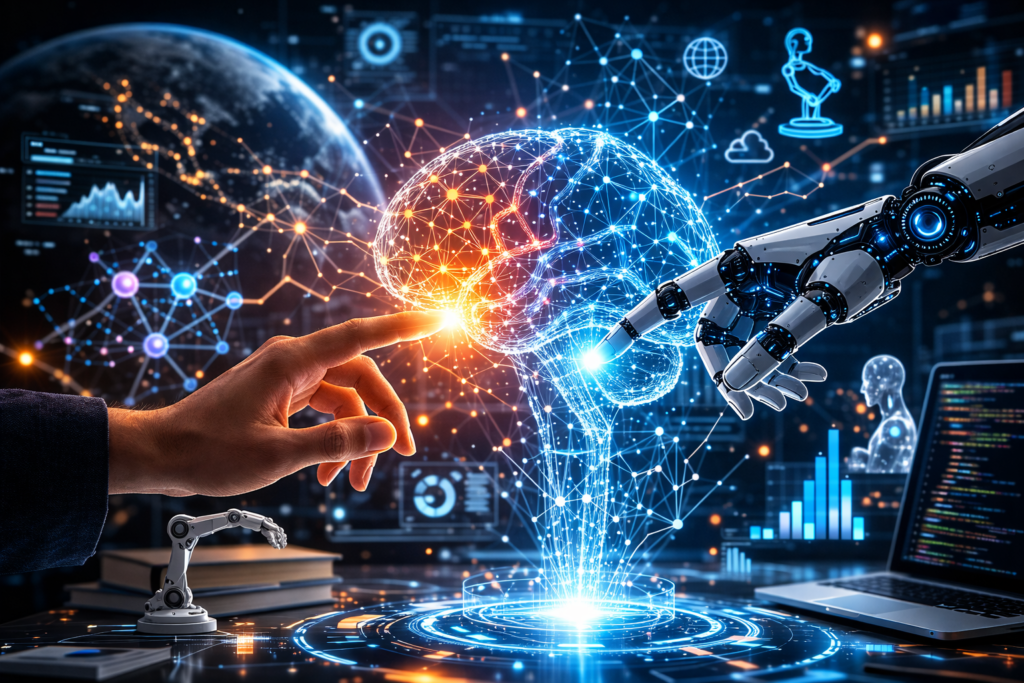
Advances in artificial intelligence are also accelerating breakthroughs in biological sciences. In our article Genetics: The Code That Writes Life — And May Rewrite Humanity, we explore how modern genetic research is reshaping the future of medicine and human evolution.
Risks and Ethical Concerns
While AGI offers incredible potential, it also raises serious ethical and safety concerns.
Experts warn that highly intelligent machines could create challenges if their goals are not aligned with human values.
Some major concerns include:
loss of human control over advanced AI systems
economic disruption due to automation
misuse of powerful AI technologies
ethical questions about machine autonomy
Because of these risks, many scientists are advocating for responsible AI development and global cooperation in AI governance.
Could AGI Become Smarter Than Humans?
One of the most debated questions in artificial intelligence research is whether AGI could eventually surpass human intelligence.
If machines gain the ability to improve their own algorithms and learning systems, they might enter a phase sometimes called superintelligence — where machine intelligence grows far beyond human cognitive abilities.
Some researchers believe this could happen within this century, while others argue it may take much longer or may never occur.
Regardless of the timeline, the development of AGI will likely remain one of the most important technological challenges of the future.
Conclusion
Artificial General Intelligence represents a bold vision of machines capable of thinking, learning, and solving problems across many domains.
Although the technology does not yet exist, research in artificial intelligence is advancing rapidly. Whether AGI arrives in decades or centuries, its development could fundamentally reshape science, economics, and society.
The future of intelligence may not belong solely to humans but could involve a powerful partnership between human creativity and machine capability.
Read More Interesting Content in My Blog Section.
Frequently Asked Questions (FAQ)
What is Artificial General Intelligence (AGI)?
Artificial General Intelligence (AGI) refers to a type of artificial intelligence that can perform any intellectual task that a human can do. Unlike current AI systems that specialize in specific tasks, AGI would be capable of reasoning, learning, adapting, and solving problems across multiple domains.
How is AGI different from current artificial intelligence?
Most modern AI systems are examples of Artificial Narrow Intelligence (ANI), which means they are designed for specific tasks such as image recognition or language translation. AGI, on the other hand, would have the ability to understand and learn any task, similar to human intelligence.
When could Artificial General Intelligence become reality?
There is no clear timeline for the development of AGI. Some researchers believe it could be achieved within the next few decades, while others think it may take much longer. The development of AGI depends on breakthroughs in machine learning, neuroscience, and computational technologies.
Could AGI become smarter than humans?
Some experts believe that once AGI is developed, it could eventually evolve into Artificial Superintelligence (ASI), where machines surpass human intelligence. This possibility raises both exciting opportunities and important ethical considerations.
What are the potential benefits of AGI?
AGI could help humanity solve complex global challenges such as climate change, disease research, space exploration, and scientific discovery. It could also transform industries including healthcare, education, and engineering.
What risks are associated with AGI?
While AGI could bring major benefits, it also raises concerns related to safety, control, and ethics. Researchers emphasize the importance of responsible AI development to ensure that advanced AI systems align with human values.