

Our Universe
The Universe is everything that exists: space, time, matter, energy, and the laws that govern them. It’s vast beyond intuition and still full of mysteries.
How it began
The Universe began about 13.8 billion years ago with the Big Bang.
Space itself expanded from an extremely hot, dense state.
Expansion is still happening today—and it’s accelerating.
How big it is
We can observe only part of it: the observable universe, about 93 billion light-years across.
Beyond that? We don’t know—space may continue far beyond what light has reached us from.
What it’s made of (the big surprise)
Ordinary matter (stars, planets, people): ~5%
Dark matter (invisible, holds galaxies together): ~27%
Dark energy (drives accelerated expansion): ~68%
Most of the Universe is made of things we can’t directly see.
Galaxies, stars, and planets
There are hundreds of billions of galaxies, each with billions of stars.
Our home is the Milky Way, with over 100 billion stars.
Many stars have planets; some may have conditions suitable for life.
Why the Universe matters to us
We are literally made of star material—heavy elements formed inside stars.
Studying the Universe helps us understand time, gravity, energy, and our own origins.
It also raises profound questions:
Are we alone? What is reality? What is time?
Mysteries still unsolved
What exactly dark matter and dark energy are
Whether the Universe is finite or infinite
If there are other universes (the multiverse idea)
How gravity fits with quantum physics
A humbling thought
Every atom in your body was forged in cosmic processes billions of years ago.
In a real sense, the Universe is not separate from us—we are a part of it.
Interesting Comparisons:
1. Moon vs Earth
The Moon is about ¼ the diameter of Earth.
If Earth were a basketball, the Moon would be a tennis ball ~7.5 meters away.
2. Earth vs Sun
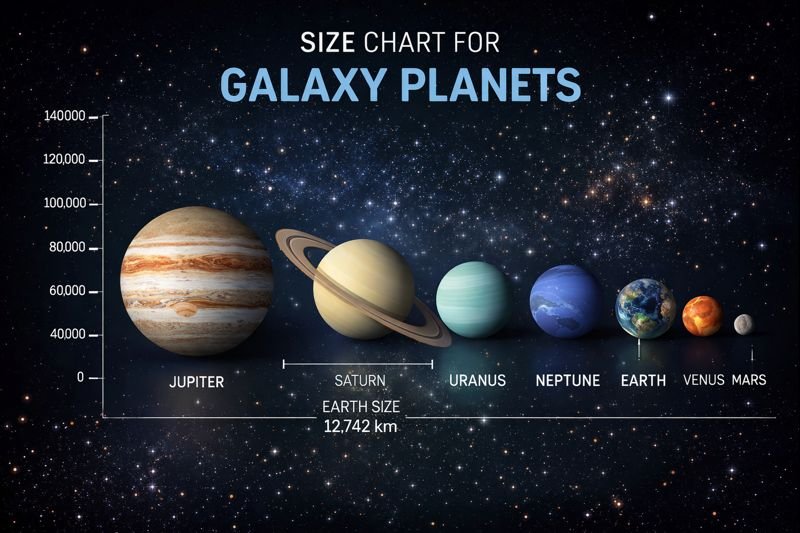
Earth’s diameter: ~12,742 km
Sun’s diameter: ~1.39 million km
You could fit ≈1.3 million Earths inside the Sun by volume.
3. Earth vs Jupiter
Jupiter is the largest planet.
~1,300 Earths can fit inside Jupiter.
4. Sun vs Giant Stars
Our Sun is actually small compared to many stars.
Betelgeuse: ~700× wider than the Sun
UY Scuti (one of the largest known stars):
Diameter ~1,700× the Sun
If placed at the center of our solar system, it would engulf Jupiter’s orbit
5. Solar System vs Milky Way Galaxy
Milky Way diameter: ~100,000 light-years
Contains 100–400 billion stars
Our entire solar system is a tiny dot inside it.
🧠 If the Milky Way were the size of India:
The solar system would be smaller than a grain of sand
6. Milky Way vs Observable Universe
Observable Universe contains ~2 trillion galaxies
Each galaxy has billions of stars
Distance across observable universe: 93 billion light-years
📌 If:
Milky Way = one grain of sand
Observable Universe = all the beaches on Earth
🧠 One humbling comparison
You are made of atoms forged inside stars.
Every heavy element in your body (iron, calcium) came from stellar explosions.
➡️ You are literally cosmic dust that learned to think.
Read More: Blogs