
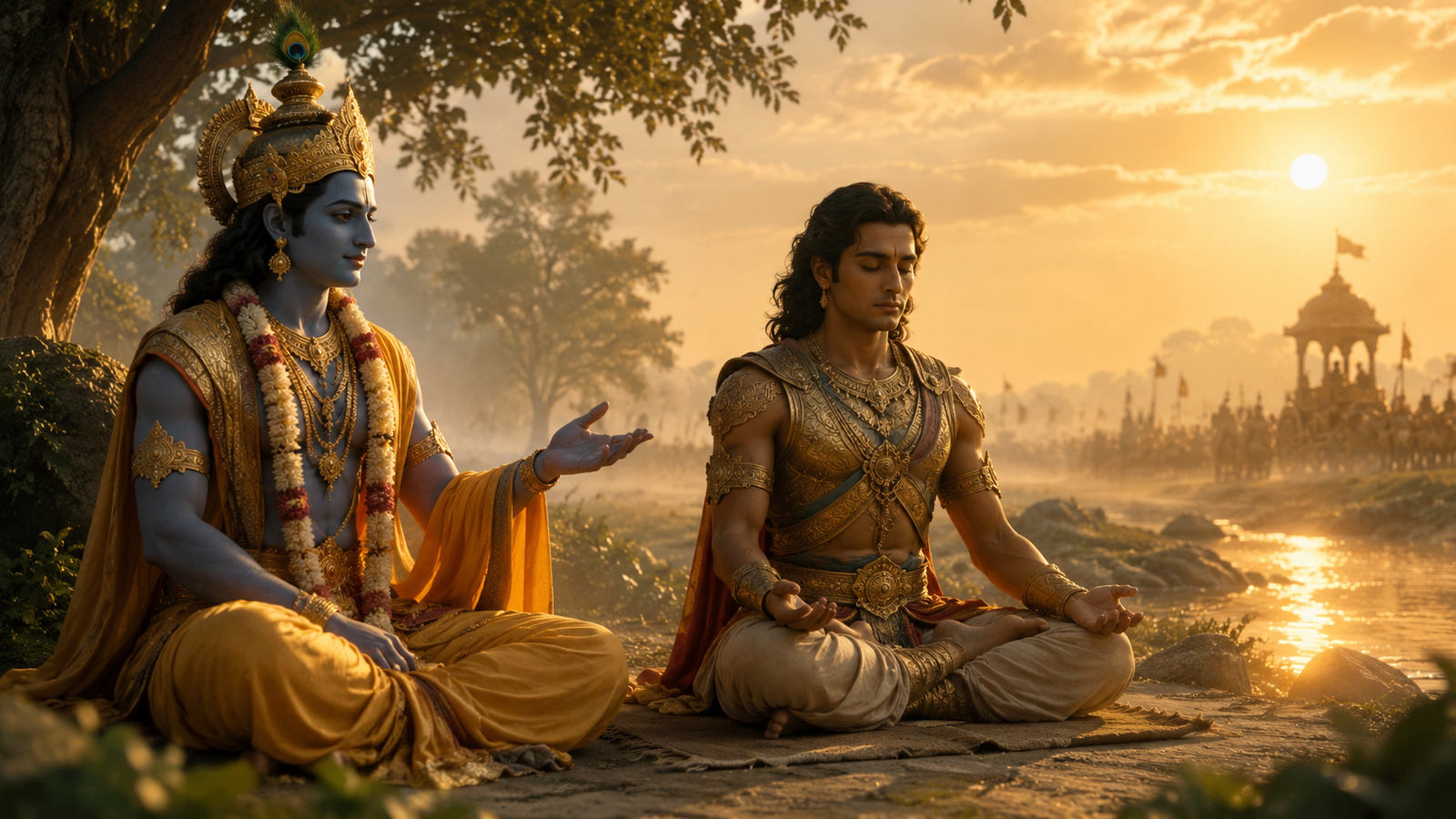

Bhagavad Gita Chapter 6, known as Dhyana Yoga, explains the science of meditation, discipline, self-control, and mastery over the restless mind. After teaching Karma Yoga and true renunciation in earlier chapters, Shri Krishna now guides Arjuna toward inner stability. This chapter shows that real spirituality is not escape from life, but the art of controlling the mind while performing one’s duty with balance, devotion, and awareness.
From Karma Sanyasa to Dhyana Yoga
In Chapter 5, Shri Krishna explained that true renunciation does not mean leaving action. A person does not become spiritual merely by abandoning duties, family, work, or social responsibilities. Real renunciation means giving up attachment, ego, selfish desire, and anxiety about results.
Now, in Chapter 6, Shri Krishna takes the teaching deeper. If action must continue, then how should a person keep the mind peaceful? If life is full of responsibilities, emotions, desires, fear, comparison, and distractions, then how can one remain stable inside?
This is where Dhyana Yoga begins.
Dhyana means meditation, but in the Bhagavad Gita, meditation is not just sitting silently with closed eyes. It is a complete discipline of life. It includes self-control, balanced habits, pure intention, mental awareness, and steady connection with the Divine.
This chapter is one of the most practical chapters of the Bhagavad Gita because it deals directly with the biggest battlefield inside every human being: the mind.
To understand how this chapter continues the previous teaching, readers can first revisit Bhagavad Gita Chapter 5: Karma Sanyasa Yoga, where Shri Krishna explains the difference between outer renunciation and inner detachment.
The real victory of life begins when a person learns to control the mind instead of being controlled by it.
Verse 6.1
Sanskrit Shloka:
श्रीभगवानुवाच ।
अनाश्रितः कर्मफलं कार्यं कर्म करोति यः ।
स सन्न्यासी च योगी च न निरग्निर्न चाक्रियः ॥ 1 ॥
Simple Translation:
Shri Krishna said: One who performs the duty that should be done without depending on the fruits of action is a true sanyasi and a true yogi, not the one who merely gives up rituals or physical action.
Explanation:
Shri Krishna begins this chapter by correcting a common misunderstanding. Many people think that a spiritual person is one who leaves worldly duties, stops working, or moves away from society. But Krishna says that real renunciation is not about leaving action. It is about leaving attachment to the result of action.
A person who performs duty sincerely without selfish expectation is both a true sanyasi and a true yogi. This means a student, employee, parent, leader, businessperson, or householder can also be spiritual if they perform their responsibilities with purity and detachment.
This verse is very practical for modern life. It teaches that spirituality is not limited to temples, forests, or meditation rooms. A person can practice yoga while studying, working, managing family, serving society, and facing daily challenges.
Verse 6.2
Sanskrit Shloka:
यं सन्न्यासमिति प्राहुर्योगं तं विद्धि पाण्डव ।
न ह्यसन्न्यस्तसङ्कल्पो योगी भवति कश्चन ॥ 2 ॥
Simple Translation:
O Pandava, what people call renunciation is the same as yoga. No one becomes a yogi without giving up selfish desires and mental attachments.
Explanation:
Here, Shri Krishna explains that true renunciation and yoga are not separate. Both require freedom from selfish desire. A person may wear simple clothes, live alone, or stop worldly activities, but if the mind is still filled with greed, ego, anger, jealousy, or craving, then that person has not truly renounced.
Krishna’s teaching is direct: yoga begins inside the mind. The real obstacle is not the outer world but the inner attachment to desire and expectation.
In today’s life, many people are physically active but mentally trapped. They compare themselves with others, chase endless goals, and feel restless even after achieving success. This verse reminds us that peace starts when the mind slowly gives up unnecessary desires and becomes steady.
Verse 6.3
Sanskrit Shloka:
आरुरुक्षोर्मुनेर्योगं कर्म कारणमुच्यते ।
योगारूढस्य तस्यैव शमः कारणमुच्यते ॥ 3 ॥
Simple Translation:
For a seeker who wants to rise in yoga, action is said to be the means. But for one who has already attained yoga, calmness and inner stillness become the means.
Explanation:
Shri Krishna now explains two stages of spiritual growth. In the beginning, a person should not avoid action. Duty, discipline, service, and selfless work help purify the mind. This is why action becomes the path for a beginner.
But when the seeker becomes mature and the mind becomes steady, inner calmness becomes more important. Such a person is no longer driven by selfish desire. Their action becomes natural, peaceful, and free from ego.
This verse teaches that spiritual life is progressive. A beginner should not imitate an advanced yogi by suddenly leaving responsibilities. First, the mind must be purified through right action. Then meditation and inner stillness become deeper and more natural.
Verse 6.4
Sanskrit Shloka:
यदा हि नेन्द्रियार्थेषु न कर्मस्वनुषज्जते ।
सर्वसङ्कल्पसन्न्यासी योगारूढस्तदोच्यते ॥ 4 ॥
Simple Translation:
When a person is no longer attached to sense objects or actions, and has renounced all selfish desires, then that person is said to be established in yoga.
Explanation:
This verse describes the state of a yogi who has risen above inner restlessness. Such a person may still live in the world, but the world no longer controls the mind. Sense pleasures, recognition, success, and personal ambition do not disturb their inner balance.
Krishna is not saying that a yogi becomes inactive or emotionless. He is saying that the yogi becomes free from dependence. The person no longer thinks, “I can be happy only if this happens,” or “I am nothing if I do not get this result.”
This is a very high state of freedom. A person established in yoga performs duty, but without mental slavery. Their happiness comes from within, not from temporary external conditions.
Verse 6.5
Sanskrit Shloka:
उद्धरेदात्मनात्मानं नात्मानमवसादयेत् ।
आत्मैव ह्यात्मनो बन्धुरात्मैव रिपुरात्मनः ॥ 5 ॥
Simple Translation:
One should uplift oneself by oneself and should not degrade oneself. The mind can become one’s friend, and the mind itself can also become one’s enemy.
Explanation:
This is one of the most powerful teachings of Chapter 6. Shri Krishna says that every person has the responsibility to uplift their own life. Others can guide, support, inspire, and bless us, but inner transformation must happen from within.
The same mind can become our best friend or our biggest enemy. When the mind is disciplined, it helps us grow, focus, forgive, work sincerely, pray deeply, and remain stable. But when the mind is uncontrolled, it pulls us into laziness, anger, fear, addiction, jealousy, overthinking, and self-doubt.
This verse is deeply relevant today. People often blame circumstances, society, family, destiny, or other people for their suffering. Krishna does not deny outer challenges, but He reminds us that the mind has a central role in our rise or fall.
Verse 6.6
Sanskrit Shloka:
बन्धुरात्मात्मनस्तस्य येनात्मैवात्मना जितः ।
अनात्मनस्तु शत्रुत्वे वर्तेतात्मैव शत्रुवत् ॥ 6 ॥
Simple Translation:
For one who has conquered the mind, the mind is the best friend. But for one who has failed to control it, the same mind behaves like an enemy.
Explanation:
Shri Krishna continues the teaching of the previous verse. The mind is not automatically peaceful. It must be trained with patience, wisdom, discipline, and practice. If trained, it supports spiritual growth. If ignored, it becomes restless and harmful.
A controlled mind helps a person remain calm in success and failure. It allows one to think before reacting. It gives strength during difficulty and humility during success.
An uncontrolled mind does the opposite. It exaggerates problems, creates fear, increases anger, and makes a person act impulsively. This is why Dhyana Yoga begins with mind control. Without mastery over the mind, even outer success cannot bring real peace.
Verse 6.7
Sanskrit Shloka:
जितात्मनः प्रशान्तस्य परमात्मा समाहितः ।
शीतोष्णसुखदुःखेषु तथा मानापमानयोः ॥ 7 ॥
Simple Translation:
For one who has conquered the mind and remains peaceful, the Supreme Self is realized. Such a person remains steady in heat and cold, pleasure and pain, honor and dishonor.
Explanation:
This verse describes the inner strength of a self-controlled person. Such a person does not become disturbed by every external situation. Whether life brings comfort or discomfort, praise or insult, success or failure, the yogi remains balanced.
This does not mean that a yogi becomes heartless or emotionless. It means the yogi is not controlled by changing circumstances. The person feels life deeply, but does not lose inner stability.
In ordinary life, many people become happy when praised and broken when criticized. They feel powerful in success and helpless in failure. Krishna teaches a higher freedom: do your duty, accept life’s dualities, and keep the mind rooted in the Divine.
Verse 6.8
Sanskrit Shloka:
ज्ञानविज्ञानतृप्तात्मा कूटस्थो विजितेन्द्रियः ।
युक्त इत्युच्यते योगी समलोष्टाश्मकाञ्चनः ॥ 8 ॥
Simple Translation:
A yogi who is satisfied with knowledge and realization, who is steady, who has conquered the senses, and who sees clay, stone, and gold with equal vision, is said to be truly united in yoga.
Explanation:
Shri Krishna now describes the maturity of a true yogi. Such a person is satisfied not merely with information, but with inner realization. Knowledge means understanding the truth, while realization means living that truth.
The phrase “clay, stone, and gold” is very important. For ordinary people, gold creates attraction, while clay and stone seem ordinary. But the yogi sees beyond material value. The yogi understands that external objects are temporary and cannot give permanent peace.
This does not mean the yogi cannot use wealth or respect material needs. It means the yogi is not mentally controlled by them. Gold may be useful, but it does not become the source of identity, pride, or greed.
Verse 6.9
Sanskrit Shloka:
सुहृन्मित्रार्युदासीनमध्यस्थद्वेष्यबन्धुषु ।
साधुष्वपि च पापेषु समबुद्धिर्विशिष्यते ॥ 9 ॥
Simple Translation:
One who maintains equal understanding toward well-wishers, friends, enemies, neutral persons, mediators, hateful persons, relatives, saints, and sinners is spiritually advanced.
Explanation:
This verse teaches the difficult but beautiful quality of equal vision. Shri Krishna says that a higher yogi does not judge people only through personal likes and dislikes. The yogi sees the deeper spiritual reality behind all beings.
This does not mean that a yogi treats good and harmful actions as the same. Dharma still matters. Right and wrong still matter. But the yogi does not become filled with hatred, revenge, or blind attachment. The yogi remains steady, fair, compassionate, and wise.
In daily life, this teaching is very important. We often behave differently based on whether someone supports us, criticizes us, praises us, or hurts us. Krishna teaches us to rise above personal bias and develop a more balanced, dharmic, and compassionate mind.
Verse 6.10
Sanskrit Shloka:
योगी युञ्जीत सततमात्मानं रहसि स्थितः ।
एकाकी यतचित्तात्मा निराशीरपरिग्रहः ॥ 10 ॥
Simple Translation:
A yogi should constantly practice meditation, staying in a quiet place, alone, with controlled mind and body, free from desires and possessiveness.
Explanation:
Now Shri Krishna begins the practical instruction for meditation. He says that a seeker should choose a quiet place and sit alone with a controlled mind. Meditation requires inward movement. If the mind is constantly scattered outside, it cannot easily become steady.
The words “free from desires and possessiveness” are very meaningful. Meditation is not just about posture. If the mind is full of greed, ego, comparison, and attachment, then sitting silently will not automatically bring peace. The outer silence must be supported by inner simplicity.
For modern life, this verse teaches the importance of a daily silent space. A person does not need to go to a forest. Even a clean and peaceful corner of the home can become a place of meditation if used regularly with devotion and discipline.
Verse 6.11
Sanskrit Shloka:
शुचौ देशे प्रतिष्ठाप्य स्थिरमासनमात्मनः ।
नात्युच्छ्रितं नातिनीचं चैलाजिनकुशोत्तरम् ॥ 11 ॥
Simple Translation:
In a clean place, the yogi should prepare a firm seat for meditation, neither too high nor too low, covered with kusha grass, deer skin, and cloth.
Explanation:
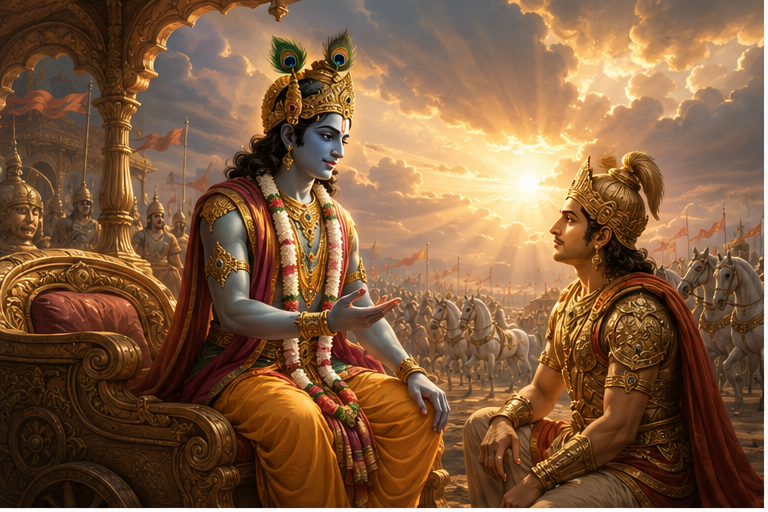
Shri Krishna now begins the practical method of meditation. He tells Arjuna that the place of meditation should be clean, peaceful, and suitable for inner concentration. The seat should be steady, not too high and not too low. This shows that meditation requires discipline, balance, and preparation.
The mention of kusha grass, deer skin, and cloth reflects the traditional meditation arrangement of ancient times. The deeper message is that the body should be stable and comfortable, so the mind can slowly become focused. If the body is restless, the mind also becomes restless.
For modern life, this verse teaches that we should create a clean and calm space for daily meditation or prayer. It may be a small corner of the home, but it should feel pure, peaceful, and free from unnecessary disturbance.
Verse 6.12
Sanskrit Shloka:
तत्रैकाग्रं मनः कृत्वा यतचित्तेन्द्रियक्रियः ।
उपविश्यासने युञ्ज्याद्योगमात्मविशुद्धये ॥ 12 ॥
Simple Translation:
Sitting on that seat, controlling the mind and senses, the yogi should practice meditation with one-pointed concentration for purification of the self.
Explanation:
This verse explains the purpose of meditation: atma-vishuddhi, or purification of the inner self. Meditation is not only for relaxation. It is a sacred practice through which the mind becomes clean, steady, and free from inner impurities.
Shri Krishna says that the yogi should make the mind one-pointed. This means the mind should not keep running toward different thoughts, desires, worries, and distractions. The senses should also be controlled, because the senses constantly pull the mind toward outer objects.
In modern terms, meditation is a practice of returning the mind again and again to one clear focus. It may be the breath, the name of God, a mantra, or the remembrance of Shri Krishna. With regular practice, the restless mind slowly becomes peaceful.
Verse 6.13
Sanskrit Shloka:
समं कायशिरोग्रीवं धारयन्नचलं स्थिरः ।
सम्प्रेक्ष्य नासिकाग्रं स्वं दिशश्चानवलोकयन् ॥ 13 ॥
Simple Translation:
Keeping the body, head, and neck straight and steady, the yogi should gaze toward the tip of the nose without looking around in different directions.
Explanation:
Shri Krishna now explains the posture of meditation. The body, head, and neck should be aligned and steady. This helps the body remain balanced and prevents sleepiness, discomfort, or unnecessary movement.
The instruction to gaze toward the tip of the nose means the yogi should avoid looking here and there. The goal is not to strain the eyes, but to reduce external distraction. When the eyes wander, the mind also wanders.
This verse shows that meditation is not careless sitting. It is a disciplined posture of awareness. In today’s life also, posture matters. A straight and relaxed sitting position helps breathing, alertness, and mental stability.
Verse 6.14
Sanskrit Shloka:
प्रशान्तात्मा विगतभीर्ब्रह्मचारिव्रते स्थितः ।
मनः संयम्य मच्चित्तो युक्त आसीत मत्परः ॥ 14 ॥
Simple Translation:
With a peaceful mind, free from fear, established in self-discipline, controlling the mind, and thinking of Me, the yogi should sit in meditation, devoted to Me as the Supreme goal.
Explanation:
Here, Shri Krishna gives the inner qualities required for meditation. The yogi should be peaceful, fearless, disciplined, and devoted. Meditation is not only a physical activity; it also requires purity of thought and intention.
The word brahmachari-vrate points toward self-control and disciplined living. It does not only mean external restraint, but also purity in thoughts, speech, habits, and desires. A mind running behind uncontrolled pleasures cannot easily become steady in meditation.
Most importantly, Krishna says the mind should be fixed on Him. This makes Gita’s meditation deeply devotional. The aim is not blankness or emptiness, but loving concentration on the Divine. The highest meditation is when the mind becomes calm and rests in Shri Krishna.
Verse 6.15
Sanskrit Shloka:
युञ्जन्नेवं सदात्मानं योगी नियतमानसः ।
शान्तिं निर्वाणपरमां मत्संस्थामधिगच्छति ॥ 15 ॥
Simple Translation:
Practicing meditation in this way, with the mind controlled, the yogi attains supreme peace and reaches the highest state of union with Me.
Explanation:
Shri Krishna now explains the result of disciplined meditation. When the yogi practices regularly with a controlled mind and devotion, the person attains supreme peace. This peace is not temporary happiness. It is a deep inner stillness that comes from connection with the Divine.
The phrase mat-sanstham means becoming established in Krishna. This shows that the highest goal of meditation is not only mental calmness, but union with the Supreme. Meditation becomes complete when it leads the soul toward God.
In ordinary life, people search for peace in comfort, money, success, relationships, or entertainment. But Krishna teaches that real peace comes when the mind becomes controlled and the heart becomes connected with the Divine.
Verse 6.16
Sanskrit Shloka:
नात्यश्नतस्तु योगोऽस्ति न चैकान्तमनश्नतः ।
न चाति स्वप्नशीलस्य जाग्रतो नैव चार्जुन ॥ 16 ॥
Simple Translation:
O Arjuna, yoga is not possible for one who eats too much or eats too little, sleeps too much or remains awake too much.
Explanation:
This is one of the most practical lifestyle teachings in the Bhagavad Gita. Shri Krishna clearly rejects extremes. He says that meditation and yoga cannot succeed if a person has an imbalanced lifestyle.
Too much eating makes the body heavy and lazy. Too little eating makes the body weak and restless. Too much sleep creates dullness, while too little sleep creates irritation, stress, and lack of focus.
This verse proves that the Gita’s spirituality is balanced and practical. Krishna does not support unnecessary harshness toward the body. The body is an instrument for dharma, meditation, and service. Therefore, it must be cared for properly.
Verse 6.17
Sanskrit Shloka:
युक्ताहारविहारस्य युक्तचेष्टस्य कर्मसु ।
युक्तस्वप्नावबोधस्य योगो भवति दुःखहा ॥ 17 ॥
Simple Translation:
For one who is balanced in food, recreation, actions, sleep, and waking, yoga becomes the destroyer of sorrow.
Explanation:
This verse completes the previous teaching. Shri Krishna explains that balance is essential for yoga. A person who eats properly, rests properly, works properly, and lives with moderation becomes fit for meditation.
The word yukta means balanced, disciplined, and properly regulated. Krishna is teaching the middle path. Spiritual life should not be careless indulgence, and it should not be extreme self-torture. It should be wise, steady, and balanced.
This verse is extremely useful for modern people. Stress, anxiety, lifestyle diseases, distraction, and mental tiredness often come from imbalance. Krishna says that a balanced life supports a peaceful mind, and a peaceful mind supports spiritual growth.
Verse 6.18
Sanskrit Shloka:
यदा विनियतं चित्तमात्मन्येवावतिष्ठते ।
निःस्पृहः सर्वकामेभ्यो युक्त इत्युच्यते तदा ॥ 18 ॥
Simple Translation:
When the controlled mind rests firmly in the self alone, and the person becomes free from craving for all desires, then that person is said to be established in yoga.
Explanation:
Shri Krishna now describes the inner state of a true yogi. When the mind becomes controlled and rests in the self, the person no longer runs helplessly behind desires. The mind becomes inwardly satisfied.
This does not mean that the yogi hates life or rejects the world. It means the yogi is no longer dependent on outer pleasures for inner peace. Desires may come and go, but they do not control the person.
This is a very high state of freedom. Most people are driven by endless wants. They think, “After I get this, I will be happy.” But Krishna teaches that real happiness begins when the mind becomes steady within.
Verse 6.19
Sanskrit Shloka:
यथा दीपो निवातस्थो नेङ्गते सोपमा स्मृता ।
योगिनो यतचित्तस्य युञ्जतो योगमात्मनः ॥ 19 ॥
Simple Translation:
Just as a lamp in a windless place does not flicker, such is the example of the controlled mind of a yogi absorbed in meditation.
Explanation:
This is one of the most beautiful images in the Bhagavad Gita. Shri Krishna compares the meditative mind to a lamp flame in a windless place. When there is no wind, the flame remains steady. In the same way, when desires and distractions reduce, the mind becomes calm and stable.
The flame represents awareness. The wind represents desires, worries, fears, and distractions. When the winds of the mind become quiet, the inner light shines clearly.
This verse also teaches that meditation is not forceful suppression. It is steady calming. Through practice, the mind becomes less scattered, less reactive, and more peaceful. A steady mind becomes capable of seeing truth.
Verse 6.20
Sanskrit Shloka:
यत्रोपरमते चित्तं निरुद्धं योगसेवया ।
यत्र चैवात्मनात्मानं पश्यन्नात्मनि तुष्यति ॥ 20 ॥
Simple Translation:
When the mind becomes restrained through the practice of yoga and becomes still, the yogi sees the self through the purified mind and rejoices in the self.
Explanation:
This verse describes the deeper experience of meditation. When the mind becomes quiet through practice, the yogi begins to experience the self within. The joy that arises here is not dependent on outer objects. It is inner satisfaction.
Normally, the mind looks outside for happiness. It runs toward people, possessions, achievements, praise, and pleasure. But when the mind becomes calm, the person discovers that there is a deeper joy already present within the self.
This is why meditation is not just a technique. It is a journey from outer dependency to inner realization. The yogi becomes peaceful because the mind no longer needs constant external stimulation to feel complete.
Verse 6.21
Sanskrit Shloka:
सुखमात्यन्तिकं यत्तद्बुद्धिग्राह्यमतीन्द्रियम् ।
वेत्ति यत्र न चैवायं स्थितश्चलति तत्त्वतः ॥ 21 ॥
Simple Translation:
In that state, the yogi experiences supreme happiness, which is beyond the senses and can be understood only by pure intelligence. Once established in this truth, the yogi never moves away from it.
Explanation:
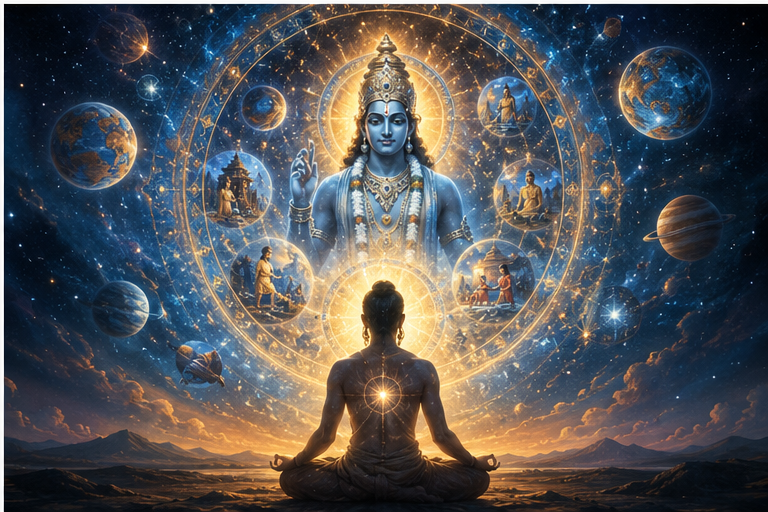
Shri Krishna now explains the deep happiness experienced in meditation. This happiness is not ordinary pleasure. Ordinary pleasure comes from the senses — taste, touch, sight, sound, smell, praise, comfort, and success. But the happiness of meditation is beyond the senses.
This inner joy is understood through purified intelligence. It is not dependent on external objects, people, or situations. When the yogi reaches this state, the mind becomes so peaceful and satisfied that it no longer runs behind temporary pleasures.
This verse teaches that the highest happiness is not outside us. It is discovered when the restless mind becomes calm and the soul experiences its own divine nature.
Verse 6.22
Sanskrit Shloka:
यं लब्ध्वा चापरं लाभं मन्यते नाधिकं ततः ।
यस्मिन्स्थितो न दुःखेन गुरुणापि विचाल्यते ॥ 22 ॥
Simple Translation:
After attaining this state, the yogi considers no other gain greater than it. Being established in it, even the heaviest sorrow cannot disturb the yogi.
Explanation:
Shri Krishna says that once a person experiences true inner peace, no worldly achievement appears greater than it. Wealth, fame, power, comfort, and praise may have their place in life, but they cannot match the joy of inner realization.
The second part of the verse is very powerful. Krishna says that even great sorrow cannot shake such a person. This does not mean the yogi will never face pain. It means the yogi has developed such deep inner stability that suffering cannot destroy their spiritual balance.
In modern life, people often feel broken by failure, criticism, loss, or uncertainty. This verse teaches that when a person becomes rooted in the self and connected with the Divine, life’s storms may come, but they cannot uproot the person from within.
Verse 6.23
Sanskrit Shloka:
तं विद्याद्दुःखसंयोगवियोगं योगसंज्ञितम् ।
स निश्चयेन योक्तव्यो योगोऽनिर्विण्णचेतसा ॥ 23 ॥
Simple Translation:
That state should be known as yoga, which separates one from the union with sorrow. This yoga should be practiced with determination and without a discouraged mind.
Explanation:
Here, Shri Krishna gives a beautiful definition of yoga. Yoga is not only physical posture or breathing exercise. True yoga is the state that separates the soul from sorrow. It frees the person from inner suffering caused by attachment, ignorance, desire, and mental restlessness.
Krishna also gives an important instruction: yoga must be practiced with determination. A person should not become discouraged if results are not immediate. The mind has been restless for many years, so it takes time to become steady.
This verse is very encouraging. Krishna knows that spiritual practice is not always easy. Some days the mind will be calm, and some days it will be disturbed. But the seeker should continue with patience, faith, and courage.
Verse 6.24
Sanskrit Shloka:
सङ्कल्पप्रभवान्कामांस्त्यक्त्वा सर्वानशेषतः ।
मनसैवेन्द्रियग्रामं विनियम्य समन्ततः ॥ 24 ॥
Simple Translation:
Giving up all desires born from imagination and mental planning, one should control all the senses from every side through the mind.
Explanation:
Shri Krishna now explains how meditation should be practiced. Desires often begin in the mind as imagination. The mind creates pictures, expectations, fantasies, and cravings. These thoughts then pull the senses toward external objects.
Krishna says that such desires should be given up completely. This does not mean destroying healthy duties or natural needs. It means giving up unnecessary cravings that disturb the mind and take the person away from inner peace.
The senses should be controlled through the mind. If the mind is weak, the senses become powerful. If the mind becomes disciplined, the senses naturally come under control. This is why Dhyana Yoga focuses so much on training the mind.
Verse 6.25
Sanskrit Shloka:
शनैः शनैरुपरमेद्बुद्ध्या धृतिगृहीतया ।
आत्मसंस्थं मनः कृत्वा न किञ्चिदपि चिन्तयेत् ॥ 25 ॥
Simple Translation:
Slowly and gradually, with firm intelligence and patience, one should calm the mind. Fixing the mind in the self, one should not think of anything else.
Explanation:
This verse is very practical and compassionate. Shri Krishna does not say that the mind will become calm immediately. He says shanaih shanaih — slowly, slowly. The path of meditation requires patience.
The mind should be calmed through steady intelligence and determination. A seeker should not fight the mind with frustration. Instead, the mind should be gently guided back again and again.
This teaching is very useful for anyone who struggles during meditation. Thoughts will come. Memories will come. Worries will come. But the seeker should not feel defeated. The practice is to return the mind patiently to the self, to peace, and to the Divine.
Verse 6.26
Sanskrit Shloka:
यतो यतो निश्चरति मनश्चञ्चलमस्थिरम् ।
ततस्ततो नियम्यैतदात्मन्येव वशं नयेत् ॥ 26 ॥
Simple Translation:
Whenever and wherever the restless and unsteady mind wanders, one should bring it back and place it under the control of the self.
Explanation:
This is one of the most important meditation instructions in the Bhagavad Gita. Shri Krishna accepts that the mind is restless. It will wander again and again. But every time it wanders, the seeker should bring it back.
This is the real practice of meditation. Meditation does not mean that thoughts will never arise. Meditation means not becoming a slave to those thoughts. The mind may go toward the past, future, fear, desire, regret, or distraction. The yogi gently brings it back.
This verse is very comforting for beginners. If your mind wanders during meditation, it does not mean you have failed. Bringing it back is itself the practice. Every return makes the mind stronger and more disciplined.
Verse 6.27
Sanskrit Shloka:
प्रशान्तमनसं ह्येनं योगिनं सुखमुत्तमम् ।
उपैति शान्तरजसं ब्रह्मभूतमकल्मषम् ॥ 27 ॥
Simple Translation:
The yogi whose mind is peaceful, whose passions are calmed, who is free from impurities, and who has become one with Brahman, attains supreme happiness.
Explanation:
Shri Krishna now describes the fruit of meditation. When the mind becomes peaceful and passions become calm, the yogi experiences supreme happiness. This happiness does not come from outside. It arises from purity and spiritual realization.
The word shanta-rajasam means that the restless energy of passion has become quiet. Rajas creates constant activity, desire, ambition, anger, and disturbance. When rajas becomes peaceful, the mind becomes clear.
The yogi also becomes akalmasham, free from inner impurities. This does not mean the person becomes proud of purity. It means the person becomes humble, peaceful, and closer to the Divine reality.
Verse 6.28
Sanskrit Shloka:
युञ्जन्नेवं सदात्मानं योगी विगतकल्मषः ।
सुखेन ब्रह्मसंस्पर्शमत्यन्तं सुखमश्नुते ॥ 28 ॥
Simple Translation:
Practicing yoga in this way, the yogi becomes free from impurities and easily experiences the infinite happiness that comes from contact with Brahman.
Explanation:
This verse continues the description of the yogi’s inner joy. Through regular meditation and self-control, the yogi becomes free from mental impurities and experiences Brahma-samsparsha — contact with the Supreme Reality.
This happiness is called atyantam sukham, unlimited happiness. It is not like ordinary pleasure, which begins and ends. Worldly pleasure depends on external conditions, but spiritual joy arises from connection with the eternal truth.
Krishna teaches that the highest joy is not achieved by running behind desires. It is achieved by purifying the mind, controlling the senses, and becoming inwardly connected with the Divine.
Verse 6.29
Sanskrit Shloka:
सर्वभूतस्थमात्मानं सर्वभूतानि चात्मनि ।
ईक्षते योगयुक्तात्मा सर्वत्र समदर्शनः ॥ 29 ॥
Simple Translation:
The yogi whose self is united through yoga sees the self present in all beings and all beings present in the self. Such a yogi sees with equal vision everywhere.
Explanation:
This verse describes the vision of a realized yogi. Such a person does not see life only through outer differences such as body, caste, wealth, position, religion, success, or appearance. The yogi sees the same spiritual essence present in all beings.
This is called sama-darshana, equal vision. It does not mean ignoring dharma or treating good and bad actions as identical. It means seeing the deeper unity of life behind outer differences.
When a person develops this vision, hatred reduces, compassion increases, and ego becomes weaker. The yogi begins to understand that all beings are connected at the spiritual level. This is one of the highest teachings of the Bhagavad Gita.
Verse 6.30
Sanskrit Shloka:
यो मां पश्यति सर्वत्र सर्वं च मयि पश्यति ।
तस्याहं न प्रणश्यामि स च मे न प्रणश्यति ॥ 30 ॥
Simple Translation:
One who sees Me everywhere and sees everything in Me is never separated from Me, and I am never separated from that person.
Explanation:
This is one of the most divine and devotional verses of Chapter 6. Shri Krishna says that the highest yogi sees God everywhere. Such a person does not limit Krishna only to a temple, idol, ritual, or scripture. The yogi sees the Divine presence in all existence.
To see everything in Krishna means to understand that the entire universe rests in the Supreme. Every living being, every force of nature, every moment of life is connected with the Divine reality.
Krishna gives a beautiful assurance: such a devotee is never lost to Him, and He is never lost to that devotee. This means that when the heart truly recognizes God everywhere, the relationship with the Divine becomes unbroken.
To understand the historical and cultural background behind the great events of Mahabharata, readers can also explore Ramayana and Mahabharata: Real History, Evidence, and the Eternal Legacy of Sanatan Dharma
Verse 6.31
Sanskrit Shloka:
सर्वभूतस्थितं यो मां भजत्येकत्वमास्थितः ।
सर्वथा वर्तमानोऽपि स योगी मयि वर्तते ॥ 31 ॥
Simple Translation:
The yogi who worships Me as present in all beings and remains established in unity, lives in Me in every condition.
Explanation:
Shri Krishna continues the teaching of divine vision. A true yogi does not see God as limited to one place or one form only. Such a yogi understands that the Supreme is present in all beings and all existence.
The phrase ekatvam asthitah means being established in the vision of oneness. This does not mean that all actions are the same or that dharma and adharma become equal. It means that beneath all outer differences, the yogi sees the same divine presence.
Krishna says that such a yogi lives in Him, no matter where the person is or what duties the person performs. This is a very deep teaching. A person does not need to escape the world to remain connected with God. If the mind is established in divine awareness, then every action can become yoga.
Verse 6.32
Sanskrit Shloka:
आत्मौपम्येन सर्वत्र समं पश्यति योऽर्जुन ।
सुखं वा यदि वा दुःखं स योगी परमो मतः ॥ 32 ॥
Simple Translation:
O Arjuna, one who sees all beings with the same feeling as oneself, whether in happiness or sorrow, is considered the highest yogi.
Explanation:
This verse gives one of the most beautiful ethical teachings of the Bhagavad Gita. Shri Krishna says that the highest yogi is one who can understand others by comparing them with oneself.
Just as we do not want pain, others also do not want pain. Just as we seek respect, safety, love, and happiness, others also seek the same. This understanding creates compassion, humility, fairness, and kindness.
This is not just emotional sympathy. It is spiritual maturity. When a person sees others’ happiness and suffering with sensitivity, ego begins to reduce. Such a person cannot easily hurt others, exploit others, or look down upon others.
In modern life, this verse is extremely important. It teaches empathy in family, workplace, society, leadership, and relationships. A true yogi is not only one who meditates silently, but one whose heart becomes sensitive to the joy and pain of others.
Verse 6.33
Sanskrit Shloka:
अर्जुन उवाच ।
योऽयं योगस्त्वया प्रोक्तः साम्येन मधुसूदन ।
एतस्याहं न पश्यामि चञ्चलत्वात्स्थितिं स्थिराम् ॥ 33 ॥
Simple Translation:
Arjuna said: O Madhusudana, this yoga of equality that You have explained seems difficult to me, because the mind is restless and unstable.
Explanation:
Arjuna now honestly expresses his difficulty. Shri Krishna has described a very high state of meditation, equality, self-control, and divine vision. But Arjuna says that he cannot see how this state can remain steady because the mind is restless.
This makes Arjuna very relatable. He does not blindly say yes to Krishna’s teaching. He raises the real problem faced by every seeker: the mind does not stay still. It changes quickly. It moves from one thought to another, from hope to fear, from confidence to doubt.
This verse shows that the Bhagavad Gita is not unrealistic. It does not ignore human weakness. Arjuna’s question represents all people who want peace but struggle with distraction, overthinking, emotions, desires, and mental instability.
Verse 6.34
Sanskrit Shloka:
चञ्चलं हि मनः कृष्ण प्रमाथि बलवद्दृढम् ।
तस्याहं निग्रहं मन्ये वायोरिव सुदुष्करम् ॥ 34 ॥
Simple Translation:
O Krishna, the mind is restless, turbulent, strong, and stubborn. I think controlling it is as difficult as controlling the wind.
Explanation:
Arjuna describes the mind with four strong words: restless, disturbing, powerful, and stubborn. This is one of the most honest descriptions of the human mind in any spiritual text.
The mind does not easily obey. It goes toward memories, fears, desires, anger, imagination, regret, comparison, and future worries. Sometimes a person knows what is right, yet the mind pulls them in another direction.
Arjuna compares controlling the mind to controlling the wind. The wind moves freely and cannot be held by force. Similarly, the mind cannot be controlled by pressure alone. It requires a deeper method.
This verse is very important for modern readers. If someone struggles during meditation, they should not feel ashamed. Even Arjuna, a great warrior and seeker, accepted that the mind is difficult to control.
Verse 6.35
Sanskrit Shloka:
श्रीभगवानुवाच ।
असंशयं महाबाहो मनो दुर्निग्रहं चलम् ।
अभ्यासेन तु कौन्तेय वैराग्येण च गृह्यते ॥ 35 ॥
Simple Translation:
Shri Krishna said: O mighty-armed Arjuna, undoubtedly the mind is restless and difficult to control. But by practice and detachment, it can be controlled.
Explanation:
Shri Krishna does not reject Arjuna’s concern. He agrees that the mind is restless and difficult to control. But Krishna also gives the solution: abhyasa and vairagya.
Abhyasa means repeated practice. The mind must be brought back again and again. If it wanders during meditation, bring it back. If discipline breaks, restart. If concentration fails, continue gently. Spiritual progress comes through steady effort.
Vairagya means detachment. It does not mean hatred for the world. It means freedom from unhealthy attachment, uncontrolled desire, and emotional dependence. When the mind stops clinging to every desire, it becomes lighter and easier to guide.
This verse is the heart of mind control in the Bhagavad Gita. Krishna gives a practical method: do not fight the mind with anger; train it with practice and free it through detachment.
Verse 6.36
Sanskrit Shloka:
असंयतात्मना योगो दुष्प्राप इति मे मतिः ।
वश्यात्मना तु यतता शक्योऽवाप्तुमुपायतः ॥ 36 ॥
Simple Translation:
In My opinion, yoga is difficult to attain for one whose mind is uncontrolled. But for one who has controlled the mind and makes proper effort, yoga can be attained.
Explanation:
Shri Krishna now makes the teaching very clear. Yoga is not impossible, but it requires self-control. If the mind remains uncontrolled, scattered, and dominated by desires, then deep yoga becomes difficult.
At the same time, Krishna does not discourage Arjuna. He says that yoga can be attained by a person who makes proper effort and gradually brings the mind under control.
This verse teaches both realism and hope. Krishna does not say that spiritual life is easy. But He also does not say that it is only for rare people. Anyone who practices sincerely, controls the senses, disciplines the mind, and follows the right method can progress on the path of yoga.
Verse 6.37
Sanskrit Shloka:
अर्जुन उवाच ।
अयतिः श्रद्धयोपेतो योगाच्चलितमानसः ।
अप्राप्य योगसंसिद्धिं कां गतिं कृष्ण गच्छति ॥ 37 ॥
Simple Translation:
Arjuna said: O Krishna, what happens to a person who has faith but lacks full discipline, whose mind turns away from yoga, and who fails to attain perfection in yoga?
Explanation:
Arjuna now asks a very compassionate and practical question. What happens to a seeker who begins the spiritual path with faith, but cannot complete it? What if the person starts meditation, devotion, or self-discipline, but later becomes distracted?
This question is important because many people face this situation. They begin spiritual practice sincerely, but due to weakness, duties, desires, distractions, or emotional struggles, they fall away from regular practice.
Arjuna is asking whether such a person loses everything. Is their effort wasted? Do they fail both in worldly life and spiritual life? This question prepares the way for one of Krishna’s most comforting answers.
Verse 6.38
Sanskrit Shloka:
कच्चिन्नोभयविभ्रष्टश्छिन्नाभ्रमिव नश्यति ।
अप्रतिष्ठो महाबाहो विमूढो ब्रह्मणः पथि ॥ 38 ॥
Simple Translation:
O mighty-armed Krishna, does such a person not become lost like a broken cloud, fallen from both paths, without support and confused on the path of Brahman?
Explanation:
Arjuna deepens his question. He fears that a seeker who fails in yoga may lose both worldly success and spiritual success. He compares such a person to a broken cloud that separates from a larger cloud and disappears in the sky.
This image is very emotional. A broken cloud has no firm place. It is neither joined to the original cloud nor able to stand independently. Arjuna wonders if the unsuccessful yogi becomes like that — unsupported, confused, and lost.
This question reflects a real fear in spiritual life. Many people hesitate to begin deep practice because they worry: “What if I cannot continue? What if I fail? What if I am not pure enough?” Through Arjuna’s question, the Gita answers the fear of every imperfect but sincere seeker.
Verse 6.39
Sanskrit Shloka:
एतन्मे संशयं कृष्ण छेत्तुमर्हस्यशेषतः ।
त्वदन्यः संशयस्यास्य छेत्ता न ह्युपपद्यते ॥ 39 ॥
Simple Translation:
O Krishna, please completely remove this doubt of mine. No one other than You can remove this doubt.
Explanation:
Arjuna now surrenders his doubt to Shri Krishna. He does not ask casually. He asks with faith, knowing that only Krishna can give the complete answer.
This verse shows the ideal relationship between seeker and teacher. A true seeker does not hide confusion. Arjuna openly admits his doubt and asks Krishna to remove it fully. This humility is necessary for spiritual learning.
In life also, doubts are natural. But when doubts are brought before wisdom with sincerity, they become stepping stones to deeper understanding. Arjuna’s doubt allows Krishna to reveal a very hopeful truth: sincere spiritual effort is never destroyed.
Verse 6.40
Sanskrit Shloka:
श्रीभगवानुवाच ।
पार्थ नैवेह नामुत्र विनाशस्तस्य विद्यते ।
न हि कल्याणकृत्कश्चिद्दुर्गतिं तात गच्छति ॥ 40 ॥
Simple Translation:
Shri Krishna said: O Partha, such a person is never destroyed, neither in this world nor in the next. One who does good, My dear friend, never comes to a bad end.
Explanation:
This is one of the most comforting verses of the Bhagavad Gita. Shri Krishna assures Arjuna that sincere spiritual effort is never wasted. A person who walks the path of goodness, even imperfectly, does not meet destruction.
The phrase na hi kalyana-krit kashchid durgatim tata gacchati is filled with compassion. Krishna says that one who does good never goes to a bad destination. Even if the seeker falls, struggles, or cannot complete the path immediately, their sincere effort remains valuable.
This verse gives great hope to every spiritual aspirant. Krishna is not looking for artificial perfection. He values sincere effort, goodness, faith, and inner intention. Every prayer, every act of self-control, every moment of meditation, every good deed contributes to the soul’s journey.
For a broader understanding of where the Bhagavad Gita stands within the vast spiritual knowledge system of Sanatan Dharma, readers can also read The Sacred Scripture Tree of Sanatan Dharma
Verse 6.41
Sanskrit Shloka:
प्राप्य पुण्यकृतां लोकानुषित्वा शाश्वतीः समाः ।
शुचीनां श्रीमतां गेहे योगभ्रष्टोऽभिजायते ॥ 41 ॥
Simple Translation:
The unsuccessful yogi, after reaching the worlds of the righteous and living there for many years, is born again in a pure and prosperous family.
Explanation:
Shri Krishna now explains what happens to a sincere seeker who begins the path of yoga but cannot complete it in one lifetime. Such a person does not lose their spiritual effort. Because of their good actions and sincere intention, they first attain higher worlds and then take birth again in a favorable environment.
The words shuchinam shrimatam gehe mean a pure and prosperous family. This does not only mean wealth. It means a family environment where values, discipline, purity, and opportunities for spiritual growth are present.
This verse gives great hope. Krishna is saying that the journey of the soul does not end with one failure. A sincere seeker receives another opportunity to continue the path. Spiritual effort is never wasted.
Verse 6.42
Sanskrit Shloka:
अथवा योगिनामेव कुले भवति धीमताम् ।
एतद्धि दुर्लभतरं लोके जन्म यदीदृशम् ॥ 42 ॥
Simple Translation:
Or such a person may be born in a family of wise yogis. Such a birth is very rare in this world.
Explanation:
Shri Krishna now gives an even higher possibility. If the seeker had advanced deeply in yoga but could not complete the path, they may be born in a family of wise yogis. This kind of birth is extremely rare because it gives the soul a natural spiritual atmosphere from childhood.
A child born in such a family does not need to struggle much to find spiritual direction. The environment itself supports meditation, devotion, discipline, scriptures, and self-control. Such a birth becomes a continuation of past spiritual effort.
This verse also explains why some people feel attracted to spirituality from a very young age. Their interest may not be accidental. It can be the result of previous spiritual impressions carried by the soul.
Verse 6.43
Sanskrit Shloka:
तत्र तं बुद्धिसंयोगं लभते पौर्वदेहिकम् ।
यतते च ततो भूयः संसिद्धौ कुरुनन्दन ॥ 43 ॥
Simple Translation:
There, O son of the Kurus, the person regains the wisdom from the previous birth and again strives for perfection in yoga.
Explanation:
Shri Krishna explains that spiritual progress continues. When such a seeker is born again, the wisdom and impressions from previous practice slowly awaken. The person may naturally feel drawn toward meditation, truth, devotion, scriptures, and inner growth.
This verse teaches that spiritual learning is never lost. Even if a person does not remember past lives consciously, the impressions remain within the subtle mind. These impressions shape natural tendencies, interests, and inner attraction.
For modern readers, this verse gives a deeper understanding of human nature. Some people naturally move toward prayer, meditation, compassion, or spiritual study without much external pressure. According to Krishna, this can be the continuation of previous effort.
Verse 6.44
Sanskrit Shloka:
पूर्वाभ्यासेन तेनैव ह्रियते ह्यवशोऽपि सः ।
जिज्ञासुरपि योगस्य शब्दब्रह्मातिवर्तते ॥ 44 ॥
Simple Translation:
Because of the practice from previous life, the person is naturally drawn toward yoga, even without conscious effort. Even a seeker of yoga goes beyond mere ritualistic understanding of the scriptures.
Explanation:
Here Shri Krishna says that previous spiritual practice has a powerful effect. Even if the person is not fully aware of it, they are pulled toward yoga by the force of past discipline. This inner pull is not ordinary curiosity. It is the awakening of old spiritual impressions.
The phrase shabda-brahma ativartate means the seeker goes beyond merely ritualistic or surface-level understanding of the scriptures. Such a person begins to search for direct truth, inner realization, and deeper connection with the Divine.
This verse shows that spiritual life is not only about outer customs. Rituals have value, but they should lead toward inner transformation. The seeker of yoga moves from words to experience, from formality to realization, and from outer practice to inner awakening.
Verse 6.45
Sanskrit Shloka:
प्रयत्नाद्यतमानस्तु योगी संशुद्धकिल्बिषः ।
अनेकजन्मसंसिद्धस्ततो याति परां गतिम् ॥ 45 ॥
Simple Translation:
The yogi who sincerely strives with effort becomes purified of sins, and after many births of spiritual practice, finally reaches the supreme goal.
Explanation:
Shri Krishna now explains that the path of yoga may take time, but sincere effort always leads forward. The yogi continues striving, becomes purified, and after many births of practice, reaches the highest destination.
This verse teaches patience. Spiritual perfection is not always immediate. The soul may need repeated effort, repeated learning, and repeated purification. But every sincere step takes the seeker closer to the final goal.
The phrase param gatim means the supreme destination. It refers to liberation, union with the Divine, and freedom from the cycle of ignorance and suffering. Krishna assures that the sincere yogi will eventually reach this state.
This is a very encouraging message. Even if progress seems slow, nothing is lost. Every moment of prayer, every act of self-control, every honest effort to improve the mind becomes part of the soul’s journey.
Verse 6.46
Sanskrit Shloka:
तपस्विभ्योऽधिको योगी ज्ञानिभ्योऽपि मतोऽधिकः ।
कर्मिभ्यश्चाधिको योगी तस्माद्योगी भवार्जुन ॥ 46 ॥
Simple Translation:
The yogi is greater than ascetics, greater than scholars, and greater than those who perform ritual actions. Therefore, O Arjuna, become a yogi.
Explanation:
Shri Krishna now declares the greatness of the yogi. A yogi is greater than one who performs only austerities, greater than one who has only bookish knowledge, and greater than one who performs rituals without inner realization.
This does not mean that austerity, knowledge, and action are useless. They are valuable when they lead to inner union with the Divine. But if they remain only external, they are incomplete. Yoga brings the person into direct inner connection with truth.
Krishna’s instruction to Arjuna is simple and powerful: become a yogi. This means live with discipline, act without selfish attachment, control the mind, meditate, and remain connected with the Divine.
For every reader, this verse becomes a personal call. Krishna is not asking us only to read spirituality. He is asking us to live it.
Verse 6.47
Sanskrit Shloka:
योगिनामपि सर्वेषां मद्गतेनान्तरात्मना ।
श्रद्धावान्भजते यो मां स मे युक्ततमो मतः ॥ 47 ॥
Simple Translation:
Among all yogis, the one who worships Me with faith, whose inner self is absorbed in Me, is considered by Me to be the highest yogi.
Explanation:
Chapter 6 ends with one of the most important conclusions of the Bhagavad Gita. After explaining meditation, mind control, discipline, posture, balance, practice, detachment, and self-realization, Shri Krishna reveals the highest form of yoga: devotion to Him.
The highest yogi is not merely the one who sits silently for long hours. The highest yogi is the one whose heart is filled with faith, whose mind is absorbed in Krishna, and whose life is guided by devotion.
This verse beautifully joins meditation and bhakti. Meditation without devotion may become dry. Devotion without discipline may become unstable. Krishna shows that the perfect yogi has both — a controlled mind and a devoted heart.
This is the final message of Dhyana Yoga. The purpose of meditation is not only mental peace. The highest purpose is loving union with the Supreme Divine.
Key Teachings of Bhagavad Gita Chapter 6
Bhagavad Gita Chapter 6 gives a complete path for inner discipline and meditation. Its main teachings are:
- A true yogi is not one who abandons duties, but one who performs duty without attachment.
- The mind can become either a friend or an enemy.
- Self-control is essential for spiritual growth.
- Meditation requires a clean place, steady posture, controlled senses, and devotion.
- Food, sleep, work, recreation, and daily habits must be balanced.
- The restless mind can be controlled through practice and detachment.
- The highest yogi sees the Divine in all beings.
- No sincere spiritual effort is ever wasted.
- Past spiritual practice continues to support the soul in future births.
- The highest yogi is one whose heart is absorbed in Shri Krishna with faith and devotion.
Modern Relevance of Dhyana Yoga
Dhyana Yoga is extremely relevant in today’s world. Modern life has become fast, noisy, and mentally exhausting. People have more information than ever before, but less inner peace. Phones, social media, competition, financial pressure, career stress, and emotional expectations constantly disturb the mind.
Chapter 6 gives a timeless solution. Shri Krishna teaches that peace does not come only from changing the outside world. It comes from training the mind. A disciplined mind can remain calm even when life is challenging.
This chapter also teaches balanced living. Krishna clearly says that yoga is not for one who eats too much or too little, sleeps too much or too little. This means spirituality is connected with lifestyle. Food, sleep, work, rest, meditation, and devotion must all be balanced.
For students, this chapter teaches focus and discipline. For working professionals, it teaches calmness under pressure. For families, it teaches emotional balance. For spiritual seekers, it gives the method of meditation. For everyone, it gives the message that the mind must be guided, not blindly followed.
The Real Victory Is Mastery Over the Mind
Bhagavad Gita Chapter 6 shows that the greatest battle of human life is not only outside. It is inside the mind. Arjuna’s struggle represents every person who wants peace but feels disturbed by thoughts, emotions, desires, and fears.
Shri Krishna does not deny that the mind is restless. He accepts it clearly and then gives the solution: practice and detachment. With repeated effort, balanced living, self-control, and devotion, the mind can become peaceful.
This chapter also gives great hope to every seeker. Even if a person fails, falls, or cannot complete the path immediately, no sincere effort is wasted. Every good action, every moment of meditation, every prayer, and every attempt at self-control carries the soul forward.
The chapter ends by declaring the highest yogi: the one who remembers Krishna with faith, devotion, and a heart absorbed in Him. Therefore, Dhyana Yoga is not only the yoga of meditation. It is the yoga of disciplined living, inner purification, mind control, and loving union with the Divine.
For Sanskrit verse reference and traditional translation comparison, readers may also refer to Bhagavad Gita Chapter 6 Sanskrit verses and translation.
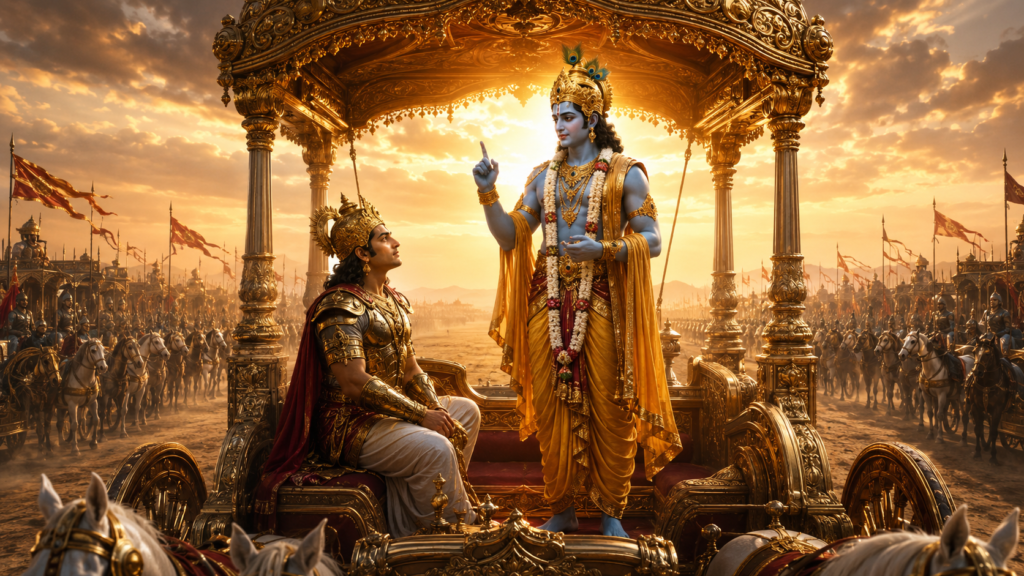
Arjuna now understands that the restless mind can be controlled through practice, detachment, discipline, and devotion. Shri Krishna has shown that meditation is not merely sitting silently, but a complete path of inner purification and self-mastery.
“When the mind becomes steady, the seeker begins to see the Divine presence within the self and everywhere in creation.”
This teaching now opens the door to a deeper revelation, where Krishna begins explaining His divine nature, His presence in the universe, and the difference between knowledge and realized wisdom.
Bhagavad Gita: Chapter 7 – Jnana Vijnana Yoga (The Yoga of Knowledge and Realization)
To understand the historical background, structure, and deeper context of this sacred dialogue, read our complete guide on Bhagavad Gita – History, Structure, and Timeless Wisdom.
Read More interesting Content in my Blog Section.