

A Complete, In-Depth Guide to the Infinite Knowledge System of Hinduism
Beyond a Single Holy Book: A Civilization of Knowledge
When people ask, “What is the holy book of Hinduism?”, the answer is never simple.
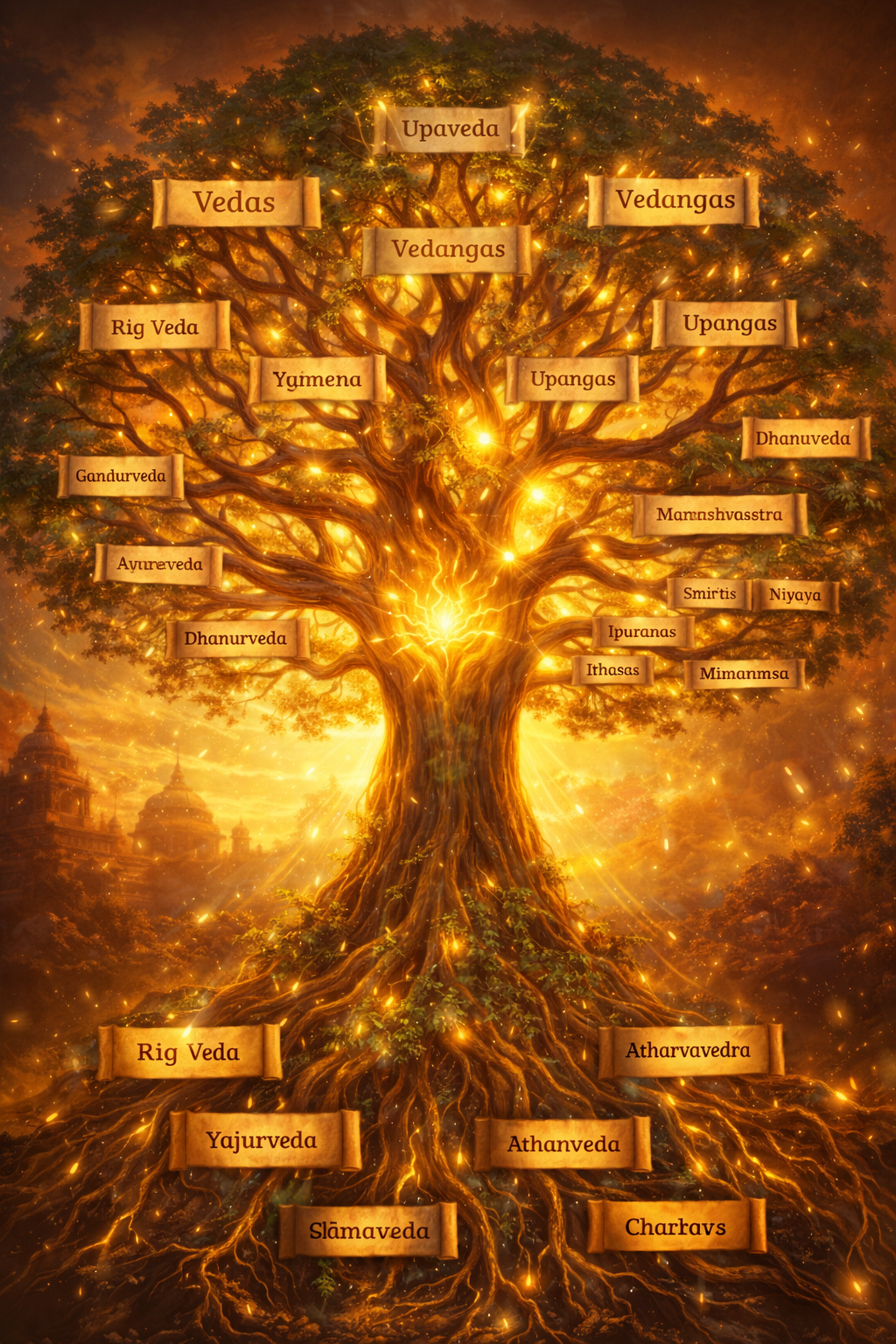
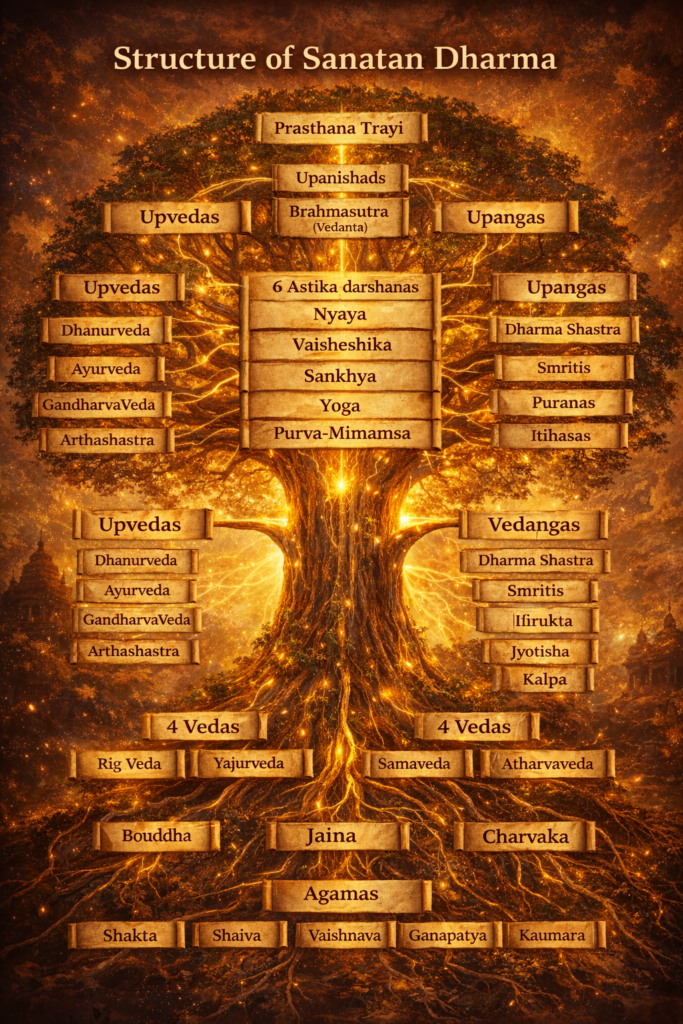
Because Sanatan Dharma is not built on a single scripture—it is built on a multi-layered, interconnected knowledge system, much like a living tree.
- The roots hold eternal truths
- The trunk stabilizes understanding
- The branches expand knowledge
- The leaves and fruits nourish human life
This “Sacred Scripture Tree” is not just spiritual—it is scientific, philosophical, cultural, and practical.
Let us now walk through this tree step by step.
1. The Roots – The 4 Vedas (Foundation of All Knowledge)
At the deepest level of Sanatan Dharma lie the Vedas, considered Apaurusheya (not created by humans).
They are not “books” in the conventional sense—they are cosmic knowledge revealed to ancient rishis.
🔹 Rig Veda – The Book of Knowledge
- Oldest known scripture in human history
- Contains over 1,000 hymns (suktas)
- Dedicated to natural forces like Agni (fire), Indra (rain), Surya (sun)
👉 Deeper Meaning:
Rig Veda is not just poetry—it is an attempt to understand the universe through consciousness. It reflects humanity’s first intellectual awakening.
🔹 Yajurveda – The Book of Action
- Focuses on rituals and yajnas
- Provides step-by-step instructions for performing sacred duties
👉 Deeper Meaning:
It teaches that knowledge alone is incomplete without action. Dharma must be lived, not just understood.
🔹 Samaveda – The Book of Sound & Vibration
- Derived largely from Rig Veda
- Mantras are sung rather than spoken
👉 Deeper Meaning:
Samaveda reveals a profound truth:
Sound is not just communication—it is energy.
This is the foundation of mantra science and even modern sound therapy.
🔹 Atharvaveda – The Book of Life
- Covers healing, protection, household rituals
- Includes knowledge of herbs, health, and social structure
👉 Deeper Meaning:
Atharvaveda bridges spirituality and daily life, proving that Sanatan Dharma is not separate from real-world living.
2. Upanishads (108) — The Spiritual Core of the Vedas
The Upanishads come immediately after the Vedas and represent their philosophical and spiritual essence.
While the Vedas provide foundational knowledge, the Upanishads explore deeper questions such as:
- What is the nature of reality?
- Who am I?
- What is Brahman (ultimate truth)?
They form the bridge between ritual (Vedas) and realization (Vedanta).
👉 There are 108 Upanishads, traditionally classified based on the Vedas they are associated with.
| Isha | Kena | Katha |
|---|---|---|
| Prashna | Mundaka | Mandukya |
| Taittiriya | Aitareya | Chandogya |
| Brihadaranyaka | Shvetashvatara | Kaushitaki |
| Maitri | Subala | Mantrika |
| Sarvasara | Niralamba | Shukarahasya |
| Vajrasuchi | Tejobindu | Nadabindu |
| Dhyanabindu | Brahmavidya | Yogatattva |
| Atmabodha | Naradaparivrajaka | Trishikhibrahmana |
| Sita | Yogachudamani | Nirvana |
| Mandala Brahmana | Dakshinamurti | Sharabha |
| Skanda | Tripadvibhuti | Advayataraka |
| Rama Rahasya | Rama Tapaniya | Vasudeva |
| Mudgala | Shandilya | Paingala |
| Bhikshuka | Mahat | Shariraka |
| Yogashikha | Turiyatita | Sannyasa |
| Paramahamsa | Akshamalika | Avyakta |
| Ekakshara | Annapurna | Surya |
| Akshi | Adhyatma | Kundika |
| Savitri | Atma | Pashupata |
| Parabrahma | Avadhuta | Tripuratapini |
| Devi | Tripura | Kathashruti |
| Rudra Hridaya | Yoga Kundalini | Bhasma |
| Rudraksha | Ganapati | Darshana |
| Tarasara | Mahavakya | Panchabrahma |
| Pranagnihotra | Gopala Tapaniya | Krishna |
| Yajnavalkya | Varaha | Shatyayaniya |
| Hayagriva | Dattatreya | Garuda |
| Kali Santarana | Jabala | Saubhagyalakshmi |
| Saraswati Rahasya | Bahvricha | Muktika |
| Amritabindu | Amritanada | Atharvashira |
| Atharvashikha | Kaivalya | Kalagnirudra |
| Kshurika | Maitrayani | Narayana |
| Nrisimha Tapaniya | Paramahamsa Parivrajaka | Sannyasa |
| Sarabha | Shvetasvatara (alt recensions) | Hamsa |
| Aruni | Garbha | Paramahamsa (minor) |
| Jabala (alt) | Paingala (alt) | Kaivalya (alt) |
Below are few major ones:-
🔹 Yoga Upanishads
| Upanishad Name | Veda | Category |
|---|---|---|
| Yoga Tattva | Krishna Yajurveda | Yoga |
| Yoga Kundalini | Krishna Yajurveda | Yoga |
| Amritabindu | Atharva Veda | Yoga |
| Tejobindu | Atharva Veda | Yoga |
| Dhyanabindu | Atharva Veda | Yoga |
| Brahmavidya | Krishna Yajurveda | Yoga |
🔹 Sannyasa Upanishads
| Upanishad Name | Veda | Category |
|---|---|---|
| Jabala | Atharva Veda | Sannyasa |
| Paramahamsa | Shukla Yajurveda | Sannyasa |
| Avadhuta | Krishna Yajurveda | Sannyasa |
| Naradaparivrajaka | Atharva Veda | Sannyasa |
🔹 Vaishnava Upanishads
| Upanishad Name | Veda | Category |
|---|---|---|
| Narayana | Krishna Yajurveda | Vaishnava |
| Nrisimha Tapaniya | Atharva Veda | Vaishnava |
| Gopala Tapaniya | Atharva Veda | Vaishnava |
🔹 Shaiva Upanishads
| Upanishad Name | Veda | Category |
|---|---|---|
| Kaivalya | Krishna Yajurveda | Shaiva |
| Rudra Hridaya | Krishna Yajurveda | Shaiva |
| Atharvashira | Atharva Veda | Shaiva |
🔹 Shakta Upanishads
| Upanishad Name | Veda | Category |
|---|---|---|
| Devi | Atharva Veda | Shakta |
| Tripura | Rig Veda | Shakta |
| Saraswati Rahasya | Atharva Veda | Shakta |
👉 “If the Vedas are the roots, the Upanishads are the consciousness flowing through the entire tree.”
3. The Branches – Upavedas (Applied Knowledge of Life)
If Vedas are theory, Upavedas are application.
They show how divine knowledge transforms into practical human systems.
🔸 Dhanurveda – Science of Warfare (Originated from Rig Veda)
- Strategy, archery, battlefield discipline
- Ethical warfare principles
👉 Insight: Even war is governed by dharma, not chaos.
🔸 Ayurveda – Science of Life(Originated from Yajurveda)
- Based on balance of body (doshas), mind, and soul
- Focus on prevention rather than cure
👉 Insight: Ayurveda sees health as harmony, not absence of disease—a concept now adopted globally.
🔸 Gandharva Veda – Art & Music(Originated from Samaveda)
- Music, dance, sound aesthetics
- Emotional and spiritual healing through art
👉 Insight: Art is not entertainment—it is a path to transcendence.
🔸 Arthashastra – Governance & Economics(Originated from Atharvaveda)
- Politics, administration, economics
- Principles of leadership and statecraft
👉 Insight: Sanatan Dharma integrates ethics into governance, unlike purely power-driven systems.
4. The Tools – Vedangas (Keys to Understanding the Vedas)
The Vedas are profound—but not easy to understand.
Hence, six Vedangas act as interpretation tools.
- Shiksha – Correct pronunciation (sound purity matters)
- Vyakarana – Grammar (precision of meaning)
- Chandas – Poetic meter (rhythm of knowledge)
- Nirukta – Word origins (hidden meanings)
- Jyotisha – Time & cosmic alignment
- Kalpa – Ritual frameworks
👉 Deeper Insight:
Vedangas prove that Vedic knowledge is structured, systematic, and scientific—not random spirituality.
5. The Expansion – Upangas (Making Knowledge Accessible)
As knowledge expanded, it became necessary to simplify and apply it to society.
🔹 Dharma Shastra
- Defines moral duties and responsibilities
- Guides ethical living
👉 Insight: Dharma is not religion—it is the law of right living.
🔹 Smritis
- Written by sages like Manu, Yajnavalkya
- Adapt Vedic wisdom for different eras
👉 Insight: Sanatan Dharma evolves with time—it is not rigid.
🔹 Puranas
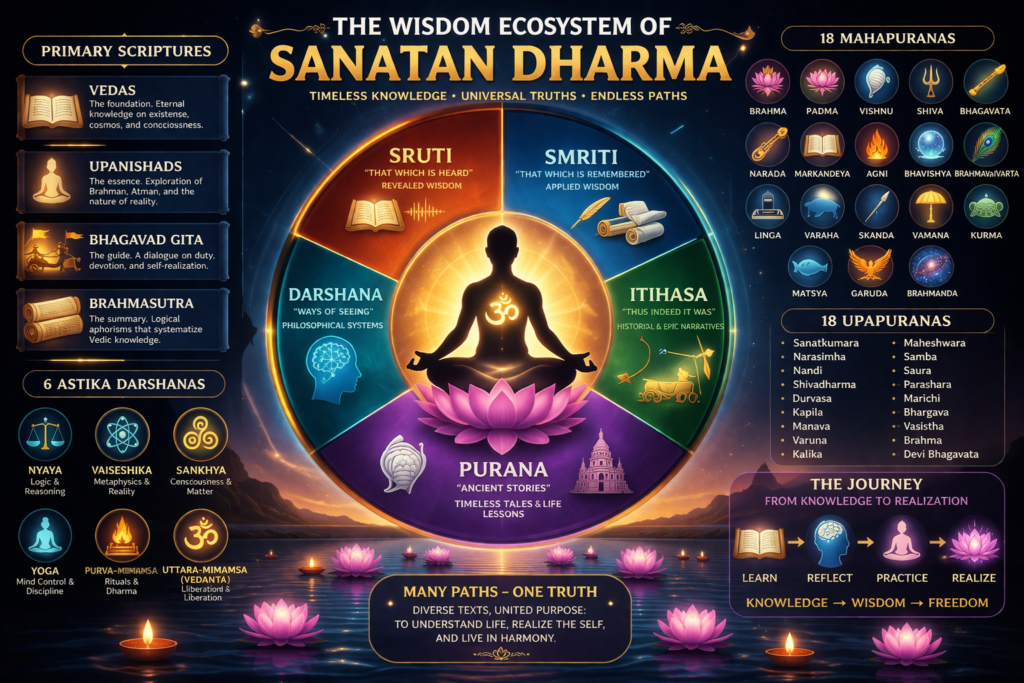
18 Mahapuranas + 18 Upapuranas
Stories of gods, creation, cosmic cycles, dharma, and spiritual wisdom explained through narratives
📜 18 Mahapuranas (With Meaningful Summary)
| No. | Mahapurana | Core Focus |
|---|---|---|
| 1 | Brahma Purana | Creation of the universe and sacred geography |
| 2 | Padma Purana | Devotion, pilgrimage, and spiritual practices |
| 3 | Vishnu Purana | Stories of Lord Vishnu and cosmic order |
| 4 | Shiva Purana | Life, power, and philosophy of Lord Shiva |
| 5 | Bhagavata Purana | Life of Lord Krishna and Bhakti (devotion) |
| 6 | Narada Purana | Bhakti, music, and spiritual wisdom |
| 7 | Markandeya Purana | Contains Devi Mahatmya (Durga’s glory) |
| 8 | Agni Purana | Knowledge on rituals, warfare, and sciences |
| 9 | Bhavishya Purana | Predictions and future events |
| 10 | Brahmavaivarta Purana | Creation and Krishna-Radha philosophy |
| 11 | Linga Purana | Symbolism and significance of Shiva Linga |
| 12 | Varaha Purana | Vishnu’s Varaha avatar and Earth’s protection |
| 13 | Skanda Purana | Largest Purana, pilgrimage and Kartikeya |
| 14 | Vamana Purana | Vamana avatar and dharma teachings |
| 15 | Kurma Purana | Kurma avatar and spiritual knowledge |
| 16 | Matsya Purana | Flood story and preservation of knowledge |
| 17 | Garuda Purana | Afterlife, karma, and journey of the soul |
| 18 | Brahmanda Purana | Cosmic structure and universe cycles |
📖 18 Upapuranas (With Brief Understanding)
| No. | Upapurana | Focus Area |
|---|---|---|
| 1 | Sanatkumara Purana | Spiritual wisdom and teachings of sages |
| 2 | Narasimha Purana | Narasimha avatar and protection of dharma |
| 3 | Nandi Purana | Teachings related to Lord Shiva |
| 4 | Shivadharma Purana | Duties and devotion toward Shiva |
| 5 | Durvasa Purana | Teachings of sage Durvasa |
| 6 | Kapila Purana | Sankhya philosophy and wisdom |
| 7 | Manava Purana | Social laws and human conduct |
| 8 | Varuna Purana | Water, cosmic balance, and rituals |
| 9 | Kalika Purana | Worship of Goddess Kali and Shakti |
| 10 | Maheshwara Purana | Shiva-related spiritual teachings |
| 11 | Samba Purana | Sun worship and healing practices |
| 12 | Saura Purana | Devotion to Surya (Sun God) |
| 13 | Parashara Purana | Dharma and societal guidance |
| 14 | Marichi Purana | Creation and sage teachings |
| 15 | Bhargava Purana | Teachings of sage Bhrigu |
| 16 | Vasistha Purana | Wisdom of sage Vasistha |
| 17 | Brahma Upapurana | Alternate cosmological teachings |
| 18 | Devi Bhagavata Purana | Supreme power of Goddess (Shakti tradition) |
Why Puranas Are So Powerful
The Puranas are not just mythological stories—they are multi-layered knowledge systems.
They translate:
- Abstract philosophy → into relatable stories
- Cosmic concepts → into human experiences
- Spiritual truths → into emotional understanding
For example:
- The story of Samudra Manthan explains cosmic balance
- The life of Lord Krishna explains duty, love, and detachment
- The journey after death in Garuda Purana explains karma deeply
👉 This is why even a common person, without reading Vedas, can understand life through Puranas.
Final Insight
The Puranas act as the heart of Sanatan Dharma, where knowledge is not just understood—it is felt.
They ensure that:
- Wisdom is not limited to scholars
- Spirituality is not restricted to rituals
- Truth is not hidden behind complexity
Instead, it flows freely through stories that educate, inspire, and transform.
🔹 Itihasas
- Ramayana – Ideal life and character
- Mahabharata – Complexity of dharma in real life
👉 Insight: These are not just epics—they are human psychology manuals.
6. The Intellectual Core – 6 Astika Darshanas
These are philosophical systems that try to answer:
👉 What is reality? Who am I? What is truth?
- Nyaya – Logic and reasoning
- Vaisheshika – Atomic theory of matter
- Sankhya – Duality of consciousness and nature
- Yoga – Path to inner realization
- Purva Mimamsa – Rituals and duty
- Uttara Mimamsa (Vedanta) – Ultimate reality (Brahman)
👉 Deep Insight:
These darshanas show that Sanatan Dharma encourages questioning, debate, and intellectual exploration—not blind belief.
7. The Essence – Prasthana Trayi (Ultimate Knowledge)
At the peak of this tree lies the distilled essence:
🔹 Upanishads
- Teach self-realization and the nature of the soul
🔹 Brahma Sutra
- Philosophical synthesis of all Vedic teachings
🔹 Bhagavad Gita
- Bhagavad Gita is a practical guide to life, action, and spirituality
👉 Insight:
If the Vedas are vast oceans, these are the purest drops of wisdom.
9. The Devotional System – 6 Agamas
These define temple worship and spiritual practices.
- Shaakta – Goddess energy
- Shaiva – Lord Shiva
- Vaishnava – Lord Vishnu
- Ganapatya – Lord Ganesha
- Kaumara – Kartikeya
- Saura – Sun worship
👉 Insight:
Different paths, same destination—unity in diversity.
Conclusion: Not a Religion, But a Living Civilization
The Sacred Scripture Tree of Sanatan Dharma reveals something extraordinary:
👉 It is not a closed system—it is an open, evolving knowledge universe.
- It combines science + spirituality
- It allows multiple truths and paths
- It adapts while staying rooted in eternal principles
This is why Sanatan Dharma has no single book—
because it is itself an infinite library of wisdom.
This structured depth is what makes Sanatan Dharma not just a belief system, but a timeless framework of knowledge that continues to guide humanity even in the modern age.
If you’re curious to explore how human consciousness is deeply connected to ancient wisdom traditions, you can read our detailed post on human consciousness and the mysteries of the mind, which beautifully connects science with spiritual understanding.
Read More Interesting Content in My Blog Section.
The Vedas are traditionally regarded as Apaurusheya (not of human origin), a concept explored in detail by this comprehensive overview of the Vedas.
FAQ
1. Why is there no single holy book in Hinduism?
Because knowledge is spread across multiple interconnected texts.
2. Which text should a beginner read?
Start with the Bhagavad Gita—it is the most practical guide.
3. Are all these texts equally important?
Each serves a different purpose—together they form a complete system.
4. Is Sanatan Dharma scientific?
Yes, it includes structured systems like Ayurveda, astronomy, and logic.