
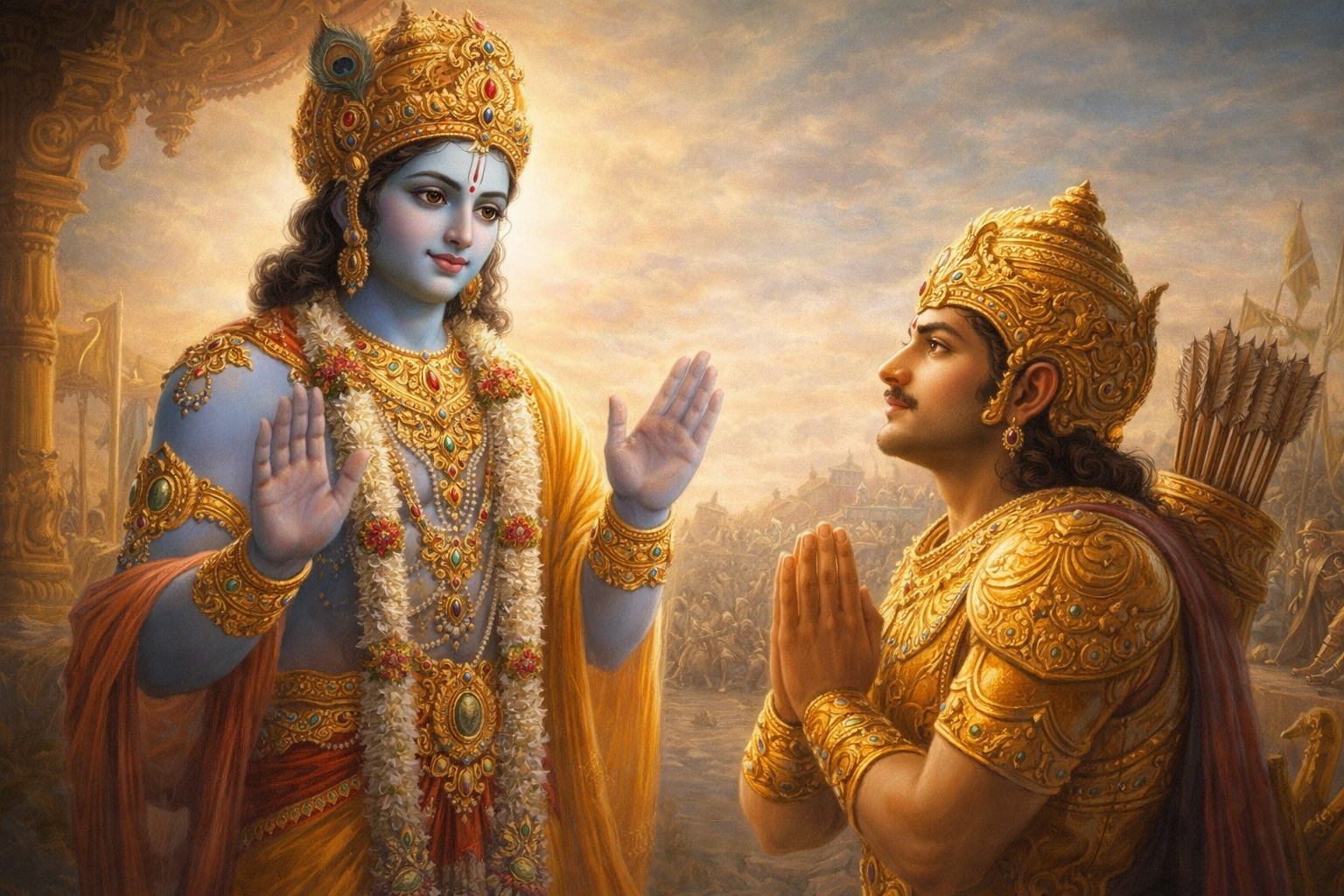

Bhagavad Gita Chapter 4 explains Jnana Karma Sanyasa Yoga — the path where knowledge and action come together. Lord Krishna reveals the divine origin of this knowledge, explains the mystery of His incarnations, and shows how true understanding can free a person from the bondage of karma.
After explaining Karma Yoga in Chapter 3, Krishna now deepens Arjuna’s understanding. He introduces the power of knowledge (Jnana) and how it transforms action into a path of liberation.
Arjuna, still curious and thoughtful, begins to question Krishna’s earlier statements — leading to profound revelations about time, existence, and divine purpose.
This chapter teaches that when actions are performed with true knowledge and without attachment, they no longer bind the soul.
“This chapter teaches that true knowledge has the power to purify all actions and liberate a person from the cycle of karma.”
Arjuna Questions Krishna’s Teachings
Verse 4.1
Sanskrit Shloka
श्रीभगवानुवाच
इमं विवस्वते योगं प्रोक्तवानहमव्ययम्।
विवस्वान्मनवे प्राह मनुरिक्ष्वाकवेऽब्रवीत्॥
Translation
The Blessed Lord said:
I taught this eternal yoga to the Sun God (Vivasvan); he passed it to Manu, and Manu passed it to Ikshvaku.
Explanation
Krishna begins by revealing that this knowledge is not new. It is ancient and was passed down through generations of great rulers and sages.
This shows that spiritual wisdom is timeless — it is preserved and transmitted across ages.
Verse 4.2
Sanskrit Shloka
एवं परम्पराप्राप्तमिमं राजर्षयो विदुः।
स कालेनेह महता योगो नष्टः परन्तप॥
Translation
This knowledge was received through the chain of disciplic succession, but over time it was lost.
Explanation
Krishna explains that although this wisdom was once widely known, it gradually disappeared due to the passage of time and decline in practice.
This highlights how truth can fade when it is not actively lived.
Verse 4.3
Sanskrit Shloka
स एवायं मया तेऽद्य योगः प्रोक्तः पुरातनः।
भक्तोऽसि मे सखा चेति रहस्यं ह्येतदुत्तमम्॥
Translation
That same ancient knowledge I am teaching you today because you are my devotee and friend.
Explanation
Krishna chooses Arjuna because of his sincerity and devotion. True knowledge is revealed only to those who are open and ready to receive it.
Verse 4.4
Sanskrit Shloka
अर्जुन उवाच
अपरं भवतो जन्म परं जन्म विवस्वतः।
कथमेतद्विजानीयां त्वमादौ प्रोक्तवानिति॥
Translation
Arjuna said:
You were born recently, whereas the Sun God was born long ago. How can I understand that you taught this in the beginning?
Explanation
Arjuna raises a logical question. He is confused about how Krishna could have taught ancient knowledge if He appears to be born in the present time.
This reflects human limitation in understanding divine reality.
Krishna Reveals His Divine Nature
Verse 4.5
Sanskrit Shloka
श्रीभगवानुवाच
बहूनि मे व्यतीतानि जन्मानि तव चार्जुन।
तान्यहं वेद सर्वाणि न त्वं वेत्थ परन्तप॥
Translation
Many births have passed for both you and Me. I remember all of them, but you do not.
Explanation
Krishna explains that while both He and Arjuna have taken many births, Krishna retains full awareness, whereas humans forget.
This reveals the difference between divine consciousness and human limitation.
Verse 4.6
Sanskrit Shloka
अजोऽपि सन्नव्ययात्मा भूतानामीश्वरोऽपि सन्।
प्रकृतिं स्वामधिष्ठाय सम्भवाम्यात्ममायया॥
Translation
Although I am unborn and eternal, I appear through My divine power.
Explanation
Krishna clarifies that He is not bound by birth like ordinary beings. His appearance in the world is a conscious and divine act.
Verse 4.7
Sanskrit Shloka
यदा यदा हि धर्मस्य ग्लानिर्भवति भारत।
अभ्युत्थानमधर्मस्य तदात्मानं सृजाम्यहम्॥
Translation
Whenever righteousness declines and unrighteousness rises, I manifest Myself.
Explanation
This is one of the most famous verses. Krishna explains the purpose of divine incarnation — restoring balance in the world.
Verse 4.8
Sanskrit Shloka
परित्राणाय साधूनां विनाशाय च दुष्कृताम्।
धर्मसंस्थापनार्थाय सम्भवामि युगे युगे॥
Translation
To protect the good, destroy evil, and establish dharma, I appear in every age.
Explanation
Krishna emphasizes that divine intervention ensures that goodness ultimately prevails.
The Divine Nature of Krishna’s Actions
Verse 4.9
Sanskrit Shloka
जन्म कर्म च मे दिव्यमेवं यो वेत्ति तत्त्वतः।
त्यक्त्वा देहं पुनर्जन्म नैति मामेति सोऽर्जुन॥
Translation
One who truly understands My divine birth and actions does not take birth again, but attains Me.
Explanation
Krishna explains that His birth and actions are not ordinary — they are divine and beyond human limitations.
Understanding this truth is not just intellectual; it requires deep realization.
When a person truly grasps this, they break free from the cycle of birth and death.
Such a person attains liberation because they align with divine consciousness.
Verse 4.10
Sanskrit Shloka
वीतरागभयक्रोधा मन्मया मामुपाश्रिताः।
बहवो ज्ञानतपसा पूता मद्भावमागताः॥
Translation
Freed from attachment, fear, and anger, many have attained Me through knowledge and discipline.
Explanation
Krishna highlights three major obstacles: attachment, fear, and anger.
When a person rises above these emotions and focuses on higher knowledge, transformation begins.
Through self-discipline and inner purification, many have already reached this state.
This shows that liberation is achievable — it is not just a theoretical idea.
Verse 4.11
Sanskrit Shloka
ये यथा मां प्रपद्यन्ते तांस्तथैव भजाम्यहम्।
मम वर्त्मानुवर्तन्ते मनुष्याः पार्थ सर्वशः॥
Translation
As people approach Me, I respond to them accordingly. Everyone follows My path in different ways.
Explanation
Krishna explains that people connect with the Divine in different ways — devotion, knowledge, action, or even desire.
He responds to each person based on their approach and intention.
This reflects the inclusiveness of spiritual paths — there is no single rigid way.
It also shows that sincerity matters more than the method.
Verse 4.12
Sanskrit Shloka
काङ्क्षन्तः कर्मणां सिद्धिं यजन्त इह देवताः।
क्षिप्रं हि मानुषे लोके सिद्धिर्भवति कर्मजा॥
Translation
Those who desire success in actions worship various deities, as results are quickly achieved through such actions.
Explanation
Krishna explains that many people perform rituals or worship for material gains.
These actions can give quick results, but they are temporary.
Such pursuits keep a person within the cycle of karma and desire.
Krishna is gradually guiding Arjuna toward a higher, more permanent goal beyond temporary success.
The System of Creation and Action
Verse 4.13
Sanskrit Shloka
चातुर्वर्ण्यं मया सृष्टं गुणकर्मविभागशः।
तस्य कर्तारमपि मां विद्ध्यकर्तारमव्ययम्॥
Translation
The four divisions of society were created by Me based on qualities and actions, though I am not the doer.
Explanation
Krishna explains that societal roles are based on qualities (guna) and actions (karma), not birth.
This system was meant to maintain harmony and balance in society.
However, Krishna clarifies that He is not personally bound by these actions.
This teaches that even while creating systems, the Divine remains unattached.
Verse 4.14
Sanskrit Shloka
न मां कर्माणि लिम्पन्ति न मे कर्मफले स्पृहा।
इति मां योऽभिजानाति कर्मभिर्न स बध्यते॥
Translation
Actions do not bind Me, nor do I desire their results. One who understands this is not bound by karma.
Explanation
Krishna emphasizes that attachment to results is what binds a person, not the action itself.
Since He has no desire for outcomes, He remains free from karma.
If a person adopts this mindset, they too can act without being bound.
This is a key principle of Karma Yoga.
Verse 4.15
Sanskrit Shloka
एवं ज्ञात्वा कृतं कर्म पूर्वैरपि मुमुक्षुभिः।
कुरु कर्मैव तस्मात्त्वं पूर्वैः पूर्वतरं कृतम्॥
Translation
Knowing this, ancient seekers performed actions. Therefore, you should also act as they did.
Explanation
Krishna reminds Arjuna that even great sages of the past followed this path.
They did not abandon action but performed it with the right understanding.
This gives Arjuna confidence that he is not alone in this path.
Following the wisdom of those before us helps avoid confusion and mistakes.
Verse 4.16
Sanskrit Shloka
किं कर्म किमकर्मेति कवयोऽप्यत्र मोहिताः।
तत्ते कर्म प्रवक्ष्यामि यज्ज्ञात्वा मोक्ष्यसेऽशुभात्॥
Translation
Even wise people are confused about what is action and inaction. I will explain it to you.
Explanation
Krishna acknowledges that karma is not simple — even intelligent people misunderstand it.
The difference between right action, wrong action, and inaction is subtle.
Therefore, guidance is essential to understand it correctly.
Krishna prepares Arjuna for deeper knowledge that will free him from confusion.
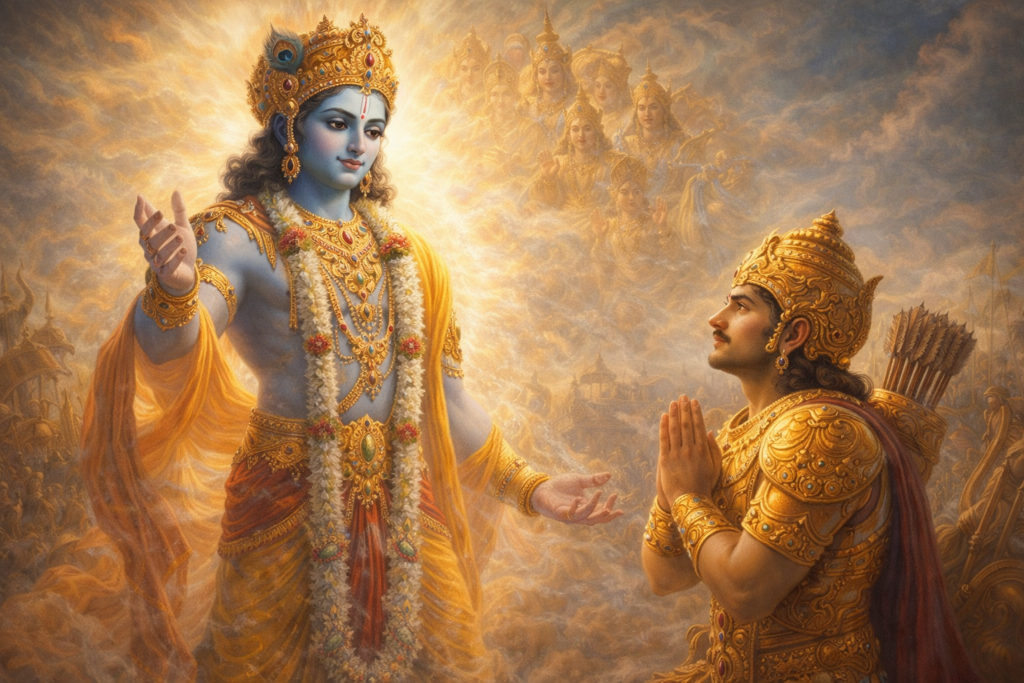
The Deep Mystery of Karma
Verse 4.17
Sanskrit Shloka
कर्मणो ह्यपि बोद्धव्यं बोद्धव्यं च विकर्मणः।
अकर्मणश्च बोद्धव्यं गहना कर्मणो गतिः॥
Translation
One must understand what action is, what wrong action is, and what inaction is. The nature of karma is very complex.
Explanation
Krishna makes it clear that karma is not as simple as it appears.
There are three aspects — right action (karma), wrong action (vikarma), and inaction (akarma).
Even wise people struggle to distinguish between them because intention plays a major role.
This verse prepares us to go beyond surface-level understanding and look deeper into our actions.
Verse 4.18
Sanskrit Shloka
कर्मण्यकर्म यः पश्येदकर्मणि च कर्म यः।
स बुद्धिमान्मनुष्येषु स युक्तः कृत्स्नकर्मकृत्॥
Translation
One who sees inaction in action and action in inaction is truly wise.
Explanation
This is a very profound teaching. A person may appear active externally but be internally detached — this is true inaction.
Similarly, someone may appear inactive but mentally engaged in desires and thoughts — this is action.
Krishna is teaching that true karma is determined by inner state, not just external activity.
Wisdom lies in understanding this subtle difference.
Verse 4.19
Sanskrit Shloka
यस्य सर्वे समारम्भाः कामसंकल्पवर्जिताः।
ज्ञानाग्निदग्धकर्माणं तमाहुः पण्डितं बुधाः॥
Translation
One whose actions are free from desire and whose karma is burned by knowledge is considered wise.
Explanation
Krishna explains that when actions are performed without selfish desire, they no longer bind a person.
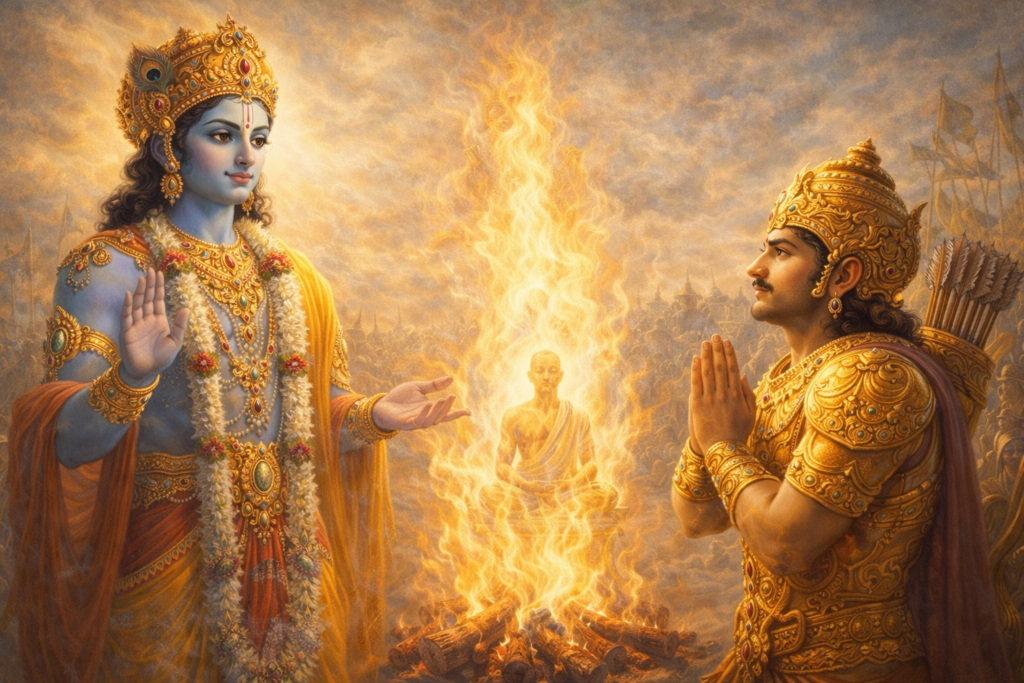
Knowledge acts like fire, burning the effects of past actions.
Such a person becomes free from the cycle of karma.
This is the state of a truly wise individual.
Verse 4.20
Sanskrit Shloka
त्यक्त्वा कर्मफलासङ्गं नित्यतृप्तो निराश्रयः।
कर्मण्यभिप्रवृत्तोऽपि नैव किंचित्करोति सः॥
Translation
Giving up attachment to results and being content, such a person is not bound even while performing actions.
Explanation
Krishna teaches that inner contentment is the key to freedom.
When a person does not depend on results for happiness, they become independent.
Even while actively working, such a person remains internally detached.
This is the ideal state of Karma Yoga.
Verse 4.21
Sanskrit Shloka
निराशीर्नियतचित्तात्मा त्यक्तसर्वपरिग्रहः।
शारीरं केवलं कर्म कुर्वन्नाप्नोति किल्बिषम्॥
Translation
A person who is free from desires, self-controlled, and without possessions does not incur sin.
Explanation
Krishna emphasizes simplicity and self-control.
When a person acts without greed and unnecessary accumulation, their actions remain pure.
Such actions do not create negative consequences.
This highlights the importance of intention and lifestyle.
Verse 4.22
Sanskrit Shloka
यदृच्छालाभसन्तुष्टो द्वन्द्वातीतो विमत्सरः।
समः सिद्धावसिद्धौ च कृत्वापि न निबध्यते॥
Translation
Satisfied with whatever comes, free from dualities and envy, such a person is not bound by actions.
Explanation
Krishna describes the qualities of a balanced person.
They remain steady in success and failure, without jealousy or comparison.
Such mental stability prevents the creation of karmic bondage.
This teaches emotional maturity and inner peace.
Verse 4.23
Sanskrit Shloka
गतसङ्गस्य मुक्तस्य ज्ञानावस्थितचेतसः।
यज्ञायाचरतः कर्म समग्रं प्रविलीयते॥
Translation
For one who is detached and established in knowledge, all actions dissolve completely.
Explanation
Krishna explains that when actions are performed as a sacred offering (yajna), they do not bind.
Detachment combined with knowledge transforms action into a spiritual practice.
Such actions lose their karmic impact.
This is the essence of Karma Yoga — action without bondage.
Verse 4.24
Sanskrit Shloka
ब्रह्मार्पणं ब्रह्म हविर्ब्रह्माग्नौ ब्रह्मणा हुतम्।
ब्रह्मैव तेन गन्तव्यं ब्रह्मकर्मसमाधिना॥
Translation
The offering, the act, and the performer are all Brahman. One who realizes this attains Brahman.
Explanation
Krishna reveals a higher spiritual vision — everything is part of the same divine reality.
When a person sees unity in all actions, duality disappears.
This realization leads to liberation.
It transforms everyday actions into spiritual experiences.
The Role of Sacrifice and Knowledge
Verse 4.25
Sanskrit Shloka
दैवमेवापरे यज्ञं योगिनः पर्युपासते।
ब्रह्माग्नावपरे यज्ञं यज्ञेनैवोपजुह्वति॥
Translation
Some yogis perform sacrifices to the gods, while others offer their actions into the fire of Brahman.
Explanation
Krishna explains that people follow different forms of spiritual practice.
Some perform external rituals, while others focus on inner spiritual offerings.
The deeper idea is that all these practices aim toward purification and higher awareness.
This shows that spirituality can be expressed in multiple ways.
Verse 4.26
Sanskrit Shloka
श्रोत्रादीनीन्द्रियाण्यन्ये संयमाग्निषु जुह्वति।
शब्दादीन्विषयानन्य इन्द्रियाग्निषु जुह्वति॥
Translation
Some offer their senses into the fire of self-control, while others offer sense objects into the senses.
Explanation
Krishna describes different types of inner discipline.
Controlling the senses is like performing a sacrifice within oneself.
Instead of being controlled by desires, a person learns to regulate them.
This transforms daily life into a spiritual practice.
Verse 4.27
Sanskrit Shloka
सर्वाणीन्द्रियकर्माणि प्राणकर्माणि चापरे।
आत्मसंयमयोगाग्नौ जुह्वति ज्ञानदीपिते॥
Translation
Some offer all actions of the senses and life force into the fire of self-control, guided by knowledge.
Explanation
Krishna highlights a higher level of discipline.
Here, a person dedicates all actions — physical and mental — to self-mastery.
Knowledge acts as the guiding light in this process.
Such a life becomes deeply conscious and purposeful.
Verse 4.28
Sanskrit Shloka
द्रव्ययज्ञास्तपोयज्ञा योगयज्ञास्तथापरे।
स्वाध्यायज्ञानयज्ञाश्च यतयः संशितव्रताः॥
Translation
Some perform sacrifices through wealth, austerity, yoga, or study of knowledge.
Explanation
Krishna shows the diversity of spiritual paths.
People can grow through charity, discipline, meditation, or learning.
Each path contributes to inner purification.
The key is sincerity and commitment in whichever path one follows.
Verse 4.29
Sanskrit Shloka
अपाने जुह्वति प्राणं प्राणेऽपानं तथापरे।
प्राणापानगती रुद्ध्वा प्राणायामपरायणाः॥
Translation
Some practice breath control by offering the incoming breath into the outgoing breath and vice versa.
Explanation
Krishna introduces practices like pranayama (breath control).
Such practices help regulate the mind and body.
By controlling breath, one gains control over thoughts and emotions.
This shows the connection between physical discipline and spiritual growth.
Verse 4.30
Sanskrit Shloka
अपरे नियताहाराः प्राणान्प्राणेषु जुह्वति।
सर्वेऽप्येते यज्ञविदो यज्ञक्षपितकल्मषाः॥
Translation
Others regulate their diet and offer life forces into one another. All these practitioners are purified by sacrifice.
Explanation
Krishna emphasizes discipline in lifestyle, including food habits.
Moderation and awareness in daily living are also forms of sacrifice.
Such practices gradually purify the mind.
This teaches that spirituality is not separate from daily habits.
Verse 4.31
Sanskrit Shloka
यज्ञशिष्टामृतभुजो यान्ति ब्रह्म सनातनम्।
नायं लोकोऽस्त्ययज्ञस्य कुतोऽन्यः कुरुसत्तम॥
Translation
Those who partake in the nectar of sacrifice attain the eternal. Without sacrifice, one cannot even succeed in this world.
Explanation
Krishna explains that sacrifice is essential for both spiritual and worldly success.
Living selfishly leads to dissatisfaction and imbalance.
Sacrifice creates harmony and growth.
It is a fundamental principle of life itself.
Verse 4.32
Sanskrit Shloka
एवं बहुविधा यज्ञा वितता ब्रह्मणो मुखे।
कर्मजान्विद्धि तान्सर्वानेवं ज्ञात्वा विमोक्ष्यसे॥
Translation
Various forms of sacrifice are described in the Vedas. Understanding them leads to liberation.
Explanation
Krishna summarizes that there are many paths, but all involve some form of sacrifice.
When a person understands the deeper meaning behind these practices, they progress spiritually.
Knowledge transforms ritual into realization.
This leads toward freedom from karma.
The Supremacy of Knowledge
Verse 4.33
Sanskrit Shloka
श्रेयान्द्रव्यमयाद्यज्ञाज्ज्ञानयज्ञः परन्तप।
सर्वं कर्माखिलं पार्थ ज्ञाने परिसमाप्यते॥
Translation
Sacrifice performed through knowledge is superior to material sacrifice, as all actions culminate in knowledge.
Explanation
Krishna elevates knowledge above all other forms of sacrifice.
While external rituals have value, true transformation comes from understanding.
Knowledge gives clarity and removes ignorance.
It is the highest form of purification.
Verse 4.34
Sanskrit Shloka
तद्विद्धि प्रणिपातेन परिप्रश्नेन सेवया।
उपदेक्ष्यन्ति ते ज्ञानं ज्ञानिनस्तत्त्वदर्शिनः॥
Translation
Approach wise teachers with humility, inquiry, and service. They will impart knowledge to you.
Explanation
Krishna explains the correct way to gain knowledge.
It requires humility, curiosity, and respect for teachers.
True wisdom is received, not imposed.
This highlights the importance of guidance in spiritual growth.
Verse 4.35
Sanskrit Shloka
यज्ज्ञात्वा न पुनर्मोहमेवं यास्यसि पाण्डव।
येन भूतान्यशेषेण द्रक्ष्यस्यात्मन्यथो मयि॥
Translation
After gaining this knowledge, you will not fall into confusion and will see all beings in yourself and in Me.
Explanation
Knowledge removes ignorance and confusion completely.
It brings a sense of unity — seeing all life as interconnected.
This leads to compassion and clarity.
Such realization transforms one’s entire perception of reality.
Verse 4.36
Sanskrit Shloka
अपि चेदसि पापेभ्यः सर्वेभ्यः पापकृत्तमः।
सर्वं ज्ञानप्लवेनैव वृजिनं सन्तरिष्यसि॥
Translation
Even if you are the worst sinner, knowledge will carry you across all sins.
Explanation
Krishna gives hope to everyone.
No matter how difficult the past, transformation is always possible.
Knowledge acts like a boat that carries a person across suffering.
This is a powerful message of redemption.
Verse 4.37
Sanskrit Shloka
यथैधांसि समिद्धोऽग्निर्भस्मसात्कुरुतेऽर्जुन।
ज्ञानाग्निः सर्वकर्माणि भस्मसात्कुरुते तथा॥
Translation
Just as fire burns wood to ashes, knowledge burns all karma.
Explanation
Krishna uses a powerful metaphor to explain knowledge.
Just as fire destroys wood completely, knowledge destroys karmic bondage.
This means past actions lose their hold on a person.
It brings true freedom.
Verse 4.38
Sanskrit Shloka
न हि ज्ञानेन सदृशं पवित्रमिह विद्यते।
तत्स्वयं योगसंसिद्धः कालेनात्मनि विन्दति॥
Translation
There is nothing as pure as knowledge. One who is perfected in yoga realizes this over time.
Explanation
Krishna emphasizes that knowledge is the highest purifier.
It removes ignorance and reveals truth.
This realization comes gradually through practice.
Patience and consistency are essential.
Verse 4.39
Sanskrit Shloka
श्रद्धावान्लभते ज्ञानं तत्परः संयतेन्द्रियः।
ज्ञानं लब्ध्वा परां शान्तिमचिरेणाधिगच्छति॥
Translation
A faithful and disciplined person gains knowledge and quickly attains peace.
Explanation
Krishna highlights three key qualities: faith, focus, and self-control.
These qualities make a person ready for true understanding.
Once knowledge is gained, inner peace follows naturally.
This shows the connection between discipline and happiness.
Verse 4.40
Sanskrit Shloka
अज्ञश्चाश्रद्दधानश्च संशयात्मा विनश्यति।
नायं लोकोऽस्ति न परो न सुखं संशयात्मनः॥
Translation
A person without knowledge, faith, or clarity is lost and cannot attain happiness.
Explanation
Krishna warns about doubt and lack of faith.
Constant confusion prevents progress.
Such a person struggles both in this world and spiritually.
Clarity and trust are essential for growth.
Verse 4.41
Sanskrit Shloka
योगसंन्यस्तकर्माणं ज्ञानसंछिन्नसंशयम्।
आत्मवन्तं न कर्माणि निबध्नन्ति धनंजय॥
Translation
One who has renounced actions through yoga and destroyed doubts through knowledge is not bound by karma.
Explanation
Krishna explains the final state of a realized person.
Such a person is free from doubt and attachment.
Their actions no longer create bondage.
This is true liberation while living.
Verse 4.42
Sanskrit Shloka
तस्मादज्ञानसम्भूतं हृत्स्थं ज्ञानासिनात्मनः।
छित्त्वैनं संशयं योगमातिष्ठोत्तिष्ठ भारत॥
Translation
Therefore, cut off doubt with the sword of knowledge and stand up to perform your duty.
Explanation
Krishna concludes the chapter with a powerful message.
Doubt is the biggest obstacle in life.
Knowledge acts as a weapon to remove this confusion.
He urges Arjuna to rise, act, and fulfill his responsibility with clarity.
The Role of Sacrifice and Knowledge
Verse 4.25
Sanskrit Shloka
दैवमेवापरे यज्ञं योगिनः पर्युपासते।
ब्रह्माग्नावपरे यज्ञं यज्ञेनैवोपजुह्वति॥
Translation
Some yogis perform sacrifices to the gods, while others offer their actions into the fire of Brahman.
Explanation
Krishna explains that people follow different forms of spiritual practice.
Some perform external rituals, while others focus on inner spiritual offerings.
The deeper idea is that all these practices aim toward purification and higher awareness.
This shows that spirituality can be expressed in multiple ways.
Verse 4.26
Sanskrit Shloka
श्रोत्रादीनीन्द्रियाण्यन्ये संयमाग्निषु जुह्वति।
शब्दादीन्विषयानन्य इन्द्रियाग्निषु जुह्वति॥
Translation
Some offer their senses into the fire of self-control, while others offer sense objects into the senses.
Explanation
Krishna describes different types of inner discipline.
Controlling the senses is like performing a sacrifice within oneself.
Instead of being controlled by desires, a person learns to regulate them.
This transforms daily life into a spiritual practice.
Verse 4.27
Sanskrit Shloka
सर्वाणीन्द्रियकर्माणि प्राणकर्माणि चापरे।
आत्मसंयमयोगाग्नौ जुह्वति ज्ञानदीपिते॥
Translation
Some offer all actions of the senses and life force into the fire of self-control, guided by knowledge.
Explanation
Krishna highlights a higher level of discipline.
Here, a person dedicates all actions — physical and mental — to self-mastery.
Knowledge acts as the guiding light in this process.
Such a life becomes deeply conscious and purposeful.
Verse 4.28
Sanskrit Shloka
द्रव्ययज्ञास्तपोयज्ञा योगयज्ञास्तथापरे।
स्वाध्यायज्ञानयज्ञाश्च यतयः संशितव्रताः॥
Translation
Some perform sacrifices through wealth, austerity, yoga, or study of knowledge.
Explanation
Krishna shows the diversity of spiritual paths.
People can grow through charity, discipline, meditation, or learning.
Each path contributes to inner purification.
The key is sincerity and commitment in whichever path one follows.
Verse 4.29
Sanskrit Shloka
अपाने जुह्वति प्राणं प्राणेऽपानं तथापरे।
प्राणापानगती रुद्ध्वा प्राणायामपरायणाः॥
Translation
Some practice breath control by offering the incoming breath into the outgoing breath and vice versa.
Explanation
Krishna introduces practices like pranayama (breath control).
Such practices help regulate the mind and body.
By controlling breath, one gains control over thoughts and emotions.
This shows the connection between physical discipline and spiritual growth.
Verse 4.30
Sanskrit Shloka
अपरे नियताहाराः प्राणान्प्राणेषु जुह्वति।
सर्वेऽप्येते यज्ञविदो यज्ञक्षपितकल्मषाः॥
Translation
Others regulate their diet and offer life forces into one another. All these practitioners are purified by sacrifice.
Explanation
Krishna emphasizes discipline in lifestyle, including food habits.
Moderation and awareness in daily living are also forms of sacrifice.
Such practices gradually purify the mind.
This teaches that spirituality is not separate from daily habits.
Verse 4.31
Sanskrit Shloka
यज्ञशिष्टामृतभुजो यान्ति ब्रह्म सनातनम्।
नायं लोकोऽस्त्ययज्ञस्य कुतोऽन्यः कुरुसत्तम॥
Translation
Those who partake in the nectar of sacrifice attain the eternal. Without sacrifice, one cannot even succeed in this world.
Explanation
Krishna explains that sacrifice is essential for both spiritual and worldly success.
Living selfishly leads to dissatisfaction and imbalance.
Sacrifice creates harmony and growth.
It is a fundamental principle of life itself.
Verse 4.32
Sanskrit Shloka
एवं बहुविधा यज्ञा वितता ब्रह्मणो मुखे।
कर्मजान्विद्धि तान्सर्वानेवं ज्ञात्वा विमोक्ष्यसे॥
Translation
Various forms of sacrifice are described in the Vedas. Understanding them leads to liberation.
Explanation
Krishna summarizes that there are many paths, but all involve some form of sacrifice.
When a person understands the deeper meaning behind these practices, they progress spiritually.
Knowledge transforms ritual into realization.
This leads toward freedom from karma.
The Supremacy of Knowledge
Verse 4.33
Sanskrit Shloka
श्रेयान्द्रव्यमयाद्यज्ञाज्ज्ञानयज्ञः परन्तप।
सर्वं कर्माखिलं पार्थ ज्ञाने परिसमाप्यते॥
Translation
Sacrifice performed through knowledge is superior to material sacrifice, as all actions culminate in knowledge.
Explanation
Krishna elevates knowledge above all other forms of sacrifice.
While external rituals have value, true transformation comes from understanding.
Knowledge gives clarity and removes ignorance.
It is the highest form of purification.
Verse 4.34
Sanskrit Shloka
तद्विद्धि प्रणिपातेन परिप्रश्नेन सेवया।
उपदेक्ष्यन्ति ते ज्ञानं ज्ञानिनस्तत्त्वदर्शिनः॥
Translation
Approach wise teachers with humility, inquiry, and service. They will impart knowledge to you.
Explanation
Krishna explains the correct way to gain knowledge.
It requires humility, curiosity, and respect for teachers.
True wisdom is received, not imposed.
This highlights the importance of guidance in spiritual growth.
Verse 4.35
Sanskrit Shloka
यज्ज्ञात्वा न पुनर्मोहमेवं यास्यसि पाण्डव।
येन भूतान्यशेषेण द्रक्ष्यस्यात्मन्यथो मयि॥
Translation
After gaining this knowledge, you will not fall into confusion and will see all beings in yourself and in Me.
Explanation
Knowledge removes ignorance and confusion completely.
It brings a sense of unity — seeing all life as interconnected.
This leads to compassion and clarity.
Such realization transforms one’s entire perception of reality.
Verse 4.36
Sanskrit Shloka
अपि चेदसि पापेभ्यः सर्वेभ्यः पापकृत्तमः।
सर्वं ज्ञानप्लवेनैव वृजिनं सन्तरिष्यसि॥
Translation
Even if you are the worst sinner, knowledge will carry you across all sins.
Explanation
Krishna gives hope to everyone.
No matter how difficult the past, transformation is always possible.
Knowledge acts like a boat that carries a person across suffering.
This is a powerful message of redemption.
Verse 4.37
Sanskrit Shloka
यथैधांसि समिद्धोऽग्निर्भस्मसात्कुरुतेऽर्जुन।
ज्ञानाग्निः सर्वकर्माणि भस्मसात्कुरुते तथा॥
Translation
Just as fire burns wood to ashes, knowledge burns all karma.
Explanation
Krishna uses a powerful metaphor to explain knowledge.
Just as fire destroys wood completely, knowledge destroys karmic bondage.
This means past actions lose their hold on a person.
It brings true freedom.
Verse 4.38
Sanskrit Shloka
न हि ज्ञानेन सदृशं पवित्रमिह विद्यते।
तत्स्वयं योगसंसिद्धः कालेनात्मनि विन्दति॥
Translation
There is nothing as pure as knowledge. One who is perfected in yoga realizes this over time.
Explanation
Krishna emphasizes that knowledge is the highest purifier.
It removes ignorance and reveals truth.
This realization comes gradually through practice.
Patience and consistency are essential.
Verse 4.39
Sanskrit Shloka
श्रद्धावान्लभते ज्ञानं तत्परः संयतेन्द्रियः।
ज्ञानं लब्ध्वा परां शान्तिमचिरेणाधिगच्छति॥
Translation
A faithful and disciplined person gains knowledge and quickly attains peace.
Explanation
Krishna highlights three key qualities: faith, focus, and self-control.
These qualities make a person ready for true understanding.
Once knowledge is gained, inner peace follows naturally.
This shows the connection between discipline and happiness.
Verse 4.40
Sanskrit Shloka
अज्ञश्चाश्रद्दधानश्च संशयात्मा विनश्यति।
नायं लोकोऽस्ति न परो न सुखं संशयात्मनः॥
Translation
A person without knowledge, faith, or clarity is lost and cannot attain happiness.
Explanation
Krishna warns about doubt and lack of faith.
Constant confusion prevents progress.
Such a person struggles both in this world and spiritually.
Clarity and trust are essential for growth.
Verse 4.41
Sanskrit Shloka
योगसंन्यस्तकर्माणं ज्ञानसंछिन्नसंशयम्।
आत्मवन्तं न कर्माणि निबध्नन्ति धनंजय॥
Translation
One who has renounced actions through yoga and destroyed doubts through knowledge is not bound by karma.
Explanation
Krishna explains the final state of a realized person.
Such a person is free from doubt and attachment.
Their actions no longer create bondage.
This is true liberation while living.
Verse 4.42
Sanskrit Shloka
तस्मादज्ञानसम्भूतं हृत्स्थं ज्ञानासिनात्मनः।
छित्त्वैनं संशयं योगमातिष्ठोत्तिष्ठ भारत॥
Translation
Therefore, cut off doubt with the sword of knowledge and stand up to perform your duty.
Explanation
Krishna concludes the chapter with a powerful message.
Doubt is the biggest obstacle in life.
Knowledge acts as a weapon to remove this confusion.
He urges Arjuna to rise, act, and fulfill his responsibility with clarity.
Final Understanding of Chapter 4
- Knowledge transforms action into liberation
- God incarnates to restore balance
- Karma is subtle and depends on intention
- True knowledge removes doubt and frees the soul
Arjuna now asks another profound question:
“Is renunciation better, or is action better?”
This question leads to the next teaching of Krishna.
Bhagavad Gita: Chapter 5 – Karma Sanyasa Yoga (The Yoga of balanced path of detached action)
To understand the historical background, structure, and deeper context of this sacred dialogue, read our complete guide on Bhagavad Gita – History, Structure, and Timeless Wisdom.
Read More interesting Content in my Blog Section.