
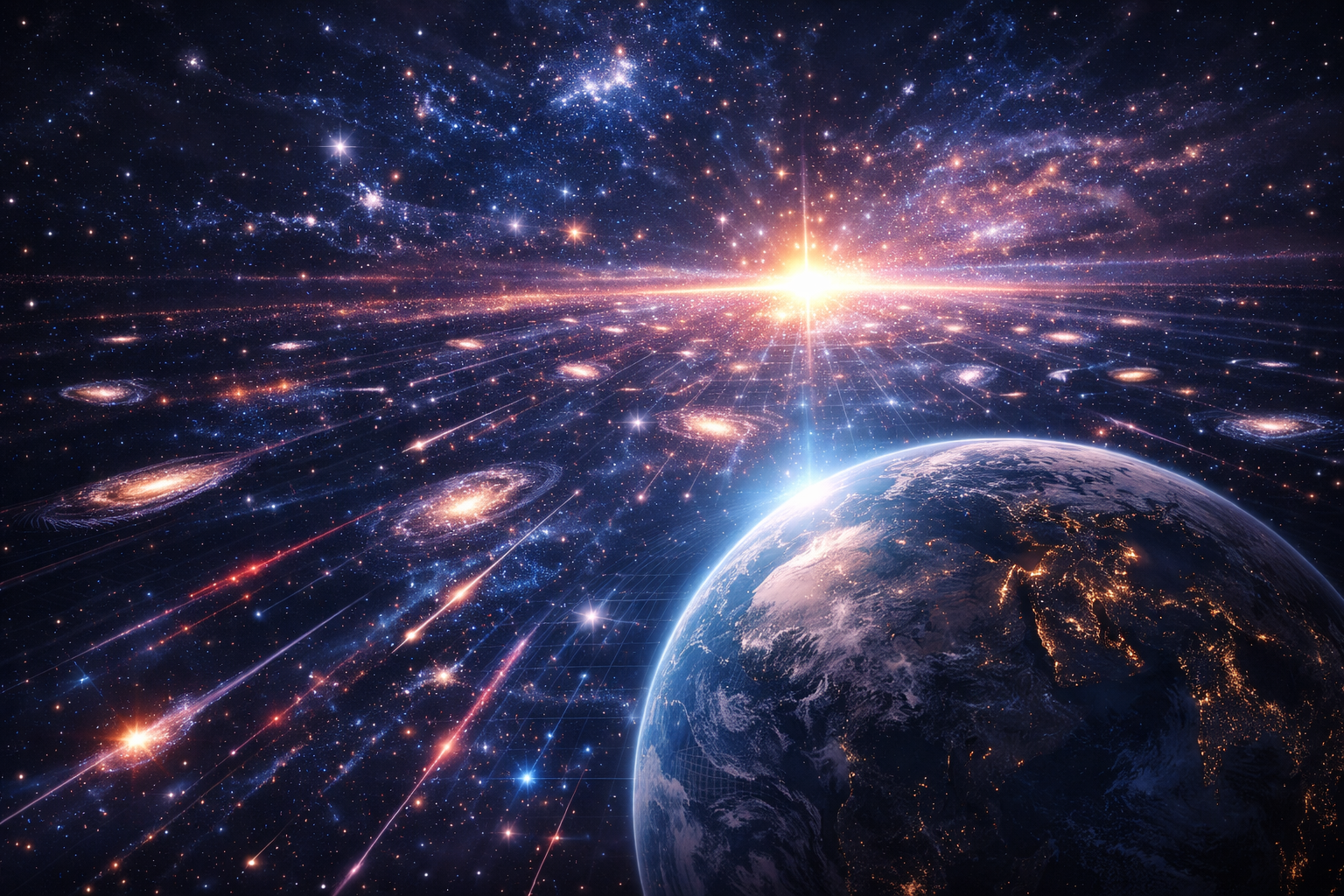

The universe is expanding — and accelerating. But what makes this fact extraordinary is not just physics. It is timing. Humanity exists in a rare cosmic window where we can still observe distant galaxies. In the far future, the universe may become dark, silent, and unknowable.
We Were Born at the Right Time
There is something deeply unusual about our era in cosmic history.
The universe is 13.8 billion years old. Civilizations, if they arise billions of years from now, may not see what we see today.
Why?
Because the universe is expanding — and accelerating.
Galaxies beyond our local cluster are slowly drifting away. Not just moving. Receding into invisibility.
Right now, we can observe hundreds of billions of galaxies.
In the far future, observers may see only darkness beyond their own galaxy.
We are living in what physicists sometimes call a “cosmological sweet spot.”
The Science: Expansion Is Not Motion — It Is Stretching
In 1929, Edwin Hubble discovered that distant galaxies showed redshift — their light was stretched toward longer wavelengths.
This was not because galaxies were flying through space like debris in an explosion.
It was because space itself is expanding.
A useful (but limited) analogy is a balloon with dots drawn on its surface. As the balloon inflates, the dots move apart — not because they are crawling away, but because the surface expands.
But unlike a balloon, the universe has no center.
Every observer sees other galaxies receding.
Expansion is universal.
The Acceleration Problem: Dark Energy
In the late 1990s, something unexpected emerged.
The expansion was not slowing down.
It was accelerating.
Gravity should pull matter together over time. Instead, galaxies are separating faster.
The unknown driver behind this is called dark energy.
Dark energy:
Makes up about 68% of the universe
Has never been directly detected
May be a property of empty space itself
Here is where physics becomes philosophical.
If empty space has energy, then “nothing” is not truly nothing.
Vacuum itself pushes reality apart.
The Hubble Tension: Is Our Model Incomplete?
Modern measurements of the expansion rate don’t fully agree.
Observations of early-universe radiation give one value.
Measurements from nearby galaxies give another.
This disagreement is known as the Hubble tension.
If it persists, it could mean:
Dark energy evolves over time
There are new unknown particles
Or our cosmological model is incomplete
We may be standing at the edge of new physics.
The Loneliest Future
Here is the part rarely discussed in popular science blogs.
If acceleration continues indefinitely, distant galaxies will eventually move beyond our cosmic horizon.
Their light will never reach us.
Future astronomers — billions of years from now — may look into the sky and see only their own galaxy.
They might conclude:
“There is nothing else out there.”
They would be wrong — but they would have no evidence.
We exist in a rare epoch where the cosmic background radiation is still detectable, distant galaxies are still visible, and expansion is measurable.
Cosmology may become impossible in the far future.
We are cosmically privileged observers.
What This Means for Humanity
This realization changes perspective.
We often assume we are latecomers in a vast, mature universe.
In reality, we are early enough to witness its structure.
The universe has not always been observable.
It will not always be observable.
We are living in the only era where cosmic truth is still accessible.
That is not just physics.
That is timing.
Science Meets Philosophy
The expanding universe forces three reflections:
1️⃣ Reality is dynamic, not static.
2️⃣ “Nothing” (vacuum) has power.
3️⃣ Observation depends on era — not just intelligence.
If civilization survives long enough, its descendants may inherit a darker sky.
Our generation holds a responsibility:
To understand the universe while it is still visible.
Conclusion: Consciousness in an Expanding Cosmos
The universe is stretching.
Galaxies are drifting.
Space itself is evolving.
And here we are — self-aware matter — observing the process.
Perhaps the most extraordinary fact is not that the universe expands.
It is that it produced beings capable of noticing.
In a temporary window of cosmic clarity, we are awake.
Read More: My Blog
Other Blog in same Category: A Quick Travel To Universe